
432 AND ABOVE EME NEWS
January 2026
Volume 55 Number 1
Editor: Barry VE4MA
Production Assistance: Peter G3LTF, Frank NC1I & Bob W1QA
News, Contests and Dxpeditions
The December/ January holiday period was much quieter for EME activity, perhaps in response to the end of the ARRL EME contest activity and the cold winter weather has certainly hindered the recovery of activity in the Northern Hemisphere!
The Next “Activity” weekend is January 31 / February 1, with the first round of the DUBUS/ REF EME contest scheduled for 70 cm (see below), however with the high Declination, close to Perigee and very low Spreading conditions, this would also be a good time for activity on the higher bands (10, 24, 47 & 76 GHz).
I want to call your attention to a most interesting report submitted by Nic G3YEG. Many stations do not try to operate EME because they are unable to install antennas outside or have very poor Moon windows. Nic has certainly made the best of his situation, has learned some valuable lessons and been very successful in spite of the obstacles!
EME Conference 2026
Registration for the 2026 EME conference is still open but must be completed by January 31. Rainer is looking for prize donations for the conference as well as any presentations that can be delivered, either on site or remotely. See DF6NA’s report below.
K2UYH 28 foot Dish Removal
The 28 foot dish of K2UYH (SK) that provided so many stations with first EME QSOs has been removed and is in the process of moving to a new home. See the W2HRO Report below.
23 cm Frequency Plan & New Threats to 13 cm Use
Things are still developing regarding the international response to the CEPT approval of the ECC Decision DEC(25)01. There is also a threat from the possible use of the 13 cm by commercial interests in Great Britain. Please see the Article by G3LTF after the Station Reports.
In Austria, The RTR (Austrian Regulatory Authority for Broadcasting and Telecommunications) is currently holding a tender for 5G and wants to claim the 2300-2600 MHz band for itself. There is already at 10 W power limitation in place there, so 13 cm EME operation is out of the question there.
New High Dynamic Range “IQMap” Receiver for QMAP Users
Alex HB9DRI has been evaluating the possibility of developing a new, simpler, single channel receiver specifically optimized for QMAP users. See the HB9DRI Report below.
Project Diana 80th Anniversary
Csaba HG5BMU pointed out that January 10th is the 80th anniversary of the first EME echoes detected by Project Diana. Please see Page 25 of the following link for a most interesting story.
https://www.worldradiohistory.com/Archive-Radio-News/40s/Radio-News-1946-04-R.pdf
In parallel to the American experiment, Moon echo experiments were also conducted in Hungary under the leadership of Zoltán Bay (Tungsram Ltd), and a few weeks later, on February 6, they were successful. For detection, they did not use an oscilloscope screen as at the USA Project, but a special signal summing device designed for this purpose (kulometer).
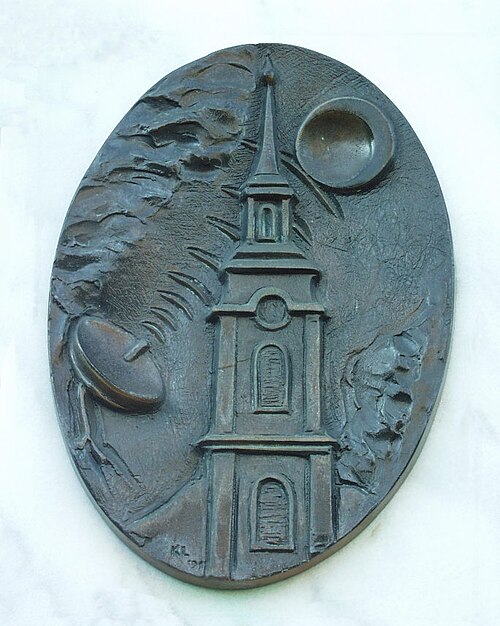 VE4MA Relief in Memory of Zoltan Bay EME Experiments - Sculptor Kiss László György
G3YGF Silent Key
Julian Gannaway, G3YGF, sadly passed away suddenly in early December aged 72. His interest in EME began in the late 70s. He was active with the Flight Refuelling Club (G4RFR). He will be much missed by his many friends. RIP ("DROM") Julian, G3YGF.
Please see the detailed Obituary below.
Contests
DUBUS-REF
The rules for the 2026 DUBUS-REF contest are now on the website http://www.marsport.org.uk/dubus/EMEContest2026.pdf
Coming up is the first part on 70 cm on January 31st, the DL7APV memorial.
Funtests
The dates for the 2026 Funtests are MARCH 1 (erroneously shown as Feb 1 previously) for 13 cm, and March 28 for 23 cm. A new entry class is being created this year to encourage CW stations to work cross mode with SSB stations. More info in the December 2025 newsletter: https://eme.radio/432-and-above-newsletter/432-and-above-2025-12
DJ3JJ 23 cm EME SSB Contest 2025
G3LTF is the winner of the 2025 DJ3JJ 23 cm EME SSB Contest. Please see the DJ3JJ report below.
Dxpeditions
9J2EME
From 28 March 2026 until 1 April 2026, The Ribbetjies EME Team: Bernie ZS4TX, John ZS6JON, Paul ZS6NK and Lins PA3CMC, plans to be active from KH22 in Zambia. Activity is planned on the following bands:
6m: 8el 6M8GJ
2m: 2 x 18el 2M18XXX
70 cm: 2 x 28 el 432-9WL
23 cm: 70 el YU1CF
Modes: Q65, JT65 and CW upon request. They will be on HB9Q logger and N0UK logger.
EME Activation of Andorra – C3
ON7EQ Jean-Jacques and EA8DBM Alex are teaming up to be QRV in EME from the Principality of Andorra on 70 cm, 23 cm and 13 cm during the weekend of August 08-09 2026, in collaboration with the ‘Unió de Radiaficionats Andorrans’.
The Call sign is expected to be C37EME operating from locator JN02SK.
During the 2 moon transits, with favourable degradation, declination, and moon at its perigee, they will look out for DX to VK, JA, NA, SA, KH6 …
Confirmation of the plans are to follow in March/April, after which details will be announced … but you can already circle in pencil these dates into the agenda!
For your information, the last known EME activity from C3 on 70 cm was in 2009, and on 23 cm in 2005.
Contributions are welcome via Paypal to
JD1/O (QL17CB)
JP3EXR/ JD1BPY Taka and JH3AZC/ JD1BPW Kay are preparing to activate JD1YCC again from a cottage on Chichijima-Ogasawara, while visiting there once again for the first time in three years.
The bands and modes planned for operation at this time are 2 m (JT65B/Q65) and 23 cm (Q65).
The 2 m equipment includes IC-9700, Kawagoe Radio LNA, SSPA (500 W output), 2x9ele LFA Yagi, and a KENPRO KR-5400B.
The 23 cm equipment includes a IC-9700, G4DDK LNA, SSPA (500 W output), W2HRO 2.4 m Folding Dish, OK1DFC Short Septum Feed, SL-1 Rotator with PstRotator software, and a Green Heron RT-21 modified Controller.
Operation will likely be from February 22nd MR to March 1st MS, alternating bands daily.
The network environment will be set up to connect to N0UK Chat for 2 m and HB9Q/Logger for 23 cm to provide operational status. Logs will be uploaded to LoTW.
Ogasawara islands are designated as a national park, and we are not allowed to operate the radio from anywhere other than Chichijima Cottage, where we have a license.
Furthermore, Chichijima Cottage faces the northern slope of the mountain, and the moon is not visible from the ridges on both the east and west sides of the mountain located on the south side until an elevation angle of about 20-25 degrees. Therefore, unfortunately, the time when communication is possible is at least 1.5 hours to 2 hours after moon rise, and the same hours before moon set. However, we believe it to be the most suitable location for EME in the JD1/O environment where HAM radio operation is permitted.
Articles and Announcements
Don't miss the articles and announcements that follow this month's station reports.
G3YGF Julian Silent Key
Julian Gannaway, G3YGF, sadly passed away suddenly in early December aged 72, after nearly 60 years as a very keen and highly competent radio amateur. His interest spanned VLF to microwaves. He served as President of the Radio Society of Great Britain (RSGB) for one year. His interest in EME began in the late 70s, where he worked with other members of the Oxford University Radio Club (G3OUR) to build a 432 MHz EME station using 4 x G3JVL loop yagis, located on a tennis court belonging to one of the Oxford colleges. Other members of the group later built a 20 foot dish for 432 and 1296, and Julian designed the mechanics and servo control system (Fox Box) for a rotatable polarisation 432 feed, that could swing up to 180 degrees in less than a second, to combat Faraday. He was also involved in the design of some early GaAs FET preamps, including measurement of noise figure using the hot/cold technique.
During his time at Oxford, Julian was involved in the development of practical narrow-band techniques for 10 GHz. His doctorate supervisor had been involved in the development of TWTs, and gave Julian a 10 W tube. He used this as part of a fixed station (on the top of the Oxford University Engineering building) to conduct daily tropo-scatter tests with Mike, G3JVL, over a 110 km path. During these tests they discovered massive enhancements due to rain scatter, which at the time was unknown to the amateur community.
Mike and Julian were also involved in very early attempts at 10 GHz EME. Mike had access to a 100 W tube, which he brought to Oxford on several in an attempt (unfortunately unsuccessful) to receive EME echoes on 10 GHz. The dish was a 3.65 m 4-petal dish that Julian had been given by RSGB, having originated from the Post Office Tower in London.
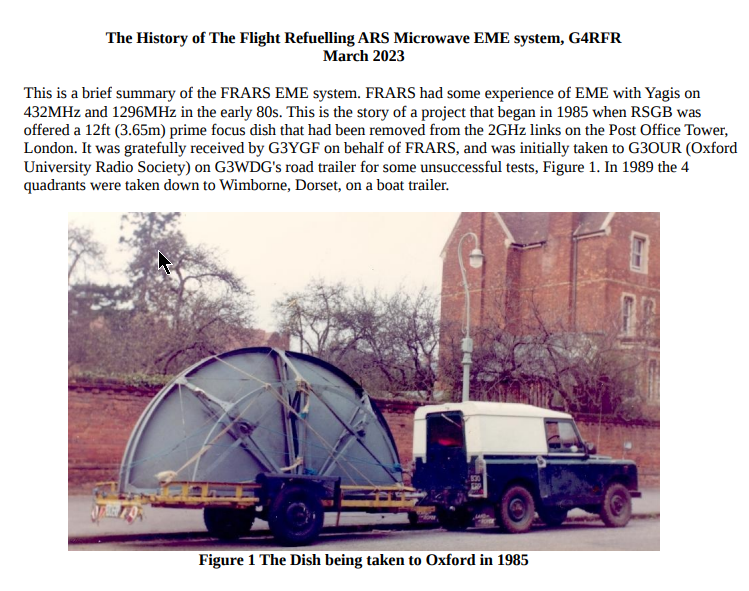 G3YGF History of G4RFR Dish
After completing his D. Phil, Julian moved from Oxford to work at Plessey Roke Manor Research, until his retirement. He joined the Flight Refuelling Club (G4RFR) and using the same 3.65 m dish, made the first G - G contact on 10 GHz EME, using a borrowed 20 W TWT. Working with other members of G4RFR, many refinements to the system were made in the decade which followed, including auto-tracking, a novel anti-backlash mechanism and acquisition of a high power 10 GHz TWT. G4RFR's strong signal will be known to many! In recent years, more bands were added, so that G4RFR is now QRV on 1.3 - 10 GHz. Julian was hoping to also become active on 24 GHz soon, and the club is planning to continue this project.
Julian also collaborated with other G4RFR club members, to design and construct the ambitious 5-band microwave beacon complex using the GB3SC series callsigns at IO80UU59.
He will be much missed by his many friends. RIP ("DROM") Julian, G3YGF
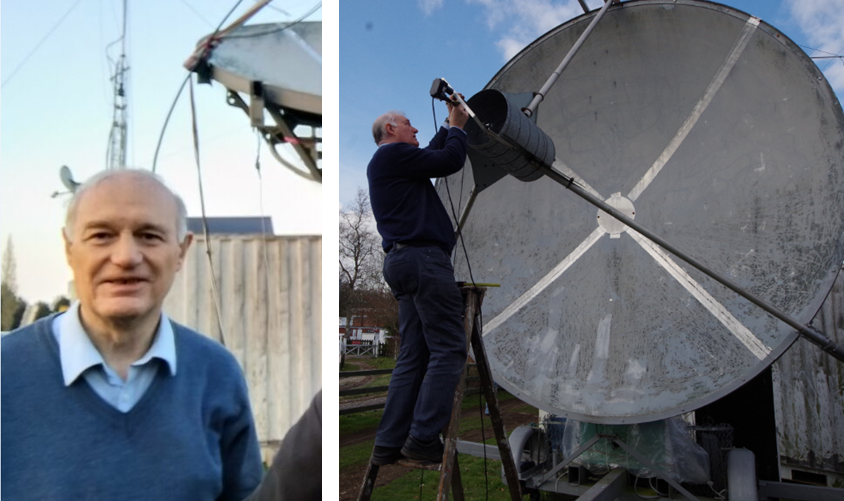 G3YGF with G4RFR Dish
DF6NA Rainer
EME 2026 Tenerife
Registration for EME 2026 will be open only for the month of January (must be completed before January 31st).
European participants can use "European Money Transfer" to my account. (Please ask for details! I don't want to post it in public.)
Participants from outside Europe can use my Paypal account:
I would also like to ask for donations of prizes for the raffle. (Do not send anything by mail!)
I am looking for Presentations / Lectures to be given at the conference and I already have proposals from: G4SWX, HB9DRI , W1GHZ, K1DS and N1AV!
Alex EA8DBM will make a demonstration of 23 cm EME.
DJ3JJ Andreas
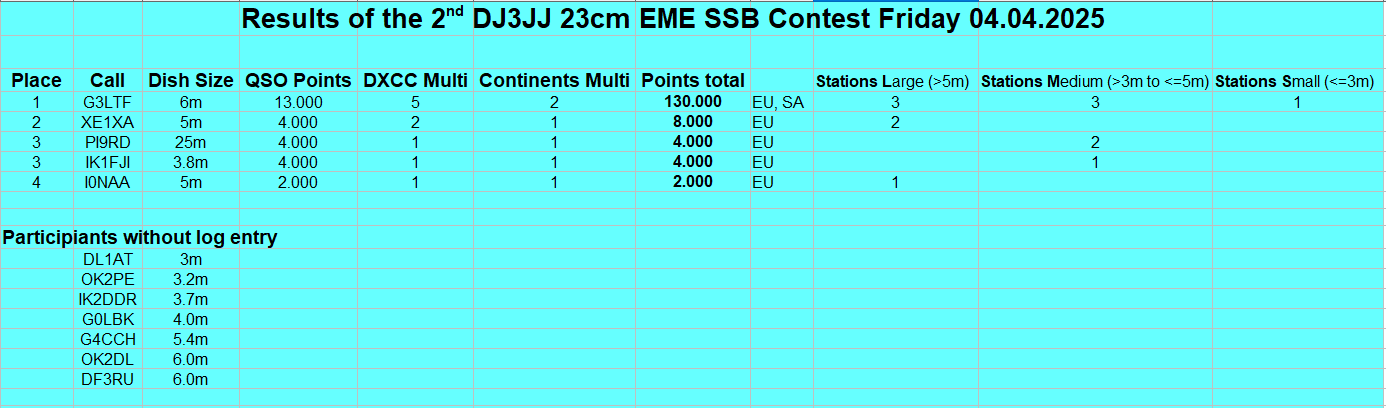
The results of the 2nd DJ3JJ 23 cm EME SSB Contest 2025 Contest are now on my QRZ page. G3LTF is once again the winner!
It was a big success in growing activity compared to the 1st contest and this on a Friday only. It’s not easy to establish a new contest format and I hope more people like to transmit your dish size together with the report so that you can calculate the points directly.
To attract QSOs with medium or small size dishes you get significantly higher points for working these stations. Also continents are a multiplier to motivate stations from different continents.
Several people asked me to switch the contest from the pre Dubus 23 cm CW Contest Friday to a separate weekend. Thanks for this feedback. The date of the 3rd ssb Contest can be found in the updated DL7APV calendar and will be the weekend of May 23 & 24, 2026 See the link https://eme.radio/dl7apv-eme-calender-2026 Best 73s and I hope to hear your voices via the moon. 🌙
 DJ3JJ results 2nd 23 cm SSB Contest 04 04 2025
DL3WDG Charlie
I ran my 2.4 m / 125 W 1296 Q65-30B 'beacon' again on 27 Dec 2025 (day 1) and 28 Dec 2025 (day 2). Equipment was the same as used last time (described in the last issue of the NL).
Day 1 ran from approximately local transit, and day 2 was from local moonrise to local moonset (clear of obstructions). I collected signal report information from folks on HB9Q, via the LiveCQ .csv database and from a few personal emails. I hope I did not miss any.
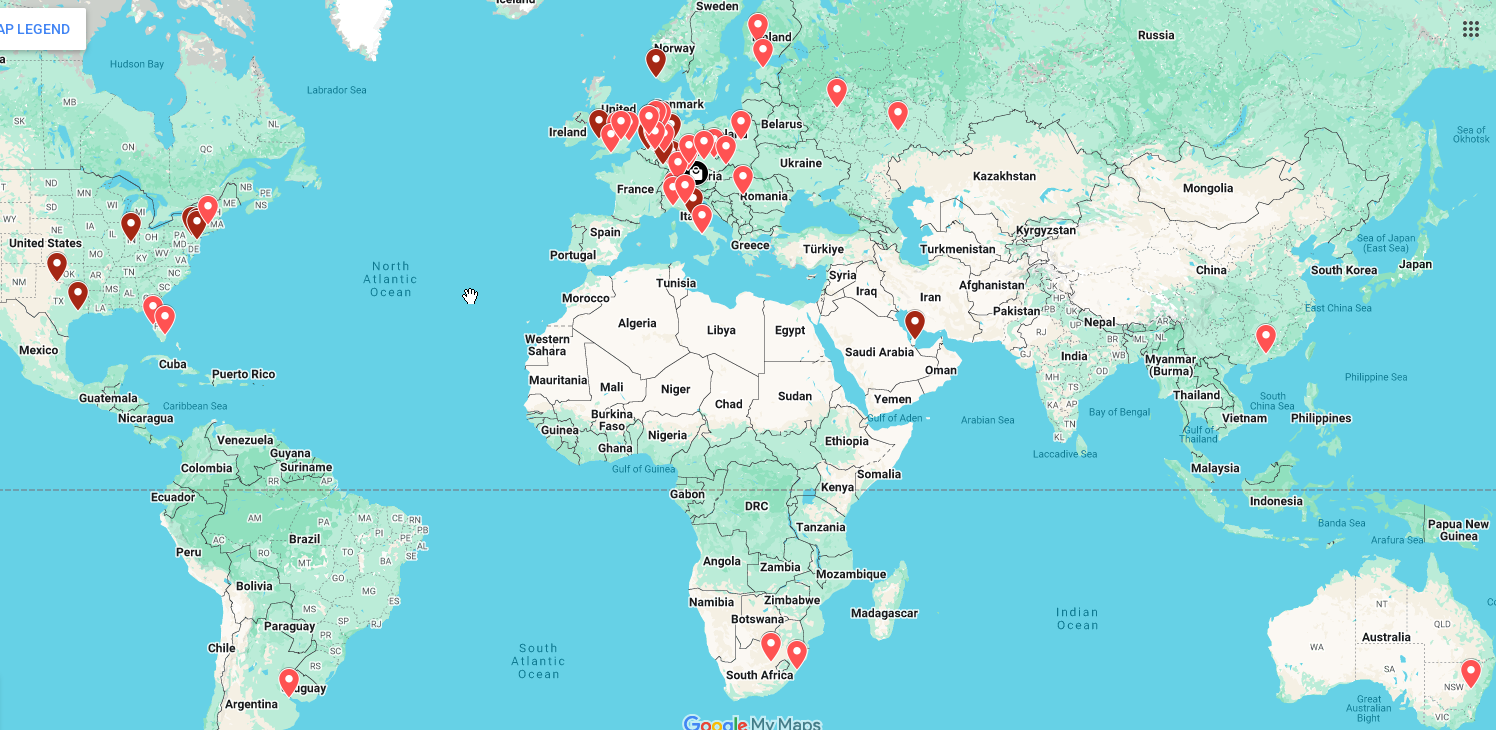
Approximately 50 stations decoded it, using antennas ranging from 1.5 m 'cooker' dishes to 10 m.
The map below shows the beacon's 'coverage'. Brown pins were from day 1, and red from day 2.
The map is available on-line at https://tinyurl.com/mryxf752. Clicking a pin identifies the reporting station and SNR.
 DL3WDG 1296 EME Beacon Coverage
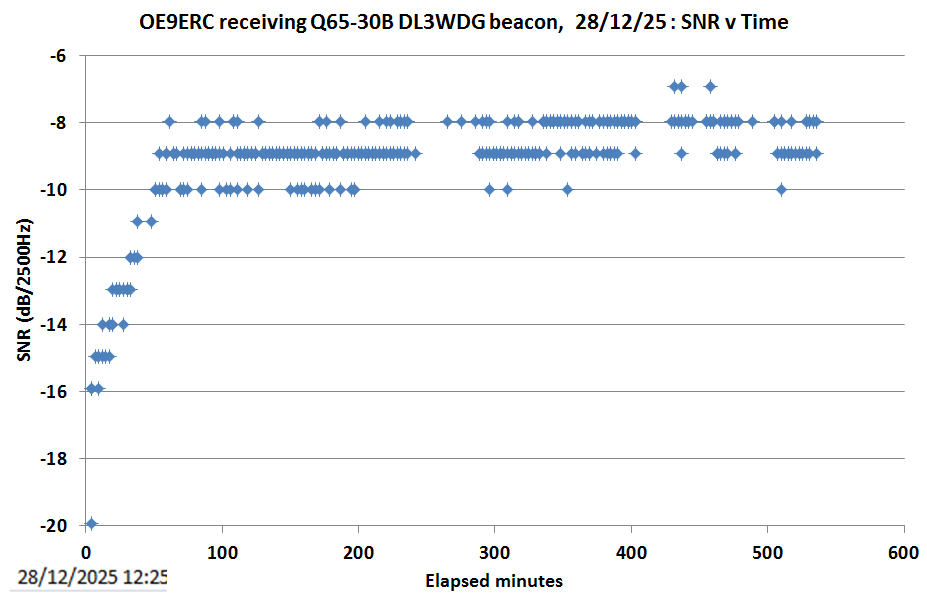
One motivation was to check my tracking accuracy by analysing some LiveCQ reports, where the data for every period exists.
The graphs below show how SNR varied with time for one station:
 DL3WDG Beacon RX by OE9ERC SNR vs Time
The increasing SNR at the beginning was caused by the moon moving out of tree obstruction at Erich's QTH. Once the moon was in the clear, SNR varied by only +/- 1 dB. Similar results were obtained from DF3RU's reports, and also from KA1GT the previous month.
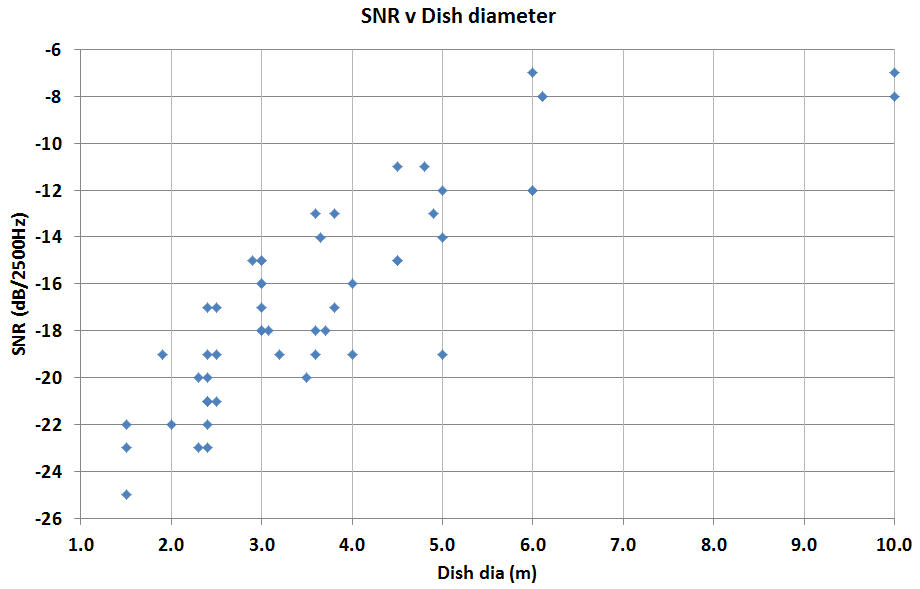
Given a relatively constant signal available from the beacon, I also plotted the received SNRs as a function of receiving stations' dish size, and the results are shown below:
 DL3WDG SNR vs Dish Diameter
The dish size data came from the information shown on HB9Q. It is possible of course that some data is out of date, but the general conclusion is that there is a considerable variation in performance for a given dish size. Also it is possible that some reports came from stations who had blockage, but nobody reported this on HB9Q. It is not known if anyone was using noise reduction, which of course would distort the result (as well as the audio!).
Only one report was received for the CW sequence (559 from OK2PE).
G0JDL John
70 cm EME operation has been fairly low for the past couple of months but I have worked R1NW, SM3LBN and SM7SJR for new initials. All of these were worked during December when I also had QSOs with PA3FVW, DF6LH, OK1VUM, SM4GGC, OZ9AAR, OE3JPC, NC1I and DF3RU.
January has been very quiet so far and the only station worked is JF6CTK but the lack of activity is mostly due to the moon position not really being suitable for the UK time zone. On January 21st, with the moon still quite low, I tried to have QSOs with DL1VPL, OE3JPC and OK1VUM. Normally it is quite easy for me to work any of these stations but all of them failed as propagation seemed to be one-way, with the EU stations unable to hear me or only getting an occasional decode despite me receiving DL1VPL and OE3JPC at stronger than usual levels. From comments on HB9Q it appears that I was not alone in seeing this. This was only two days after the massive solar event of January 19th and I would imagine the two are related?
I’m still undecided as to whether the new Antennas-Amplifiers LNA is a big improvement over my SP70. A rather crude statistical analysis of decodes since installing the new LNA suggests a possible improvement of around 1 dB but I still really need more data before being certain.
Ed Note: One way propagation is common on 70 cm. The "extra sensitivity" that WSJT provides has helped to minimize the impact but it is still there. Being able to adjust polarity quickly by switching or mechanical adjustment is highly advantageous.
G3LTF Peter
On January 2nd I was on 23 cm with great echoes on CW and SSB but got no takers. On January 2nd I put the 13 cm system in the dish to look for DU3T, again great echoes on both modes, however Howard G4CCH reported that he couldn’t hear me.
I then discovered that I had set my HB 2 m transverter 1 MHz high and that obviously accounted for the lack of results on 23 cm the previous night. After correcting it I then had a nice 589/589 QSO with G4CCH.
For interest I attach a picture of the receive connection to my 13 cm septum feed, designed to minimise connectors.
I plan to be on and looking for Alex in OA later this week and will be QRV for the 432 MHz DUBUS contest, wx permitting.
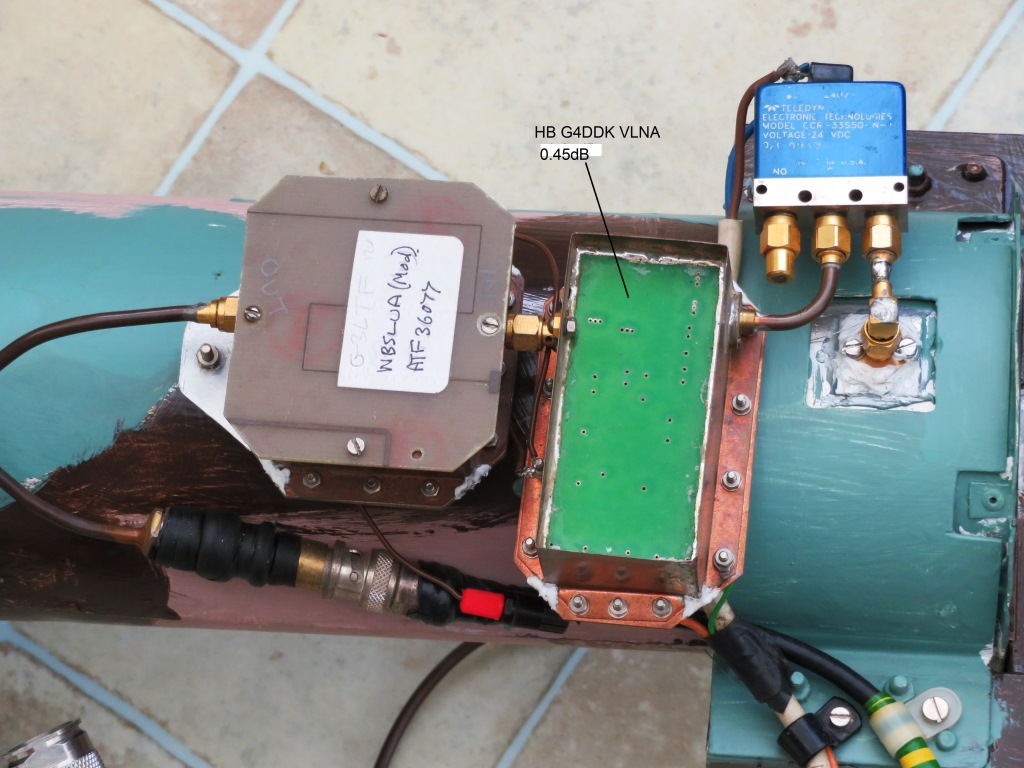 G3LTF 2.3 GHz Preamp Connection to Feed
G3YEG NIC
Over the last month the weather here on the Isle of Wight has improved with dry / cold conditions leading to a much drier roof. This enabled me to add two more new station decodes, this time using the 21 element at low elevation to the East, on 30 Dec 2025 SM7SJR was -28 dB and on 4 Jan 2026 DL6KAI (never seen before) was -23 dB. On two evenings in early January I carried out some testing using the 21 element with Mick VK2CMP. I saw multiple good DT values and a clear peak at 1500 Hz on the spectrum display but no decodes. Mick expressed his appreciation of my efforts and is now keen to make it to my hall of fame!!
I now have a grand total of 46 different stations decoded and over 50% of these have been 1st time decoded using just the 9 element yagi at high elevation. The others 1st time decoded have been using a combination of 15 or 21 element antennas but I have subsequently seen many of these using the 9 element at much better levels (SM4GGC first time -32 dB subsequently seen at -22 dB on 9 element). Looking at my detailed table of decode levels and approximate decode headroom available (I regularly decode at -32 dB and have seen a handful of decodes at -35 dB) it would seem likely that only 2 stations would not have been possible on the 9 element (K1EEP and K5QE).
The general technique I use for achieving this number of stations using my very small / simple / unsophisticated system (Barefoot GPS locked IC-9700 + SP70 LNA - nominally 50 w at antenna on TX) is as follows. The bungalow roof construction allows for 4 antenna positions, 21 element between 070-120 az up to 30 deg elevation, 15 element between 170-210 az at 45 deg elevation, 9 element between 140-225 az at 50-80 deg elevation and finally a 21 element 195-225 az & 10-30 deg elevation. All of these directions point out over the English Channel which is only 400 m away past a small number of domestic houses. I have found the best results are always with the antenna pointing slightly below the moon elevation by approximately 5 deg and over elevation of the antenna has a quite severe degradation.
I was out recently by around 30 deg (finger trouble) and the performance was at least 10 dB down and for the first time for ages resulted in a failed QSO attempt with Frank NC1I. Having looked at my moon prediction programme I set the antenna in the attic so it will "work" for about 4 days with the moon just drifting past an "optimum position" each day. Even the 21 element is not at all sharp and I have a minimum of a couple of hours each pass to find signals. With this approach I have even managed to decode 2 stations, DL7APV and HB9Q when the moon was low to the North East behind the gable end wall of the roof which introduces another 2 layers of concrete block work plus mortar rendering!! When I started all my EME work testing with Bernd DL7APV we were estimating that my roof loss was in the order of 3 to 6 dB but recent comparative analysis leads me to the conclusion that it is only of the order of 1 to 2 dB at a maximum when using the 9 element at high elevation. However a soaked roof adds another 3 dB and simultaneous heavy rain an additional 3 dB but I have still managed a QSO with Frank under these stressed conditions!
Operationally WSJT is set on 1500 Hz with an FTOL of 50 Hz, Single decode, and Max Drift set at 0. My system needs to have the DX call set for signals below -26 dB, so I use a combination of the HB9Q logger and PSK reporter to find callsigns and QRG - even with GPS locking there are still quite a few stations that are not even close to 1500 Hz.
I always save everything so later on I can try and find the proverbial "needle in a haystack". To do this I use a sliding narrowing FTOL window technique. If I start by finding a good DT I can usually find and decode a signal. Having developed this technique on saved data I estimate that over the past few years I have data-mined over 100 Gbytes of data. Using this technique on marginal signals I often experience the following sequence - repeating sequence of high value DTs approximately 4.x secs, repeating sensible value of DT (as appropriate for moon distance) followed by a good decode. I do not often see average decodes.
I have recently run some tests with John G0JDL (approximately 8 Kw ERP) and saw a good series of repeating high value DTs on the correct cycle, a clear peak at 1500 Hz on the spectrum display and cessation of these indications of his signal when he stopped calling CQ.
My whole "station" is in a small bedroom cupboard with no space for a seat but having direct cable access through the ceiling to the antenna using just 7 m of coax to the LNA. Given the lack of seating near my radio, I now access my set up remotely from the comfort of my easy chair in the lounge using a Chrome remote desktop on my old Android cell phone which works over my Wi-Fi but also has no issues remotely over a 4G Cell Phone network (I only use this on receive).
Finally this month I managed to achieve my 50th QSO with Frank NC1I - the first was just 30 months ago using my trusty 9 element and the 50th on Jan 2nd this year again with the 9 element. Looking back through my log, 72% of these QSOs have been made using the 9 element with my best report from Frank being -22 dB and my best report to Frank -11 dB on multiple occasions again on the 9 element.
Frank and I have been extensively examining just what is possible with my small system and the best we have achieved is a QSO with just 5 w at the antenna feed using the 15 element antenna (circa 100 w ERP). We can now reliably have a QSO using 25 w and the 9 element (300 w ERP) - as long as I actually point the antenna at the moon. However we have managed a QSO when the 9 element antenna was actually off the moon by 50 degrees. Given the numbers we have seen we both believe that a QSO will be possible using 5 w and the 9 element (circa 60 w ERP) but haven't achieved that yet.
My QRZ page details what I discovered over the first couple of years of eme tests. Lots learned!
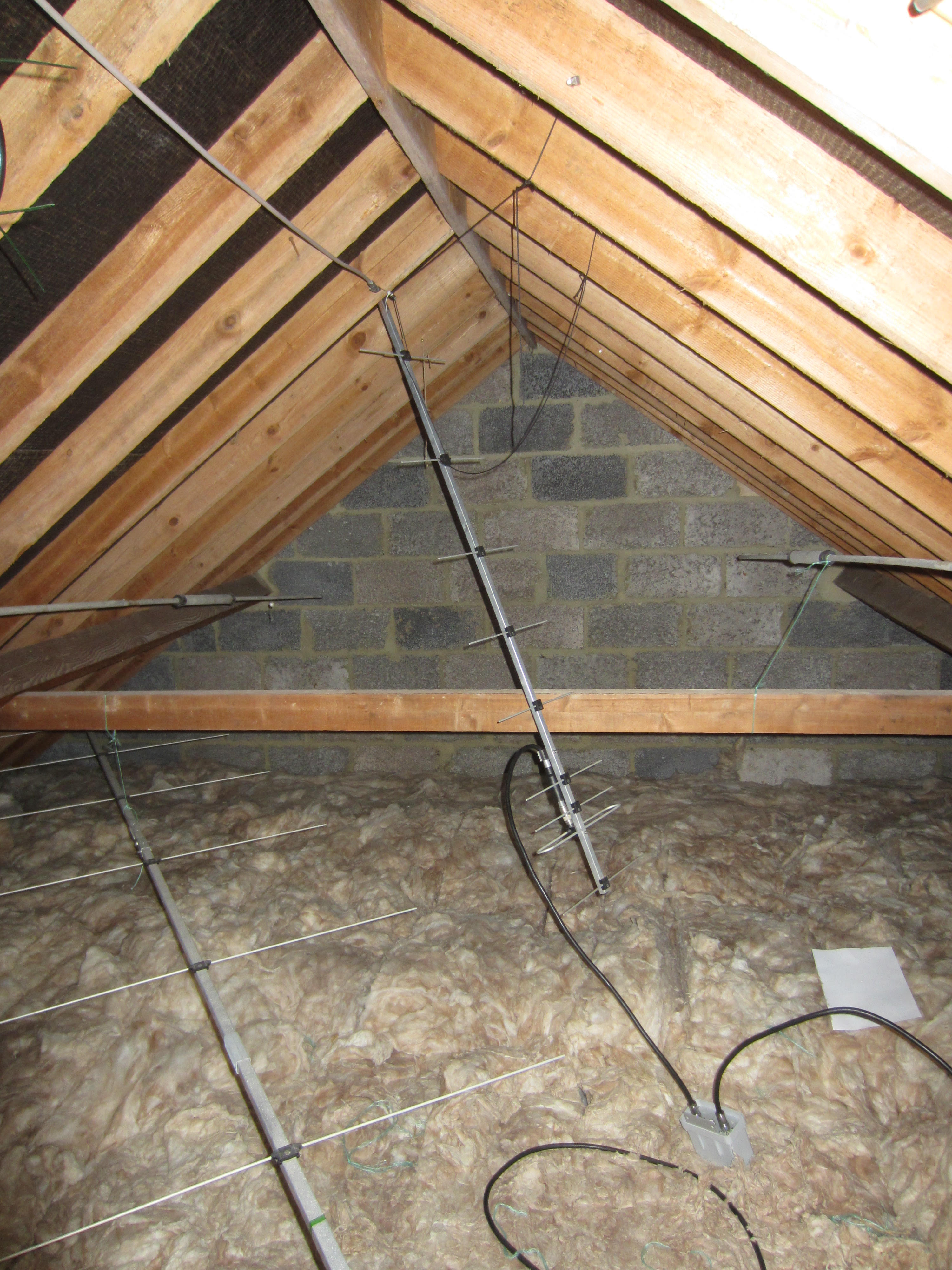 G3YEG Extreme EME using Attic Loft Tonna antenna
G4CCH Howard
I just worked a few stations on 13 cm after the activity event early December. It was great to work on DU3T on 13 cm for my first contact in 2026, and then Alex in Peru OA7/LY3UM on 23 cm.
13 cm
28 Dec - PE9GHZ -10/R-16 (D), K5DOG -15/R-15 (D), JA6XED 579/579
30 Dec - G4SDG (D)
02 Jan - DU3T -08/-07 (D) for digi Initial #65, grid, digi DXCC #31 and first G to DU. We used 2400 MHz simplex due to QRM on 2320 at Ron's end
03 Jan - G3LTF 589/589
04 Jan - PE9GHZ -08/R-12 (D)
23 cm
24 Jan - OA7/LY3UM -13/R-14(D) for digi Initial #715, grid, digi DXCC #140 and first G to OA
I am Hoping there's a chance to work Alex again on CW and maybe on 13 cm if he has his TX fixed.
HB9DRI Alex
With great pleasure, I want to announce the upcoming arrival of a new wideband SDR radio, the IQMap.
Based on the great success of the IQ+ and IQ+PRO, the IQMap is a single-channel RF SDR receiver. Unlike the IQ+ and IQ+PRO, which are radios specifically designed for Adaptive Polarization in the 50 to 432 MHz bands and have two RF channels, the IQMap is built on the same DNA as the IQ+PRO, with a coverage of 28 MHz to 1400 MHz. It incorporates the same IQ mixer as the IQ+PRO and a powerful internal preamplifier with 47 dBM OIP3 (the biggest in the market) and it integrates the ADC conversion with a chip capable of achieving up to 128 dB of dynamic range. Because IQ+PRO production will begin this European summer, and with the aim of lowering costs and benefiting everyone, I launched the IQMap idea a few weeks ago. The response has been tremendous, resulting in a considerable pre-order list. We will be producing the IQMap in parallel with the IQ+Pro.
This benefits everyone, as the IQMap will reduce the price of the IQ+PRO by 20%. I don't have the final price yet, but the IQMap will cost 50% or less than the IQ+PRO. The IQMap is designed to be used as a wideband receiver, allowing quick and easy integration with LINRAD and MAP65/QMAP. No internal modifications to the radio will be necessary, as the IQMap will be installed on the RX line (IF or direct frequency), means those from 23 cm and UP can use the IQMap in an easy way without complex radio modifications, last at not least due its tremendous OIP3 (47 dBm), the IQMap is a perfect Terrestrial Radio receiver especially for VHF/UHF Contests.
As a companion of the IQMap I am currently working in a software called DRIRAD, which is essentially a Linrad Engine Controller accessible through a Windows GUI. Many people have stated that using Linrad is problematic and sometimes difficult. DRIRAD solves this problem and will be a great tool for those who don't want to deal with all of Linrad's options and only need Linrad as the transport layer between the radio and MAP65/QMAP. The DRIRAD software will be distributed free of charge and can be downloaded from my website, https://www.linkrf.ch
I am currently looking for two or three volunteers with some basic knowledge of Linrad, and especially those who are already using it with MAP65/QMAP, to conduct beta tests. Those interested in helping me test DRIRAD can contact me at hb9dri (at) bluewin (dot) ch.
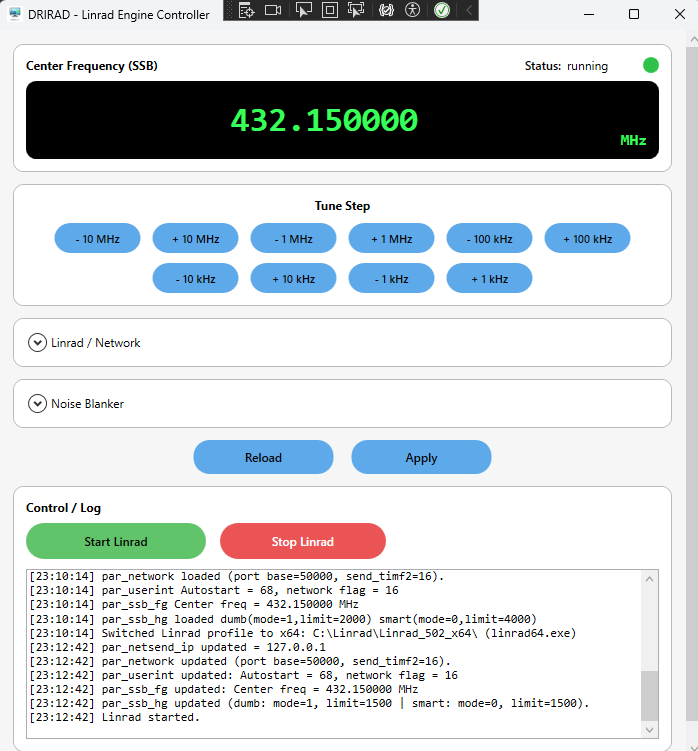 HB9DRI Compact View of DRIRAD Software
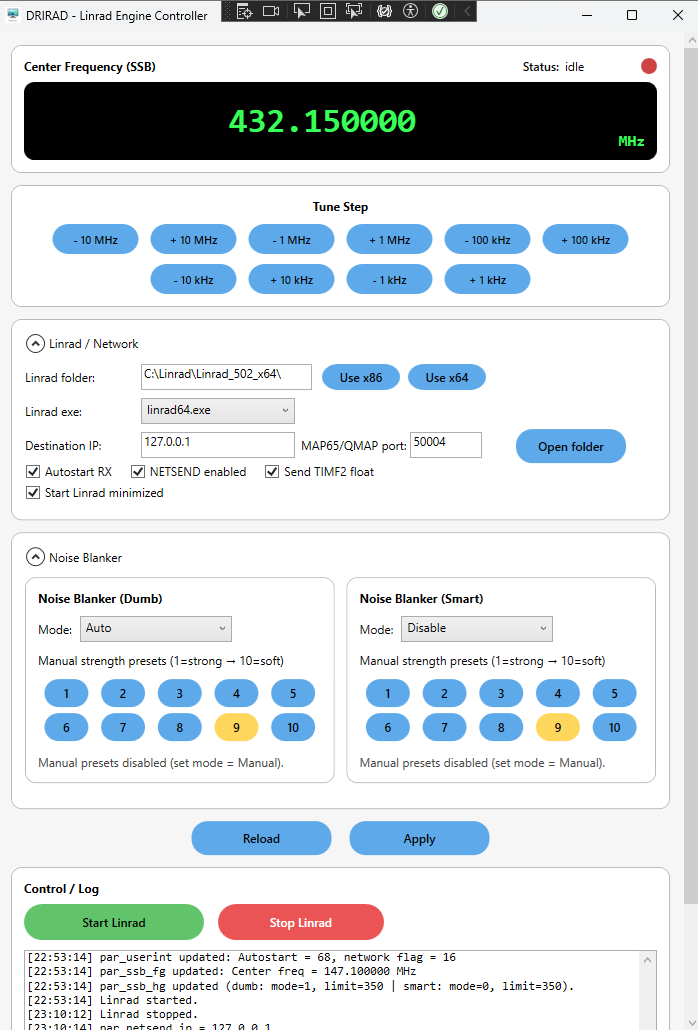 HB9DRI Expanded View of DRIRAD Software
IW2BNA Walter
I was active for the third lunar pass at 24 GHz and, after exchanging emails to try and test it, I connected two new initials on December 31, 2025, Gerard PA0BAT, and on January 5, 2026, Barry VE4MA.
I'm very happy with the easy QSOs. I hope to be active on 24 GHz for the next moon passes until April, then I'll switch to 10 GHz.
If anyone is interested in trying, please email
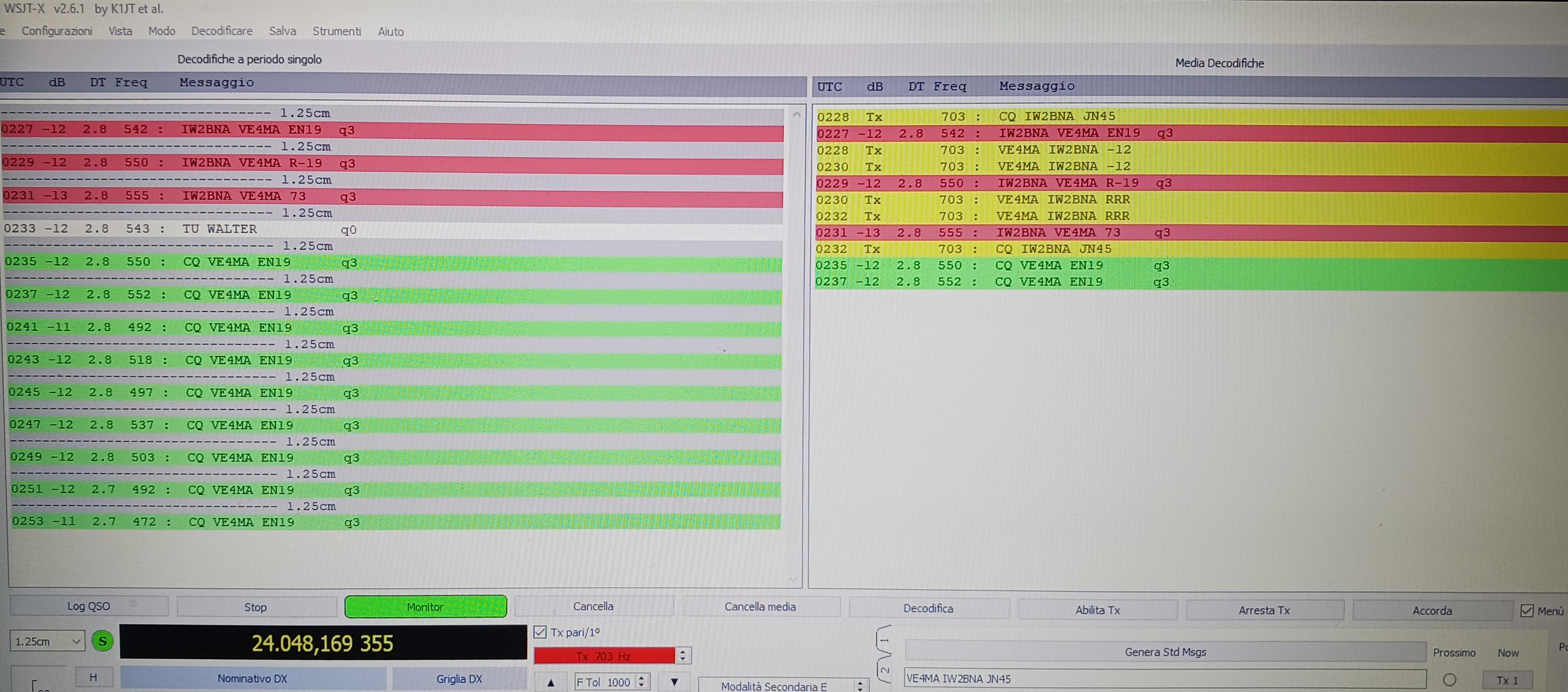 IW2BNA 24 GHz screenshot of VE4MA QSO
JJ1NNJ Koichi
I repaired my 70 cm antenna system and I was QRV on 432 MHz at the end of December 2025 and the beginning of January 2026 and I experienced my first digital QSO. The last time I was QRV on 70 cm was in April 2011!
My antenna system is 16x 13el FO (old design) with open wire feed, rear mount Yagi and rotatable polarization, FHX35LG LNA, and my TX power is only 50 W at the time.
I have an estimated antenna gain of 26.8 dBi based on the measured 3 dB beam width. The Sun noise was around 16 dB at 120 sfu. WSJT-X echo-mode SNR was best -15 dB. The polarization seems surprisingly stable during the day, but echoes are difficult to detect around sunrise and sunset.
I made QSOs with the following 14 stations using Q65-60B: R1NW(#121,digi#1), OK1VUM, JO4KVP, SM7SJR, DL1VPL, DF6LH, ON7EQ, SM4GGC, OE3JPC, JR7PJS, OZ9AAR, YL2GD, NC1I(digi#13), VK4EME(#133,digi#14)
I plan to be QRO in the near future, but it will likely take several months.
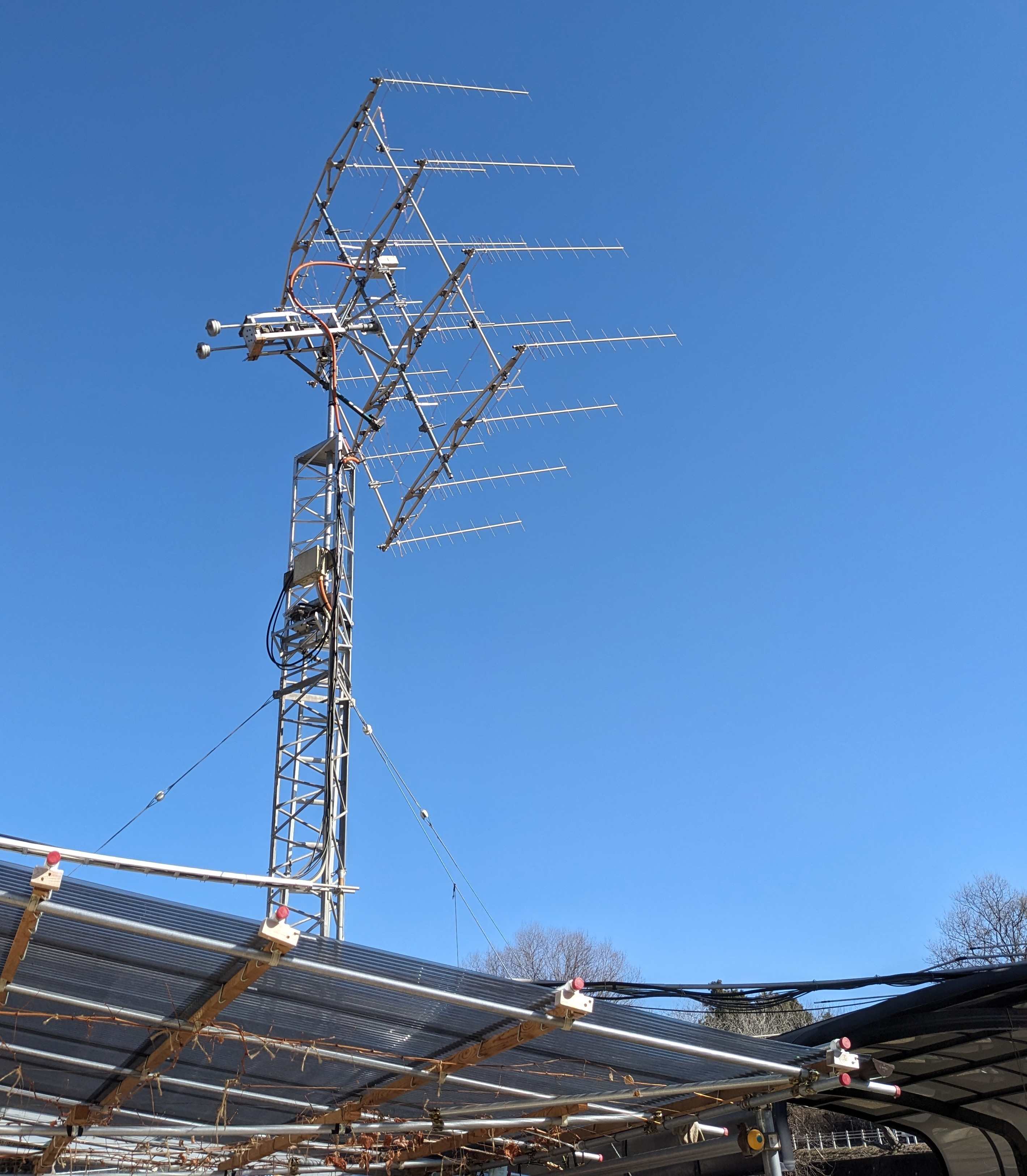 JJ1NNJ 70 cm 16x13 FO
KB7Q Gene
I spent the last days of the year testing out the 240 mm 3D printed transition and S12 disk I added to my 1.5 m “Cooker” dish on 23 cm EME.
As a challenge, I made it a point to see if I could work other identical stations using Q65-15A mode. KG0D, NY1V, and KN2K were logged without much effort! Best echo testing session near perigee with 1.0 db path degradation averaged -21.5 db. These are my best results ever. I’m seeing the DL3WDG beacon from -22 to -27 db. My sense is that the additions to the OK1DFC ”Lite” septum feed are worthwhile. With over 35 contacts and looking at sent/received signal reports I’m sensing a bit better on transmit and about the same on receive. The improvements are quite small and incremental. My S12 disk isn't in the exact right place ... yet.
Another data point: With the “Cooker” parked facing due east it came through three distinct frontal passage windstorms with measured 60 mph (100 kph) west winds unscathed. Phew!
During the testing I even worked two new-to-me stations to ratchet my initial count to #250. Thank you CX9BT (-26/-25) and A71AW (-21/-22). A71AW has 4x Yagis and 200 watts. I worked him in 5 minutes. What a thrill!
I'm more of a who can I work guy vs a numbers/spreadsheet guy. With 375 watts I feel I can work just about anybody near perigee.
The "Cooker" beats my folding dish. I think new folks have a well tread path on 23 cm to success.
NC1I Frank
I have not been very active and when I was on activity seemed low.
On 70 cm I added three initials, KK4MA (-15/-14) 1 x 28-elements and 400 watts, VK4AMG (-22/-23) 4 x 24-elements and 400 watts (George's first 70 cm EME QSO), and KR1ST (-22/-28) 1 x 6 wl and 800-watts. This was Alex's first 70 cm EME QSO.
No initials were added on 23 cm, this is very unusual.
A highlight in January was completing my 50th QSO with Nic G3YEG. Nic does an amazing job using just a small yagi in his attic and about 55-watts. I believe Nic's report includes many statistics regarding our 50 QSOs.
OH3LWP Ari
I was active on 23 cm and achieved new initial QSOs: 3/12/2025 VK6PY digital, SP3XBO digital
I participated in 13 cm activity weekend and completed a total of 22 13 cm QSOs and new 13 cm initial QSOs:
5/12/2025 JJ1NNJ CW crossband 2320/2400 MHz
6/12/2025 PE1CKK digital
7/12/2025 VE6BGT CW, DL6SH digital, PI9RD digital
8/12/2025 I heard and called JA6XED on CW crossband 2320/2400 MHz but did not complete a QSO.
There was nice activity on the microwave bands during the holiday season and during the first days of the end of January moon pass. I worked several new initial and DXCC QSOs:
On 23 cm 25/12/2025 DL6ZG digital, A71AW digital (also new DXCC), 30/12/2025 HG5BMU digital (also new DXCC), 24/01/2026 N4BAA digital
25/01/2026 PA7JB digital, 25/01/2026 OA7/LY3UM digital (also new DXCC)
Thank you to Alex!
On 6 cm initial QSO: 26/12/2025 BA7NQ digital (also new DXCC)
On 9 cm initial QSO: 27/12/2025 PI9RD digital
On 3 cm initial QSO: 25/01/2026 SM5DGX digital
I also received a few nice 23 cm XMAS and HNY 2026 SSTV images from PI9RD 27/12/2027. Thank you to the PI9RD Team!
OK1KIR Vlada & Tonda
At the end of year 2025 we were focussed on 13 cm, especially awaiting Ron DU3T to start EME on 13 cm from the Philippines. On Dec 29 at 13:22 we heard DU3T -16 with Q65-60C on 2400,065 MHz, but got no response from Ron. The others trying (DL1SUZ, G4CCH, PA0PLY, PA3DZL, PA3EXV, PE9GHZ and SP3XBO) also only heard him. All that time Ron suffered from a high level of interference throughout the 13 cm band and was not able to find anybody. After that he concluded that an appropriate RX filter seems to be a must and probably only receiving on 2400 MHz would be possible for him.
On Dec 29 we worked only with Q65-60C at 12:20 SP3XBO -4/-4 as #123 and at 13:50 PE9GHZ -19/-18 as #124. During the next two days DU3T was silent. However, on Jan 1 at 15:33 we found Gerrie, PA3EXV calling CQ and we worked him -13/-13 RX/TX on 2400.065 MHz. Then Gerrie continued calling CQ for almost an hour. Later, DU3T announced on HB9Q logger that he solved the RX issue, heard PA3EXV very well, but rain knocked out the 28 V power supply of the SSPA and he needed daylight to fix that trouble.
On the next day Jan 2 DU3T appeared on 2400,065 CFOM with a great Q65-60C signal. We worked Ron at 17:05 -7/-8 as #125, DXCC #75 and 1st DU-OK 13 cm QSO. His signal with 30 W into 4.6 m PF dish was unbelievably strong. Ron further worked G4CCH, PA3EXV, PE9GHZ and SP3XBO.
Periodically we also tested the RX system and usually measured a CS/Zo ≈6 dB. Assuming a NF <0.4 dB at feed mouth (G4DDK VLNA), i.e. RX ≈25 K and Tamb ≈280 K, we perceived a total system noise temperature of only ≈50 K. So, we are happy that the sharp filtering in front of the 13 cm transverter almost eliminates background noise contribution from strong local Wi-Fi signals. BTW, when the filter is removed the noise background jumps up by tens of dB and eliminates EME operation completely!
Then we finished our long 13 cm “watchdog” activity and on Jan 5 we removed the feed and LNA from the focus bracket.
After a longer pause, and based on the EA8DBM announcement of his Peru expedition, we installed 23 cm on January 24. In the meantime we measured Zo/CS ≈9.3 dB and MN ≈0.9 dB in a cold spot found in 50…60 deg area of elevation. We heard Alex with a good signal as soon as he started operation. However, due to the big pileup of callers even preceding his initial TX signal (hi), we worked Alex, OA7/LY3UM a bit later at 17:36 with Q65-30B (-12/-11) as #659. After that at 17:49 we ended with SP2WRH #660 when our SSPA gave it up due to a failure on one of four combined PA blocks. So, we were forced to QRT.
PA0TBR Ton
I operate on 23 cm with Q65 using a 3.5 m dish and 450 W in the feed. Nature presented me with a cooled VLNA early January 2026.
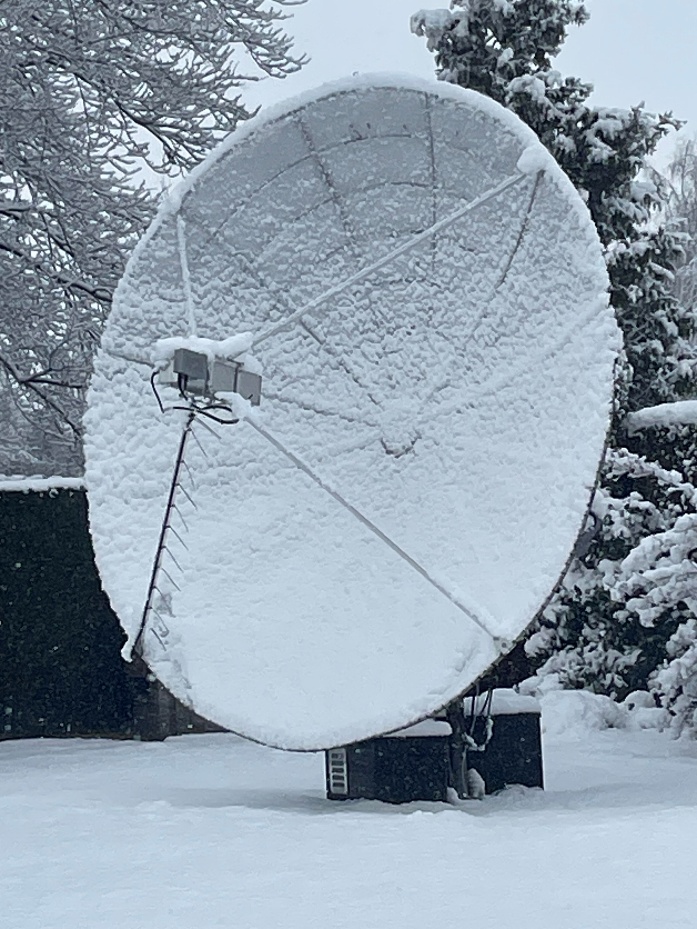 PA0TBR snow covered dish
December was quite an active period for me, I made 24 QSOs including 1 new DXCC: A71AW and 7 new initials: RY4C, SP4XD, A71AW, F4DWB, F1PDX, IZ5TEP, M0LNB.
January has added so far 11 QSOs including 1 new DXCC: OA/LY3UM and 2 initials: DC1RB and OA/LY3UM. This quarter has a number of exciting DXpeditions for which I am very grateful.
Radio Astronomy
I did an experiment to see if I could detect the 1420 MHz signal from the hydrogen line with my dish and was quite pleased with the result.
What is shown is the power spectrum of the hydrogen line at galactic coordinates longitude 84 deg, latitude 0 deg before any editing or cleaning.
I used my 3.5 m dish, septum feed and VLNA for 1296 MHz and a RTL-SDR receiver tuner to 1420 MHz. The software used to obtain the power spectrum from the RTL-SDR is "rtl-power-sdr" which I run on a Raspberry Pi.
I did obtain a nice signal thanks to the fast integration done on the measured spectrum samples. The measurement takes part in 2 steps, first of all a baseline spectrum is taken from a different direction, then a 2nd measurement is done in the required direction and the baseline is subtracted from that. The software output is a table of power against frequency which is then plotted.
To repeat the measurement for more different directions I would like to use a receiver with a better and, most important, a more stable baseline. I am considering using my SDRPlay RSP1B and I am looking now for software which will collect the data and is capable of doing the fast FFT integration.
Here is a nice introduction to radio astronomy: https://youtube.com/watch?v=8j1bVpC6M94&si=qgkkKwk-NMBJsm_s
Be patient, as it will start after the introduction ends.
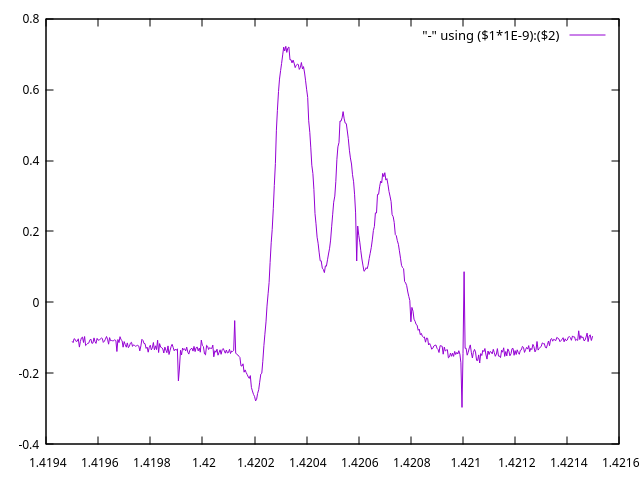 PA0TBR Hydrogen Line Spectra
PA0PLY Jan
During the 13 cm activity event, I found a lot of Interference on 2400 MHz, which made QSOs with JA very difficult.
I checked the DEMI (Down East MIcrowave) filters being used and found the 2400 Mhz filter has a BW up to 2500 MHz. After some communication with Bert PE1RKI, he made a filter for 2300-2400 Mhz to replace the two DEMI SAW-filters. See the pictures below.
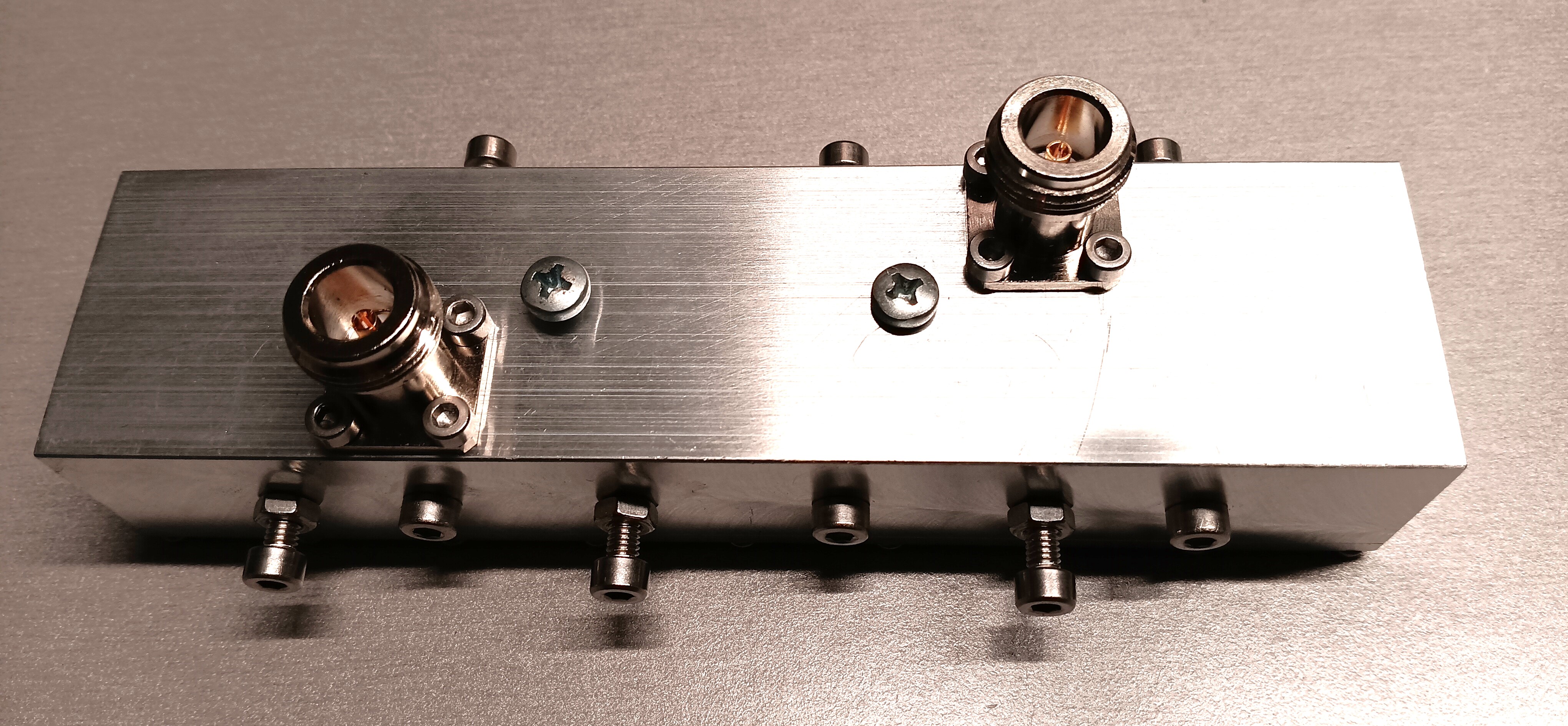 PA0PLY PE1RKI filter
The filter was placed after the preamp and it effectively lowered the out of band signals, which were really huge!
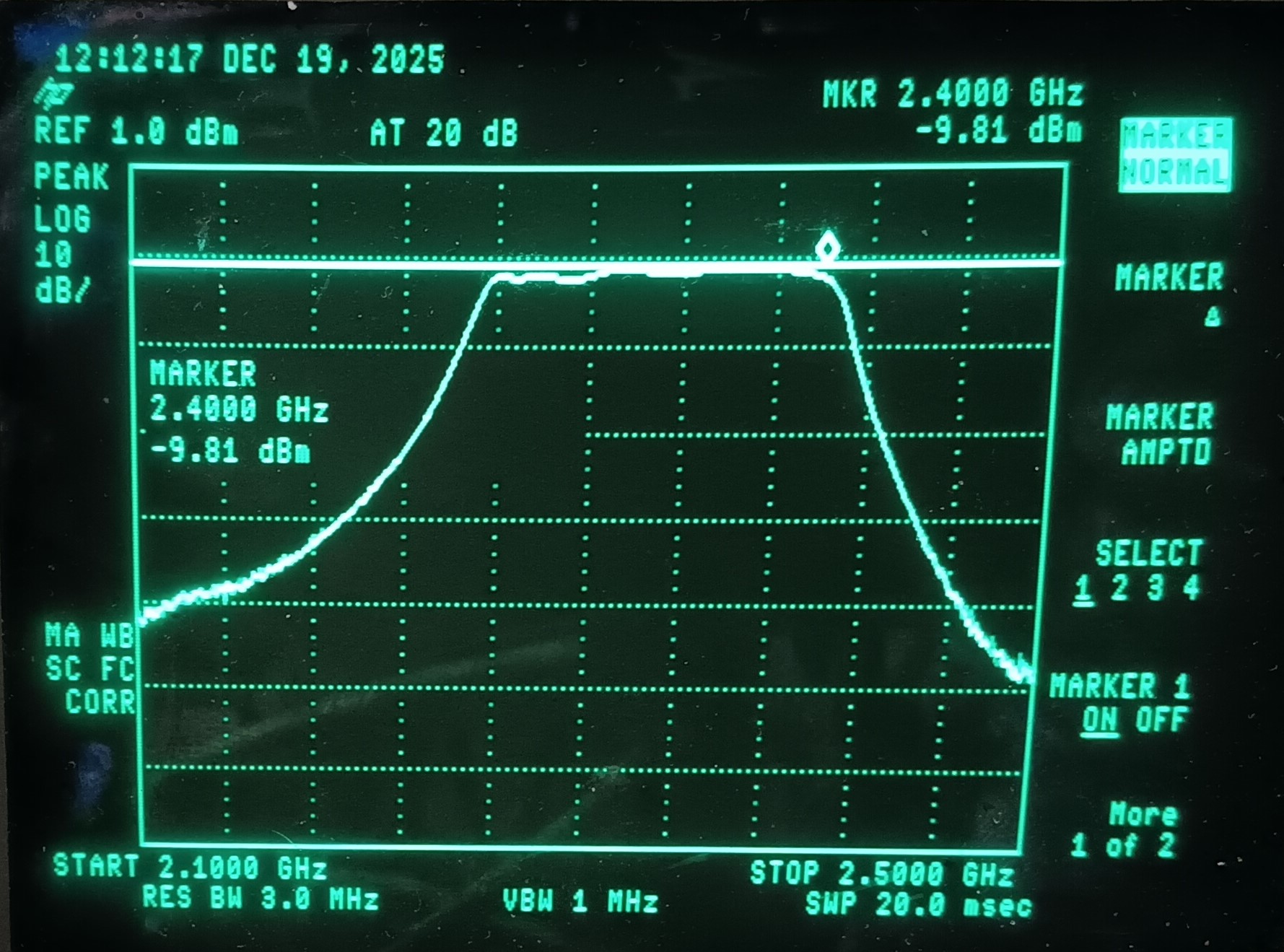 PA0PLY 2300 - 2400 filter test results
In the meanwhile I switched to 3400 MHz on Dec 27th and worked PI9RD (-8/-6) and (559/559) for their first 9 cm QSOs with their new permanent system, DL1SUZ (-19/-13),and OH3LWP (-9/-8).
On Dec 28-29th I switched back to 2320/2400 Mhz and worked OK1USW (-11/-10), SP3XBO (-10/-10), PE9GHZ (-16/-18) and JA6XED (559/569) on 2400 Mhz. The signals of Hisao were much easier to copy now, thanks to the new filter.
After another switch from 13 cm to 6 cm I worked on Dec 30th BA7NQ (-10/-14) for the first BY-PA on 6 cm, SM4DHN (529/549), SM6PGP (559/559) (-8/-9),and OH3LWP (-2/-8).
I put 13 cm back in the dish, just before we were covered with a lot of snow and dramatically low temperatures. I cannot remember so much snow since 1979!
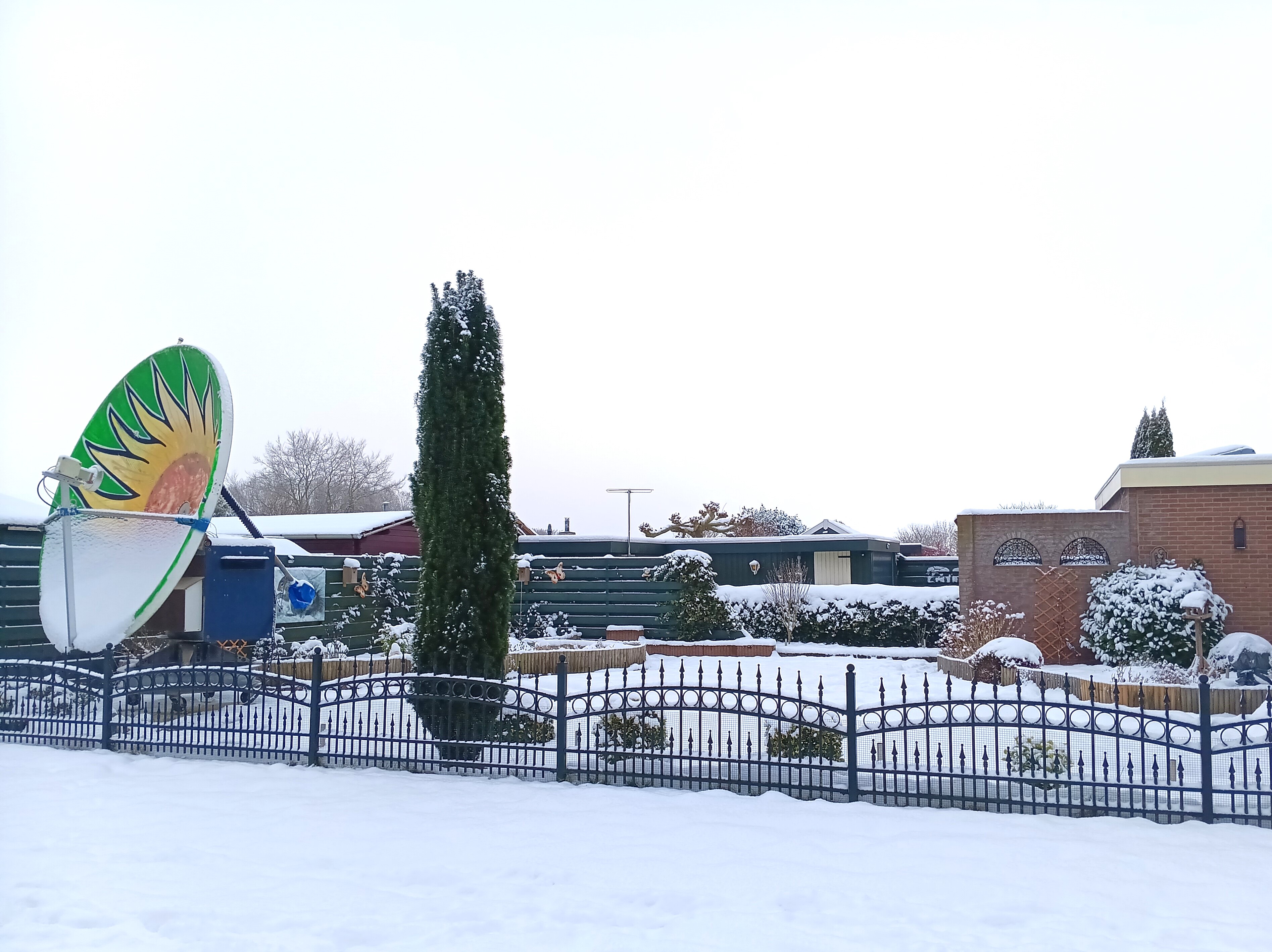 PA0PLY snow coverage
PI9RD Jan (PA3FXB)
23 cm EME SSTV Year End Party & First 9 cm Operation at PI9RD
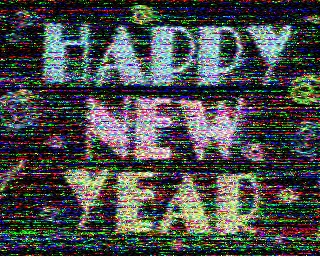
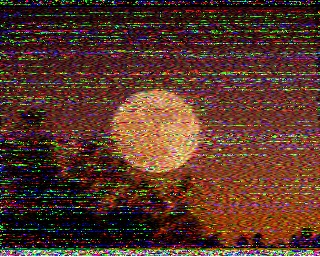
We had a great SSTV party at PI9RD. Quite a few stations received our seasonal pictures off the moon.
We saw results from: DJ2DY, DJ3JJ, DL6ZG, I0NAA, IZ8GGF, OH3LWP, ON5GS, PA3EXV and PA3JRK. Thanks all for watching!
EME SSTV is not easy. Receiving the signal at the correct pitch is important. There is a margin of error but that’s not too big 😊 If the pitch is not right you end up with an image with incorrect colours or even worse. But when the pitch is right surprisingly good results can be obtained. This year’s surprise was the excellent RX of DJ3JJ with his 2.5 m dish.
This is what he saw from us!
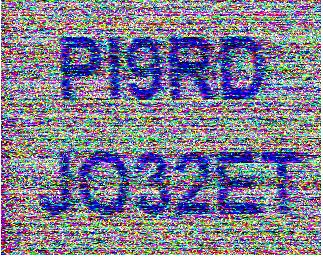 PI9RD DJ3JJ RX of PI9RD
I0NAA received at least 21 images from us. Thanks, Mario, for spending so much time! See below some of the images he received:
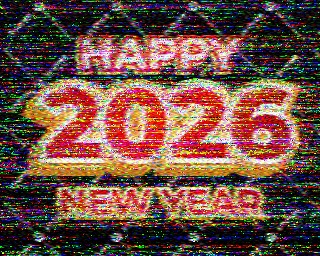 PI9RD I0NAA RX of PI9RD 1
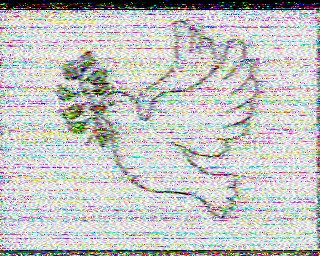 PI9RD I0NAA RX of PI9RD 2
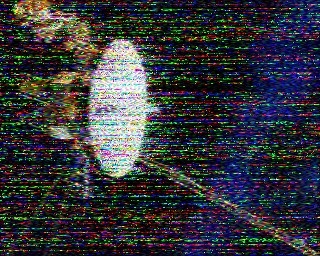 PI9RD I0NAA RX of PI9RD 3
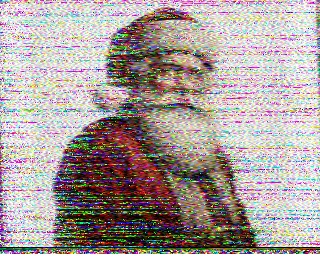 PI9RD I0NAA RX of PI9RD 4
 PI9RD I0NAA RX of PI9RD 5
 PI9RD I0NAA RX of PI9RD 6
 PI9RD I0NAA RX of PI9RD 7
ON5GS was present almost the whole event and he got 39 images from us! See below some of the images he received:
 PI9RD ON5GS RX of PI9RD 1
 PI9RD ON5GS RX of PI9RD 2
 PI9RD ON5GS RX of PI9RD 3
Gerrie PA3EXV had asked us to try SSTV on 13 cm. So, we tried that 😊 This is what Gerrie got from us on 13 cm:
 PI9RD PA3EXV RX of PI9RD 1
 PI9RD PA3EXV RX of PI9RD 2
 PI9RD PA3EXV RX of PI9RD 3
We have less power on 13 cm than on 23 cm. Probably around 50 W at the feed and we illuminate the dish a bit off centre. Not all the feeds can be at the exact focal point at the same time 😊
To get our beam on the moon we have to slightly offset the dish. It works but it is far from optimal. But the size of our dish compensates a lot 😊 This is how our focal box looks like:
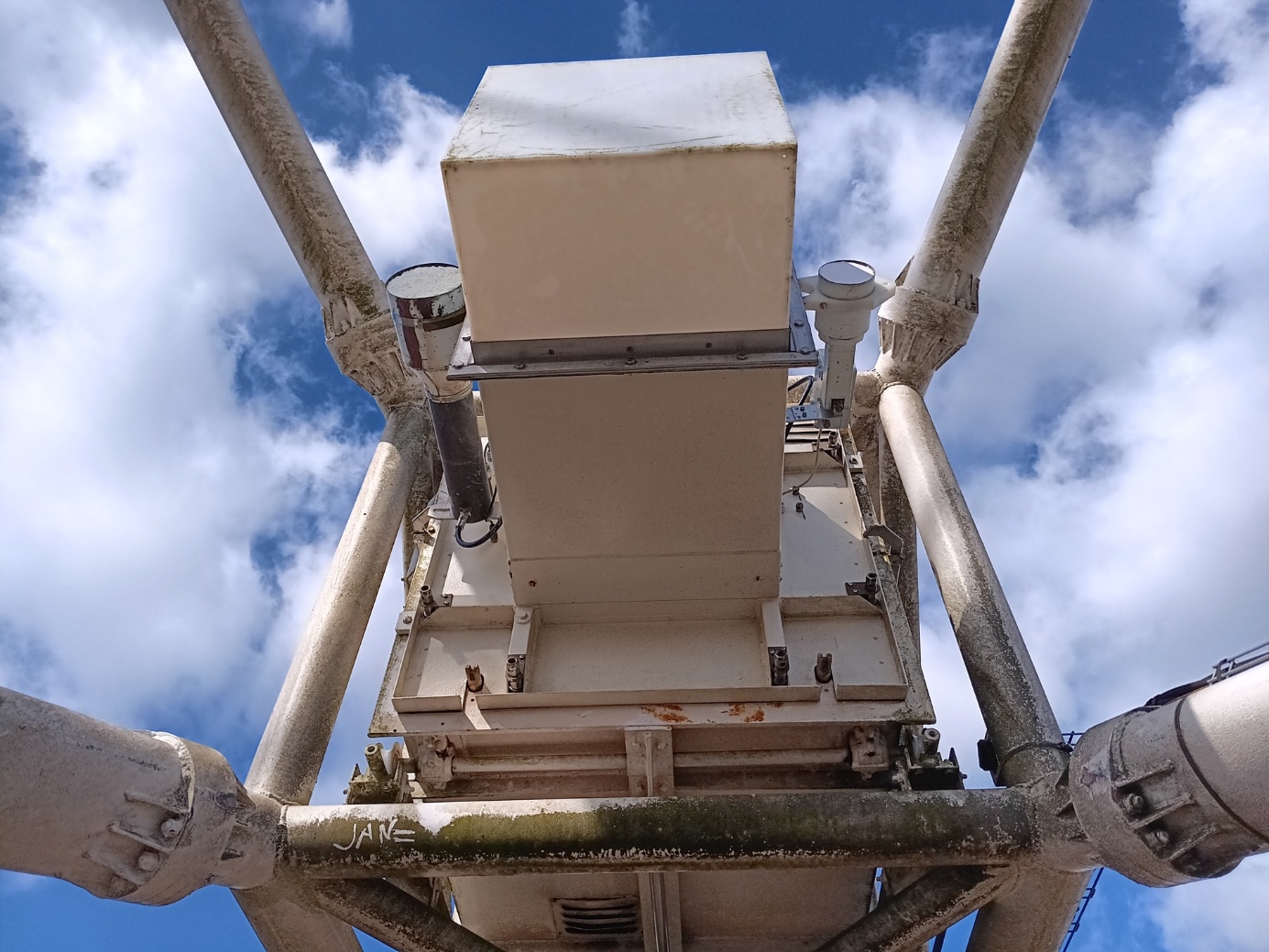 PI9RD FOCAL BOX
Inside the big white plastic box our 23 cm feed horn and 70 cm dipoles are located. On the left you see the 13 cm feed. On the right you see the recently attached 9 cm feed. (Thanks, PA3CEG for the donation of the transverter and thanks PA0PLY for putting the station together and mounting it). Both feeds are several wavelengths out of focus, so we do not reach maximum performance, but it works 😊
We tried this 9 cm setup for the first time, and we had some successful QSOs: PA0PLY (Q65 and CW), DL1SUZ (Q65), OH3LWP (Q65) and OK1TEH (Q65).
OK1TEH used a very small setup. Only a 1 m dish and 20 W at the feed but we made it!
So, this means we now have 4 bands available for EME at all times: 70 cm, 23 cm, 13 cm and 9 cm.
VE4MA Barry
I spent a lot of time upgrading / repairing the 24 GHz station after the December activity weekend. My LNA power was not sequenced and the LNA was wanting to oscillate after coming back to RX operation. So I have sequenced the LNA power now. I also had to provide some additional control contacts in order to stop my Moon noise meter from being subjected to excess signal during the TX periods and to switch my tower mounted 24 GHz station to TX also, to avoid RX damage from the EME TX.
I was having problems with the 14 kV power supply for the TWT and I found a couple of bad conductors in the HV cable. I built a temporary replacement cable and was able to work that. I have received more 30 kV HV wire and a replacement connector and will make up a more robust cable assembly.
The weather here was very cold -20 to -35 C weather on the activity weekend and we have had a lot of wind and blowing snow. I have 1 m of snow around my house but not beside my dishes! The sun is too low to make good noise measurements. The weather today January 22 was -31 C air temperature and with the wind it felt like -47 C. We are having much the same weather for the next 4 days.
On January 3rd I was still having the problem with my Moon Noise meter but I measured 3.15 dB of Moon Noise... but later it was much lower near 2 dB. The RX tests FB on the Noise Figure meter. I have not yet put the spare LNA in place to compare.
On January 3rd with the oscillating LNA I had a QSO with OZ1LPR (-6/-10) and we switched to CW for a FB 579/559 QSO. When I use digital or CW I can use WSJT to make Doppler corrections.
We switched to SSB and completed a 53/52 QSO. I had trouble tuning in the voice and with no Doppler correction it was a challenge keeping it on frequency! CFOM is such a wonderful mode but of course any full Doppler correction mode is also.
On January 5th I had a nice 24 GHz QSO with IW2BNA -19/-12. He was Best -18 and I was a steady -12. See the IW2BNA report for his decoded screen shot. That is the first I to VE QSO on 24 GHz. I plan to be active every month until spring when I will QSY to 47 GHz.
I plan on operating on 432 MHz in the DUBUS / REF contest at the end of January. The last time I operated on 432 I had RX problems of unknown origin. It may have been some local interference from 433.92 MHz devices. I will make some changes to my RX system to improve the strong signal handling. I also plan to install a 20 cm "fence" around the perimeter of my 3 m dish in order to cut down on the spillover noise. This is the same idea as KB2SA has used on his 1 m dish on 23 cm with great success. I am waiting for the weather to moderate a little before I do this... hopefully just in time for the contest 😀
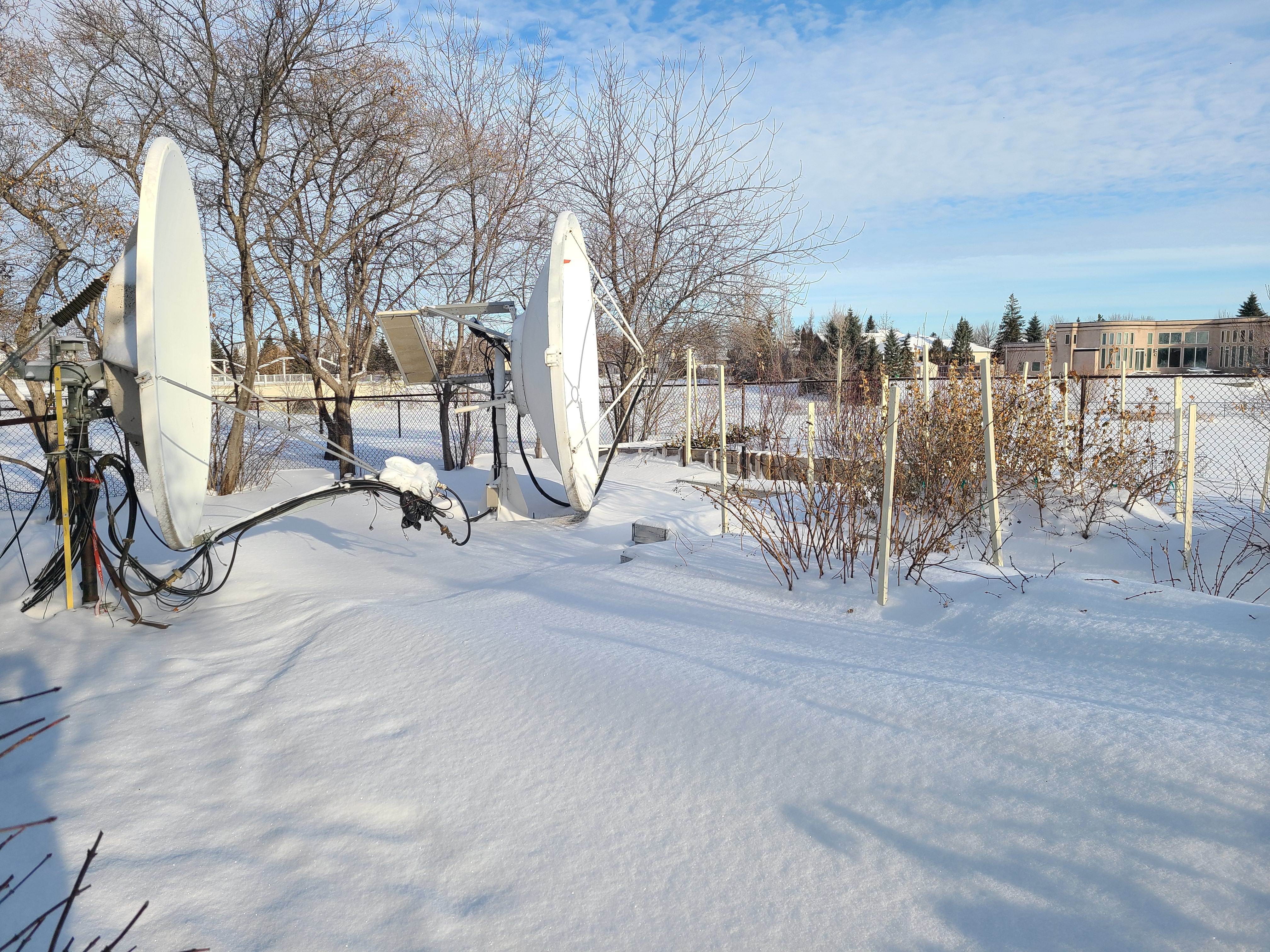 VE4MA Dishes on a Winter Day 1
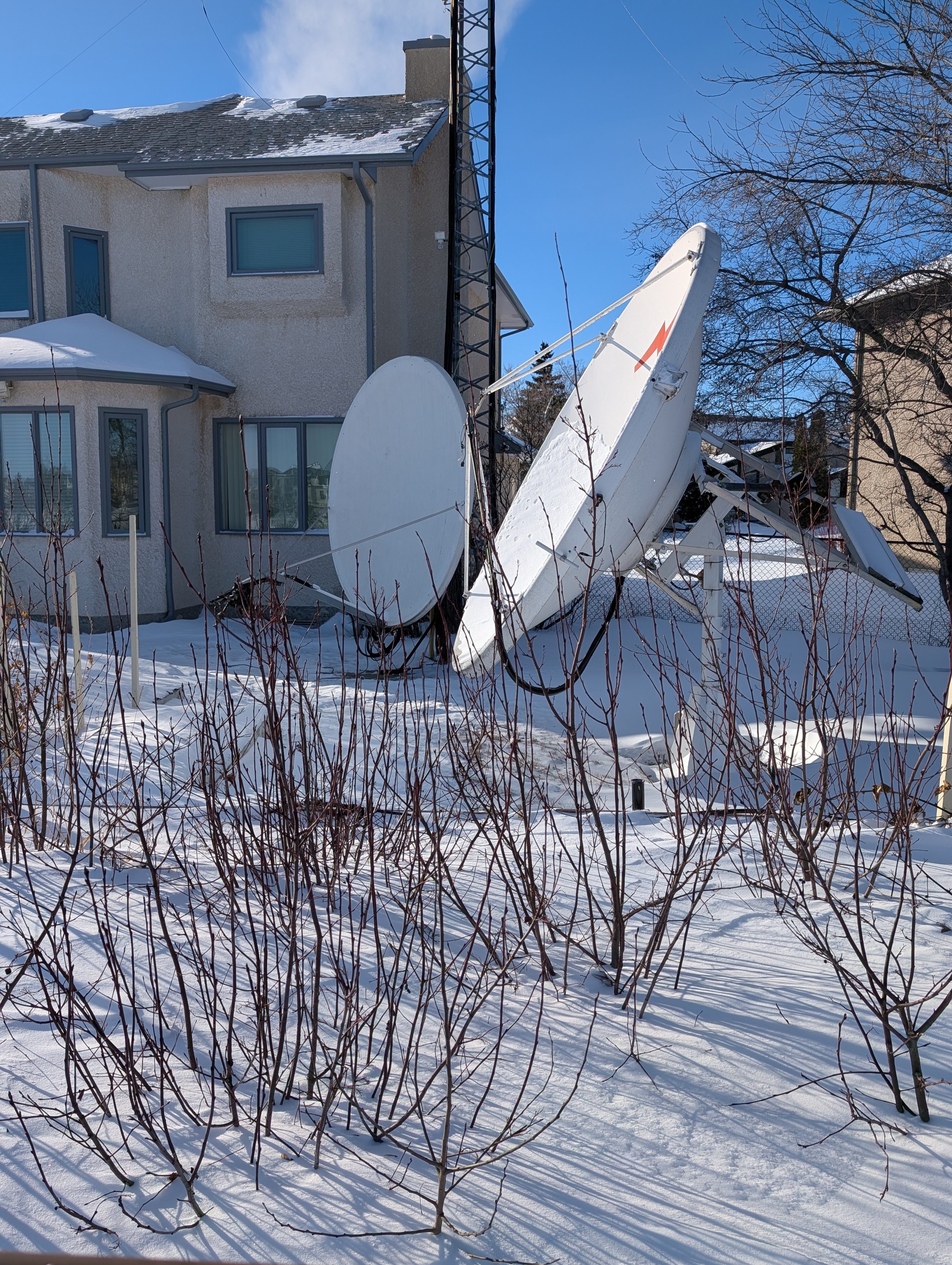 VE4MA Dishes on a Winter Day 2
VK2CMP Mick
I did a bit of maintenance during the last month in the form of installing ferrites on my own as well as my nearest neighbours rooftop solar inverters. My system is a SMA unit and is renowned for running RF quiet, but I thought I may as well do this system as well as my neighbours Chinese built system while they were on a 3 week holiday!
I installed ferrites on the 240 VAC feeds as well as all the DC feeds. I used TotalPower to look at any changes before and after. There was a slight decrease in noise using the Noise Meter of the neighbours system, so worthwhile. Unfortunately I have about 14 solar systems within 120 m of my QTH so this is a small step. One thing I noticed was my new Heat Pump water heater makes a heap of noise. I put ferrites in the 240 V lead-ins but there was a heap of noise coming out of the vents of the unit where the electronics are housed. Which will need a Faraday cage or similar?
I worked two Initials on 70 cm during the month, YO5TP and DD0VF. I also ordered the Miroslav’s Reception of Weak Radio Signals from Space book before Xmas and am still keenly waiting for delivery downunder so might go for the Digital version like all the cool kids.
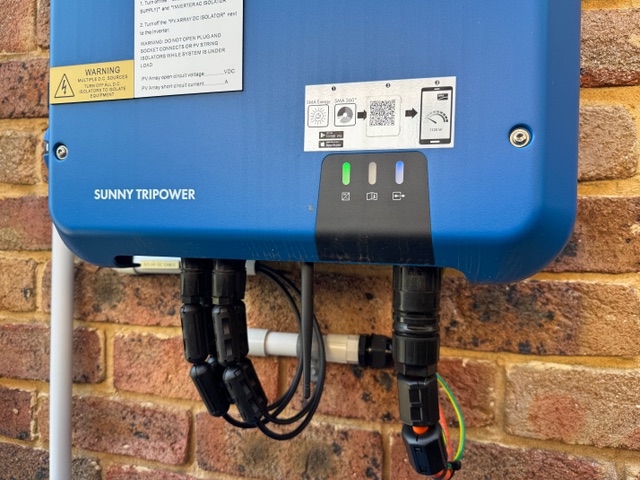 VK2CMP Ferrite Installation on Solar Inverter
W2HRO Paul
More than 50 years ago, K2UYH and many of his PackRat friends rescued and then lifted the 28 foott Kennedy dish at the K2UYH QTH in West Windsor, NJ.
Al - K2UYH operated this EME super station on bands "432 MHz and Above" for over 50 years. Sadly, K2UYH became SK in June 2024.
During mid-December of 2025, Al's 100 ft tower and the Kennedy dish were carefully taken down by Warren Whelan - WB2ONA and his skilled team. The disassembly of the tower and dish took several days over a two-week period. K2UYH's XYL Sally took her first "walk" on the Kennedy dish.
The Katz Family wants to see K2UYH's station used again for EME, so they have donated the Kennedy dish and the EME station equipment to W2ZQ - Delaware Valley Radio Association. Planning is in progress to reinstall the Kennedy dish at the W2ZQ shack in West Trenton, NJ.
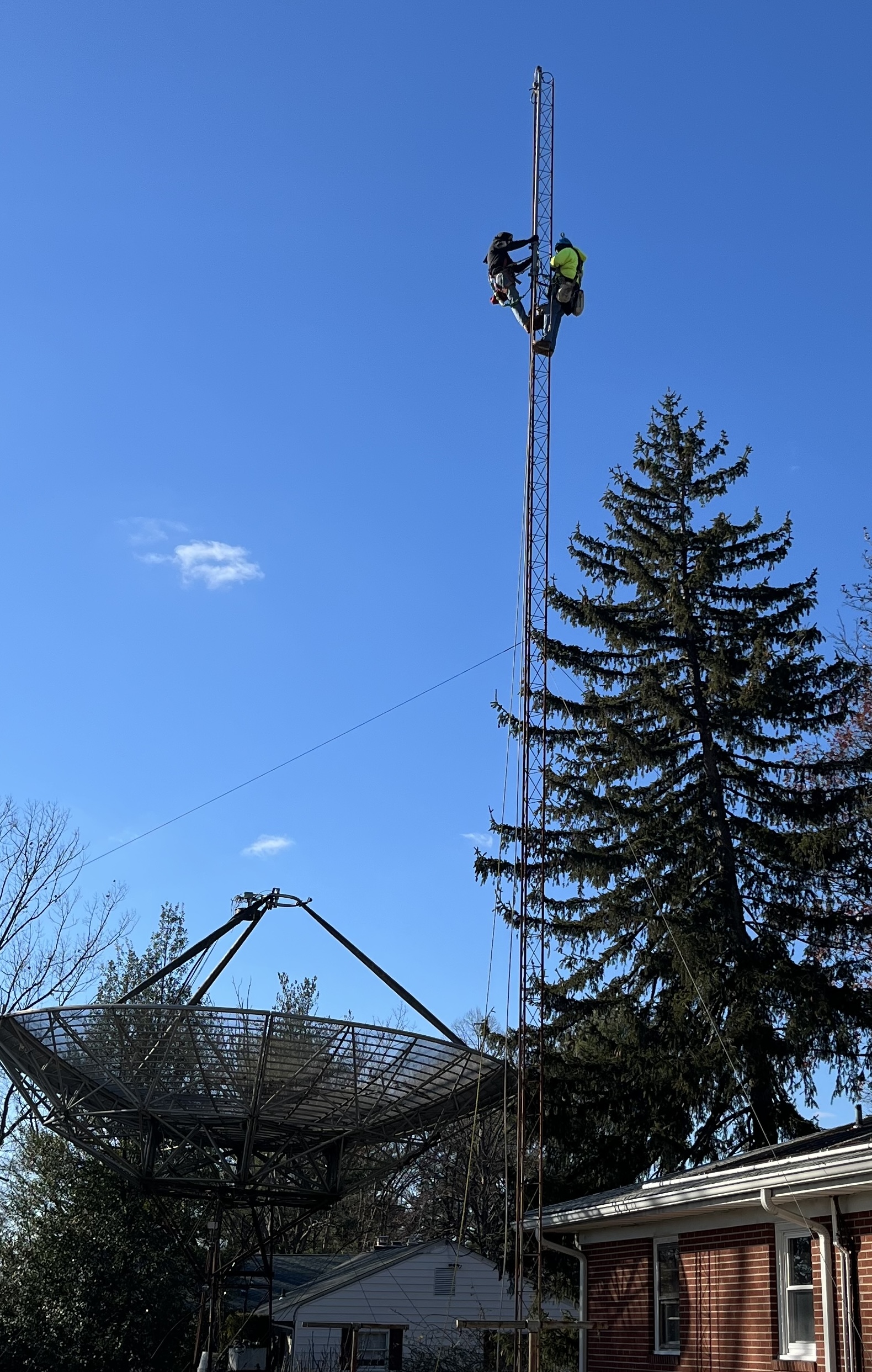 K2UYH Tower Removal
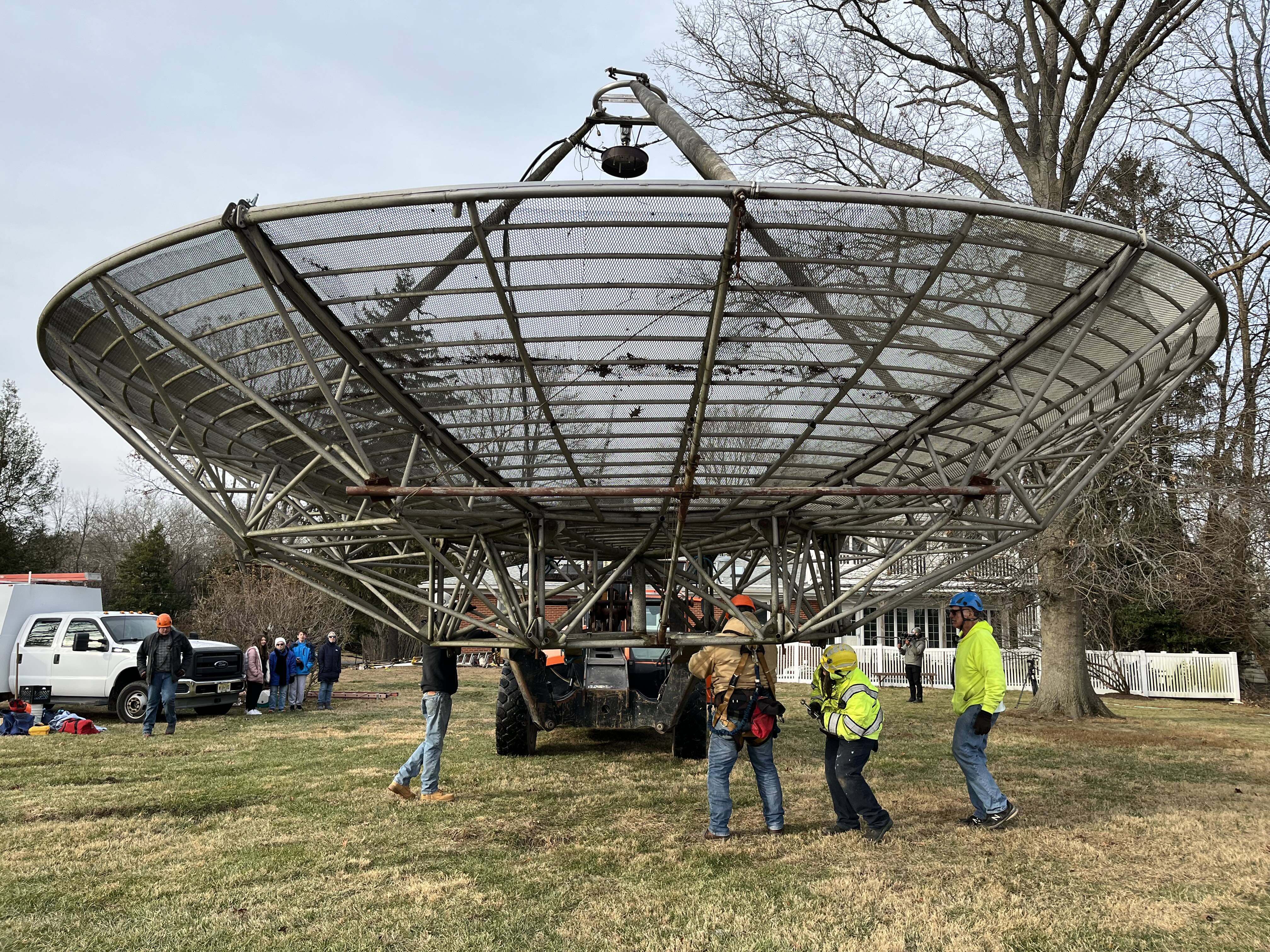 K2UYH 28 foot Dish Removed
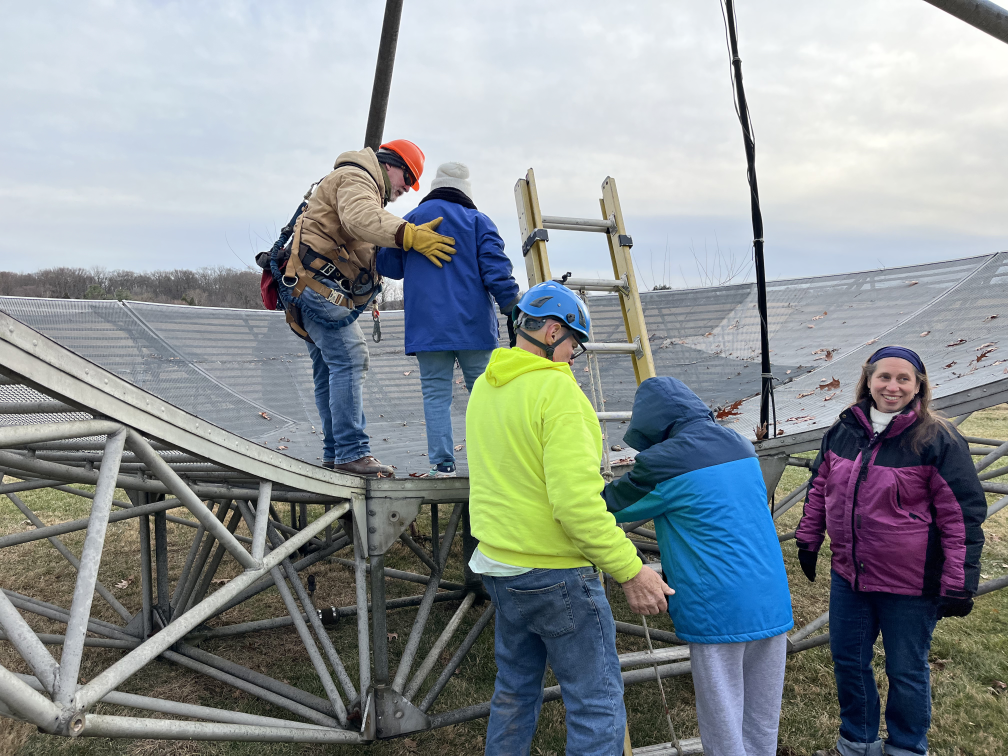 K2UYH XYL Sally Katz Walks on Dish
W2LPL Les
I continue playing with the 1.5 m Solar cooker, now with the feedhorn flare and S12 Disk. With low degrade and 300 W at the feed, I can easily work other cookers such as KB7Q (-24), KG0D (-24), KN2K (-23), NY1V (-22) and KB2SA (-20) with his 1 m dish. Many are using Q65-30B mode and KA1GT (-14) in Q65-15A. My Echoes are seen at -21/-22 and NC1I @ -5 dB.
I hope to see more stations in the coming months joining the QRP antenna fun on 1296 MHz. The "Solar Cooker Project" is an example of what happens when great minds work together and improve on each other's work and ideas. The minds on this Project include KA1GT (the spark), W2HRO (simplified mount), OK1DFC ("mini" Septum), KB2SA (optimization), K1JT (Q65) and so many others.
W5LUA Al
I have been slowly fixing/or keeping equipment running. On my 24 GHz system I pulled my WR-42 waveguide relay and managed to clean up the mechanics. An insect managed to come in through the feed and jam the operation. With that working, I am now reverse engineering the control relays as I had a rodent eat through all 6 non-color coded white wires going to the relay connector. I did not keep very good notes back then.
Operating wise, on Dec 26, 2025 I did manage to work SA5IKN, EA1IW, and IW2FZR all on 3 cm. Today we had an ice storm and temps of 20 F (-7 C). I had almost one cm of ice on the dish but I was seeing OA7/LY3UM around -18 dBm to -23 dBm. I could hardly see my echoes but I did manage to work Alex for DXCC #122. Thank you Alex.
I hope to be more active in the future.
W5ZN JOEL
I have been off the air on 432 EME the past few months due to an amplifier issue that has now been resolved. I am available for skeds most any time and will be active from Arkansas EM45 in the coming months on 70 cm.
23 cm Frequency Plan & New Threats to 13 cm Use
Barry, G4SJH, The RSGB Microwave manager, gave an update on the 23 cm band planning situation at a meeting in the UK on January 24th, 2026.
In June 2025 CEPT approved an ECC decision ECC DEC(25)01 which effectively implemented the WRC recommendations for protection of Galileo signals. National authorities will decide how they wish to implement the restrictions. Following this the Interim IARU Region 1 conference in April 2025 set up a working party to develop a proposal for discussion and hopefully agreement at the IARU Region 1 General Conference in September 2026. The proposal, shown here, is not a replacement for the current plan but an addition or supplement to it and reflects the discussions reported in the April 2025 Newsletter. https://eme.radio/component/content/article/432-and-above-2025-04 It does not preclude the possibility for national variants depending on how National Authorities decide to act.
Barry’s full presentation can be found here https://wiki.microwavers.org.uk/images/a/a7/G4SJH_Slides_Final_240126.pdf
The 13 cm band was also covered by Barry and in the UK there is increasing pressure on the allocation around 2320 MHz as can be seen on the slide. My personal view is that we shall have to get used to working up at 2400 MHz as evidenced by the problems recently faced working DU3T lower in the band. Really good, narrow band, filtering after the LNA to prevent overloading is now essential for each and every segment on 13 cm.
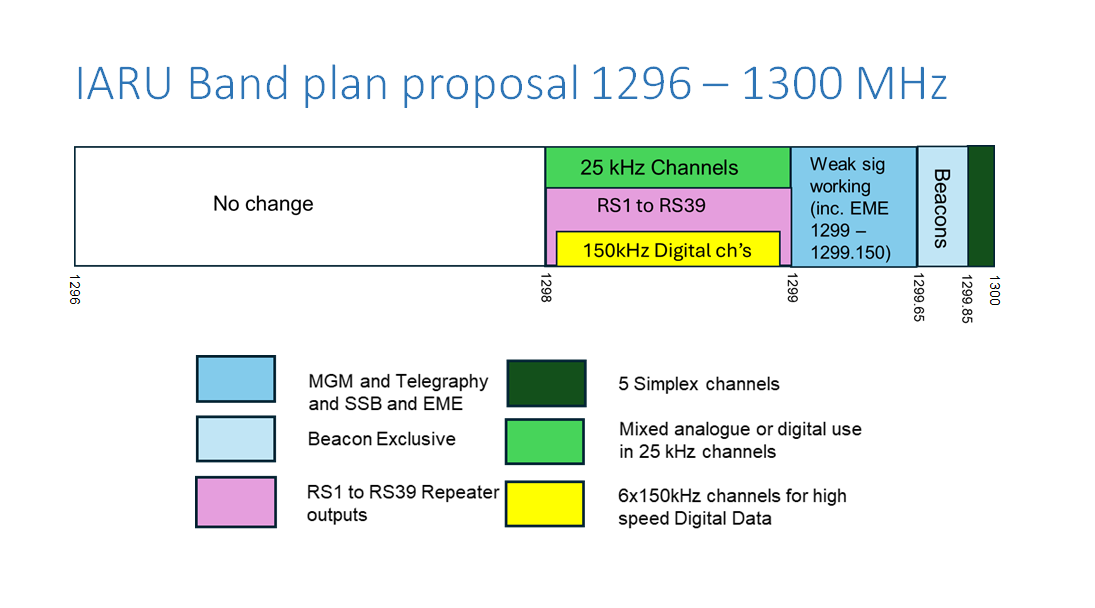 2026 Proposed change to 23 cm band plan IARU Region 1