
432 AND ABOVE EME NEWS
July 2026
Volume 55 Number 7
Editor: Barry VE4MA
Production Assistance: Peter G3LTF, Frank NC1I & Bob W1QA
News, Contests and DXpeditions
Well it certainly is summer now with very hot and humid weather in Europe and North America. This appears to have had an effect on EME activity levels, although it’s not unexpected since I know that people do go on vacation in July and especially in Europe. There has still been a lot of activity on and off of the moon.
There was some good activity for the 9 cm leg of the DUBUS–REF contest. This band is not available in all countries but this contest was good to concentrate the activity! I think we could do a better job of coordinating the activity. The contest rules do restrict the use of other communications means during the contest period, but it would help a lot if stations would indicate their intention to operate and provide as much detail as possible, before the contest starts. This could be on email reflectors or on HB9Q.
The European / Asian stations don’t know who and when anyone will be active and similarly the NA stations have no idea if and when EU or Asian stations will be active. Consequently with the time zone issues involved stations go QRT when the band is quiet, and have no prospect that activity will pick up again later. So please make your intentions known for contests and even general activity on the lightly populated bands.
Off Air Activity
Although the activity may have been lighter on the air, many operators have been busy with software and hardware creations that are of interest to many of us. I want to mention a few:
- DL3WDG has created a Windows program that attempts to emulate the sound of CW EME signals. See his report below.
- KA1GT is beta testing a new Echo and Noise measurement program.
- OZ9AAR has a new version of SimpleCalc, 1.0.0.19 with HPBW measurement. This provides some of the functionality that the VK3UM EMECalc program but includes some additional features. See SiimpleCalc
- KB2SA continues his work on high efficiency feed systems for Cooker and other small 23 cm dishes. See his report below.
Solar Eclipse
On August 12th there will be a total eclipse of the sun along a path running from Greenland to Portugal. Either side of this path will experience a partial eclipse. At G3LTF’s location IO91GG he will get about 1.5 hours of eclipse. Although it’s close to sunset he plans to try and get some sun noise data on 9 cm or possibly on 6 cm.
I suggest that it might be interesting for the CT stations that are active on 24, 47 and 76 GHz to make some recordings. I think 47 & 76 GHz would be a first. Northern CT is very close to the path of totality. The 2015 eclipse measurements that G3LTF collated are reported here Eclipse Measurements
Who knows what 47 & 76 GHz might reveal?
If you download the VK3UM EME Planner it will calculate the % sun obscuration and timings for your QTH.
2026/2028 EME Conferences
2026 EME conference Presentations - Bob W1QA has collected all the presentations from the conference and they are available at 2026 Presentations
2026 Conference Additional Prize - When the prizes were awarded at the Banquet on Saturday night, one large prize was missed. Having recognized the error, another prize drawing was made and Avelino EH8BPX was the winner.
Bill KB2SA provided a 23 cm septum feed custom tuned to Avelino’s dish requirements.
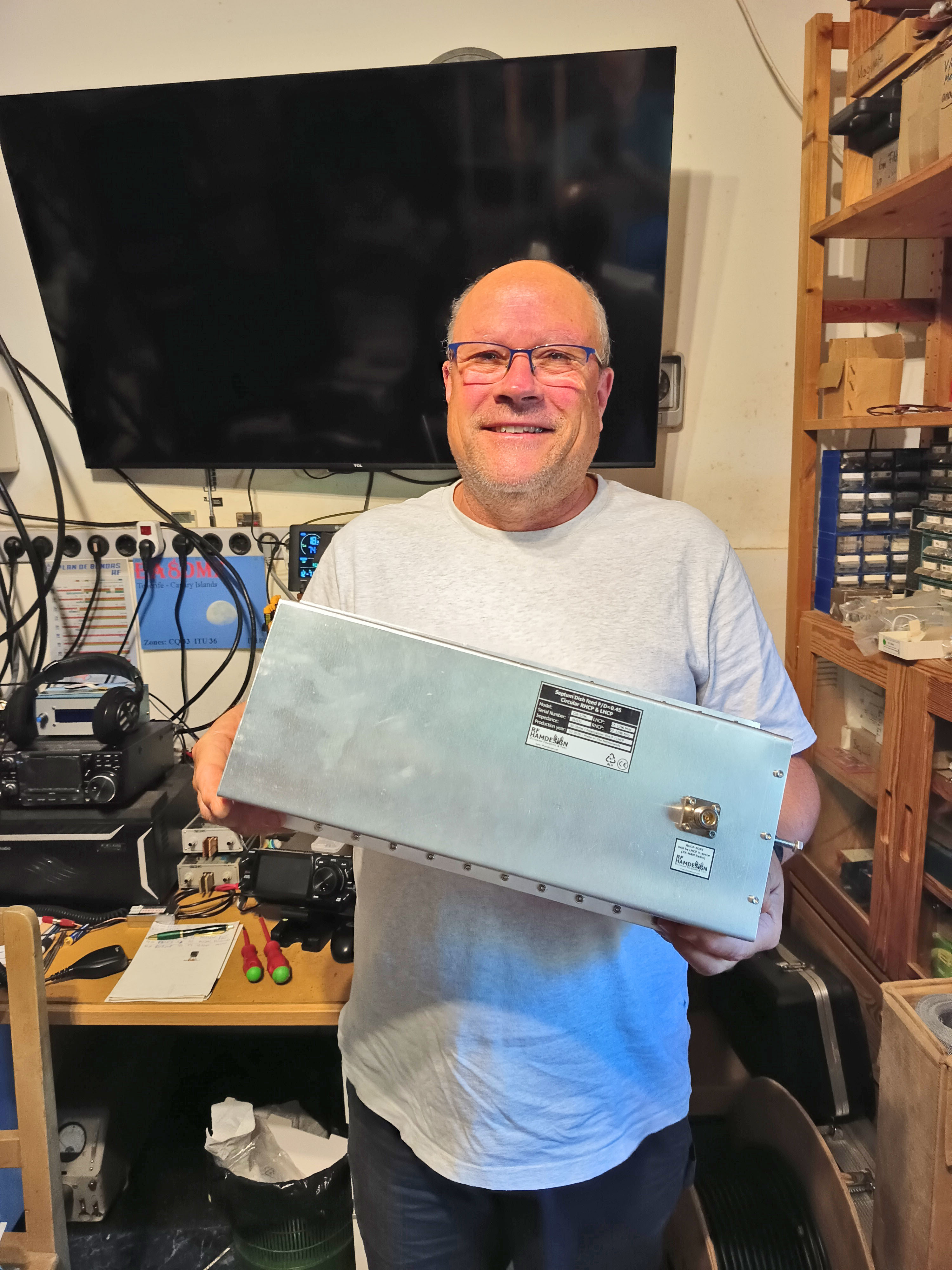 Avelino EH8BPX with 23 cm Septum Feed Prize
2028 EME Conference Site Selection - The location for the 2028 EME conference was not selected at the conference and went through an RFP and voting process created by an informal team led by Mike W9IP.
The results are in:
Lisbon, Portugal will be the site of EME2028
August 25-27, 2028
Poll results

Lisbon, Portugal has been selected with 94 votes (59% of the total cast).
https://eme2028conference.com/
The following is a message received from Tony CT1FFU:
Miguel CT1BYM has been truly unstoppable and incredibly dedicated, putting an enormous amount of effort into creating all the excellent media and presentations that you saw.
Several other Portuguese amateurs joined the team to support the initiative, and one of the biggest surprises was that colleagues from other countries — OK1DFC and PA0HRK — also became involved. Their support and contributions have been extremely valuable.
As the project evolved, it gained much broader support. We also received backing from several national and local amateur radio associations in Portugal, including REP, AMRAD, GPDX, ARRLx, and others.
The EME Lisbon 2028 Team is:
CT1WO - Victor
CT1BYM - Miguel (coordinator)
CT1DMK - Luís
CT1EIF - Rui
CT1FGW- João
CT1FFU - Tony
CT2GUR - Paulo
CT7AFN - Carlos
CT2KJR - Rui
CT1EKD - Pedro
OK1DFC - Zdenek
PA0HRK - Harke
Contests
DUBUS-REF
The 2026 DUBUS-REF Contest is now over and Contest entries MUST be sent (mail or e-mail by JULY 31, 2026). Please see the rules for the 2026 DUBUS-REF contest at: EME Contest 2026
ARRL International EME
The 2026 ARRL International EME contest is about to begin. It runs for four full weekend 48-hour periods (0000 UTC on Saturday through 2359 UTC Sunday). The Dates for 2026 are:
Weekends 1 and 2: 2.3 GHz & Up:
August 8-9, 2026; September 5-6, 2026
Weekends 3 and 4:
50 to 1296 MHz - October 31-November 1, 2026; November 28-29, 2026.
The complete rules can be found at https://www.arrl.org/eme-contest
As mentioned earlier we can do a better job of coordinating activity by indicating our plans on EME email reflectors or on HB9Q before and during the contest period for this contest. There is nothing more frustrating than to get set up to operate on one of the microwave EME bands in the middle of the night and no one else showed up on that band!
Unlike the DUBUS-REF contest which is a single band per month, we have 2.3, 3.4, 5.7, 10, 24 and 47 GHz to choose from for the 4 days of weekends 1 & 2. So pick a band and take your chances or try to attract others to your proposed bands? It is the same for weekends 3 & 4 where we have 50, 144, 222, 432, 902, and 1296 MHz to choose from. At least on many of these bands there is likely to be some good activity.
DXpeditions
C37EME Andorra - The EME activity is taking place with the URA (Unió de Radioaficionats Andorrans) call sign C37EME from locator JN02sk in August 2026. See the June Newsletter for details.
EA8DBM - Alex is planning his upcoming trips for this autumn and next summer, and he wants to know which DXCC countries you would be interested in on 13 cm. See his report below.
DB6NT Michael
Here's my short report from the DUBUS–REF 9 cm contest weekend of July 11, 2026. The weather conditions were very good.
On 3.4 GHz, there were 13 stations: OH1LRL, OK1KIR, OH2DG, OE9ERC, DL1SUN, DL4DTU, PA0PLY, G4CCH, PA3DZL, G3LTF, WA6PY, PA0BAT, and VE6TA.
My setup is a 3.7 m dish. 0.7 dB NF RX and 75 W RF out.
It was a lot of fun. Unfortunately, I was only able to be QRV for a short time. Thanks to everyone for the great QSOs.
DL3WDG Charlie
I have written a Windows program that attempts to emulate the sound of CW EME signals. I have been using it to refresh and hopefully improve my CW skills. If anyone is interested in trying it out, I am happy to provide an installer. The fading model is based on K1JT's algorithms used in his EME simulators.
To concisely summarize the features of the Morse EME Signal Simulator:
- Realistic EME Simulation: Simulates CW Morse code reception as heard in Earth-Moon-Earth (EME) contacts, including Rayleigh/Lorentzian fading (Doppler spread) and adjustable Gaussian white noise (AWGN) for realistic weak-signal conditions.
- Customizable Signal Parameters: Users can adjust tone frequency (200–2000 Hz), Morse speed (1–30 WPM), signal-to-noise ratio (−30 to +10 dB), Doppler spread, output level, filter bandwidth, and filter centre frequency.
- Multiple Modes: Includes Trainer (copy hidden DX callsign), CQ (copy CQ calls), and Free Text (send any text through the signal chain) modes.
- Audio Output and Spectrum Display: Plays simulated signals through the sound card and provides real-time spectrum and waterfall displays with adjustable smoothing and dB range.
- Callsign Management: Random DX callsigns are selected from a built-in or downloadable list; the user can specify their own callsign.
- Interactive Practice: Users type what they hear and receive immediate feedback; replay and answer checking features included.
- Signal Generator: Continuous carrier mode for tuning and measuring noise floor.
- Settings Persistence: All user settings and downloaded callsign lists are saved and restored automatically.
- Morse Code Reference: Built-in access to a Morse code character table and reference guide.
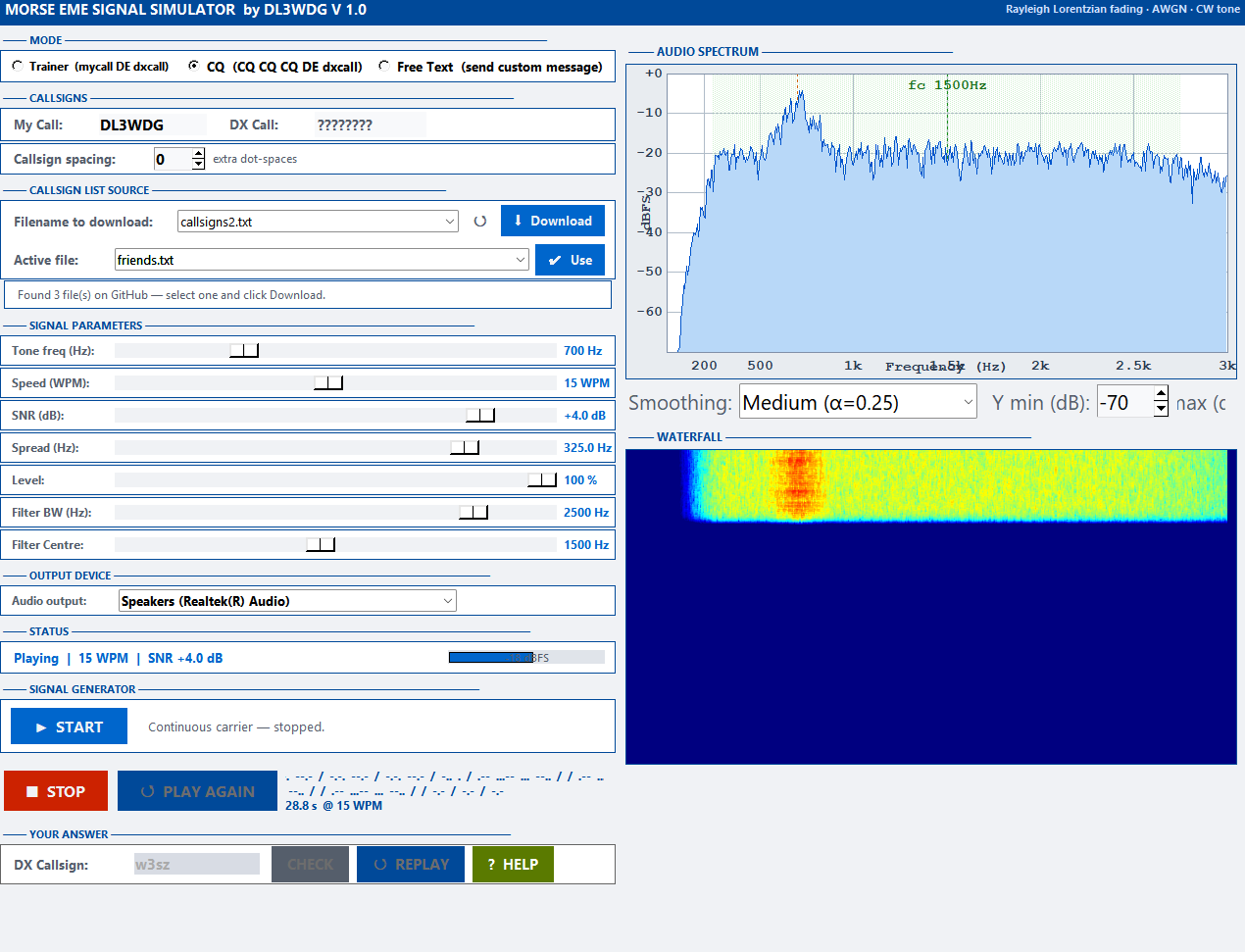 DL3WDG Morse EME Simulator Screen
EA8DBM Alex
I would like to run a small survey regarding activity and operations on the 13 cm band. I’ve grown quite fond of this band and feel right at home there, but the activity level remains very low. This might be because I don’t announce my activations enough, focusing instead on 23 cm where things are naturally busier and more exciting. Lugging an extra 10 kg of gear on a plane doesn’t make much sense if it only yields 7–10 QSOs. However, when I travel by car, taking the amplifier along is much more feasible.
For instance, here in Lithuania and Latvia, there is a widespread LTE network operating on Band 40, which runs exactly on 2320 MHz. Near major cities and highways, the 2320 MHz noise floor is completely obliterated — there’s a solid 59+20 dB roar. That said, it is possible to find a spot in the middle of nowhere, away from roads and down in a valley, to try and “hide” from the cell towers by driving some 20–30 km away from them.
But the main question is: does anyone actually need this?
I am planning my upcoming trips for this autumn and next summer, and I want to know which DXCC countries you would be interested in on 13 cm. Please send your wishes to my email:
Feel free to use any format that suits you—whether it’s just a list of prefixes or a log file in ADIF or TXT format. I will feed this data into an AI prompt to generate a breakdown table of the most wanted countries.
By the way, we can do the same analysis for other bands too, anywhere from 144 MHz up to 10 GHz. So feel free to send your complete logs containing all bands. I believe this summary table might be interesting for you as well. Data confidentiality will be strictly maintained (for those to whom it matters).
Looking forward to your emails.
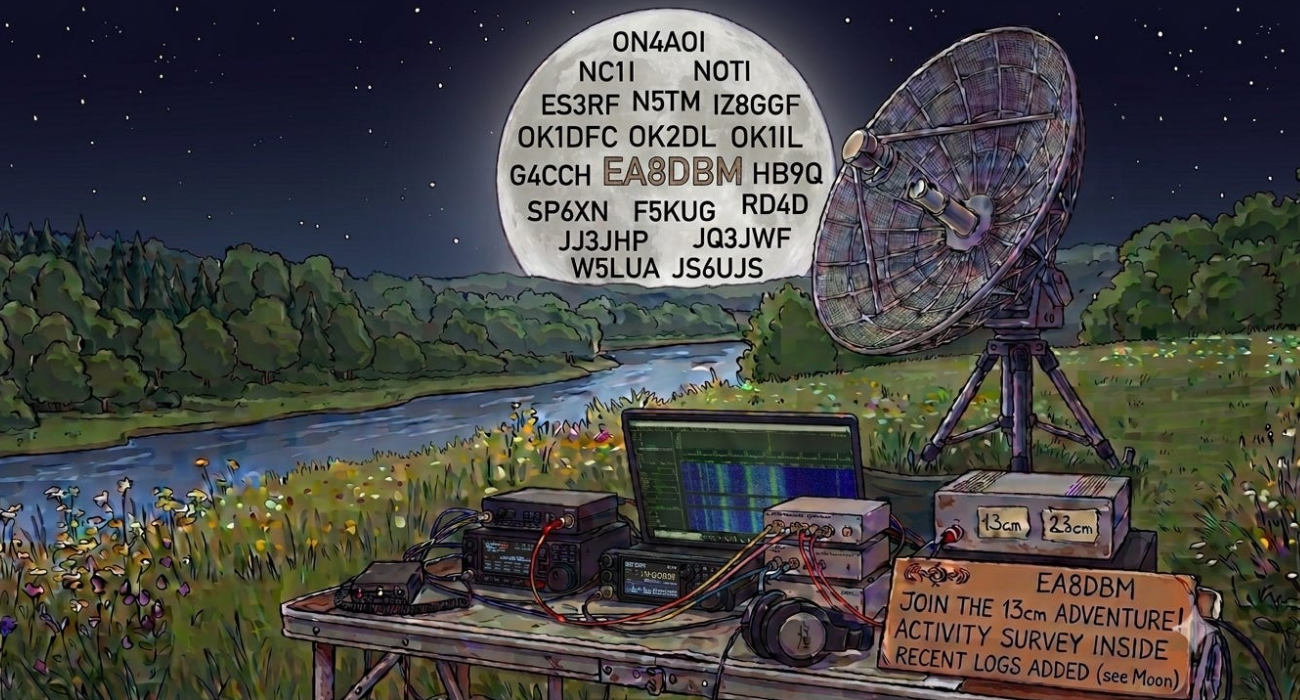 EA8DBM 13 cm survey
G3LTF Peter
On 9th July I put the 9 cm gear into the dish and checked it out, and measured 18 dB of sun noise with a SF 110. I worked Ari OH3LWP 569/579.
For the contest on 11th July we again had zero wind but a 31 C temperature. I was not QRV until 07:30 but then worked SP3XBO, PA3DZL, OK1KIR, OH2DG, DL1SUZ, OE9ERC, PA0PLY, OH1LRY, DL4DTU, VE4MA, G4CCH, WA6PY, DB6NT, VE6TA, and W5LUA. I stayed around until 15:30 but there were no more takers. It looks like I missed PA0BAT. My total of 15 QSOs is much better than last year when I blew up the driver stage before the contest!
I could not be QRV on Sunday because the dish drive failed, as it would not reverse. I believe I’ve found the problem but I had to fit a new drive belt pulley and do some work on the big worm drive. I really hope to be able to work the C31 Dxpedition on 23 cm CW, it should be possible.
G4CCH Howard
Here's an update on my activity since April 25th.
26 April - 23cm - VK0DS (D), SP6GWN, PA3DZL, R1NW, DF3RU, UA9FAD, PA2DW and DL4DTU
27 April - 23cm - A71AW (D) and OZ3Z (D)
29 April - 23cm - GB9IOW (D), GB9IOW (D) for digi Initial #736 and DJ7FJ
14 May - 23cm - G4BAO, K6EME and KG0D
15 May - 23cm - N0FJP (D) digi Initial #737. NN4X (D) and K4VJ (D)
16 May - 23cm - HA5OLA (D) for digi Initial #738, W2LPL (D) for digi Initial # 739 in FM29 and LA3EQ (D)
17 May - 23cm - OK1IPV (D), DC1RDB (D), KB7Q (D) and LU8ENU (D)
18 May - 23cm - F4BLE (D) for digi Initial #740
20 May - 23cm - W9KW (D) for digi Initial #741
13 June - 23cm FP/EA8DBM (D) for digi Initial #742, grid and digi DXCC #144
14 June - 13cm - ON5QT (D), FP/EA8DBM (D) for digi Initial #069, grid and digi DXCC #033, KN2K (D)
19 June - 13cm - 4Z5LV (D) for digi Initial #070 and grid, BA7NQ (D) and 4Z5LV (D)
11 July - 9cm Dubus Contest - OK1KIR, OH1LRY, PA0PLY, DL4DTU, DB6NT, G3LTF, OH2DG, VE4MA, SP3XBO, WA6PY, VE6TA, PA3DZL, PA0BAT, W5LUA
I checked the system before the contest and found MN = 0.7 dB, SN = 17 dB. A bit down from normal... but I worked 14 stations, missed OE9ERC and maybe a few more?
12 July I added a QPL9547 RF stage after my G4DDK LNA at the feed point. My MN improved to 1.25 dB, SN increased to 18 dB. I suspect that my RX was going into compression when measuring sun noise. I will check SN again tonight before I take 9 cm off the dish, and replace it with 23 cm.
I worked LZ4OC (D) for digi Initial #027, SP3XBO (D) for digi Initial #030, VE4MA (D) and KN0WS (D)
G4KLX Jonathan
I’ve been off 23 cm EME since last year when my PA stopped operating. What’s left of it will be used by the G4RFR team in a modified form at some time in the future. I have a water cooled replacement from PE1CKK which will get me back on once it’s been integrated into my system. I should be 1-2 dB stronger on transmit compared to before. I bought some extra parts from HAM RADIO in Friedrichshafen to update the receive side to support QMAP.
I’ve also been accumulating parts for 3 cm. I have a 1.2 m offset dish, and an XLNA preamp from DU3T. I also have a coax based preamp which I hope to use with my old 10 W Tropo PA once I find it in my storage unit. This will be a non-optimal system, but will allow me to work the bigger stations. I’ve put my name down for the DU3T 50 W PA.
It was good to meet fellow EME operators at Ham Radio. Unlike last year we didn’t have a dedicated room to meet in, and I think it suffered from not having that available. I hope next year we will have a dedicated room again.
DU3T attended and showed off a mock-up of his new 3 cm amplifier. See the picture I took of it. I’m also including a picture of the moon above clouds from near Friedrichshafen, and the Alps are in the haze below the clouds.
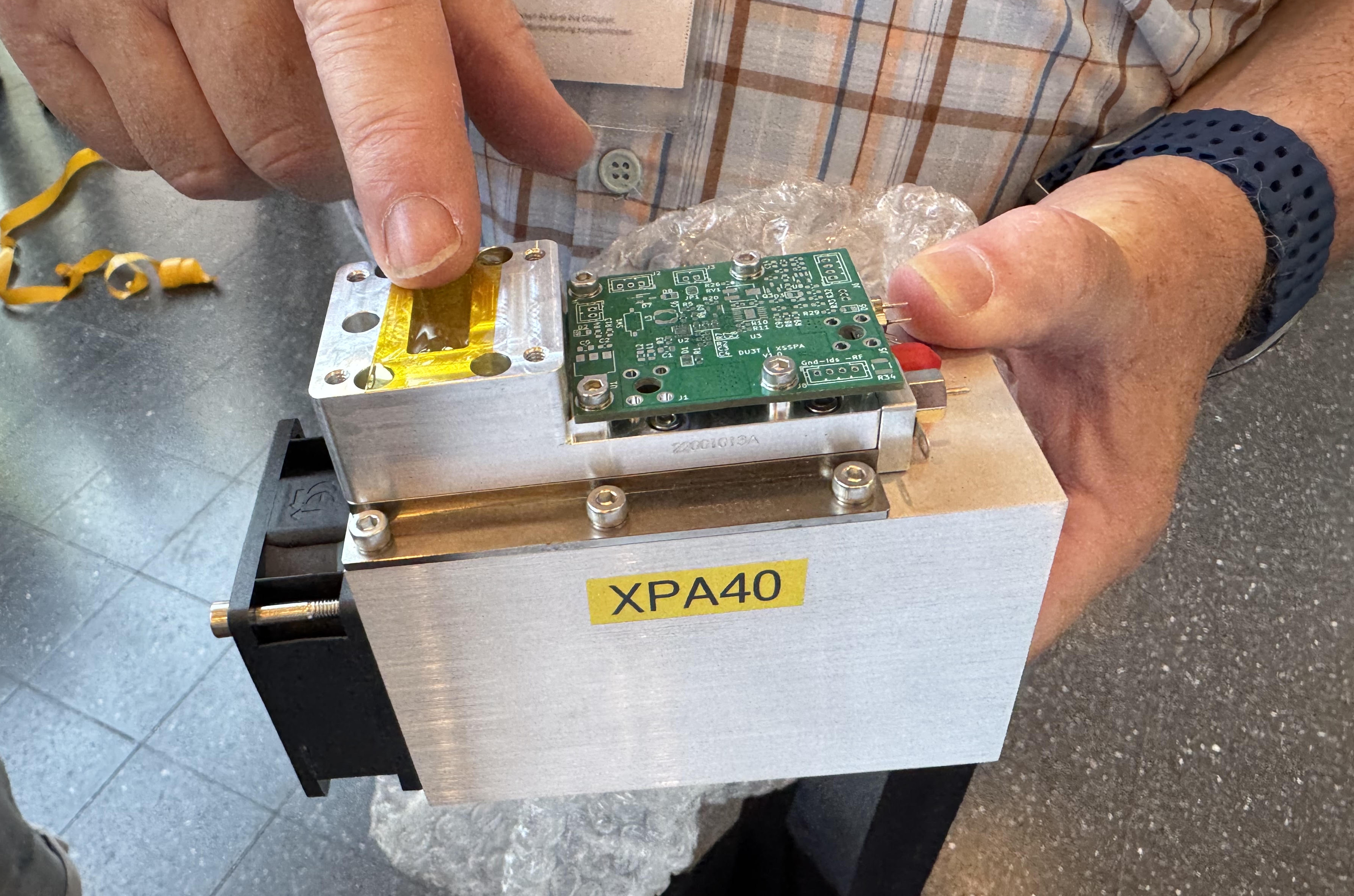 G4KLX Demo version of DU3T 40 W - 3 cm PA at HAM RADIO
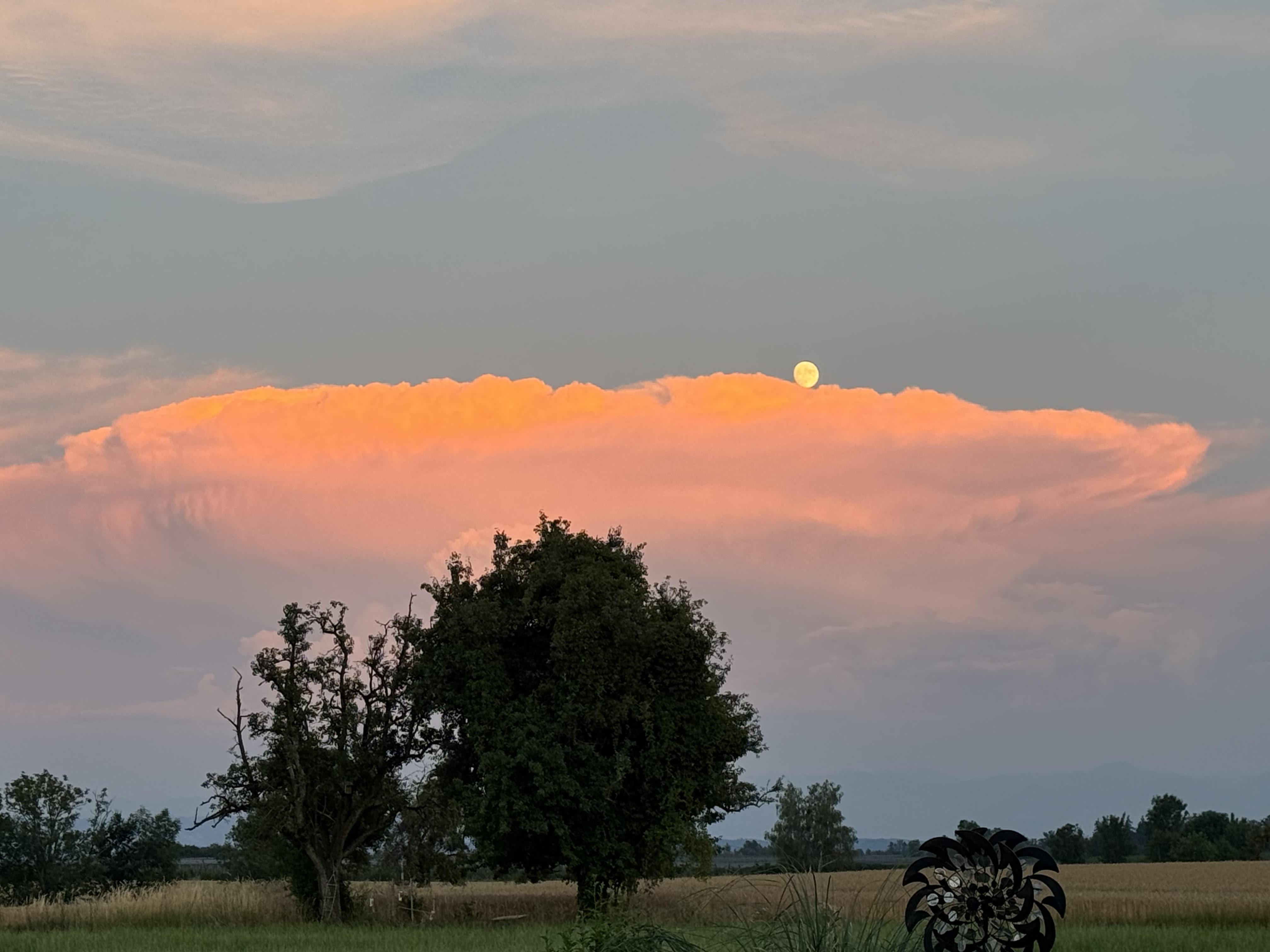 G4KLX Moon Rise Above Friedrichshafen
KB2SA Bill
Bill presented his new 23 cm "Superpatch" feed at the SIMULIA Americas User Conference in Novi, Michigan on May 14, 2026. Since then, Bill has completed hundreds of QSOs with a 1.5 m Cooker / Superpatch antenna. RX performance is about 1 dB better than the very best 23 cm cooker antennas using a square septum with 240 mm flare, S12 disk, fiberglass struts and 115 mm fence.
The compact Superpatch measures 168 x 168 x 55 mm with a 232 mm BFR. It's specifically optimized for the 1.5 m cooker dishes on 23 cm.
Bill is currently testing a much smaller 131 x 131 x 55 mm Superpatch without a BFR on a 1.0 m f/D = 0.35 dish. Preliminary results show RX performance within 3 dB of the 1.5 m Cooker / Superpatch antenna. This may be the most "invisible" antenna capable of 23 cm EME QSO with 1.5 m cooker dishes, 2.4 m folding dishes and larger yagis (e.g., OE3JPC with 2x56 el).
Superpatch details will be published in an upcoming DUBUS issue.
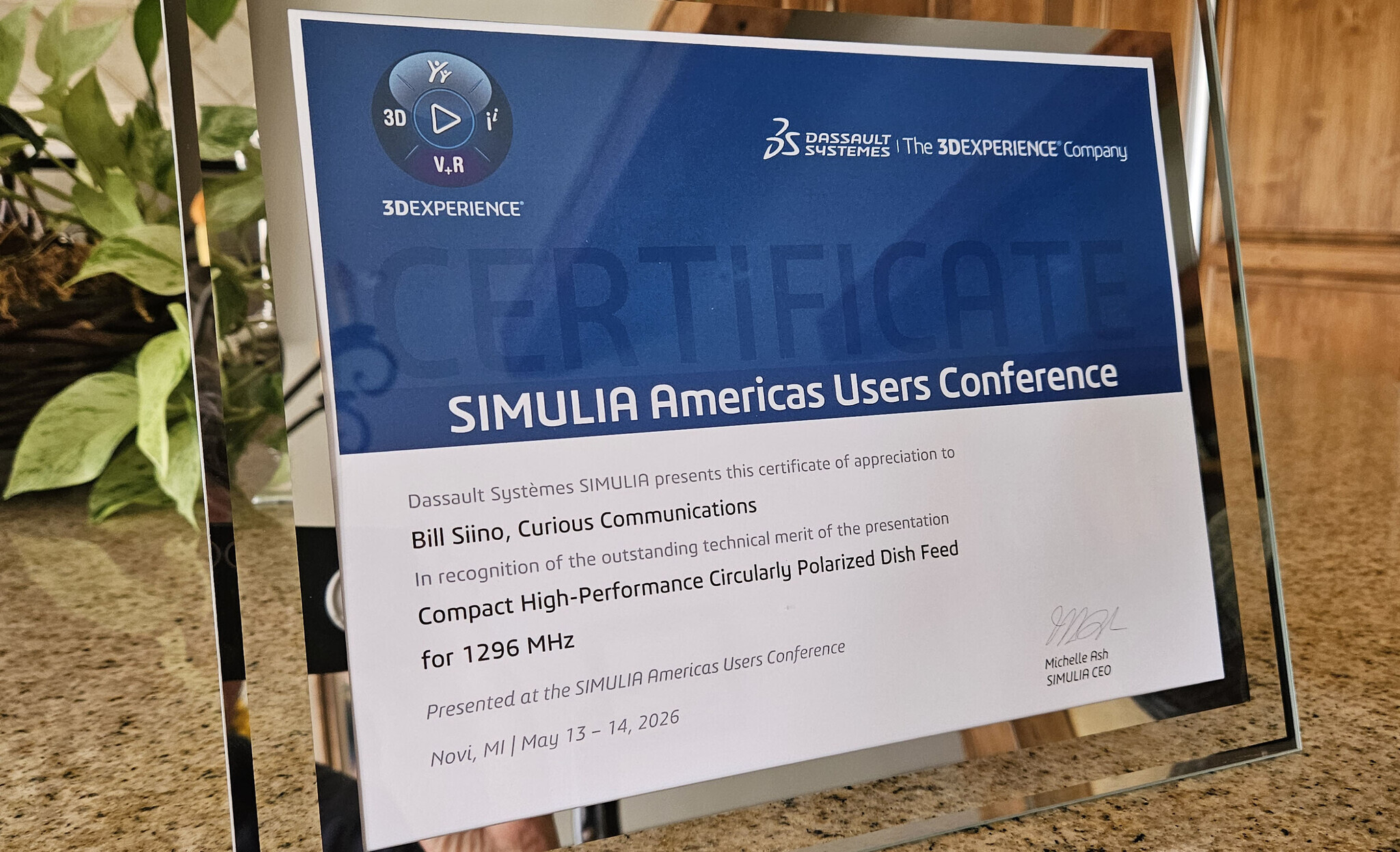 KB2SA Simulia Conferernce 1296 Feed Presentation
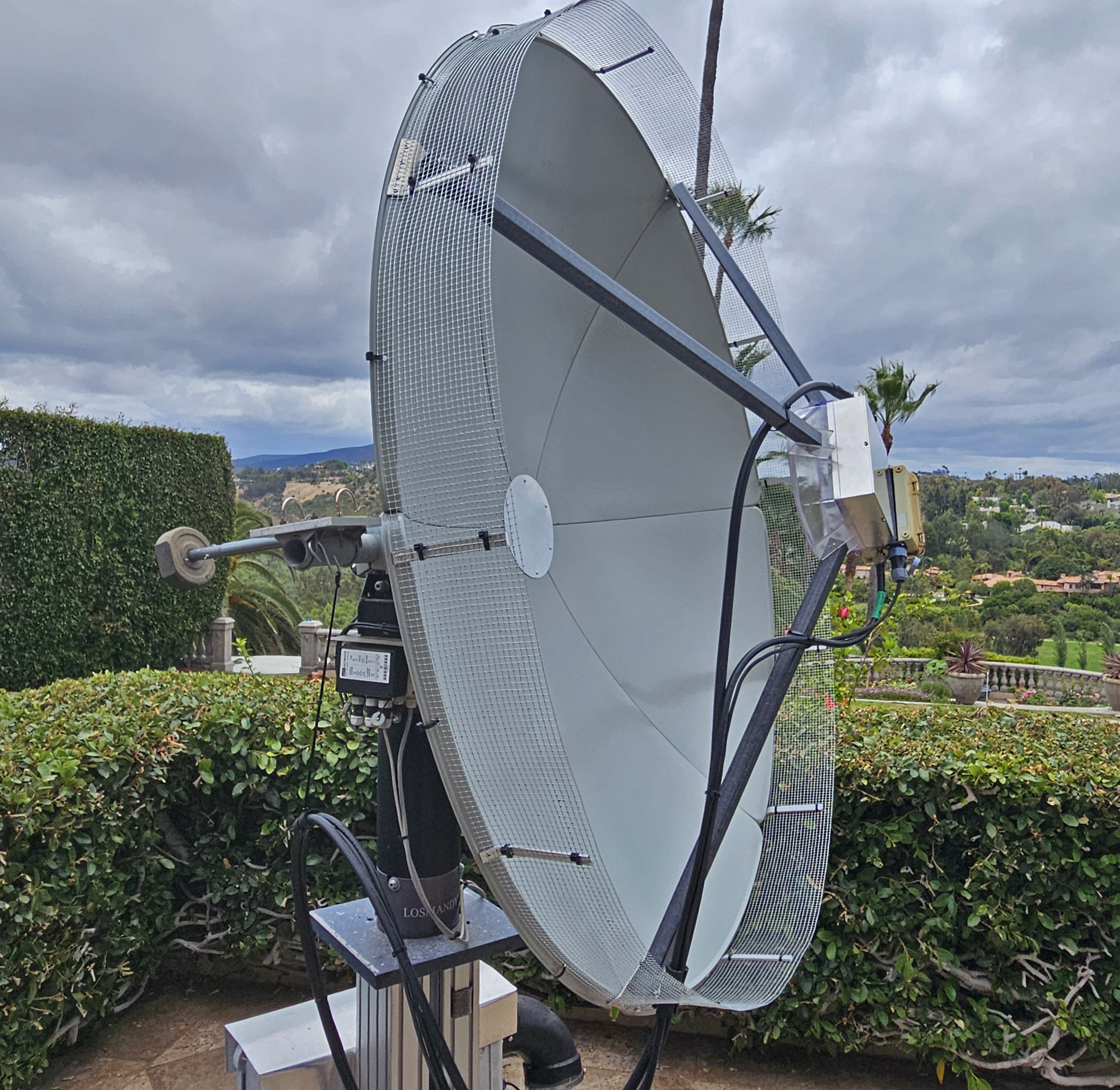 KB2SA Cooker Dish on 23 cm with Superpatch Feed
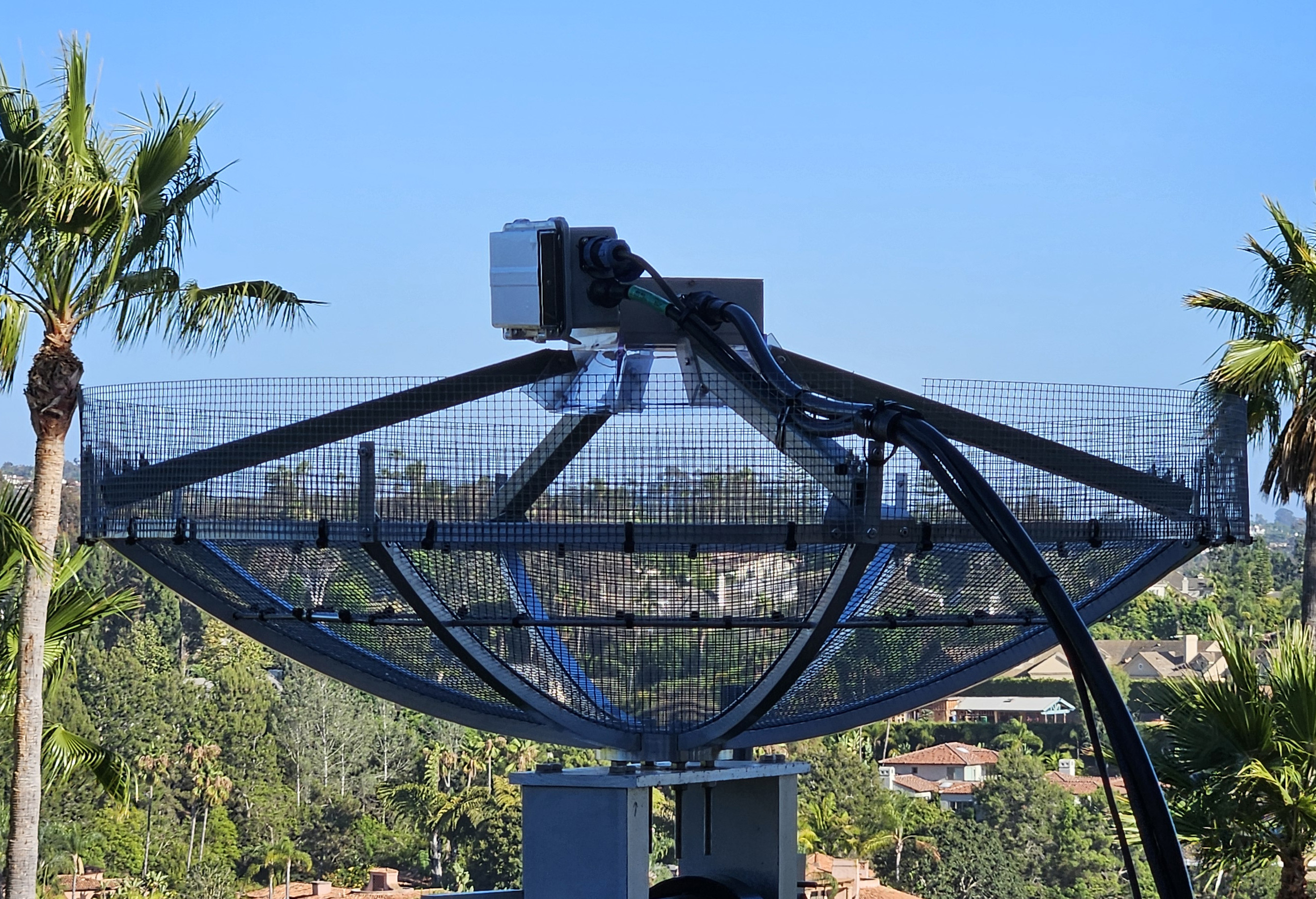 KB2SA 1 m Dish with Smaller Superpatch Feed
KN0WS Carl
I had other time commitments, but I decided on July 12 that I could set my alarm clock for 3:50 local and go out to my garage to do a minimalist setup for 9 cm EME with no MAP65 widescreen views. And since my computer has trouble doing CAT control, I would have to “fake” CFOM by setting my RIT to my self-Doppler and then transmitting at a frequency half the RIT below the nominal declared frequency. My IC-9700 radio allows a high enough RIT to do this on 9 cm, but not 3 cm.
I only had a 1.5 hour window to operate, but I was pleased to work 7 stations in that time, including 3 initials. The last time I had done 9 cm was in September 2022 and the last station I worked on 9 cm was K2UYH. Now using Q65C I worked G4CCH (13/12), W5LUA (11/15), VE6TA (16/19) and PA0BAT (8/18) and I had initials with DL4DTU (18/22), PA0PLY (16/16) and VE4MA (23/26). I’m glad I got out of bed to set up!
On another note, I am making a 33 cm feed and a W6PQL 33 cm amplifier for possible use this fall. I must be crazy to add a band when I so infrequently operate on my existing bands. I guess I just like to build stuff!
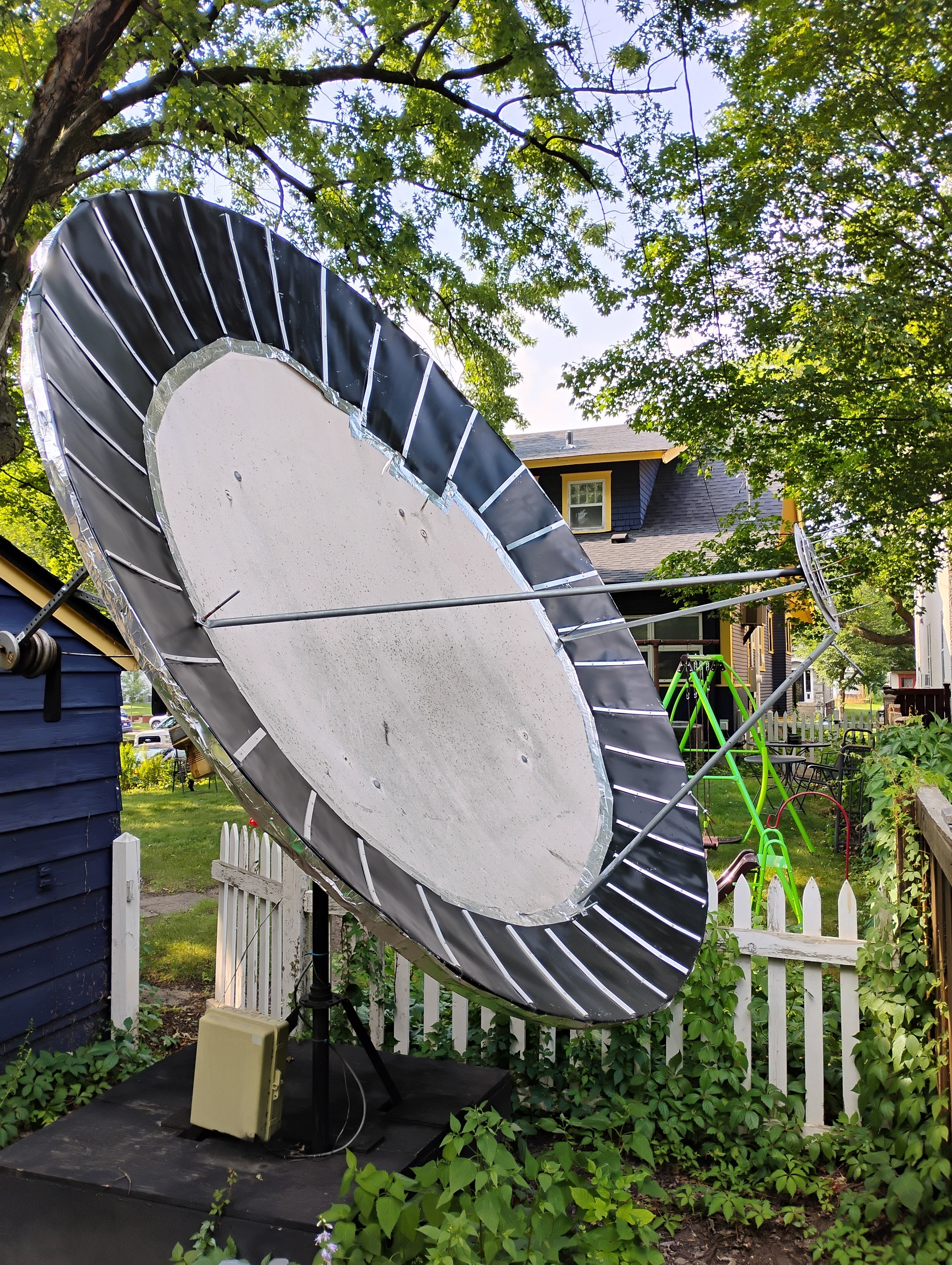 KN0WS 2.4 - 3.4 GHz Dish
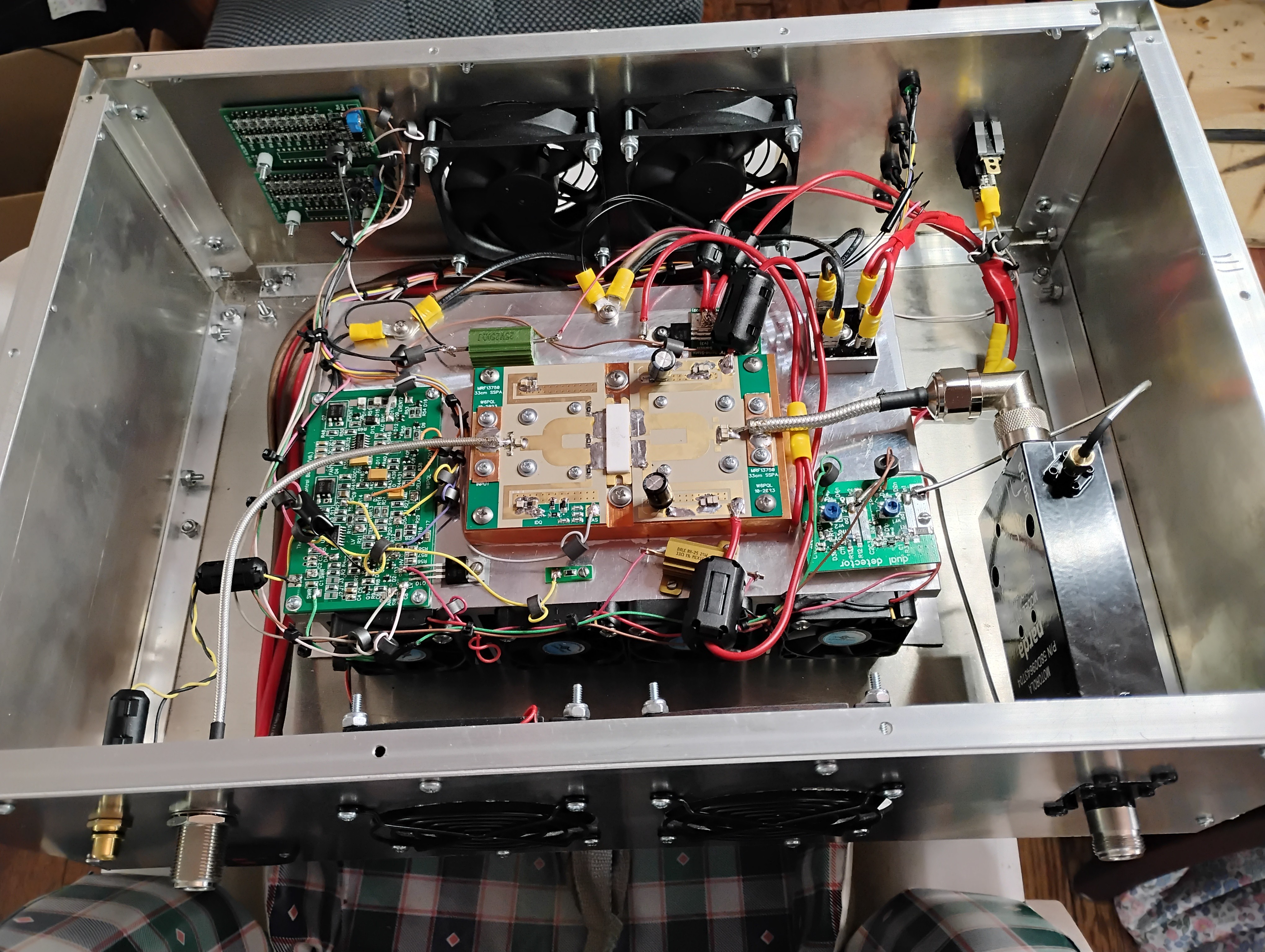 KN0WS 33 cm PA Under Construction
NC1I Frank
Activity wise I have very little to report this month, with only three QSOs on 23 cm, 11 QSOs on 70 cm, and only one initial, IZ1GRJ on 70 cm (-25/-20). Stefano was running 1 x 18-element Yagi and about 50 watts at the antenna. I did add three more QSOs with G3YEG on 70 cm.
With the help of W1QA and KA1QFE, my 70 cm RX is working again (although I still seem to have an occasional issue). Both relays up at the feed point were replaced and the preamp checked. It does not seem that the problem was with those components.
The issue may have been related to an automatic Windows update that changed sound settings in my PC. I am also suspicious that I may have an intermittent problem with my sequencer. We will look closer at that in the coming days or weeks.
OH3LWP Ari
I missed the 9 cm DUBUS - REF contest and 9 cm activity day due to traveling, so I have no 9 cm activity to report.
I did some first 24 GHz sun and moon Y-factor measurements with a simple dual mode feed.
The feed is made from 10/12 mm and 20/22 mm copper pipes with a 27 deg taper copper fitting turned in a lathe. My antenna is the same 4 m diameter dish I use on other bands but it is significantly under illuminated.
I am currently measuring 9 dB of sun to cold sky and 1 dB moon to cold sky Y-factor with SMA input tropo LNA.
New initials worked in the 23/6/2026 to 16/7/2026 time window are as follows:
23 cm: 12/07/2026 N8XS digital
13 cm: 09/07/2026 DG5NFF digital
3 cm: 15/07/2026 VK3ZAT, IW2BNA digital
OK1KIR Vlada & Tonda
On July 1 Dave VK0DS responded to our 70 cm sked request after he repaired his blown LNA. He kindly accepted the proposed early morning time and frosty WX, got up and reinstalled his 2x20 el V-pol Yagis on small tripod and dropped his 250 W SSPA just on the snow as it is a good PA cooler at tens of degrees below 0° C. However, at beginning Dave had aiming trouble with no visible moon due to snowing and he was receiving nothing.
So, we continued with Q65-60B calling repeatedly changing H and V pol and became concerned with the moon slowly approaching a big walnut tree on our horizon. Finally, Dave found the moon and our trace and we succeeded at 23:37 VK0DS -29/-19 (B-26 at the “73” final period). Thanks to Dave, it is for us the seventh continent on 70 cm, digi initial #387, mixed DXCC #140 and new MC Field. Actually, it was really quite tough with a degradation of 2.1 dB and the moon just above our southern horizon.
On the morning of Sat, July 11 during the 9 cm part of DUBUS-REF contest we preferred to join the 24 GHz activity of ZS6JON. Before John’s sked with JA1WQF we had a nice Q65-60E QSO with Mitsuo at 03:29 at great reports -11/-8 (B-7). Thanks to a predicted maximum spreading of only 40 Hz, the traces of tones looked like those on the 23 cm band. Unfortunately, we forgot to tick the record button, so we had nothing to play with later on. At the time of sked John and Mitsuo were unable to dig each other from noise, so John moved the effort to us.
Surprisingly, we completed Q65-60E QSO smoothly in full five sequences at 04:34 OK1KIR - ZS6JON -18/-14 (B-16/B-13). To enable a QSO we turned our polarization by ≈ -80 deg from John’s V-pol as predicted (see picture of our turned 24 GHz compartment). It is the 1st 24 GHz QSO OK-ZS and for us also digi initial #64, mixed DXCC #27, 5th continent on 24 GHz and new KG Field. So, we are really happy with that achievement. John used his 1.8 m offset dish and ≈23 W from a modified TWT with water cooling from PE1CKK (see previous NL). At the time we measured our moon noise at 2.1 dB.
Happy with our 24 GHz success we then reinstalled 9 cm to take part in the DUBUS-REF contest. We were surprised by the empty band, probably because of being QRV too early in the morning. However, later on band filled with stations and we made from 07:46 till 13:57 UT overall 16 easy CW QSOs exchanging nice reports with G3LTF, SP3XBO, OH2DG, OE9ERC, DL1SUZ, DB6NT, OH1LRY, PA0BAT, DL4DTU, G4CCH, VE4MA, PA3DZL, WA6PY, PA0PLY, VE6TA and W5LUA. We made no new 9 cm initials unfortunately.
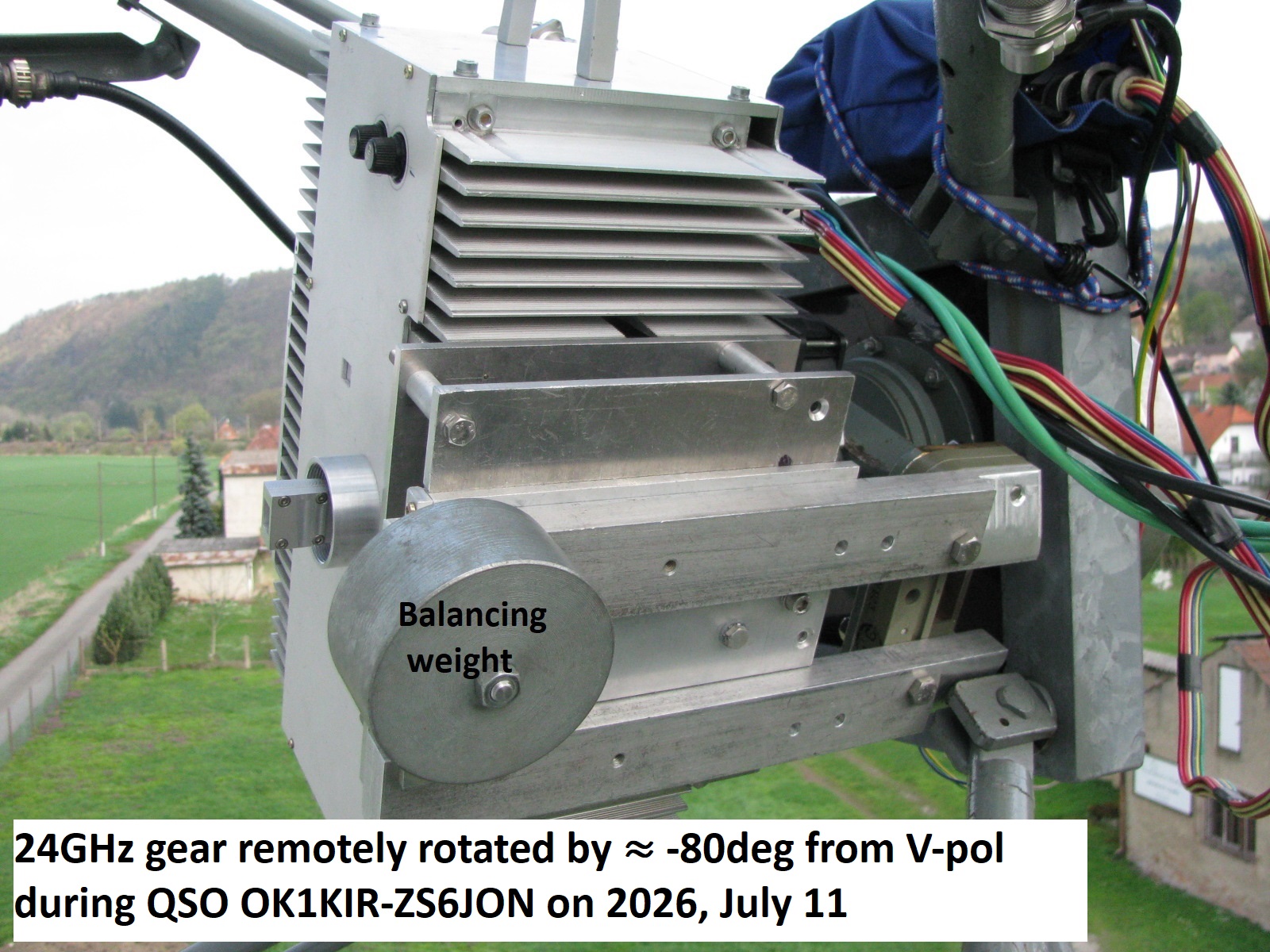 OK1KIR 24 GHz Rig Rotated by minus 80 deg from V-pol for ZS6JON
PA0PLY Jan
In preparing for the 12/13 July 9 cm weekend, I was faced with some serious interference. Lucky enough it was in a very specific direction which will not harm the EME activities. Another interference originating from a phone distribution tower should have been covered by the use of a new filter.
The filter is located after the G4DDK preamp, but still the interference breaks through. Further investigation is needed. I suspect the large out of band signals do affect the normal operation of the preamp and thus generate intermodulation products which appear in band. (Ed Note: The G4DDK preamp has 2 RF stages and the filter is needed after the first stage.)
As there were no stations expected from the east, I started joining the DUBUS contest quite late on Saturday. It was the first time I ran this contest without the support from a SDR receiver showing CW signals on the band. I made 8 CW random QSOs:
G3LTF, OH1LRY (#28), G4CCH, DB6NT, WA3RGQ (#29), OK1KIR, OE9ERC, and VE6TA (#30)
SP3XBO stopped half way in a QSO due to troubles at Marek’s end, I learned on Sunday. I heard but not worked: PA3DZL, OH2DG, and PA0BAT.
Murphy visited me again as I found that only half of the current was there for the SSPA, thus I had less than 50 W instead of 100 W.
The next day I had a sked with Charlie VK3NX, at moonrise here. Unfortunately the weather in Australia was not cooperating with wind gusts up to 90 km/hr. This happened on the Monday moon pass as well, thus we canceled the sked and are waiting for better weather conditions.
Sunday was full of Q65 signals. I worked the following stations: LZ4OC (#31), DL4DTU, DL1SUZ, SP3XBO (#32), VE4MA (#33), KN0WS (#34) and W5LUA. To complete this 9 cm event, I had an armchair CW QSO with Paul WA6PY for #35. Back in 2000 Paul, in Sweden as SM0PYP, helped me to learn CW procedures for EME.
PI9RD, with first OP Jan, PA3FXB, wanted to activate on 9 cm as well, but their RX failed for some reason. I heard them S5 in SSB off the moon, which confirmed that their TX and moon tracking were OK, but no RX. I will now investigate what is wrong.
And on 17 Jul 2026 I just worked Charlie VK3NX on 9 cm in CW. Reports: 519 / OOO. We really had a near touch. My ELE was only 15 degrees while Charlie just pickup my signal almost heading into his neighbour's trees. That happened only 1 minute after the QSO.
PA3DZL Jac
1296 MHz activity on July 12th
Almost all QSOs were made in Q65-30B with 30 second periods.
Worked KA6U, KC2HFQ, IQ2DB, N8XS #, K4VJ #, UA1ALD, R1NW, NY1V, W5AFY, HA5OLA, PA3BYV, SO5AZ, WIØJK #, NØFJP #, F1PDX, HG5BMU and KB2SA big signals from Bill using his 1 m dish, his best was -9. I was very pleased to QSO 4 initials, which brings my total initial to # 721.
3400 MHz activity on July 11th
I was only QRV for a short time (switched to 24 GHz)
Worked during the DUBUS-REF CW/SSB contest: DL4DTU, OH2DG, SP3XBO, OE9ERC very BIG Signal, G3LTF, OK1KIR, DB6NT, PAØPLY, WA6PY, OH1LRY, VE6TA and G4CCH. NO new stations this time.
24048 MHz activity on July 11th and 12th
On the 11th I had a test with ZS6JON and IW2BNA, QSOs were only partials. Differential polarity played an important role during my test with John, ZS6JON.
On the 12th we did try again and QSOs with Walter, IW2BNA and John, ZS6JON were completed in a very short time. There were excellent conditions and strong signals. So I am very happy with two initials, a new DXCC and continent of Africa on 24 GHz.
See the screenshot I received from John, ZS6JON on 24 GHz (sorry for the quality). In the same screenshot you can also see the QSO John made with JA1WQF and partial with JA8ERE.
(Ed Note: The screenshot from ZS6JON has been processed by Gemini to remove the Moiré effect.)
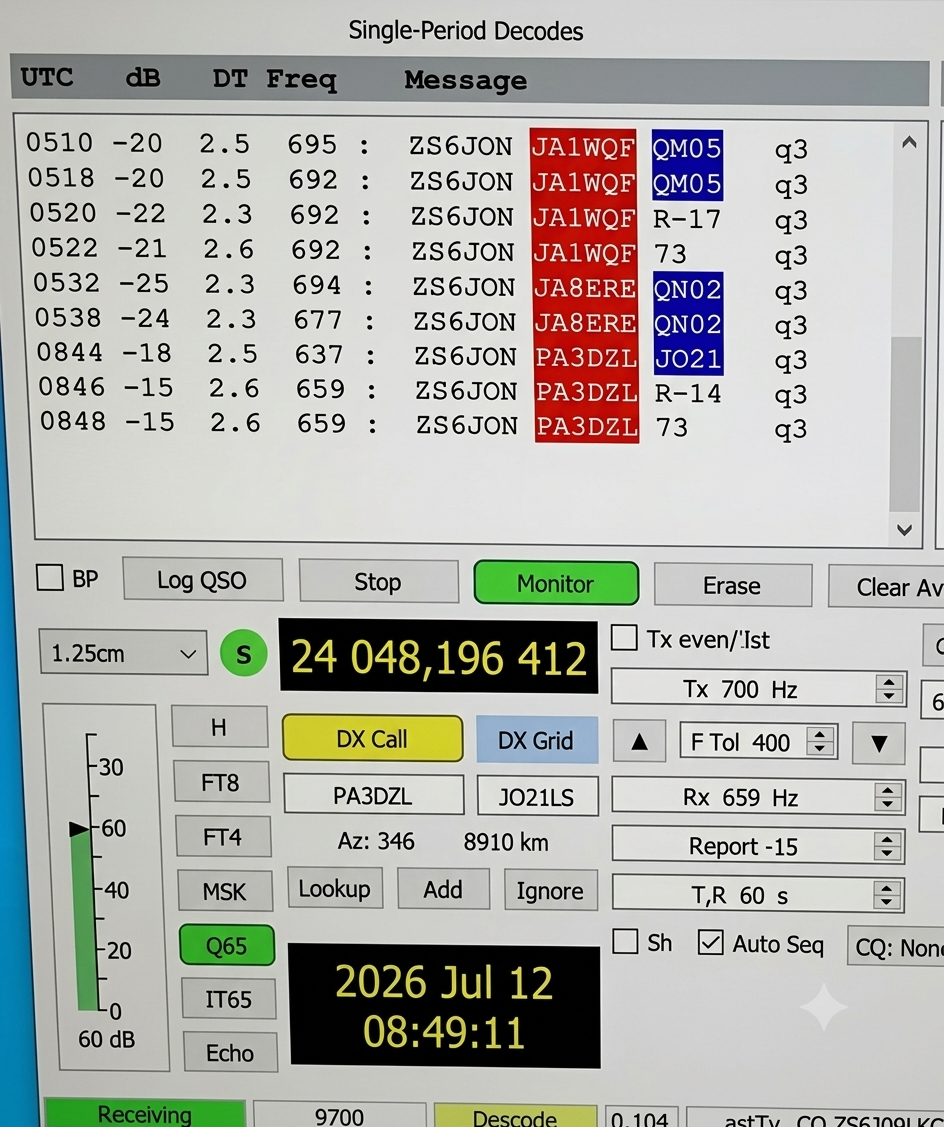 PA3DZL ZS6JON 24 GHz QSO Screen
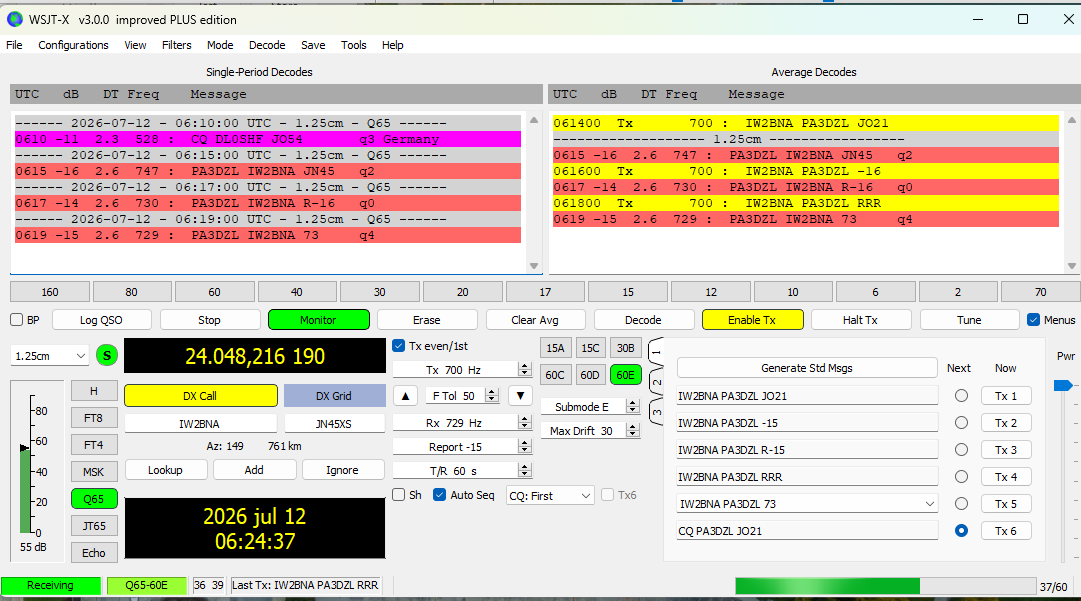 PA3DZL IW2BNA 24 GHz QSO Screen
VE4MA Barry
I have not been QRV on 9 cm for quite a long time and in preparation for the DUBUS-REF 9 cm contest I decided to make some necessary upgrades. Originally I used a 3 m prime focus dish for 3456 MHz with a scalar ring feed. This dish was polar mounted and manually tracked with electric motors. I moved to my 2.4 m offset dish and used a large 1.88 wavelength W2IMU feed coupled to the original screw polarizer launching section. Due to time constraints I did not retune the polarizer to 3400 MHz, but the dish worked very well and was computer controlled.
So now I decided to retune the screw polarizer. On 3456 I was able to achieve an axial ratio of 1.5 dB but on 3400 I could only achieve 3 dB. I did not check the probe return loss; it was 23 dB on 3456 but certainly not as good on 3400. With the time constraints there was no time to build a new feed, so I decided to go with it!
Of course here in Canada we do have many cell sites that are using the 3.45 GHz spectrum so I wanted to install a bandpass filter in the LNA system out at the feed. I retuned a surplus combline filter I had used for 3456 MHz and it still had a nice +/- 25 MHz response with steep skirts once retuned to 3400 MHz. I did not check the return loss so used a couple of ferrite isolators to keep everything “happy”.
Afterwards I did a sun noise check and it was a solid 12 dB which sounded good enough to me for a 2.4 m dish!
I had to replace a piece of 20 mm diameter heliax cable from the feedpoint to the back of the dish that managed to get kinked, perhaps in my attempt to go to a lower elevation for the Artemis flight.
For TX I am using two of the Toshiba PAs combined for 90 W in the shack with about 8 m of 20 mm heliax cable to the feedhorn.
On July 11th for the DUBUS –REF contest, I started at 0935 with OH1LRY 579/559 (15 -20 dB/ N), OK1KIR 569/559, G3LTF 579/559 (20dB/N), G4CCH 579/559, WA6PY 569/559 and PA0BAT 569/549 at 1311. I went QRT for a family commitment. Also heard were PA0PLY (I found his CW hard to copy), SP3XBO, DB6NT, DL4DTU, OE9ERC, and VE6TA as I was going QRT.
On the Activity day July 12, I started at 1045 with SP3XBO -16/-14, PA0PLY -12/-14, DL1SUZ-15/-19, G4CCH -11/-8, DL4DTU -11/-16, LZ4OC-20/-22, KN0WS -26/-23 (was -18 earlier), VE6TA -13/-14, W5LUA -7/-12, and PA0BAT-6/-12 at 1303.
I was amazed how narrow the signals were compared to the 10 & 24 GHz signals that I am used to. Howard G4CCH remarked at how clean my signal was compared to EU stations, due to the low libration between us.
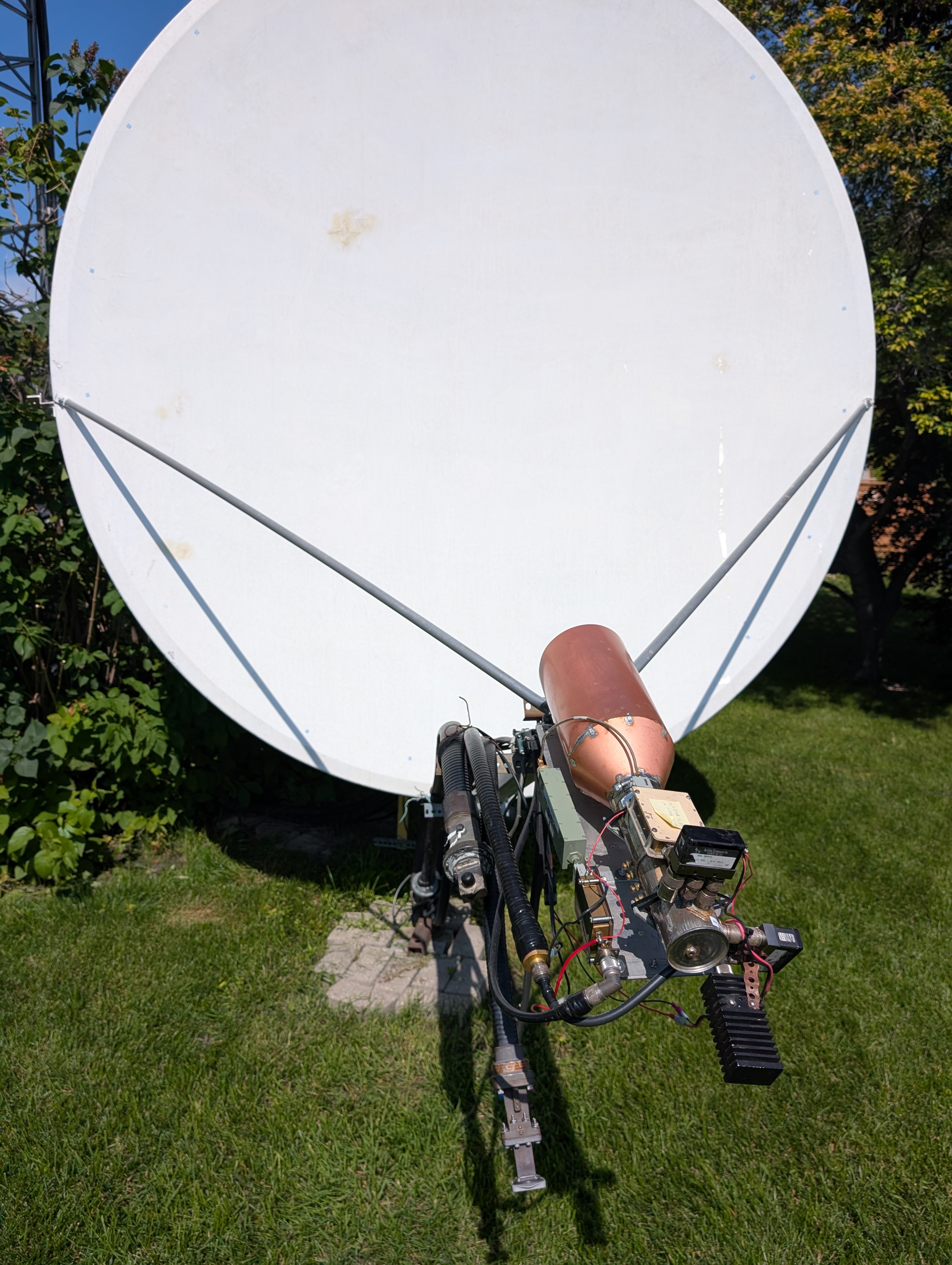 VE4MA 2.4 m Dish with 3.4 GHz Large W2IMU Feed
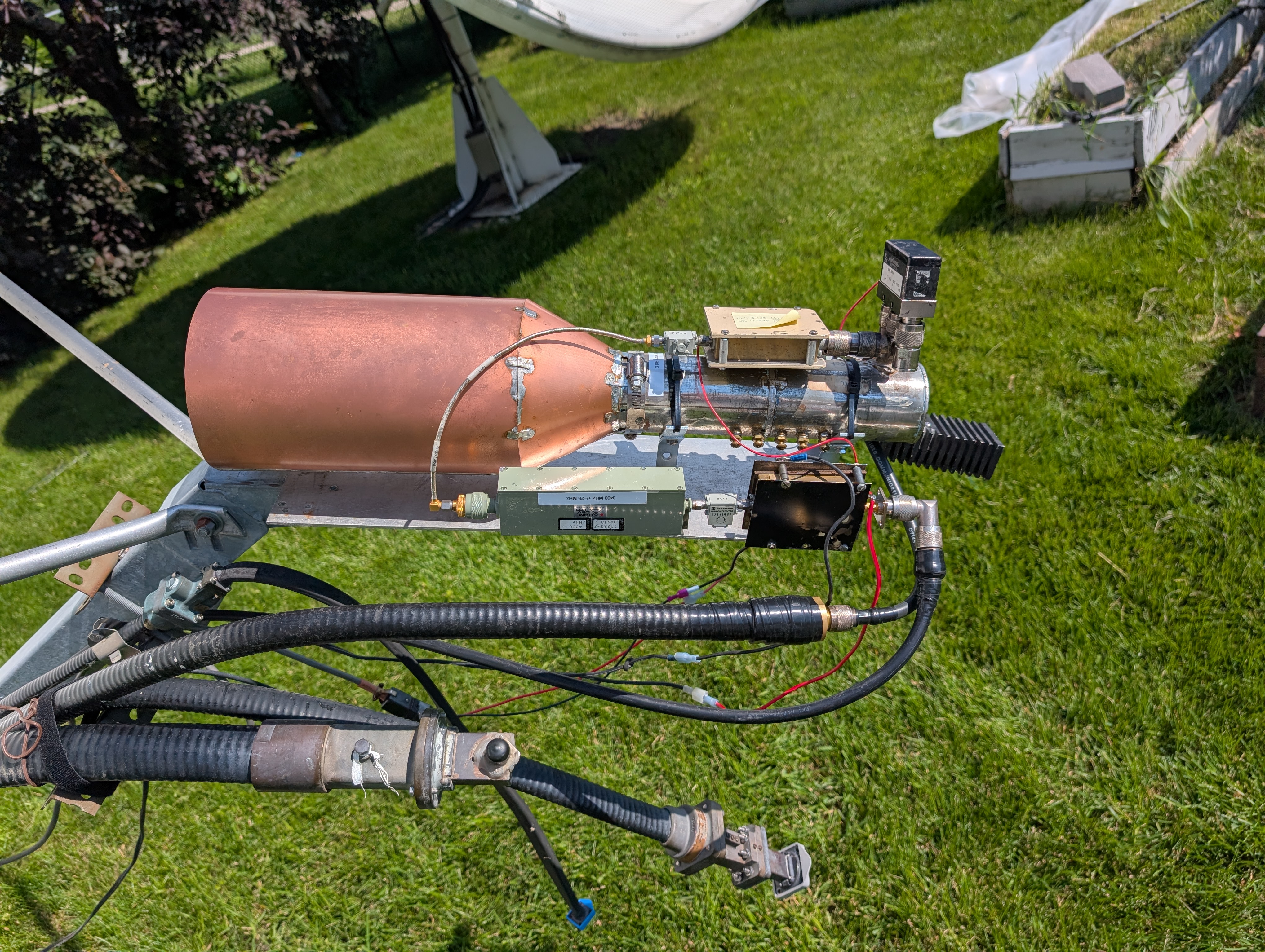 VE4MA Closeup of 3.4 GHz Feed Assembly
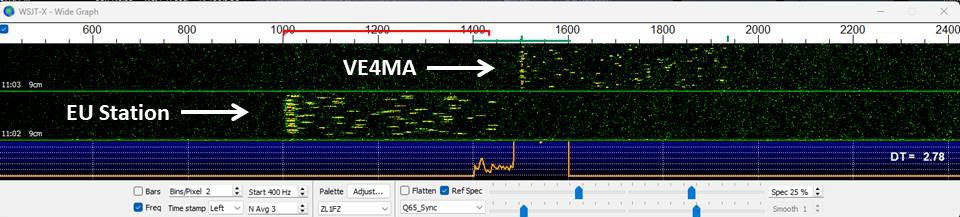 VE4MA 3.4 GHz Signal Spreading vs EU Station at G4CCH
VE6TA Grant
I worked N0AKC on June 21st for 222 initial #42 and State #35 in Minnesota. Thanks to Charlie for activating the new state and grid. My rig is a converted 8877 Henry amp, 5.5 meter HB dish, quad loop and plane reflector feed with polarization rotation.
I got on in the wee hours of the morning July 11th for the DUBUS-REF 9 cm CW pass. I heard some stations that disappeared quickly but I did manage to snag a few on CW. The weather was not cooperative either as a strong summer storm blew through just as my moon was getting good. Thank goodness for slewing drive holding power.
Stations worked on July 11th on CW were: OH1LRY, OK1KIR, G4CCH, PA3DZL, #PA0PLY, WA6PY, PA0BAT, #DL4DTU (Bert appeared to have some power supply problems perhaps as he was very strong but the tone of his CW was variable), #DB6NT, G3LTF, W5LUA. I also got on for the digital pass July 12th and worked the following; #DL1SUZ, VE4MA, #LZ4OC, #SP3XBO, KN0WS.
All stations were very strong with many 579 reports given on CW and PA0BAT with a -3 report on digital. 9 cm is a great band with little QRM in my area so it's always a pleasure to operate EME there. My rig on 9 cm is 70 W at feed, a W2IMU .55 round septum feed for CP, AGO preamp, and a HB 5.5 meter dish.
I think I will switch over to 1296 next and try to pick up a few dx-peditions that have announced operations.
Thanks for all the EME fun.
VK7ZBX Richard
Not much news from VK7.
On May 23 I worked for the 1st time Andrej S57NML for Initial #72 for me and a new DXCC. There were great signals -21/ -22.
On June 14 it was great to have a contact with Jim VK3ZAT on 3 cm EME. This was Jim’s 1st contact on 3 cm EME with his 1.2 M PF dish with 30 W. Signals were -21/-18 from my end. Jim has designed and built most of his gear including the transverter and tracking system. I hope this is the 1st of many more contacts for Jim. It was Initial #73 for me which when you think about it is amazing from my small station.
I am working on being QRV in the next week or so on 23 cm EME with a 2.4 M mesh dish, septum feed with 200 W. I am looking forward to racking up a few contacts and getting VK7 in some logs on that band.
See you all on the moon.
W5LUA Al
I participated in the 9 cm DUBUS contest in July. On Saturday July 11, I worked on CW PA0BAT, OH1LRY, OK1KIR, G3LTF, G4CCH, VE6TA, and PA0PLY.
On Sunday July 12 on 9 cm with Q65-60C, I worked DL1SUZ, LZ4OC, VE4MA, PA0PLY, and KN0WS.
My 24 GHz is now operational and I plan to be QRV. Open for skeds at
WA6PY Paul
I was QRV in 9 cm part of the DUBUS-REF contest and QSOed: DB6NT, DL4DTU, G3LTF, G4CCH, OE9ERC, OH1LRY, OH2DG, OK1KIR, PA0BAT, PA0PLY, PA3DZL, SP3XBO, VE4MA, and VE6TA.
I also operated on my western horizon. I was calling CQ on 3400.100 with switching to 3399.800 and 3398.100, but I had no luck QSOing any station. This year in the DUBUS-REF contest I was active on 7 bands.
I plan to be active in the ARRL EME contest on August 8/9. I will be on 24 GHz using a 3 m dish on both days. Depending on activity I will switch to 13 cm on Aug 8 and to 6 cm on Aug 9. For the lower bands I am using a 3.6 m mesh dish. I can quickly shift between 3 m and 3.6 m dishes.
I plan to be on 10 GHz for the ARRL EME contest on September 5 and 6 on both days and depending on activity may switch to the lower bands (13 or 9 or 6 cm).
WA9FWD John
Sorry to say, I have no good results to submit for the newsletter. Saturday was a frustrating day for me. I turned everything on and pointed at the moon and nothing was heard. I checked the sun noise at 10.5 dB, way down from the 13 to 14.8 dB I have seen over the years depending on the solar activity. The sun was right where the W2DRZ tracker said it should be, but I went back to the moon and ran outside to visually confirm and it was good. I next tried another preamp and had the same readings.
So I thought I would fire up my 8970B noise figure meter and check the transverter NF. Error E20 immediately showed up. I spent an hour trying to fix that by calibrating the IF attenuators to no avail. It appears that HP stopped giving out service info after the HP8970A. I have the A manual, but the B manual only has operating info and not block diagrams or schematics.
It has been very close to 100 degrees F (30 C) this week, but I decided to try swapping the cables and hooked the preamp output to my transmit feedline in case the 1/2-inch Superflex feed to the shack was lossy. No luck there, same 10.5 dB of sun noise.
I did check for echoes with 200 Watts at the feed with no results. My last thought is to check the feed location in the dish to see if it moved off of the focal point, but I don't know how that could happen.
I also notice that there is random junk on frequency that wasn't there the last time I was on. I have completely lost 5760 and 2304 and 3400 seem to be getting worse very quickly.
I have figured out a method of mounting my 6-foot dish on my 12 footer for 10 GHz. I am in the process of making all the parts, but I am hopeful that this might work.
WB6CWN Frank
I’m now QRV on 3 cm EME from DM15cq in the eastern Sierra Nevada mountains at Inyokern, California, with a small station built around a 1.2 m offset dish on a Coresun SVH3 dual axis slew drive. The RF head includes a GPS locked 3 cm transverter, 30 W PA, 0.73 dB NF LNA, and a Chaparral feed.
The motors are driven by a small USB controller and Windows based pointing/tracking software that I’ve written over the past few months. The antenna stays on both the moon and sun. I’m seeing about 9.5 dB sun noise and 0.5 dB moon noise on the GR1236 meter, and have been hearing the DL0SHF 10 GHz beacon consistently with –10 dB Q6560E decodes. Echo Mode tests show CW echoes down to –16 dB S/N, though not yet strong enough for data decodes.
This 1.2 m system is fully operational and ready for 10 GHz EME activity from California. I’m also interested in connecting with anyone else who’d developed a dual axis controller/tracker.
I’m looking forward to making contacts, meeting new friends, and joining the fun. See you on the air.
(WB6CWN worked VE4MA(-16/-16) , OE9ERC and PA0BAT on July 17 for his first 10 G EME QSOs)
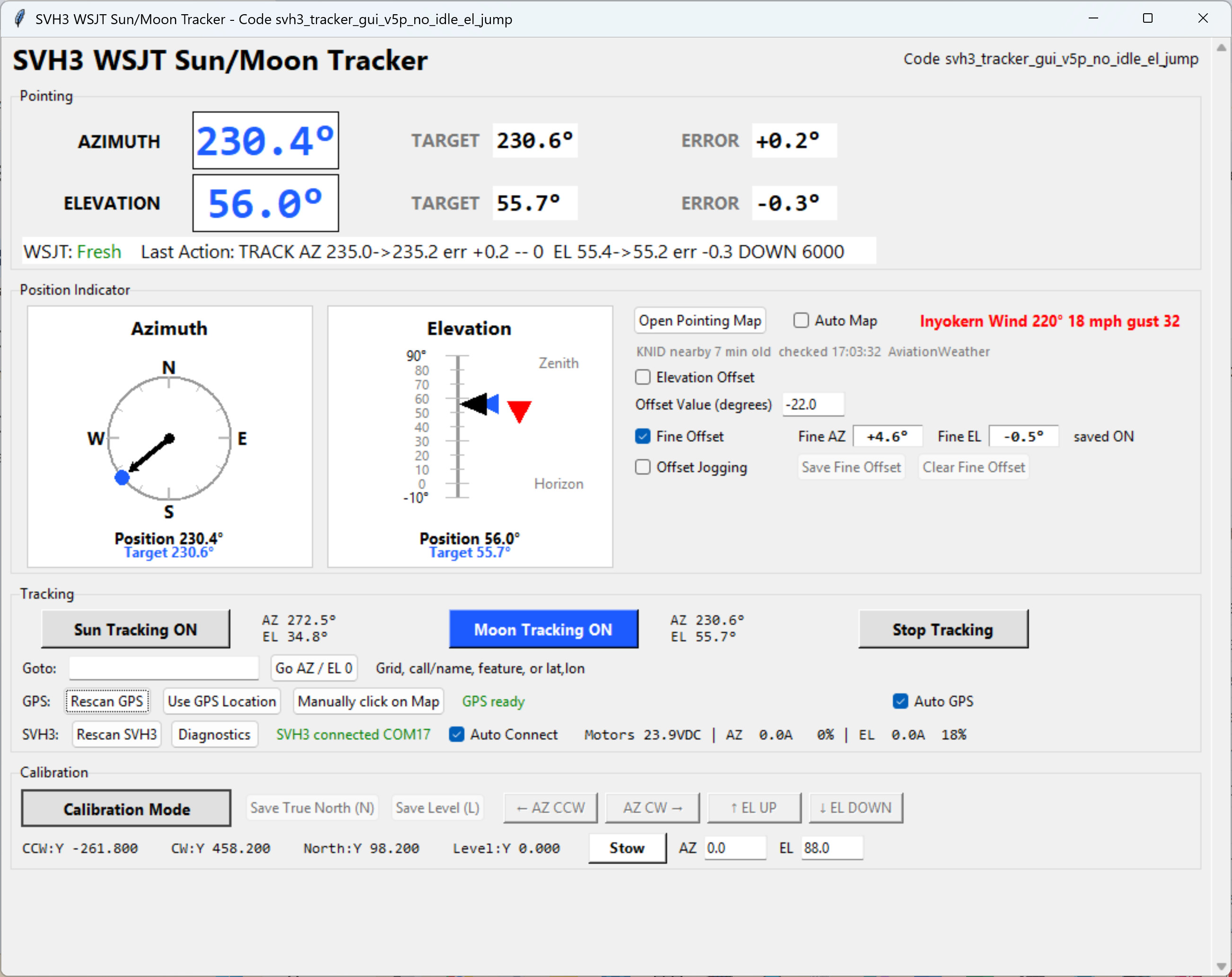 WB6CWN Tracking Program Display
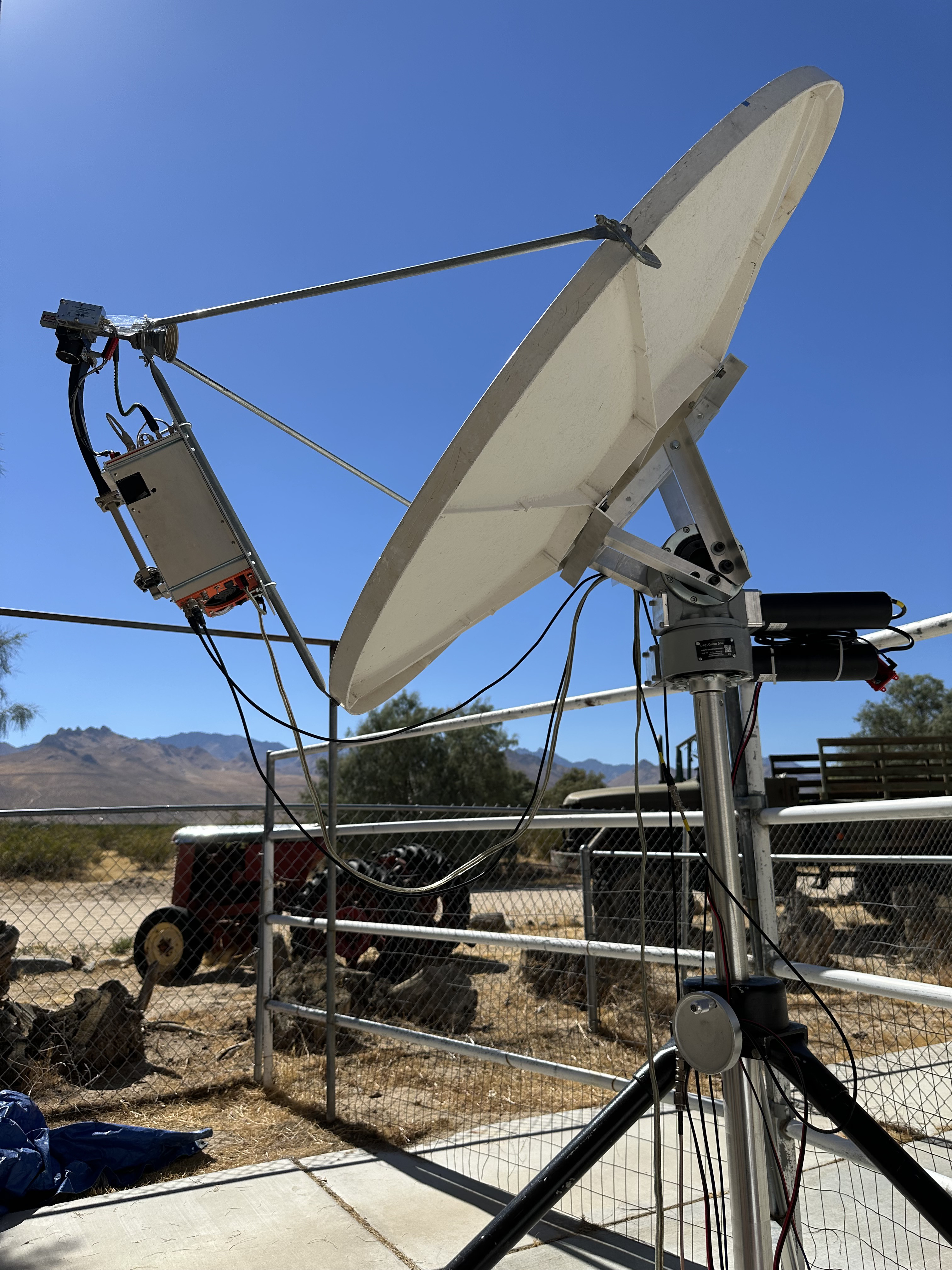 WB6CWN 1.2 m Dish for 3 cm
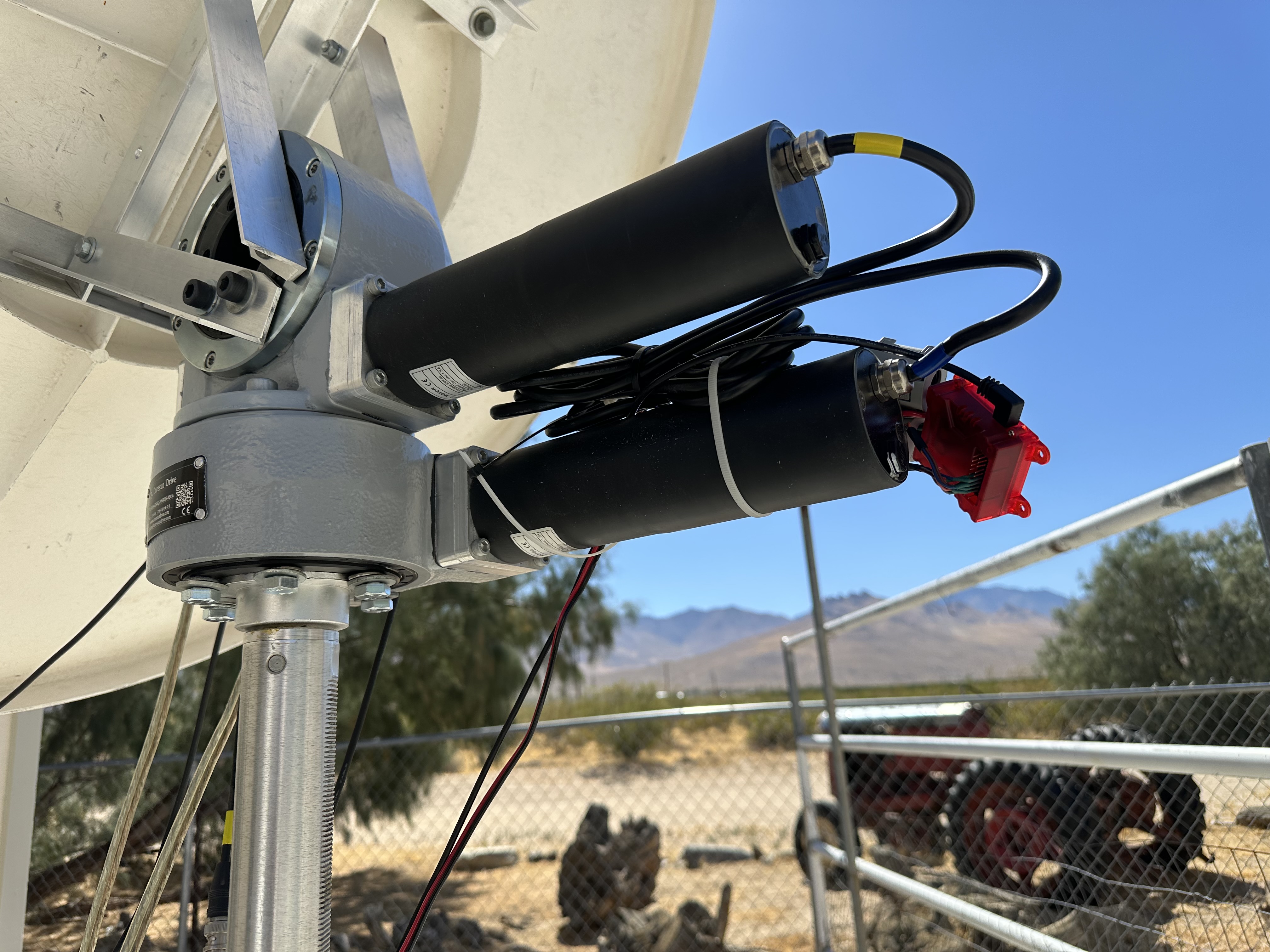 WB6CWN Slew Drive on Tripod
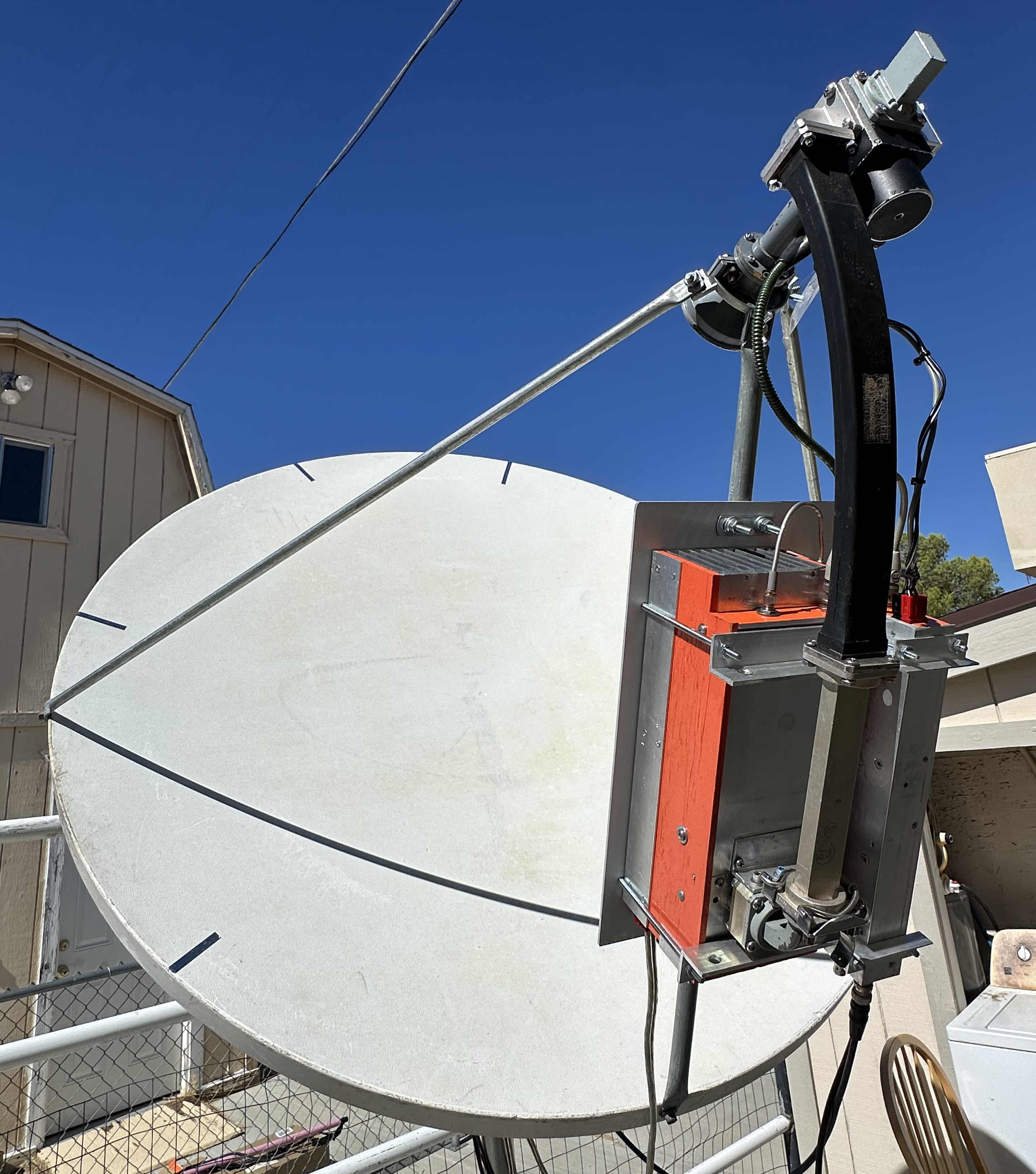 WB6CWN 3 cm system