
432 AND ABOVE EME NEWS
April 2026
Volume 55 Number 4
Editor: Barry VE4MA
Production Assistance: Peter G3LTF, Frank NC1I & Bob W1QA
News, Contests and DXpeditions
News
This past month has been really incredible for the 432 and Above EME community. We had extreme technical successes, several incredibly successful DXpeditions, 2 consecutive weekends with contests with great activity and terrific conditions. We even had VK0DS operating from Antarctica with a Bamboo 65 element Yagi on 1296 MHz (see G4CCH’s report). Please enjoy the reports and articles that capture just some of the excitement of the past month.
First Ever 76 GHz EME QSO
The first ever EME QSO at 76 GHz took place on April 22, 2026, between RW3BP (KO85) and DL7YC (JO62)! This completes an extraordinary effort by Sergei RW3BP over the past 20 years to develop the systems needed to make this possible. Of course it “Takes 2 to Tango” and Manfred DL7YC rose to accept the incredible challenge. There are many other technical contributors over the years to this effort. Please see the amazing and detailed report below.
2026 EME Conference
Things are moving ahead for the conference. The registration has closed. Several participants have not yet sent information about what they choose for the starter and main course for the Lunch on Friday 29/05/2026. The hotel needs this information a minimum of 1 week before the conference!
https://eme2026.moonbounce.info/Gastro.html
So please send it now if you haven't done so already!
24, 47 & 76 GHz EME Activity
I know that this past week there has been some 47 GHz & 76 GHz activity and that will increase as time goes on with better weather conditions. Zdenek OK1DFC has finally been able to use his 50 W 47 GHz PA to make his first QSO. Please see his report below.
Also June 13th is the 24 GHz CW/SSB contest (logger use allowed). With the spring weather starting to appear in many places I would expect the activity to increase even further as for many it is a fair weather activity.
23 cm Feedhorn / Dish work
There continues to be a lot of work being done by KB2SA and others to improve and reduce the size of feedhorns being used for 23 cm. Bill KB2SA has designed and is working to create a practical patch feed that will produce circular polarization without a hybrid or scalar ring and yet achieve “best in class” illumination efficiencies. Hopefully at some point this work will provide some practical solutions. This work combined with the emergence of the “Cooker” dishes has resulted in a tremendous increase in 23 cm activity.
Contests
DUBUS-REF
The 3 cm DUBUS-REF CW contest – K2UYH memorial will be on Saturday May 16th. The rules for the 2026 DUBUS-REF contest are on the website here.
3 cm All Mode Activity Day
There will be an informal 3 cm All Mode Activity day on Sunday May 17th as proposed by Jan PA0PLY.
3rd 23 cm EME SSB Appetiser Contest
There will be a 23 cm EME SSB Contest organized by DJ3JJ to be held on May 23/24. For contest details see: https://www.qrz.com/db/DJ3JJ
The smaller the stations the higher the points per QSO. It’s important to send the station class together with the report.
Categories are: Small, Medium & Large
A Report is for example: 55Lima etc.
That’s important for the point count. See the announcement at the end of the newsletter.
DXpeditions
EME Activation of Andorra – C3
ON7EQ Jean-Jacques and EA8DBM Alex are teaming up to be QRV in EME from the Principality of Andorra on 70 cm, 23 cm and 13 cm during the weekend of August 08-09, 2026, in collaboration with the ‘Unió de Radiaficionats Andorrans’. The Call sign is expected to be C37EME operating from locator JN02SK.
During the 2 moon transits, with favourable degradation, declination, and moon at its perigee, they will look out for DX to VK, JA, NA, SA, KH6 …
Confirmation of the plans are to follow, after which details will be announced … but you can already circle in pencil these dates into the agenda!
For your information, the last known EME activity from C3 on 70 cm was in 2009, and on 23 cm in 2005.
EME Activation of Bolivia - CP7DX
It will be held from May 26 to June 6 and will have both 2 m and 432 EME stations operating from Grid FG78pl in Bolivia. See the announcement at the end of the newletter and on https://www.mmmonvhf.de/latest.php
Articles and Announcements
Don't miss the articles and announcements that follow this month's station reports.
9J2EME
Bernie ZS4TX + John ZS6JON + Lins PA3CMC
In November 2025 we received our license for Zambia, 9J2EME. We planned an EME expedition from 27-31 March 2026. Activation was planned on 4 bands: 6 m, 2 m, 70 cm and 23 cm.
Bernie ZS4TX traveled for 2 days by car up to Zambia. Bernie transported all the towers and equipment for 6 m, 2 m and 70 cm. John ZS6JON and Lins PA3CMC would fly into Zambia.
We would all meet at the Blesco Lodge in Kazungula, KH22pf.
For 70 cm we used Bernie’s proven system used on many expeditions, 2 x 28el m2 antennas, rotatable on the boom to change the polarity, IC9700.
Lins PA3CMC took care of the portable station for 23 cm. The 23 cm had to be built from scratch. That was a much bigger job then he thought. On 23 cm we would be on the moon on Friday 27 March, Bernie would arrive on Saturday 28 March. Lins had to take the complete 23 cm station with him on the airplane. It had to be as light as possible. Flying to South Africa and Zambia, the station had to fit into a golf bag and suitcase, with a maximum of 23 kg each. That was an enormous challenge.
The 23 cm antenna was a 70 el YU1CF; 6 m boom Yagi with 21 dBd. As it was too heavy to fly with, some modifications brought the weight down from 6.7 kg to 5 kg. Lins built a light weight tripod including glass fiber pipes, there were no rotators and we used all manual tracking.
To keep the losses as low as possible the pre amp and coax relay were mounted just after the director. We had less than 1 m of RG142 coax to the pre amp. Just below the antenna on the vertical pipe the 23 cm amplifier and second coax relay was mounted. The power supply was at the foot of the tripod. We had to use 15 m LMR400 to the shack with losses of 2.4 dB.
The weekend before the DXpedition the 23 cm station was ready and tested. That was very succesful and a working station could be packed ready to go.
After arrival on Friday 27 March at 14.00 hour at the Blesco Lodge, John and Lins started building up the 23 cm Station in the Zambian 30+ deg heat. Just before moon rise all was ready to start. We where happy when the first signals appeared on the screen. The first QSO was made with Jac PA3DZL, 78 more would follow in next moon passes. With this small station we where very happy with the results.
On Saturday 28 March we built up 3 more stations. We were ready at moonrise with 2 m and 70 cm. On 70 cm the first QSO was made with Jac PA3DZL, and 45 more would follow in next moon passes.
Thanks to all for worked and we look forward to seeing you on the next one.
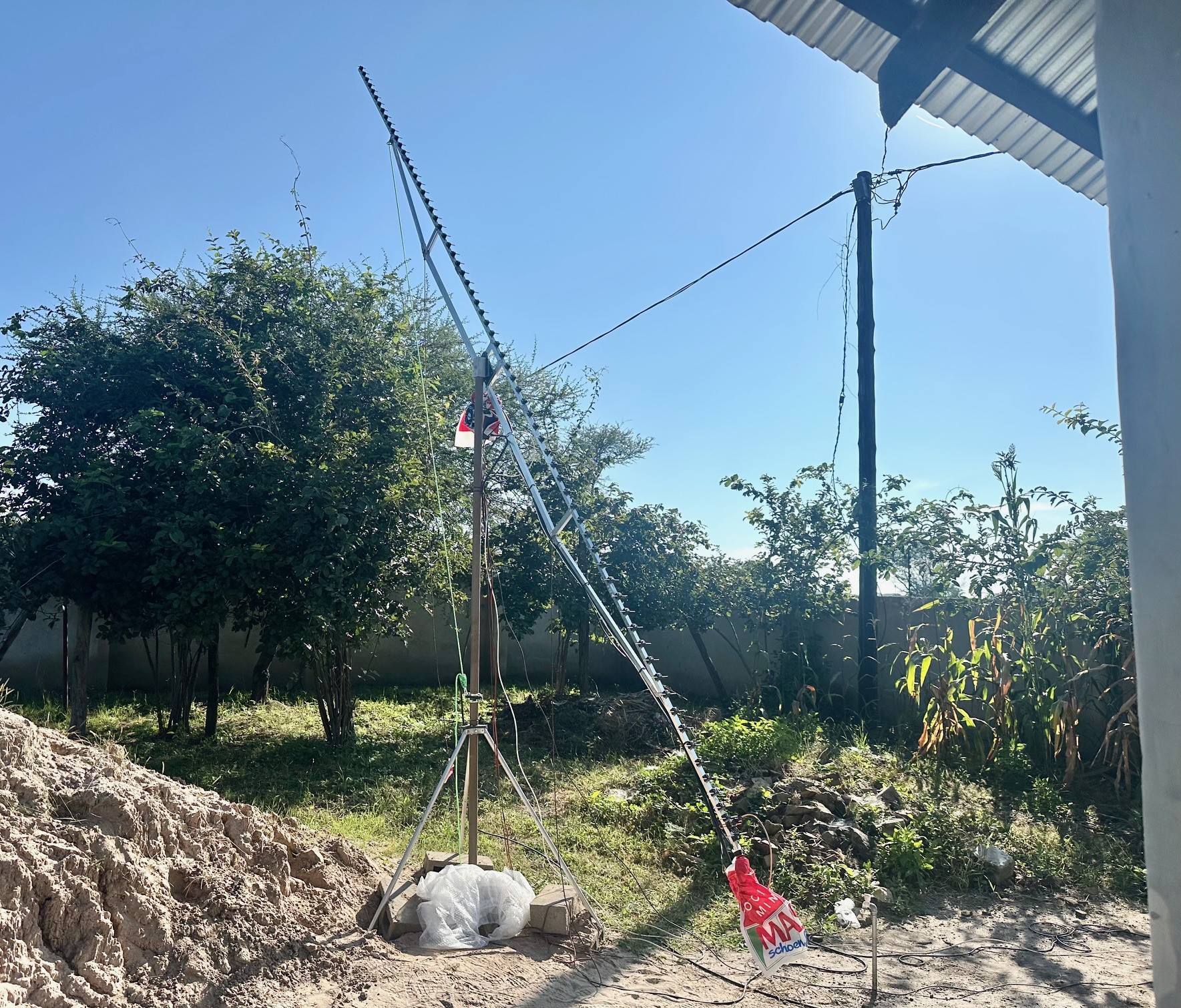 9J2EME 23 cm antenna
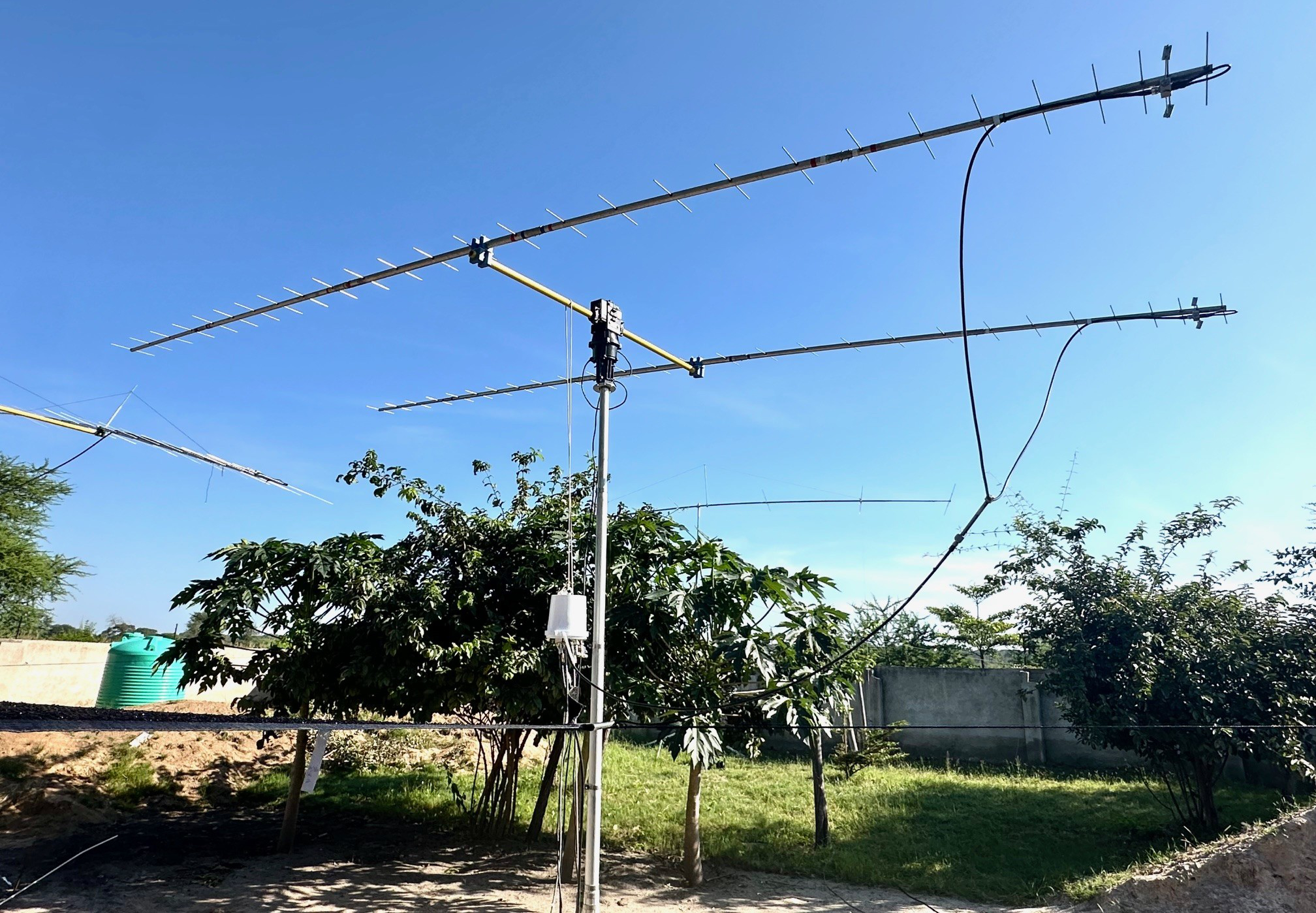 9J2EME 70 cm antenna
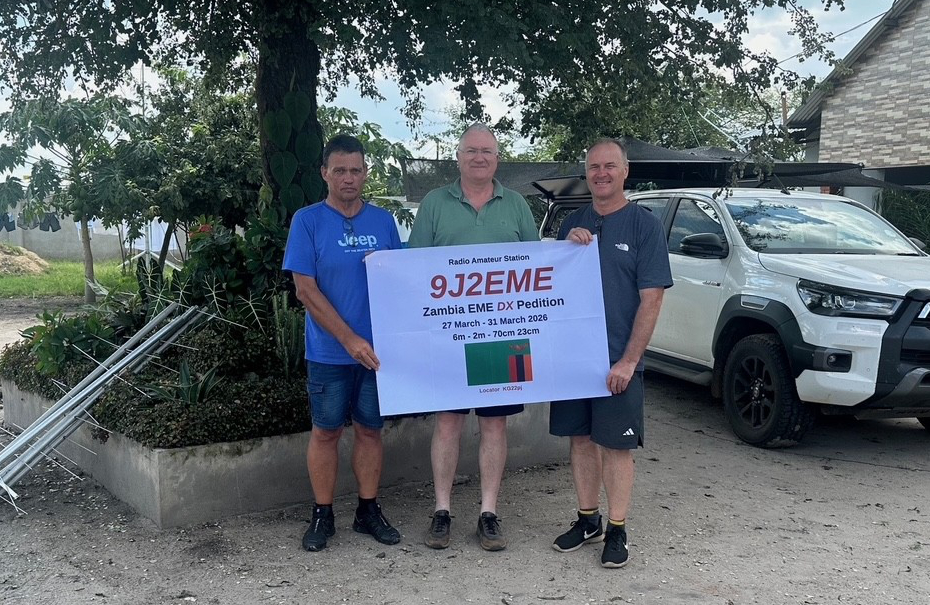 9J2EME group
Bernie ZS4TX, Lins PA3CMC, John ZS6JON
BA7NQ Terry
My EME host is the BA7LOK club station, and I have one 4.5 m mesh dish and one 2.4 m solid dish there. The 4.5 m mesh dish is now for 23 cm only, and the 2.4 m solid dish can work on 13 cm / 9 cm / 6 cm / 3 cm by changing the feed boxes. I always remotely operate the EME system. I have had the 9 cm feed box on the dish recently, but will replace it with 13 cm or 3 cm in early May.
I worked PA3DZL S-10/R-11, VE6TA S-15/R-12, and OE5VRL S-25/R-21 in April. The current 9 cm system is a 2.4 m solid TVRO dish, SG-Labs transverter, 100 W SSPA from DU3T, and a homemade LNA.
I want to thank Jan PA0PLY for his support and some ideas on how to build the system. Please see the pictures of my 9 cm QSO with PA3DZL and of my 2.4 m dish.
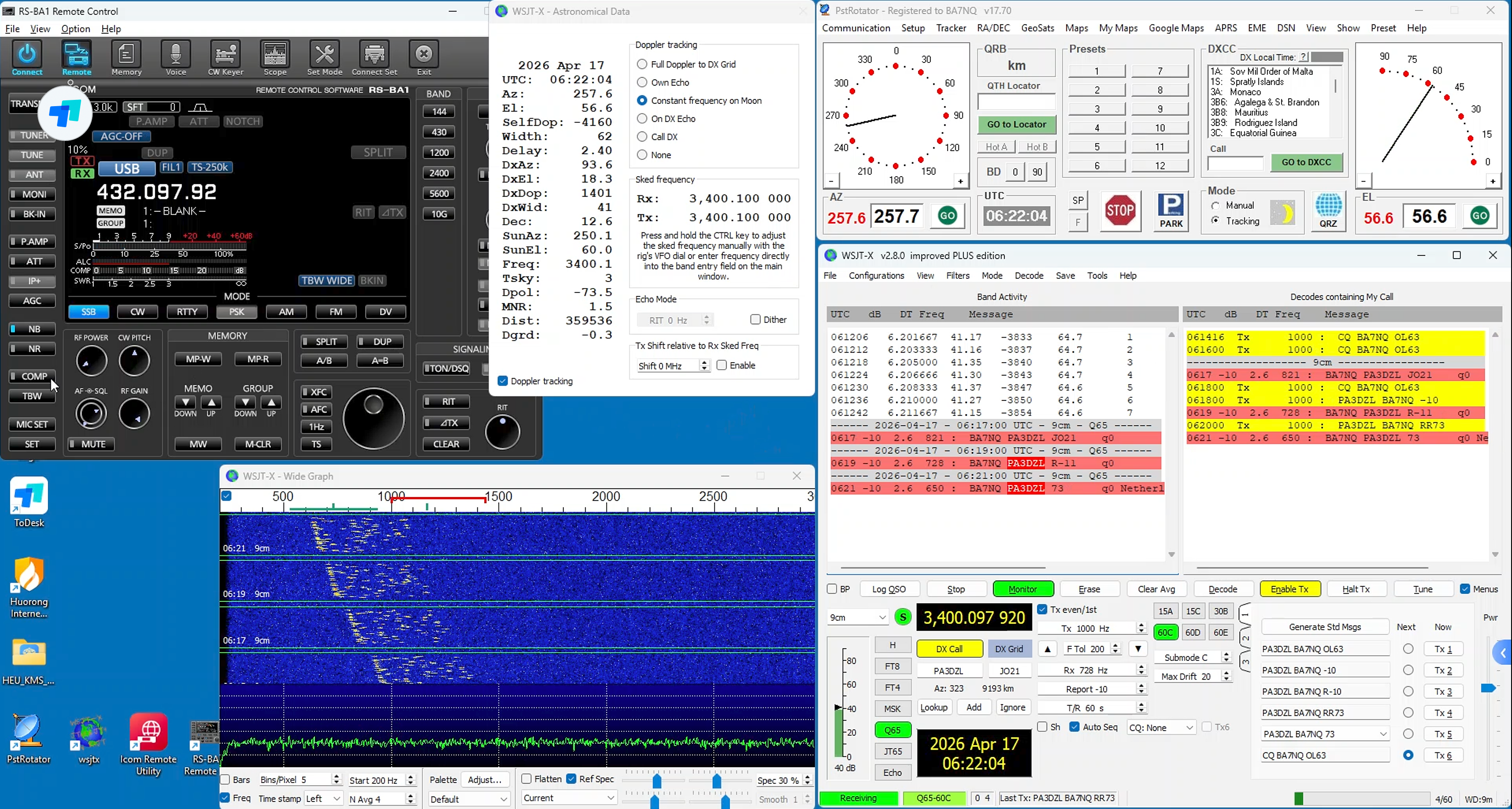 BA7NQ PA3DZL 9 cm QSO
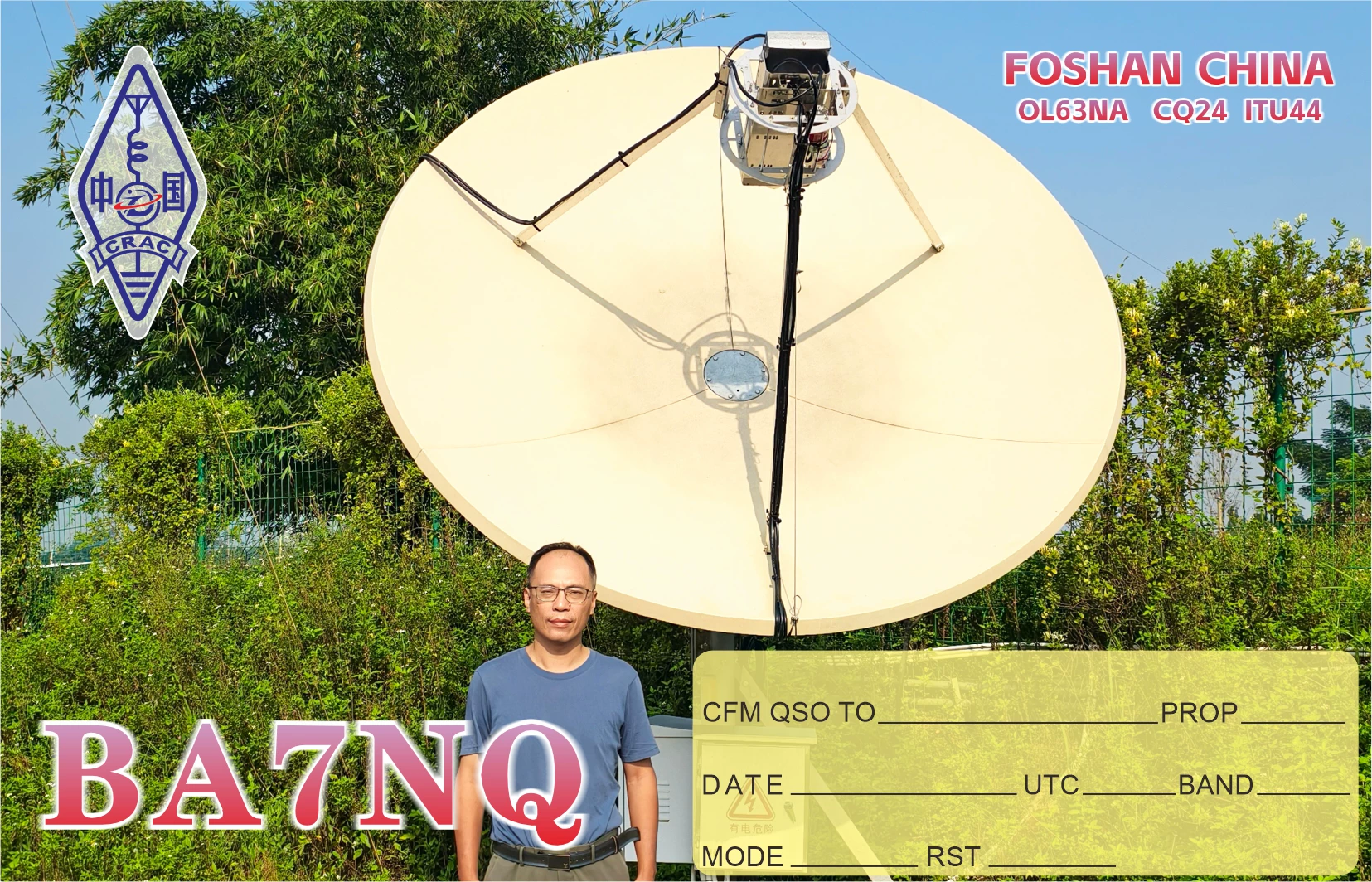 BA7NQ 2.4 m EME Dish
F2CT Guy
This weekend (April 17/18) I was only on 3 cm.
I worked John ZS6JON completing my 3 cm WAC and a new one UT4UWR, our Ukrainian friend from Kiev!
I am now working hard to put my 4 m Cassegrain dish again on 6 and 1.25 cm and hope to work everyone during the ARI contest.
G3LTF Peter
On March 23rd I put the 13 cm system in the dish to look for T7, while waiting I worked OK1DFC and PA7JB and then T7/IW2BNA #169 and DXCC #51 with excellent signals. All contacts are CW; I then changed to 23 cm in the hope of working them there as well and worked OZ9AAR with a big signal, on SSB as well as CW. Next day, the 24th, I did indeed work T7/IW2BNA on 23 cm #575 and DXCC #91. It’s beginning to look like I might get to my DXCC after all!
Walter and team have done an amazing job; there have not been many 5 band dx-peditions in my memory. Unfortunately I was not able to be QRV for the 23 cm Funtest this year. We drove up to GM to see Margaret’s second great-grandson!
On 18th April I was delighted to be able to participate in the 23 cm VK3UM memorial contest and even more pleased that my first QSO was with Chris VK5MC with a big 589 signal, followed by SP9VFD, UA3PTW, SM3BYA, RW6HM, SP3XBO, SV3AAF, DJ3JJ, OK2DL, PA3DZL, OM6AA, OH3LWP, G4CCH, ON5GS, OH1LRY, SA6BUN, OK2PE, CT1FFU, G4RGK, SP6ITF, RX3DR, SP6JLW, WB8HRW, AA4MD, OK1KKD, ON4BCB, IK3MAC, NQ7B, UA9FAD, OK1DFC, G0LBK, IK2FAK, WA6PY, VE6TA, F5KUG, KL6M, IK7EZN, and WA9FWD.
On 19th I continued with F6ETI, JH5LUZ, IK1FJI, PI9RD, F6KRK, OZ9AAR, PE1LWT, UA3XCR # 576, OK1USW, SM2CEW, SP6GWN, K0PRT, NC1I, and I5YDI. Total of 53, last year it was 56. Getaways were PA2DW, PA0PLY and VE4SA.
At times, Saturday afternoon, my SDR screen was full of signals from 010 to 048, probably 20 QSOs going on. Sun noise / quiet sky on 20th was 21 dB with SF 110.
In the ARI contest, 25/26th April, on 23 cm CW, I worked IK1FJI, OK2PE, UA9FAD, I2FAK, SP6ITF,OK1KIR, F6ETI, IK2DDR, OM4XA, DF3RU, G4CCH, IZ8GGF,ON5GS, K5VLS, R1NW #577, DL4DTU, UA3PTW, OH3LWP, PA2DW, PE1LWT, and DL4DTU (repeat), total of 20 QSOs. I heard DJ3JJ. I missed the peak NA window but I don’t think there was a lot of CW activity from there compared to Europe.
G3YEG Nic
It was an interesting and productive time over the past month. As EU-EU conditions have continued to be poor for most of this year I have been using vertical polarization with the 9 ele for a change. This has resulted in new station decodes from G4RGK at -23 dB (First G station), OK1IN at -26 dB (tried to decode many times before without success), UX5UL at -23 dB, UT6UG at -22 dB plus W5ZN again but at a much better level of -23 dB. I also added RY4C at -26 dB when using the 9 ele horizontal.
I have also noticed that when using vertical polarization I have seen many more partial decodes including a string from Henry DF6LH before getting a full decode, plus only a partial decode from Frank NC1I at -22 dB which is very unusual. Up until now, I have only ever seen a very small number of partial decodes and wondered if anyone else has noticed this?
Frank NC1I has again been trying to decode me at very low power levels and has managed to receive a string of more than 12 good DTs in a row when I was running around 8 W at the feed of the 9 ele when trying vertical polarization. Frank saw two very good traces and was expecting decodes around -28 dB but nothing came of it. So far there seems very little difference in performance between the two polarities of the antenna in the roof space. What we have observed is that when Frank is using -45 degree polarization we seem to get the best results. Quite often it is with me seeing Frank around the -13 dB level, even though he is still around 1 dB down in transmit power, but I have also seen -11 dB a couple of times recently.
It may seem quite trivial to others but for the first time ever I managed to call CQ and have my second QSO with Dmitrij UA3PTW (at -18 horizontal TX / -26 dB vertical RX). In my previous 89 QSOs every single QSO over the past 5 years have been as a result of me calling stations or a pre-arranged testing schedule or sked. I have also had reports when running 50 W to the 9 element from Rafal SP2WRH seeing 2 good DTs from me and Joel W5ZN seeing a trace when I have been calling CQ. Looking at the numbers using Carsten OZ9AAR’s Simple Calc programme this is about what would be expected with a small possibility of a full QSO.
Virtually all of my operations are now undertaken using my Pixel 9a phone and a Wi-Fi connection to my home network. This is because the "station" is in a small cupboard in a bedroom with no seating. I am using a secure and encrypted Chrome remote desktop session on my phone to the laptop which is running WSJT controlling the IC-9700.
I normally run another session on the phone with Chrome connecting to the HB9Q logger. I don't however do any transmission when away from my bungalow. My home Wi-Fi (300 Mbps fibre Internet connection) plus local 4G and 5G connections give a solid way of working on receive while out and about in the garden or at the local shops!
G4CCH Howard
I was initially active on 23 cm and worked on 22 Feb KG0D (D), 23 Feb W4AF (D) Digi Initial #721, 24 Feb IZ8GGF, 25 Feb HG5BMU (D), & OZ5TG (D)
Then on 13 cm for the DUBUS-REF EME Contest:
28 Feb OH2DG, SP3XBO, WA6PY, W5LUA, VE6TA, G3LTF, PA0PLY, JJ1NNJ, OK1KIR, OM6AA, PA3DZL DF3RU, OH1LRY, CT1DMK, SP9VFD, SP6JLW, F5JWF, G4BRK (D) Digi Initial #66, PE9GHZ (D), KN2K (D)
Then on 01 March N0AKC, PI9RD, JJ1NNJ (D) Digi Initial #67, G3LTF, DF3RU, JJ1NNJ, PA3DZL, CT1DMK, F1RJ on SSB for CW/SSB Initial #146
On 23 cm on 18 March M0FXX (D), WA4LM (D), 19 March WI0JK (D) Digi Initial #722, 20 March CY0S (D) Digi Initial #723 DXCC
Then on 6 cm for the DUBUS-REF EME Contest on 21 March PE1CKK (D), G3LTF, UA3PTW, PA3DZL, OH1LRY, OZ1LPR, T7/IW2BNA (D) Digi Initial #30, LZ4OC (D) Digi Initial #31, PA0PLY, SA6BUN, SP3XBO, IK0HWJ, G4BAO (D) Digi Initial #032, PA0PLY, VE4MA, SP6JLW, SP6GWN, CX2SC (D) Digi Initial #33, WA6PY, OE9ERC
On 22 March ON/PA0MHE (D) Digi Initial #34, G3LTF, OH3LWP (D), OH3LWP, G4DDK (D) Digi Initial #35
On 13 cm 23 March T7/IW2BNA (D) Digi Initial #068, T7/IW2BNA CW Initial #147
On 23 cm 23 March T7/IW2BNA (D) Digi Initial #724, OZ9AAR, 24 March ZL/LY3UM (D) Digi Initial #725, T7/IW2BNA CW Initial #590, 25 March KA6U (D), CY0S CW Initial #591, 26 March NN4X (D) Digi Initial #726, 27 March ZL/LY3UM (D) Digi Initial #727, 9J2EME (D) Digi Initial #728 and DXCC
On 18 & 19 April for the DUBUS-REF VK3UM Memorial EME Contest I worked 56 in the contest, but I haven't worked out the multipliers yet ... too lazy to type all the callsigns ... Including UA3XCR for CW Initial #593 and OK1USW for CW Initial #594.
Also worked N8ECI (D) Digi Initial #729, VK2CMP (D) Digi #730 and also CW for Initial #592, and AF6SA (D) for Digi Initial #731.
On 23 April I worked KG0D (D) and KE7NR (D) for Digi Initial #732, and on 24 April I worked DM3OS (D) for Digi Initial #733 and F6ETI
On 25 & 26 April for the ARI Contest, I was not really in the mood for another contest, so I hovered around working a few stations now and then... made 22 QSOs altogether, Including PA3BYV (D) for Digi Initial #734, R1NW for CW Initial #595, and KV7E (D) for Digi Initial #735
Dave VK2JDS messaged me on Sunday morning asking to try a test with him from Davis Research Station on Antarctica using the call VK0DS. His station was a homemade 65 el Yagi on a 7 m bamboo boom and 80 W and a G4DDK VLNA. The station was built using scraps of what he had available on site!
In our sked, he saw my trace on the second call and after setting delay for EME path decoded me easily. We completed in a few overs with -26 / R-21 exchanged.
I was up late to try and work Al WB1QBE on Q65, I could see him, but he had a very high noise level on RX - later he found it was coming from his SSPA.
I have been slowly working on improvements to my multi band transverter RX side, to try and deal with Wi-Fi and other sources of interference… in particular I have been adding filters for 13, 9 and 6 cm, and low noise high IP amplifiers to go between the filters and the mixer.
I built a QPL9547 amplifier using a PCB I got from Hannes SM6PGP. I also bought a few Chinese LNAs which seem to have very similar Gain and NF as the QPL9547 I built. I found that the Gain and NF was much worse at 6 cm, so am still looking for ways to improve the QPL9547 gain to around 13 dB, or find a different device with better performance.
I also built a 3 pole evanescent mode filter for 6 cm, and managed to tune it up using a directional coupler, HP power meter and a MAX2870 PLL. I had intended to make a 5 pole version, but found tuning to be impossible with the test gear I have. I finally decided to buy a Libre VNA 6 GHz which arrived today and I will see what I can do with that as I want to build a 5 pole interdigital Filter for 6 cm and 9 cm now.
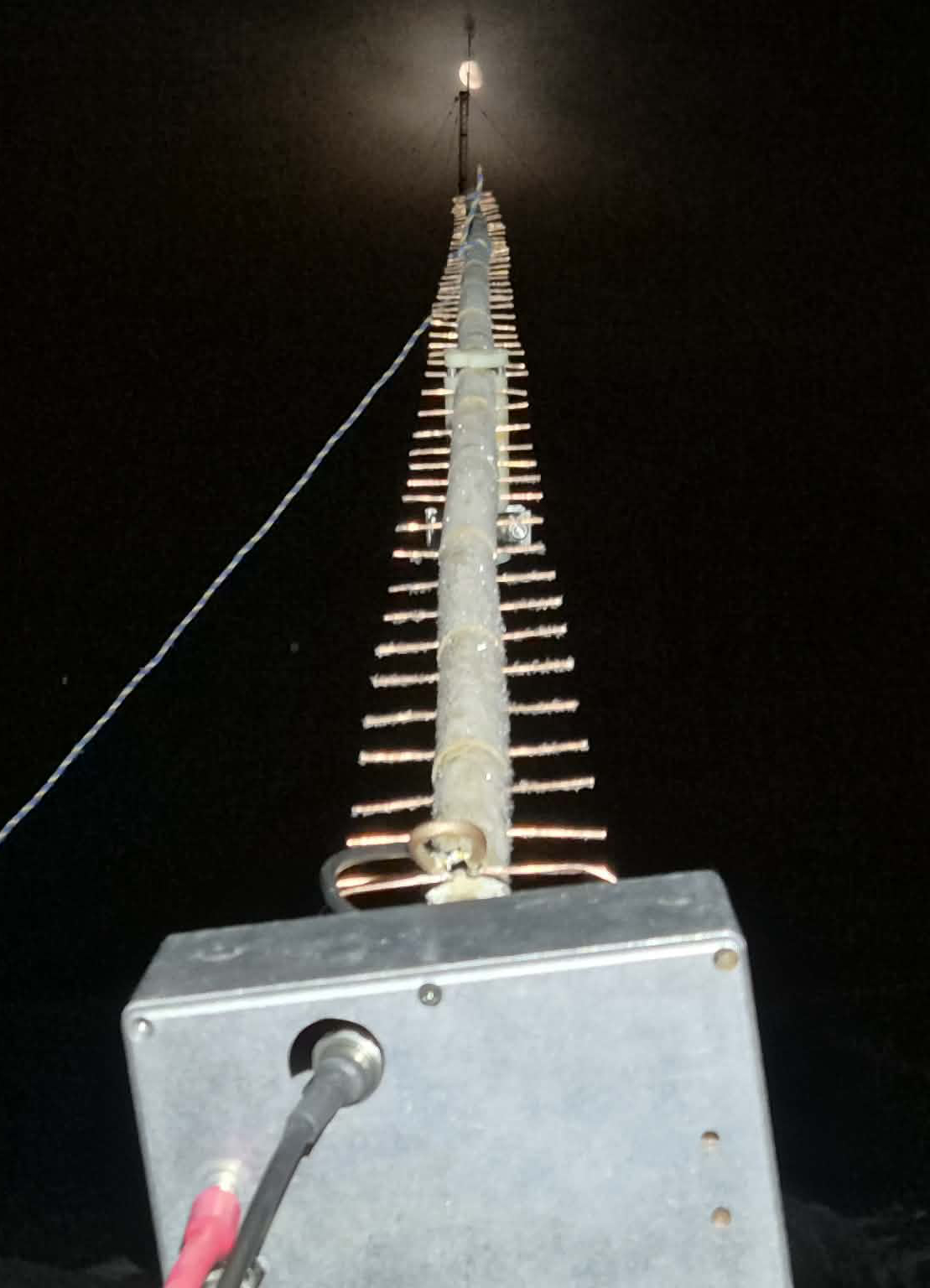 VK0DS 65 el yagi
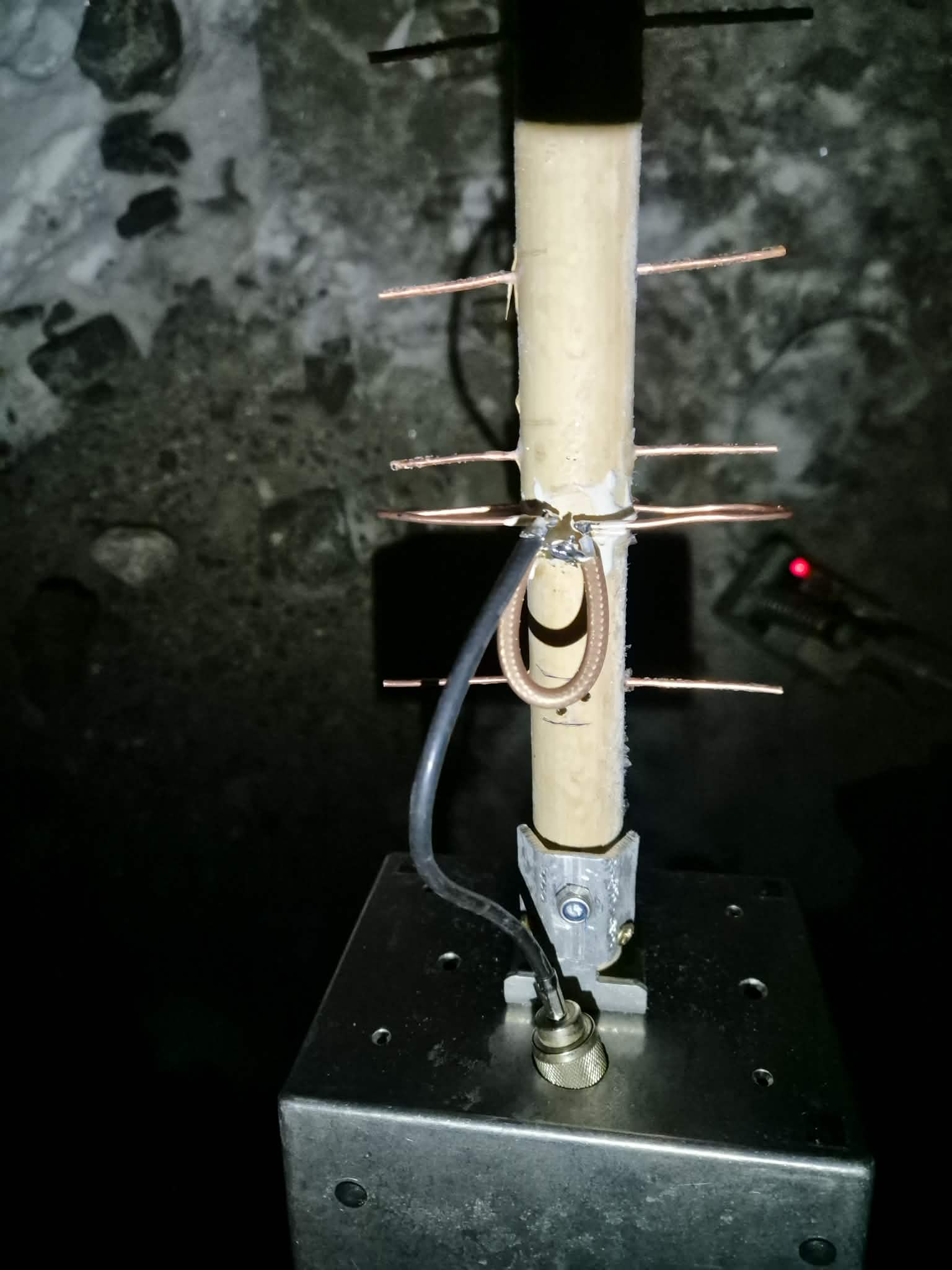 VK0DS Driven Element Closeup 65 el Yagi
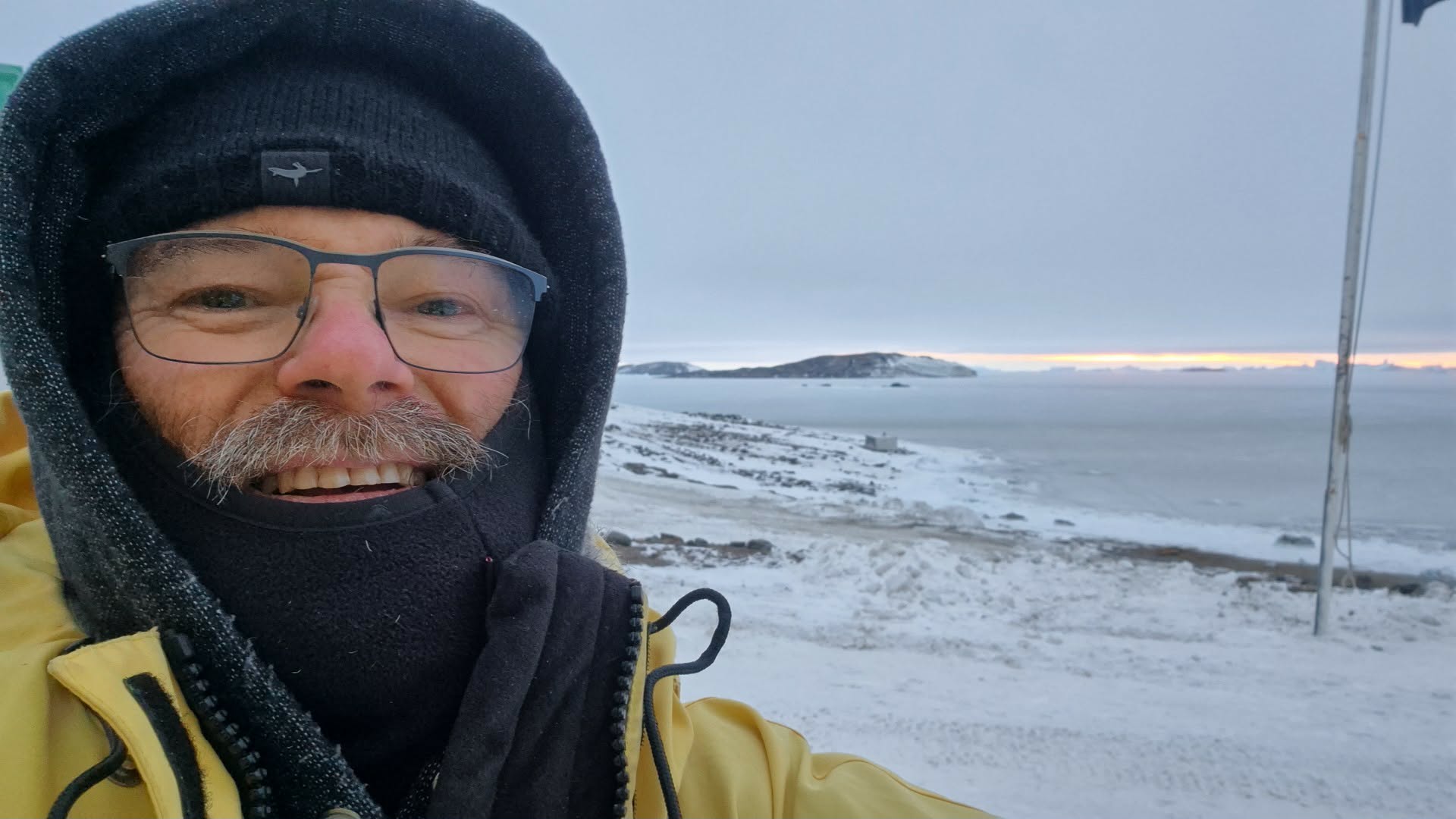 Dave VK2JDS in Antartica
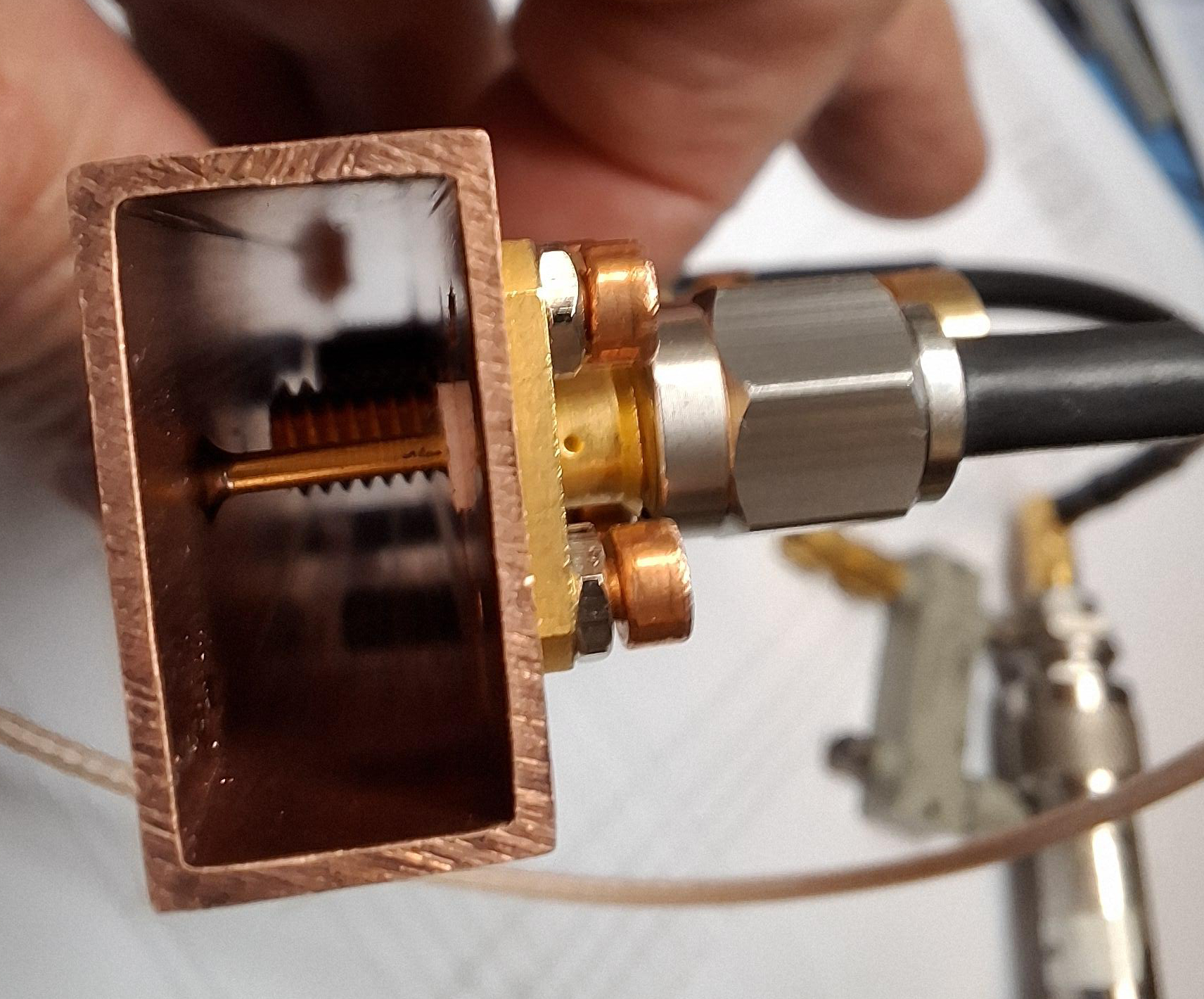 G4CCH End View of 6 cm Evanescent BPF
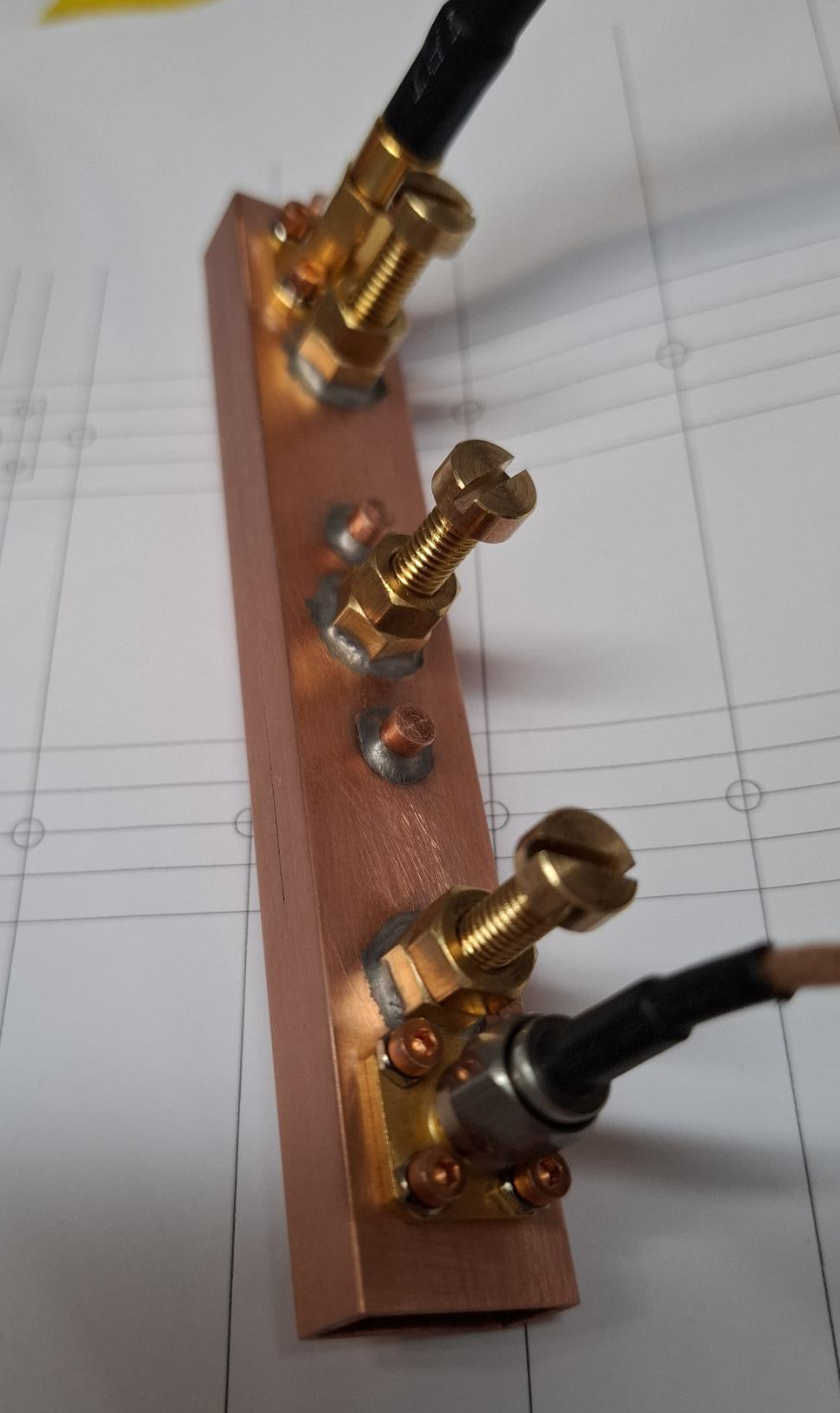 G4CCH Full View of 6 cm Evanescent BPF
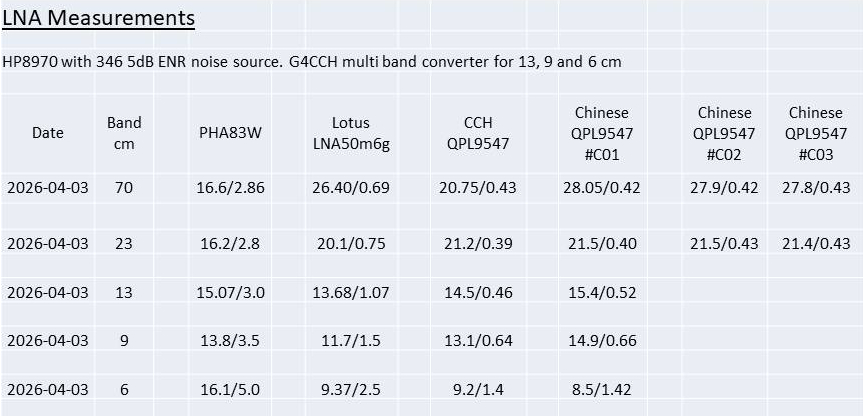 G4CCH LNA Measurements
G8RWG Niels
I have now managed to resolve the sequencer / IF switching problems that were bugging me for a few months and added 8 new initials to the 10 GHz EME log during April.
Activity on 10 GHz during the ARI Contest wasn't as high as I thought it might be and I didn't work anyone from North America which was a surprise. I split my operating time between 144 MHz and 10 GHz, and managed to complete 11 QSOs on 10 GHz.
10 GHz new initials:
19 April 2026 G4HSK -20/-20, K5DOG -21/-18
20 April 2026 OE5VRL -16/-16,
24 April 2026 PE1CKK -12/-17, PE1MMP -18/-17, LZ40C -17/-19
25 April 2026 IZ2DJP -15/-14
26 April 2026 IW2BNA -19/-22
Ed Note: Niels is using a 1.2 m Dish and 20 W
IK1FJI Valter
IK1FJI was active in both the DUBUS-REF and ARI contests and all of his QSOs were in CW.
For the DUBUS-REF contest I was QRV for 2 hours on Sunday morning and worked: SV3AAF, SP6JLW, OK2DL, OM6AA INIT #181 CW, JH5LUZ, SP6ITF, I2FAK, SA6BUN, UA3PTW, ON5GS, G3LTF, F6KRK, and SM2CEW
For the ARI contest I was QRV for about 4 hours and worked: OK2PE, G3LTF, I2FAK, IK2DDR, OM4XA, F6ETI, DF3RU, G0LBK, ON5GS, DL4DTU, IK5VLS, IK7EZN, UA9FAD, UA3PTW, OH3LWP, SP6ITF.
My station has a 3.8 m dish, a TH327 PA, and an LNA with 34 dB gain and a NF of 0.22 dB
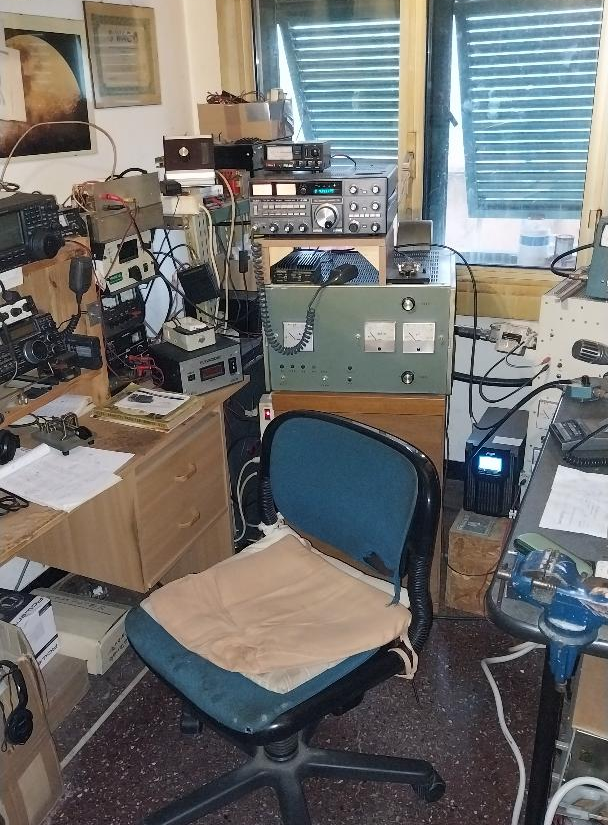 IK1FJI Part of Ham Shack
IK2DDR Francesco
Many thanks to all participants of the 12th Spring ARI EME Contest (2026).
As usual it was a lot of fun. I participated on 1296 MHz MIX and worked a total of 97 QSOs (4 dupes) 21 on CW and 76 on Q65. Participation as usual, was very good and especially on digi mode.
CW conditions were not so good on the afternoon of 1st moon pass, while excellent in the night. I worked a lot of the usual stations, with some new initials on digi. I didn't operate full time, but I spent a lot of my free time.
So many thanks to all and I will see you again on EME. I have been active on 144 MHz since October 1991 and on 1296 since May 2021. Obviously in the last year my main focus was on 23 cm and I consider it to be a fantastic band!
IZ0JNY Ivan
A sked for 47 GHz EME testing was scheduled for April 20–21, 2026. During the session on the 20th, despite very poor weather conditions on my side, I was able to decode in average mode signals from Zdenek OK1DFC. On the 21st, however, with accurate moon alignment, I was able to decode his signal continuously with solid reports.
This also marked the “first light” of my W2IMU-style feedhorn, which performed well on RX. Testing is continuing on my side, with ongoing efforts to optimize the setup and reduce the noise figure (NF) as much as possible.
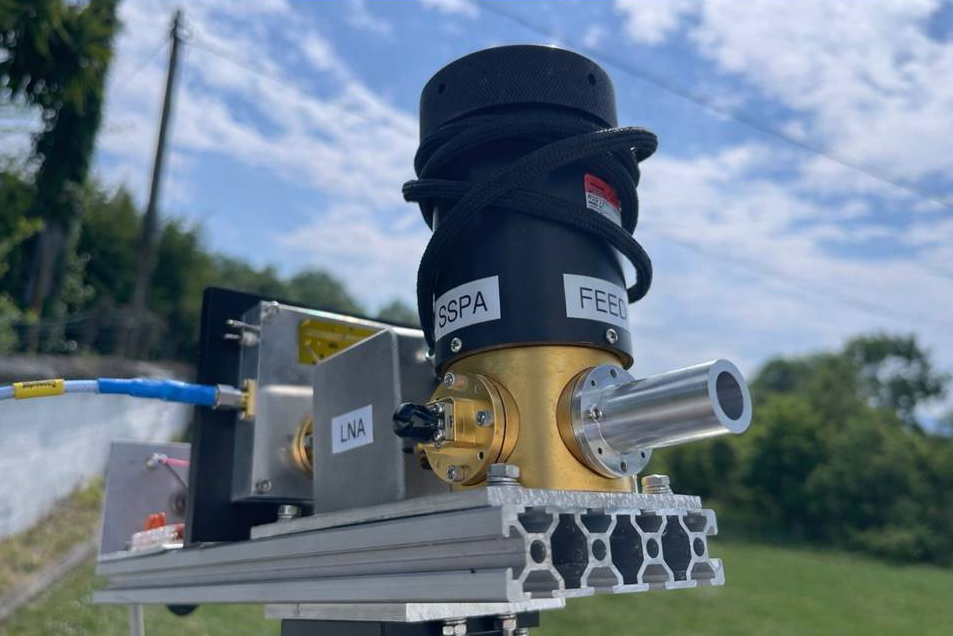 IZ0JNY 47 GHz W2IMU Feedhorn RX
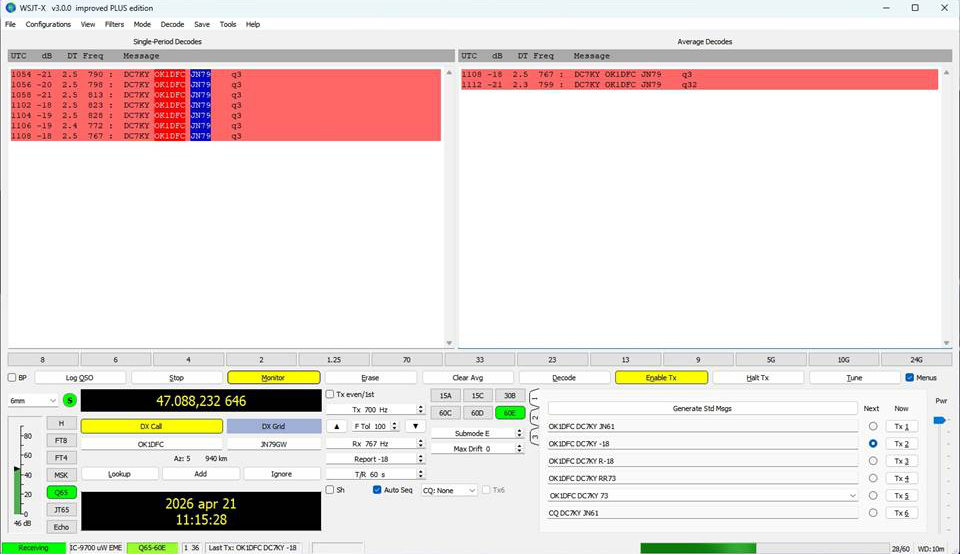 IZ0JNY 47 GHz Decodes of OK1DFC
K0PRT Alex (K6VHF)
The big 18.3 m dish at Haswell Colorado was active during the DUBUS-REF 23 cm Contest with 5 operators (NO0T, W7UM, K0RPC, AA0RS and K6VHF).
The full and lengthy report is available at:
https://groups.io/g/DSES/message/1144
DSES DUBUS 2026 Contest Report – Summary of trip to Haswell
Here are the Contest statistics: Station: K0PRT, Grid : DM88kj , Category: QRO MULTI (5 ops), Total QSOs: 38, Total Multipliers: 32, Total Score: 115,200
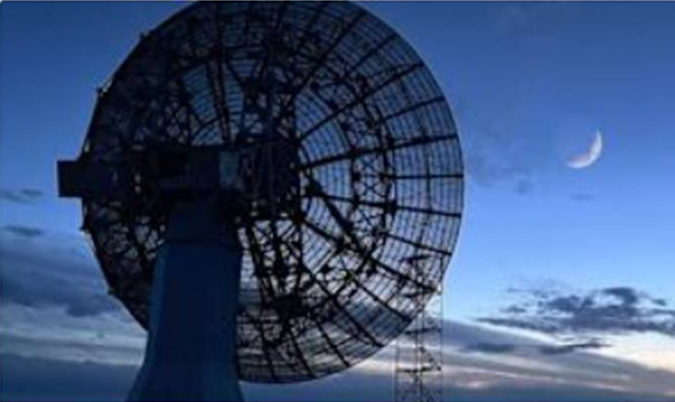 K0PRT Dish
KB7Q Gene
23 cm band activity has been excellent lately, so good in fact, that I picked up eight new stations to bump my initial count to #262.
First timers in my 23 cm log: W4AF (-25/-22), K0DSP (-21/23), ON4BCB (-11/-14), AF6SA (-23/-24), OE5VRL (-25/-24), N8ECI (-26/-26), DC1RDB (-28/-23), and F5AOL (-28/-24 via Q65-120D).
Best DX contact: A71AW (-20/-18). King of the hill signal: KD5FZX (-7/-9). Most fun contact: OE3JPC (2x Yagis -25/-25).
Each month now we see one, two, or even three new stations show up sporting 1.5 m "Cooker" dishes. It has made quite an impact on band activity.
KN0WS Carl
This weekend was my first EME activity of 2026. I headed up north to my dish. Spring mud after fresh rain was too risky for my truck, so I used my 1946 tractor to get gear back to the dish.
Pre-ARI activity on the 70 cm band yielded 8 QSOs, including new initials with PJ4MM, IZ6MVK, DD0VF and OZ7UV.
Once the contest started, there was only one station calling in the first hour, and he had RX troubles. Because the activity was so very low, I spent a few hours tearing down my 70 cm gear and setting up for 23 cm. On 4/25 I worked 21 stations (all digital), including initials with IZ8GGF, HG5BMU, N0LWF, AF6SA and LU1HKO. Then new rain put me at risk for getting stuck on the property, so I shut down, packed up and went home. I next plan to be on the moon for fall ARRL weekends.
N5BF Courtney
For the 23 cm DUBUS weekend, I set up the 2.4 meter folding dish with OK1DFC feed and 600 watts from a W6PQL amplifier and operated when the moon was in view here, 4/18/26 from 15:40 to 17:45 and 4/19/26 from 16:25 to 20:40 UTC. In 2025 I had no QSOs in this event. After many lessons learned and equipment and technique improvements, I had six QSOs for 2026, a great improvement: OK2DL, UA3PTW, KL6M, NC1I, SP6JLW, and G4CCH. (I note that only G4CCH has reported these QSOs to LotW.) I also note that these are stations I've been working on CW every year since I started in 2016. No new initials on CW.
After 19:15 on Sunday, nothing was seen or heard anywhere in the CW band (1296.000 to .050) and after calling CQ for half an hour to no responses (audible or in waterfall) went QRT DUBUS and moved up to the digital band where I immediately worked two new initials on Q65: PA1PS and AF6SA. Other new digital initials since my last report (November 2025) are N0LWF, LU1HKO, W8TN, CY0S, W1FKF, W1AW/KH6 and K0DSP. Good to see all these new stations QRV.
I started into EME because the digital modes offered by WSJT enabled QSOs with SNRs 10 dB and even 20 dB poorer than conventional CW practice. I knew that there would be a sufficient number of digital stations to work (hundreds) to justify the time and expense of setting up a 1296 MHz operation. My criterion was to be able to detect ("see in a waterfall") my own echoes, meaning that I could work stations down to my own size and hopefully below. Once I was QRV at this level I was able and eager to give CW a try, but even with my original 3.8 meter system, I was only able to work the larger stations (a handful worldwide), and only rarely down to my own size.
Most of the CW QSOs I have had over ten years (several hundred) have been "20 meters" style, meaning that CQs, calls, RST, RRR, and 73s are repeated a few times (three or four) on each end, "free form" (i.e., with no reference to the clock). Referenced to 2500 Hz SNRs reported by WSTJ, I have found this "easy" at -14 and above, doable at -16, very difficult at -18 and impossible (that is, no audio detection) below that.
But a few times I have conducted a planned schedule with another station using the old "two minute" exchange cycle and was surprised at how much this helped on CW. A station that I could not have even attempted "20 meters" style, because I could never have gotten their callsign in just three tries, was still possible to work within the rigid "two minute overs" protocol, typically within 20-30 minutes.
If there is an interest in continuing a robust CW presence in this community in this new era of mostly QRP stations, such as my current one, I have the following suggestion:
For all stations, especially the big ones, once you've worked the "easy ones" in whatever style you found "easy", go to the 2-minute protocol. This will, in my experienced guess, give another 4-6 dB in a high libration / deep fading environment. You will not be able to work most of the myriad of 2.4 meter stations out there without doing something like this, so it will improve everyone's QSO count.
There are many places where you can look this up but in outline, it is.
Minutes past the hour - activity referenced to "you" and "me" (QRP station):
00-02 [CQ yourcall] [CQ yourcall] repeated until the two minutes runs out
02-04 [yourcall mycall] [yourcall mycall] repeated until the two minutes runs out
04-06 [mycall yourcall] [mycall yourcall] ditto
06-08 OOO (or MMM or TTT) repeated for two minutes
08-10 RRR OOO RRR OOO ...
10-12 RRR 73 RRR 73 ...
12-14 73 73 ... (optional as always)
This assumes we both got everything every time. If not, the transmission cycle stays where it is until successful reception of the other station allows it to move on. Traditionally, MMM or better. In all the cases where I've done this, it ended up being OOO although it would have been a total bust in the currently practiced 3x3 exchanges standard.
Historically, if you hadn't made it by minutes 58-60 you would call it.
This may seem like it takes too long. It would if it were some HF contests where we were all trying to bust pileups. But that's why EME QSOs count for 100 points, not two. This last weekend I made six CW QSOs in six hours on the air from a marginal station. There were another half dozen stations I would have called if I could have definitely gotten their callsigns but in only three tries at it, there weren't enough peaks among the fast libration fades to piece them together. Once you are in the part of the event where all that is left is to work the marginal ones, taking longer to complete is expected. The two minute overs really make this work as well as it can.
And yes, I can improve my receiving or transmitting setup and I continue to do that, but there will always be marginal QSO situations in every event and using the stricter protocol will allow more of them to complete, or even attempt. I bet you will be surprised too.
N9HF Dave
I have been off the Moon for nearly a year and I am now getting back on. I am concentrating on 432 MHz as I only need 12 states to finish WAS there. The station is still the same, 4x22 and 400 watts.
I am also putting together a 10 GHz EME station as well with 30 to 35 watts and a 4 foot dish. That could be on within a month, if Murphy gives me a break!
NC1I Frank
Initials worked on 70 cm since my report last month include: DO3OI (-28/-20) 1 x 7-element Yagi and 10 (yes ten) watts. Note that Steffen was using a handheld Yagi and the QSO was random. Steffen called me as I was completing a QSO with another station. This was his first ever EME QSO. I worked WM3M (-24/-19) 1 x 19 elements and 60-watts. This was Emory's first ever EME QSO. I worked 9J2EME for DXCC #113 and my digital initial #800, and F6HRE (-12/-13) 2 x 25-elements and 500 watts. This was Patrick's first 70 cm EME QSO. I worked SM4LMV (-19/-21) 2 x 26-elements and 50-watts. This was Roger's first 70 cm EME QSO.
Initials worked on 23 cm since my last report include OE3GWC (-14/-09) 1.9 meter and 125-watts, ZL/LY3UM (-15/-24) in RF72, JS6SUS (-04/+00) no station info, PA2V (-27/-21) 1 x 36 elements and 250-watts. Peter was horizontal only and peaked at -19. I also worked NN4X (-19/-14) 2 x 36-elements and 150-watts, 9J2EME (-16/-14) for DXCC #121, N8ECI (-17/-08) 1.5 meter and 400-watts, AF6SA (-07/-08) 1.7-meters and 400-watts, ZL/LY3UM (-08/-13) in RF73, BV3CE (-13/-09) 1.8-meters and 80-watts for DXCC #122.
On 19 April I went to my station so that I could operate CW (I don't have CW capabilities from either of my remote operating positions) and worked 22 stations on CW in about 90-minutes. Many of the signals were VERY strong! I have not totaled my 23 cm initials in over a year. I will try and do that before my next report.
I would like to thank and congratulate the 9J2EME team and Alex EA8DBM for their outstanding DXpeditions! I am always amazed at what these guys are able to do.
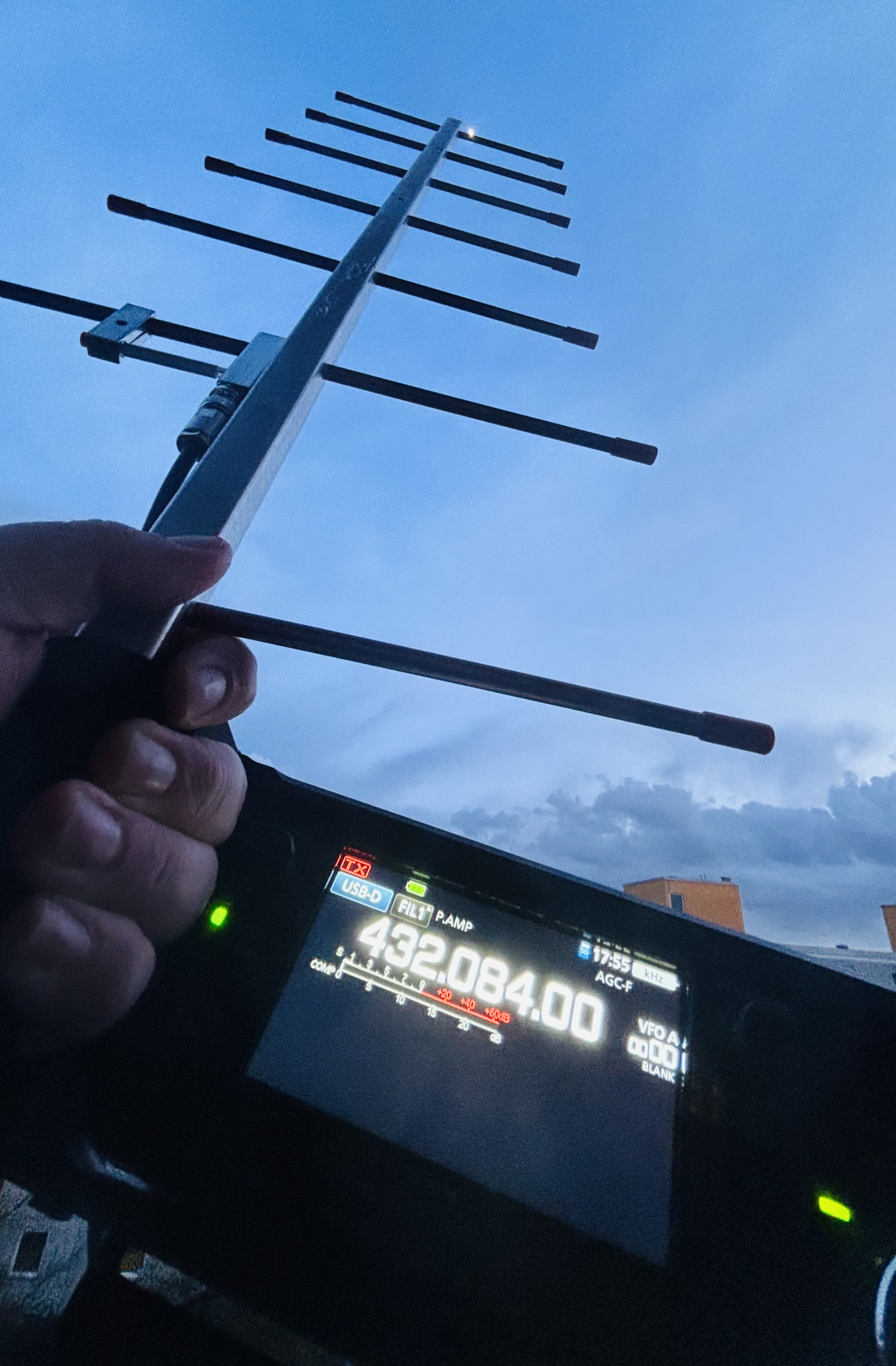 DO3OI Handheld 9 Element Yagi
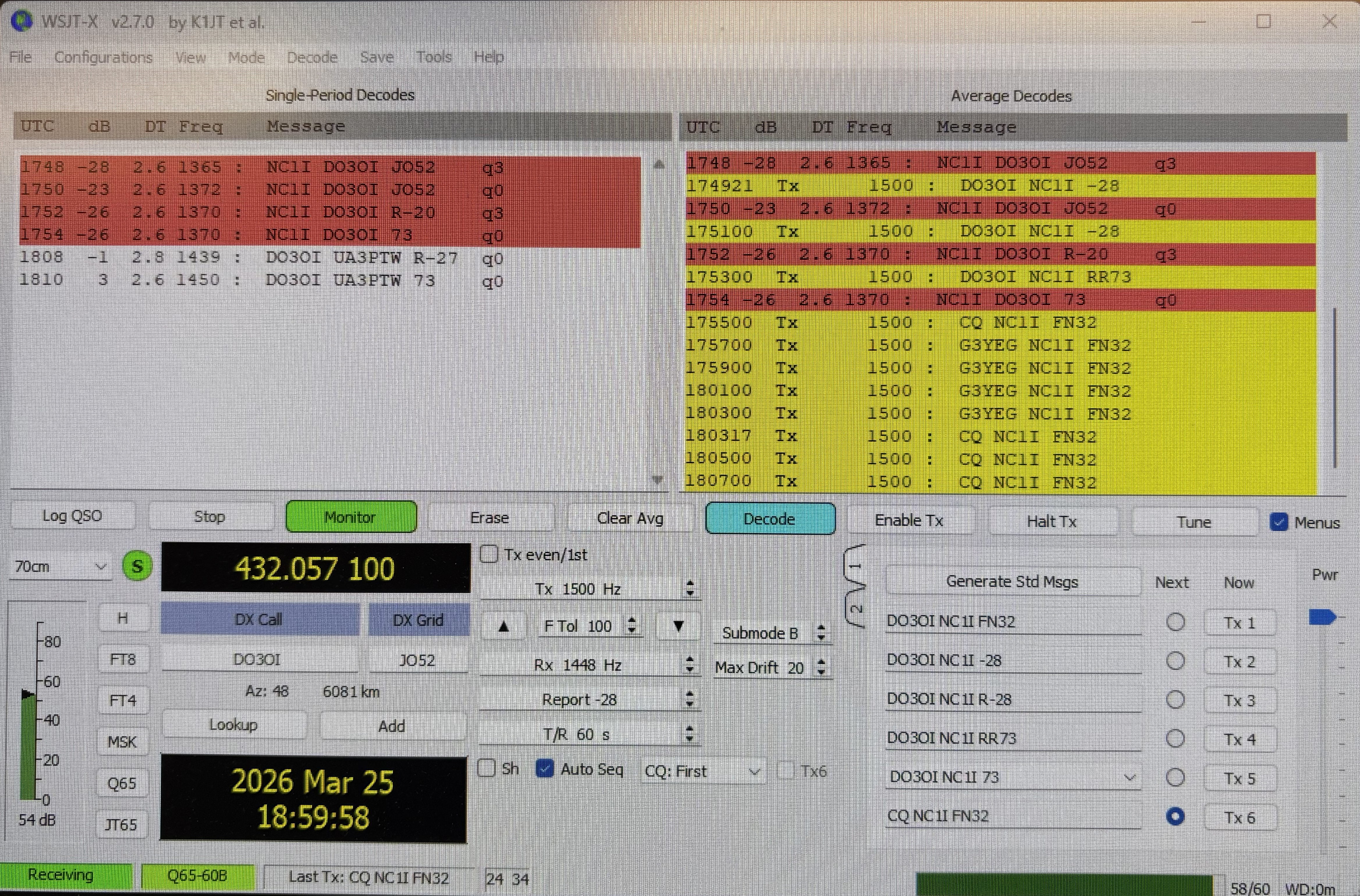 NC1I DO3OI WSJT Screenshot
OH3LWP Ari
Participated in Dubus 1296 MHz EME contest 18-19/04/2026 with the following CW QSOs completed: UA3PTW, OK2DL, SP9VFD, SP6JLW, SP6ITF, G3LTF, OH1LRY, G4CCH, OK1KKD, SA6BUN, RW6HM, OK2PE, OM6AA, WA6PY, KL6M, IK3MAC, PA3DZL, JH5LUZ, SP3XBO, OK1DFC, SM2CEW, F6ETI, OZ9AAR, ON5GS, PI9RD, G0LBK, WA9FWD, NC1I, K0PRT, NQ7B. I heard and called also VE6TA, OH2DG but did not complete QSOs.
A spring storm hit OH with high wind gusts and snow during the weekend of 25-26/4/2026 and thus could not fully participate in ARI Spring EME contest. Still gave a few QSO points during calmer periods:
25/4/2026 3cm VK7ZBX, OZ1LPR, IK3GHY all digital 13cm PA0PLY, DL1SUZ, 4Z5LV, DL4DTU, PE9GHZ, SV3AAF all digital PA0PLY CW
26/4/2026 3cm IK3HAR, OK2AQ, PA3DZL, OE5VRL all digital 23cm IK5VLS, OM4XA, DL4DTU, DM2CFH, PA0TBR, UA9FAD, IK7EZN all digital IK2DDR, G3LTF, IK1FJI all CW
Called also OK2PE but I did not complete a CW QSO due to strong wind gusts.
I worked several new initial QSOs and new DXCC in 24/3/2026 to 27/4/2026 time window as below:
New 23cm inits:
24/03/2026 ZL/LY3UM digital (also new DXCC)
30/03/2026 9J2EME digital (also new DXCC)
15/04/2026 N8ECI digital
16/04/2026 WI0JK digital
18/04/2026 OM6AA CW
19/04/2026 F6ETI CW
20/04/2026 K1WHS digital, W4AF digital
New 13cm init:
29/03/2026 4Z5LV digital (also new DXCC)
New 9cm init:
20/04/2026 VE6TA digital (also new DXCC)
New 3cm init:
23/04/2026 ON/PA0MHE digital
OK1DFC Zdenek
The DUBUS EME contest in the 1296 MHz band took place on the weekend of April 18/19. Unlike other bands, 23 cm operations are conducted on both days. Excellent conditions for testing the 47 GHz band also coincided with these dates. So I set up the 23 cm band on an 8-meter dish and prepared a small 2.4-meter antenna so that I could quickly install the 47 GHz setup on it.
There was lively traffic on the 23 cm band, while the 47 GHz band was limited by bad weather at my QTH. So I transmitted on 23 cm and worked on preparing the 47 GHz setup at the same time. On Sunday, the weather cleared up, so I was at least able to install the 47 GHz transverter and try to measure the noise from the sun and the moon. I recalibrated the sensors, but unfortunately I found that the repaired LNA, which I had managed to “fix” during my first high-power attempt in the fall, wasn’t performing as it used to. The values of +7 dB for the sun and 0.56 dB for the moon suggested that something was wrong. Originally, I had 12 dB for the sun and 1.6 dB for the moon.
I finished the 23 cm contest early on Sunday because there was nothing left to do on the band; after all, CW traffic isn’t as popular as WSJT, and there were few stations. From OK, I only worked Marek OK2DL and Vláďa OK1USW, with a nice signal from both. I was pleased with 5 new CW QSO initials. You can see the 23 cm contacts I made:
April 18, 2026 UA3PTW, OK2DL, SP6JLW, G4CCH, OK1KKD, G3LTF, OH1LRY, G4RGK, PA3DZL, IK3MAC, SM3BYA, SP6ITF, RW6HM, AA4MD #516, SA6BUN, F5KUG, NQ7B, OM6AA #517, SP3XBO, ON4BCB, OK1USW, F6ETI, VE6TA, KL6M.
April 19, 2026 I2FAK, PI9RD, OH3LWP, SV3AAF, RX3DR, JJ3JHP, SP9VFD, YB2MDU, DJ3JJ, PE1LWT, JH5LUZ, IK7EZN,F6KRK, CT1FGW, SM6PGP, SP6GWB #518,OZ9AAR #519, ON5GS, UA3XCR #520, K0PRT, UA9FAD.
Monday, April 21, 2026: The weather seemed unusable in the morning, but it improved during the day to the point where I could install the 47 GHz band on the dish and calibrate the antenna to the moon’s noise. Then I just waited for the scheduled time for the contact between JA1WQF and DC7KY. I listened to both stations, but I couldn’t decode either of them. Unfortunately, neither station managed to make a connection either. So I tried calling Mitsuo JA1WQF, who decoded me on the very first call at a level of -16 to -20 dB. I couldn’t receive anything from Mitsuo.
Then I made an attempt with Klaus DC7KY, and again he decoded me easily at -14 dB; unfortunately, I could neither see nor hear him. Copies and screenshots of the displays are below. I had urgent QRL work in PA0 until Wednesday, April 22, so I had to reschedule further attempts for Thursday, April 23, 2026. However, there were still several stations on the band capable of receiving in the 47 GHz band, and they all decoded me without the slightest problem as well. See the screenshots. On my end, I used a 2.4 m offset dish, a DB6NT transverter, and a GPS mounted on a DB6NT LO. A 50 W SSPA (running only 45 W for unknown reasons ??) on WR19 waveguide, an LNA that’s supposed to have an NF of 2.5 dB but doesn’t. I also have a spare LNA from JA8CMY, so I’ll use that next time. That concluded my efforts in the 47 GHz band, and I flew off to work in PA0.
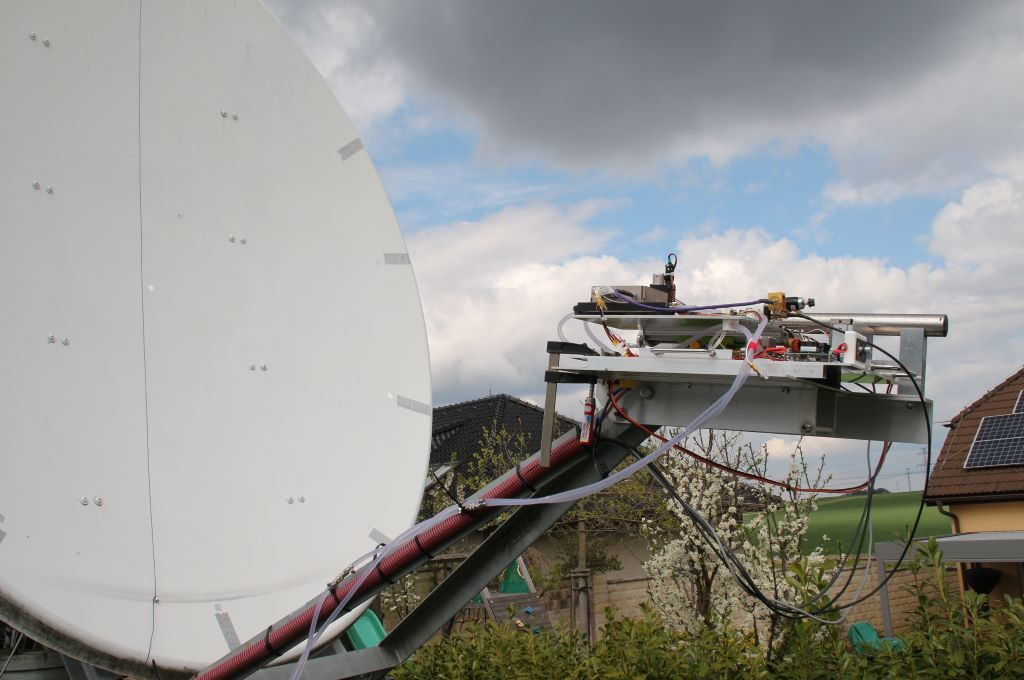 OK1DFC 47 GHz Dish and Feed
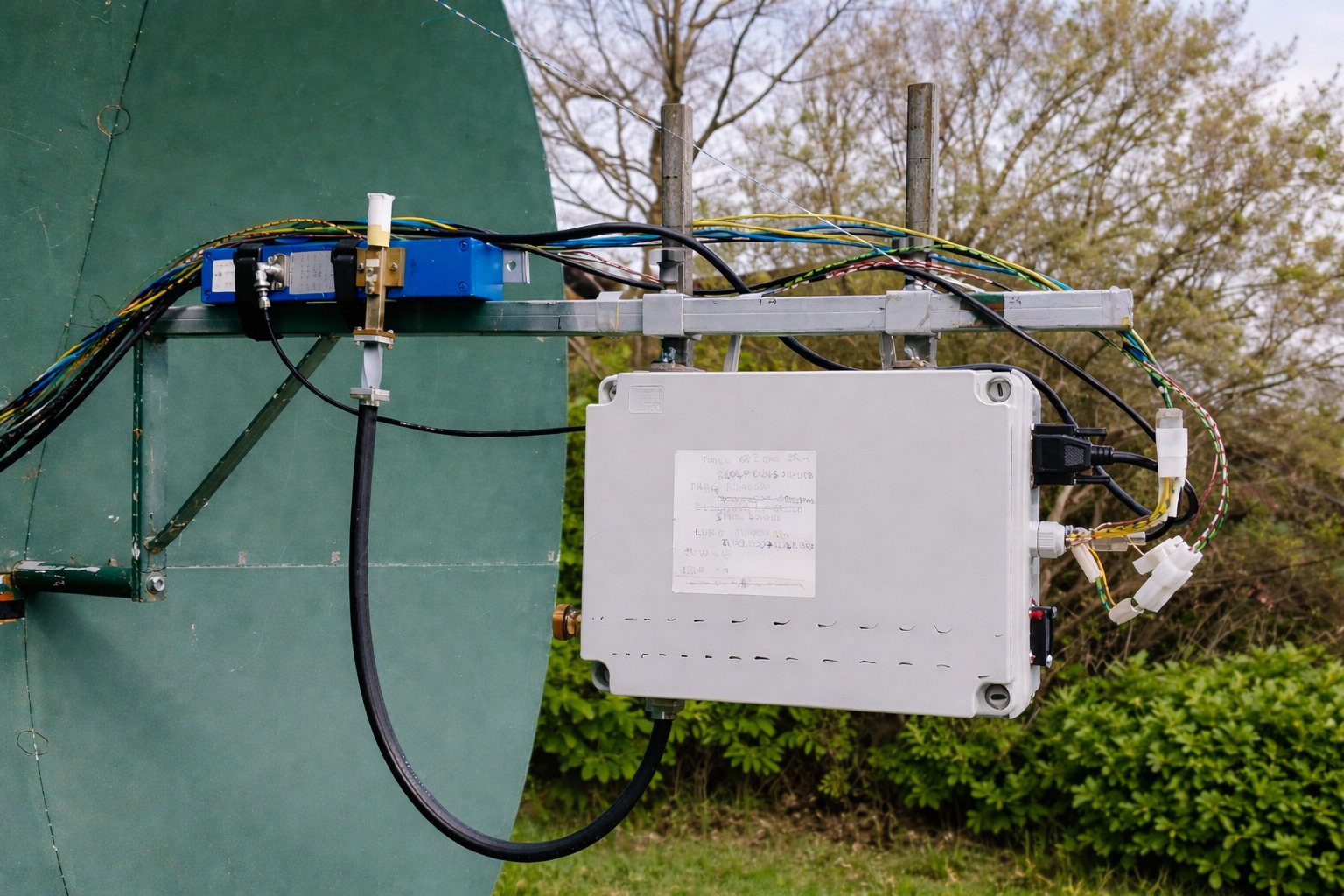
A view into the focal point of the parabolic dish with the 47 GHz transverter installed. The hoses running along the feed holder lead to a heat sink filled with antifreeze. The entire SSPA is a liquid-cooled "machine" because its efficiency is only 33% and a lot of heat needs to be effectively dissipated.
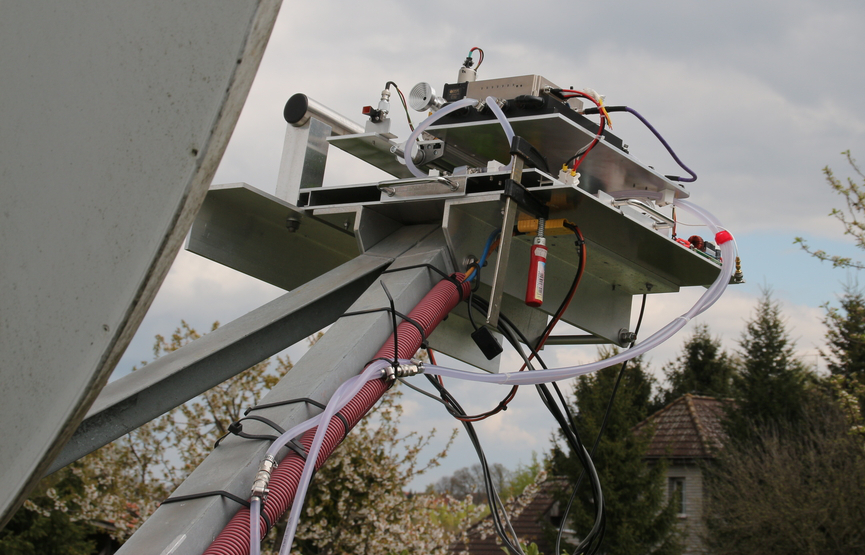 OK1DFC Another View 47 GHz Feed Assembly
Another view of the parabolic dish's focal point, where the 50 W RF SSPA and feedhorn are located at the top right. Next to the feed is a small box containing a 47 GHz horn with RF detector for monitoring power in the dish.
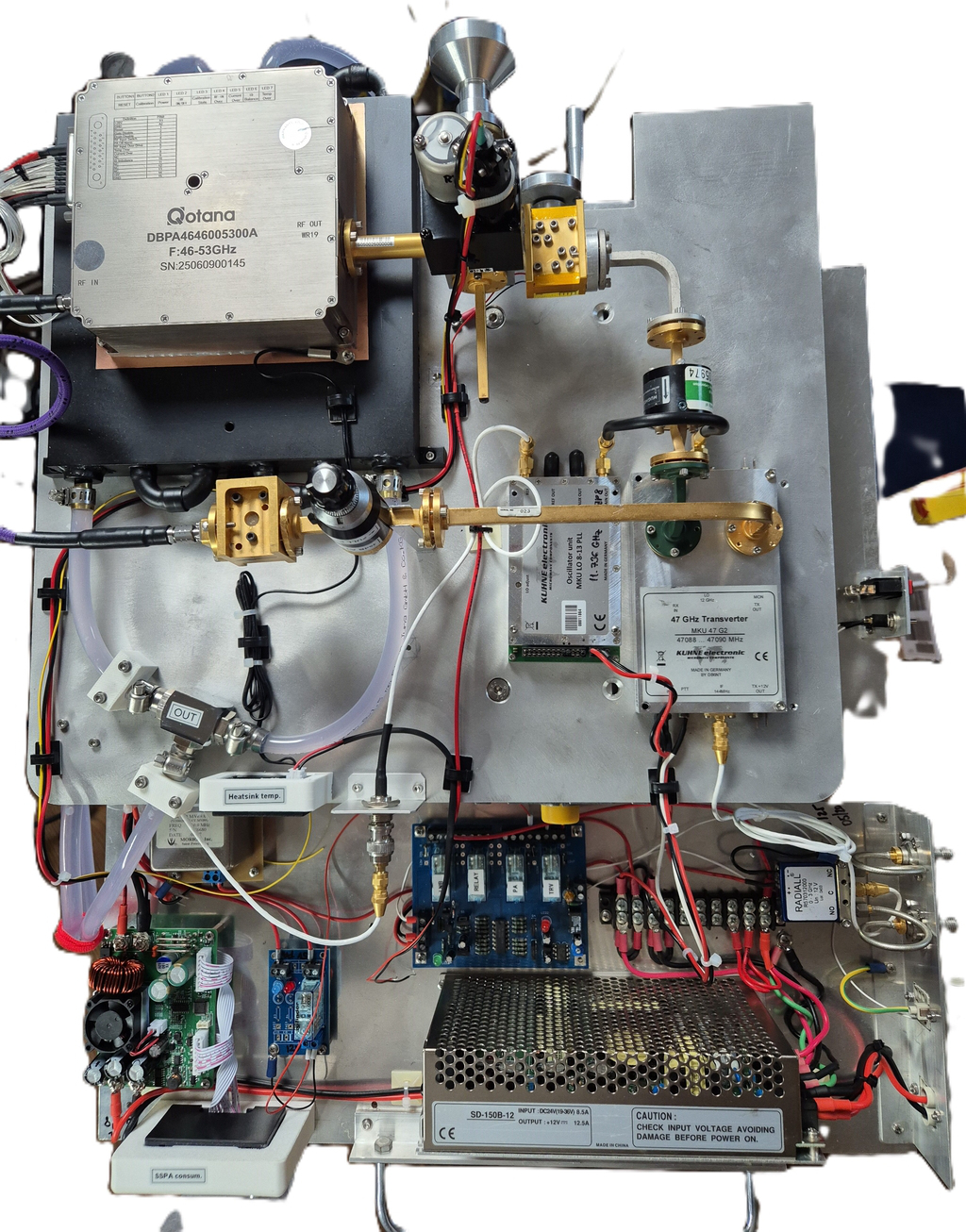 OK1DFC Closeup of Feed Electronics
An overview of the transverter and all auxiliary and control circuits, such as the sequencer, the 28 V / 10 A current limiter for the SSPA power supply, and the 28 V to 13.8 V DC/DC converter for powering other components.
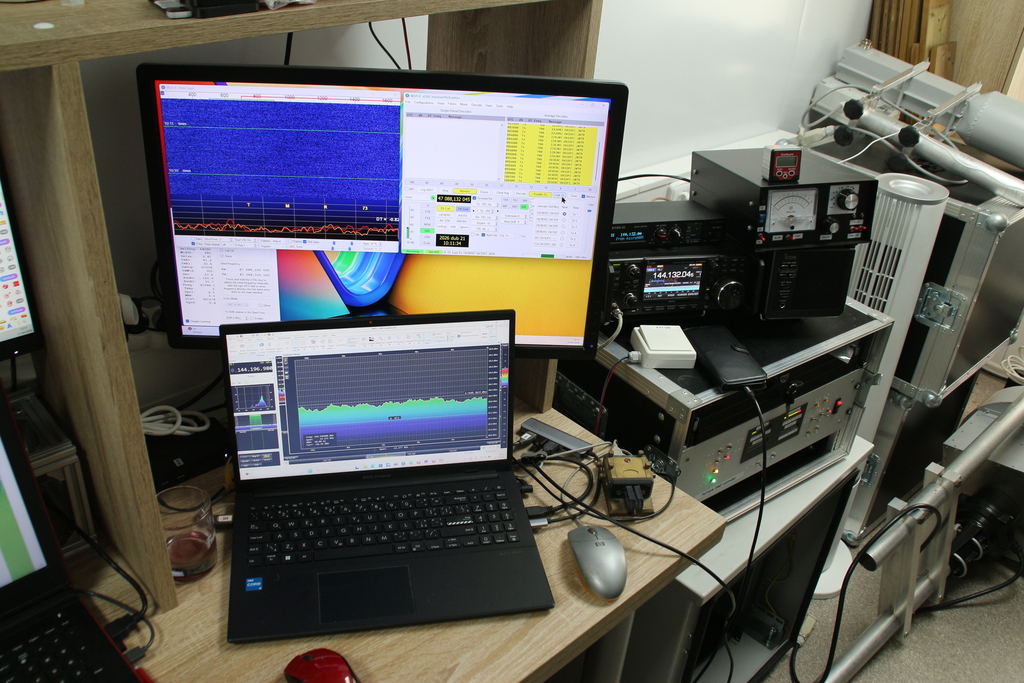 OK1DFC 47 GHz ham shack
A look inside the ham shack: an IC9700 hooked up to a Bodnar GPS, a lunar noise meter, WSJT, and other auxiliary circuits for controlling all the equipment.
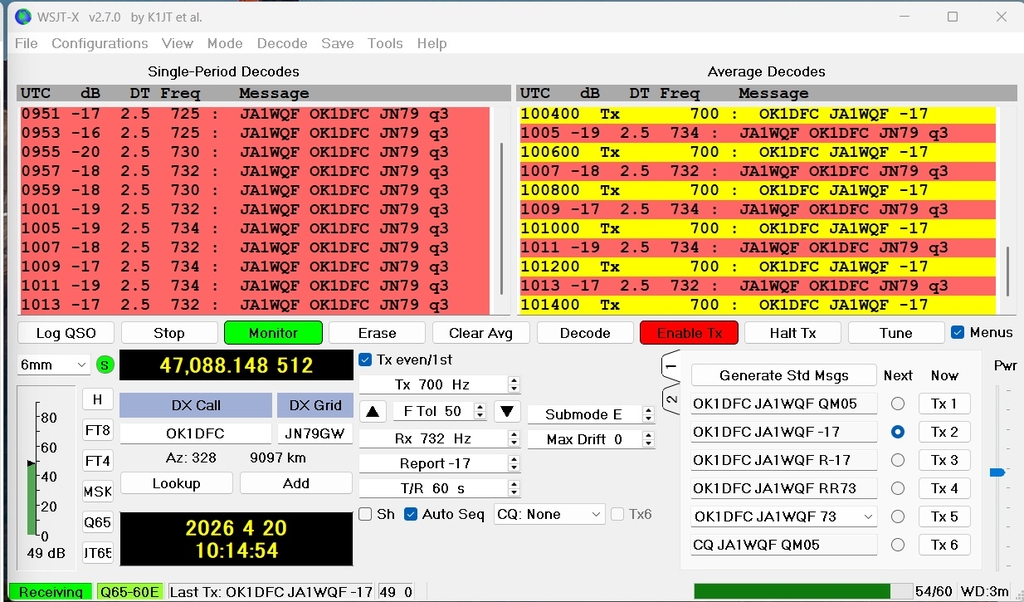 OK1DFC JA1WQF 47 GHz Decodes
First attempt to contact JA1WQF. Mitsuo decoded all my periods, but unfortunately I didn't receive anything from him. Mitsuo uses a 2.4 m center-fed dish with a Cassegrain and 10 W RF SSPA.
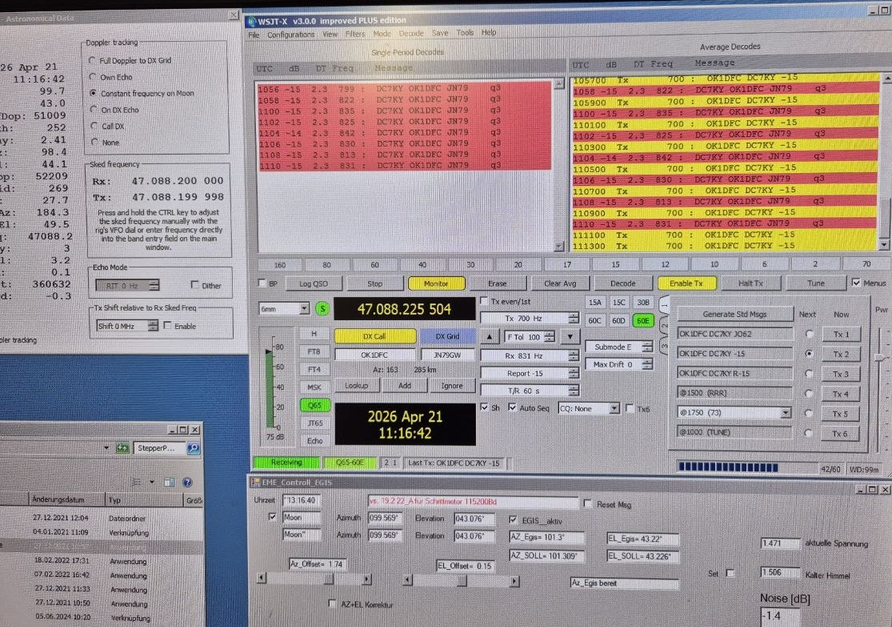 OK1DFC DC7KY 47 GHz Decodes
Another person listening to me on April 21 was Klaus DC7KY, who also called me, but I didn't receive anything from him. We agreed on a sked for Thursday, April 23.
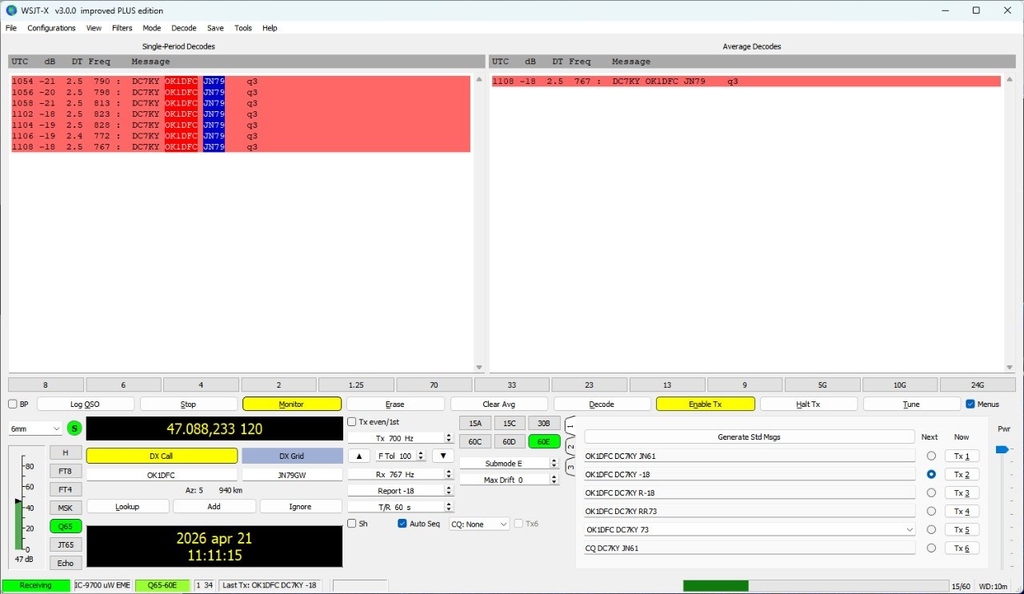 OK1DFC IZ0JNY 47 GHz Decodes
The next person to hear me was Ivan IZ0JNY. He uses a 120 cm offset dish. He set Klaus's callsign as his own to make it easier to decode when I'm not calling his station.
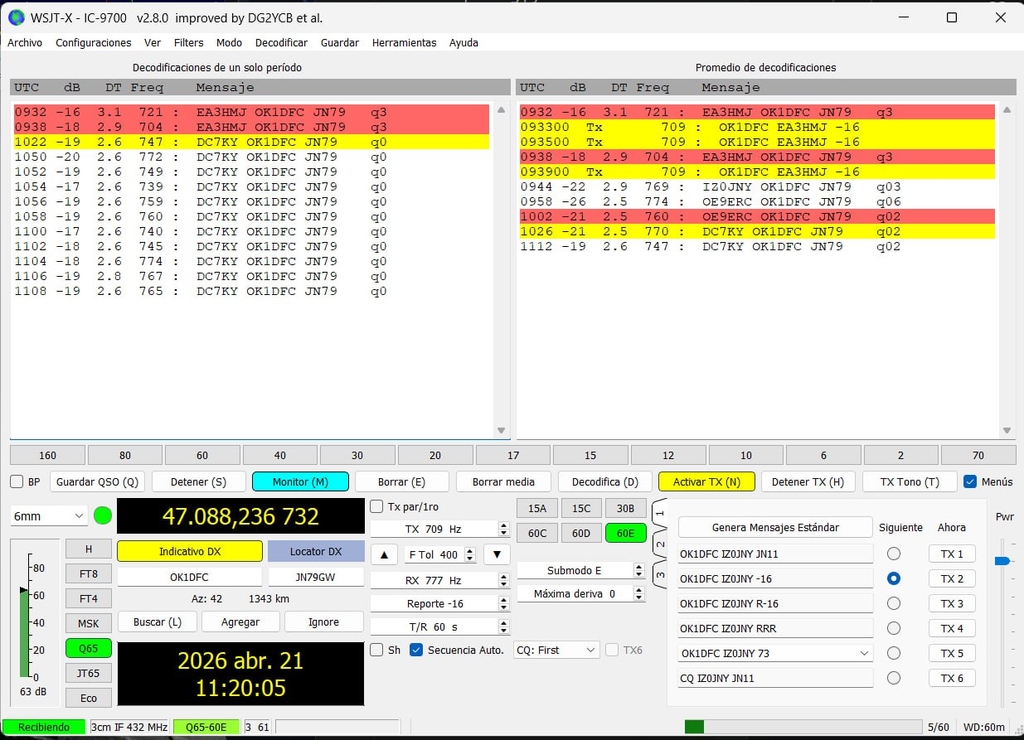 OK1DFC EA3HMJ 47 GHz Decodes
The next person to respond was Jose EA3HMJ; he received me without any problems. Unfortunately, he doesn't have enough power for testing.
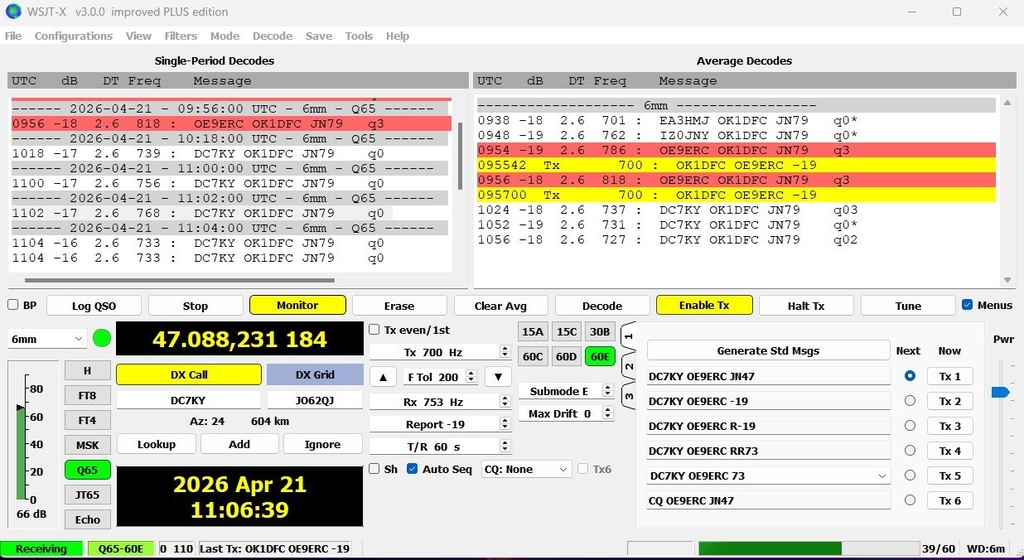 OK1DFC OE9ERC 47 GHz Decodes
The last person listening to me that day was Erich OE9ERC. Erich uses a 120 cm offset dish and a 2.5 dB N/F LNA. You can see his equipment in the following pictures.
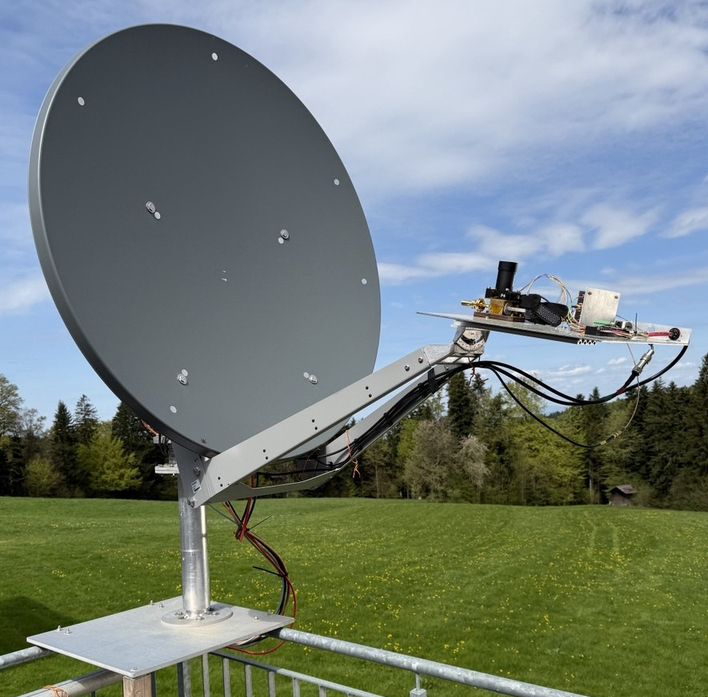 OK1DFC OE9ERC 47 GHz 1.2 m Dish Installation
OK1KIR Vlada & Tonda
Our exceptional activity in March 2026 which was crowded by several EME expeditions and the DUBUS-REF 6 cm contest continued on Mar 24 with 23 cm CW QSOs with T7/IW2BNA 549/559 at 10:39 as #533 and finally at 17:02 with Lee, WW2DX on Sable Island as CY0S O/559 as #534 and CW DXCC #94.
And to top it all off on March 26 we had a successful 24 GHz QSO with YO8RHI at 13:03 -18/-14. It is #62, 1st YO-OK 24 GHz QSO and mixed DXCC #26 after many failed previous trials.
On the next day March 27 on 23 cm at 11:21, we worked Alex as ZL/LY3UM -19/-28 #669 from RF73 and at 12:38 PA2V -24/-26 #670 with 200 W and only single 36 el. Yagi w/o elevation.
Finally later that evening at 21:14 we worked the 9J2EME expedition -14/-14 as #671 and DXCC #150.
Our last day of March with expeditions was March 28 when we worked on 70 cm with Q65-60B VK4AMG -21/-19 as #380, then 9J2EME -19/-15 on V-pol as #381 and 1st 9J-OK 70 cm QSO. Later we added OM3TRN -18/-9 as #382, BA4QRN -22/-18 as #383, BA7TGI -25/-14 as #384 and DD0VF -21/-15 as #385. All were worked with V-pol. Later we decoded JO4KVP -18, 7K3LGC -15 and we were decoded -21 at GM0OTI with a 15 el. Yagi.
Sincere thanks to all EME expeditions for their effort and dedication.
After a few weeks without EME we were active again on 23 cm in the DUBUS-REF EME Contest and worked on April 18 with CW OK2DL, OK2PE, OM6AA as #536 and I2FAK as #537. With Q65-60C worked N4BAA as #672, OZ5TG, N8ECI as #673, W3TI, DC1RDB, N0LWF as #674, KG0D, OE3JPC as OE100OEVSV and K1WHS as #675. On April 19 we added with Q65-60C KH6FA, VK2CMP as #676, G4BRK and in CW VK2CMP as #538.
In the ARI EME Contest we tried 23 cm and worked on April 25 with CW OK2PE, IK2DDR, G3LTF, IK1FJI, SP6ITF, F6ETI and R1NW as #539. With Q65-60C worked 4X1AJ (on 1268/1268 MHz), DM2CFH as # 677, PA3BYV as #678, OM4XA, SP5MS as #679 and with Q65-30B AF6SA as #680. More details can be found on https://www.ok1kir.cz
OK2AQ Mirek
In the very cold weather of early April we moved to our cottage in JN89eu and I was able to begin installing the EME equipment. I started with the 23 cm band, as the VK3UM Memorial (DUBUS - REF) was approaching and increased activity was therefore expected.
I didn’t participate in the Contest itself, but from April 12 to 20, I made 41 QSO Q65s with the initial callsigns F5AOL (-23/-22), DC1RDB (-23/-23), OZ9AAR (-9/-12),W4AF (-27/-24), N4BAA (-15/-23), A71AW (-19/-18) DXCC, BV3CE (-24/-24) DXCC, KA6U (-19/-25), N8ECI (-23/-25), SO5AZ (-22/-22), VE4SA (-16/-17), K1WHS (-17/-21), VK2CMP (-22/-25), RW9OW (-17/-18), and WA4LM (-18/-24) {#265}.
New stations generally use “folding dishes” and, more recently, “cooker dishes” with aperture diameters of 1 to 2 meters. They also use power amplifiers with outputs of 400 to 600 watts. The contact with BV3CE, who has a 1.8-meter dish and 90 W of power, was a real treat.
The following week was the A.R.I. Trophy Spring Contest, in which I participated on the 3-cm band. Collecting initial callsigns is somewhat more difficult here, but even before the contest I had worked NJ6D (-15/-13), W3TI (-16/-16), IK3HAR (-18/-20), and PE1MMP (-16/-15).
In the contest, I made 27 Q65 QSOs and 2 CW QSOs, including the initials with SV3AAF (-21/-17) DXCC and PA3BYV {#183}.
The online logs are here.
ON5TA Eric
There was very nice activity on 3 cm during the ARI contest. Stations using 1 to 1.2 m dishes were easy to copy despite high spreading conditions. I made 29 QSOs, with 4 in CW.
The highlight in April was a totally unexpected 3 cm QSO with John ZS6JON. I have been dreaming of a 3 cm WAC certificate since I started EME on this band 17 years ago! John had a very good signal with his 1.8 m dish.
I am now assembling a 24 GHz EME station. Hope to start testing in June.
Ed Note: ZS6JON is working to make significant improvements to his station before he will be seriously active.
OZ1LPR Peter
I was QRV in the spring session in the ARI EME contest. I like this contest a lot as it combines CW and digi modes and where you get additional points for a CW QSO.
I was QRV on both Saturday and Sunday as much as possible. There is always some family business to take care of 😀. I worked a total of 42 QSOs with 10 in CW and the rest in Q65-60D mode. Conditions where quite good and I had 1.8 dB of moon noise and the sun was measured at 15.8 dB. There was a lot of activity and the signals were great.
I worked: VK7ZBX, VK4WYM, OH3LW , OK2AQ (CW+Q65), IK3GHY (CW+Q65), IK3HAR,YO2LAM, PE1CKK, DL4DTU (CW+Q65), ON5TA (CW+Q65), SM5DGX, IZ2DJP, YO8RHI, I4TTZ, OZ1FF, IK2RTI (CW), SV3AAF, G8RWG, IK0HWJ (CW+Q65), PE1MMP, ON4CDU, PA3DZL (CW+Q65), G4HSK, W3TI, OE5VRL (CW+Q65), VE4MA(CW+Q65), NJ6D, K5DOG, PA3BYV, IZ0JNY, IW2BNA, F2CT (CW+Q65), N1AV. All stations without a mode mentioned were in Q65 only.
During last month BY1BY OM89 was QSO'd on 3 cm in Q65 mode. BY1BY is a club station.
I can be QRV anytime for skeds or just act as a beacon on 5.7 GHz, 10 GHz or 24 GHz on request. Just write an email to
Ed Note: I can attest that Peter is a great beacon on all bands!
OZ9AAR Carsten
I will be attending the EME 2026 conference in Tenerife May 28th-31st. If you attend the conference (or one of your friends does) and you need something from me, please let me know ASAP. I can, within reason, bring stuff with me and hand it over at the conference.
For a current list of my projects (both DIY and ready made) and what I have to offer, have a look at https://www.moonbounce.dk/forsale
At the conference, I will be doing a talk about designing and building my 4.8 m system as well as all the components and subsystems I developed (and made available as "DIY" projects) for the system.
Since I got my 4.8 m dish up and running on 23 cm March 22nd, I have been doing various tests and measurements of the system. I'm not finished yet (when will we ever be :-) but so far things look positive. I measure sun noise within 0.7 dB from the predicted level, I will be experimenting with my feed (changing choke) and also will be looking into a small fence along the perimeter of the dish. Simulations have shown that this would have a positive influence, parts have arrived and work will soon start. The equipment, PA systems etc. are all (still) working as intended.
Two days ago I received my new QSL cards (produced by Gennady UX5UO) and I will be sending direct QSL cards to all my initials so far (around 100+).
I have been improving both my SimpleCalc (adding some nice "reference and delta markers" in the noise window) and SkyScanner (improved the sun- and moon-sweep functions) applications, several new features and improvements of existing features have been implemented. For more information, have a look at:
SimpleCalc: https://www.moonbounce.dk/hamradio/simplecalc
SkyScanner: https://www.moonbounce.dk/hamradio/skyscanner
More information on my 4.8 m dish here
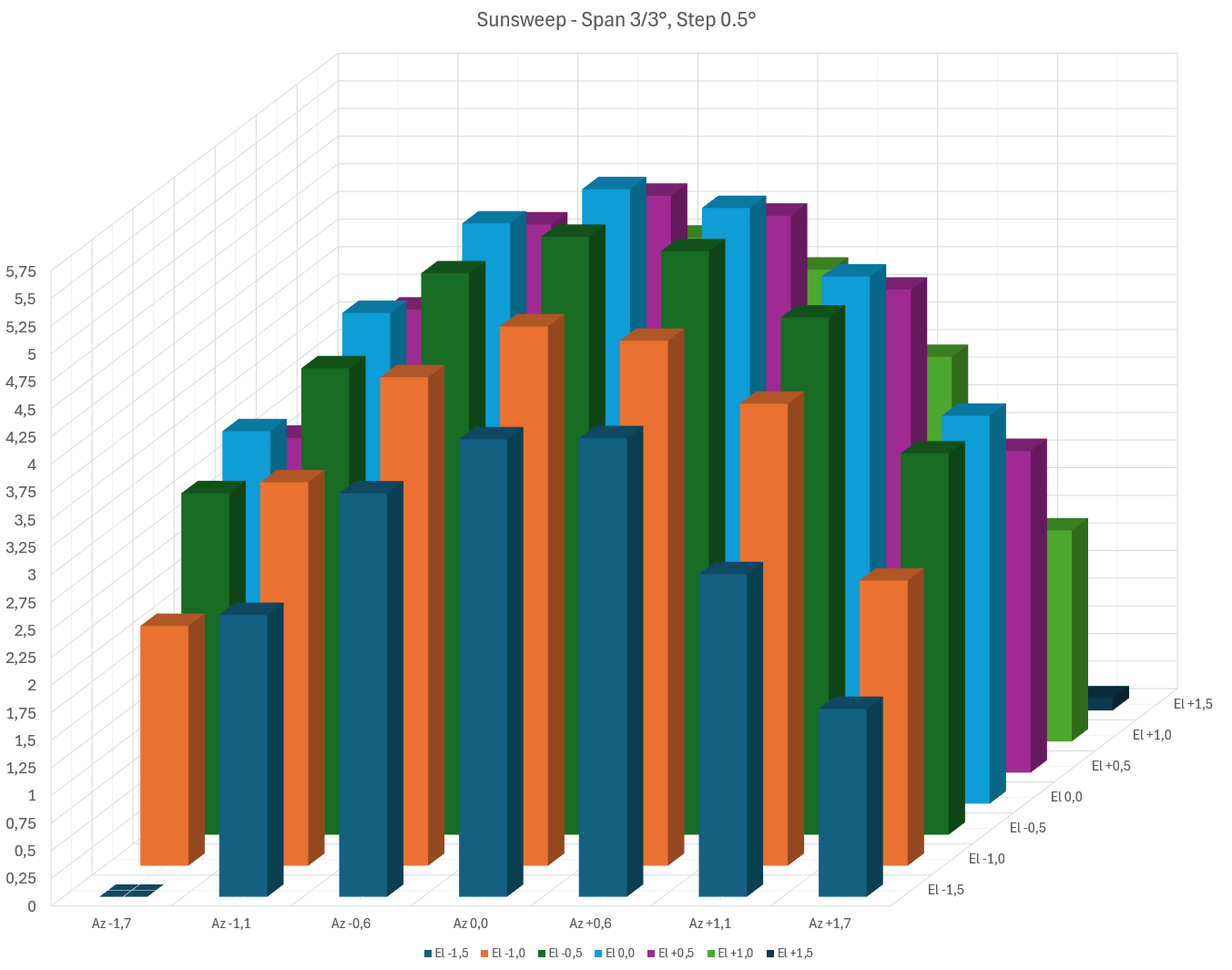 OZ9AAR Sunsweep
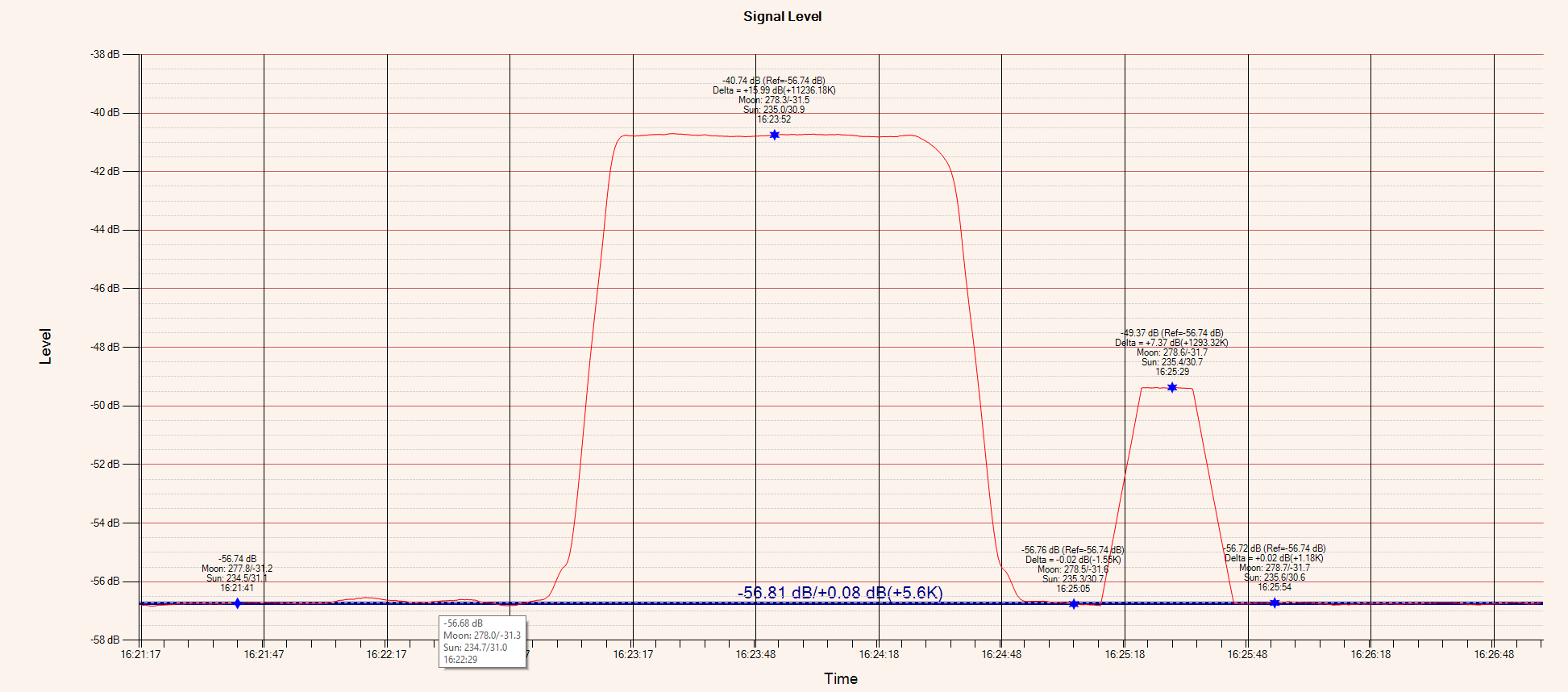 OZ9AAR Sun and 50 Ohm termination test
PA0PLY Jan
I started with 23 cm on 18 Apr: PA3BYV #380 and VK2CMP #381
In the DUBUS-REF CW contest I worked:
CW: OK2DL, UA3PTW, SP6JLW, JH5LUZ #382, RW6HM, SP9FVD, G4CCH, SP6ITF #386, OK1KIR
Digi: N8ECI #383, N0LWK #384, KG0D, OE100OESV #385, KA6U
I missed K0PRT and tried with another CW station which had a funny dot setup; very short dots. Unfortunately the OM kept speeding and I could not decode anything. Also OK1KIR was a funny one. His signal was close to a birdie and was difficult to decode. I was so concentrating that I completely forgot to switch my tracking. So next to having to deal with the birdie, his signal became weaker and weaker!
Then I switched to 13 cm and Worked 4Z5LV #95 (1.8 m - 40 W).
In the ARI Contest I worked:
DL4DTU, OH3LWP, 4Z5LV, DL1SUZ, PE9GHZ, ON5QT #96, SV3AAF, PA0BAT,OE5VRL, JA6XED, SP3XBO
No activity found from NA side. Lucky enough I worked most stations both in Q65 and CW. I tried a long time with Mihai YO5PGG. I saw him on QMAP although he indicated RX only.
I copied him -17 with the 1.5 m dish and 150 W, unfortunately his RX was not working.
Before starting with 13 cm I finally solved a problem with the G4DDK preamps. Sam G4DDK produced some new preamps based on a new PCB; purple coloured. Initially both units failed although he measured good specifications. In the dish those did not work at all and on the bench with a transverter hooked up with the EATON 2075B Noise gain analyser they showed erratic behaviour. I tried multiple times to cure this with repositioning the absorber material inside the box but never came to a satisfactory result.
I had the opportunity to check the preamps with Jaap, PA0JRK. He owns a full HP measurement setup. Surprisingly we found both units were very stable with good performance. It was measured with my EATON noise source. After returning home I redid my own measurements and found erratic behaviour again. Puzzling where it came from I added a 3 dB attenuator between the preamp and the transverter. This cured the problem! I consulted Sam to discuss this behaviour. He mentioned that there might need to be a correction to do for the S22 of this new preamp. See the picture of this 13 cm preamp.
During this process I also increased the performance of my temporary preamp in the dish. It consisted of the front section of a G4DDK preamp (0.3 dB / 10 dB) followed by a wideband amplifier (4 dB / 20 dB). I replaced the WB amplifier for a WB unit purchased from ALIEXPRESS (~Eur25,). This setup gave me 1 dB more SN compared to the initial setup.
At PI9RD I proceeded to work on the new 2.4 m Prime focus dish. I used a Kuhne transverter equipped with a DU3T preamp for calibration of AZ and ELE. As the moon was up as well I took the opportunity to check for the DL0SHF beacon and found it easily. The dish will be used for Hydrogen measurements as a teaching tool for schools. Next to this we are working on a 10 GHz setup as well.
BTW: Hisao JA6XED mentioned he will be active on 10 GHz during the coming DUBUS contest. Please look for his CW signal.
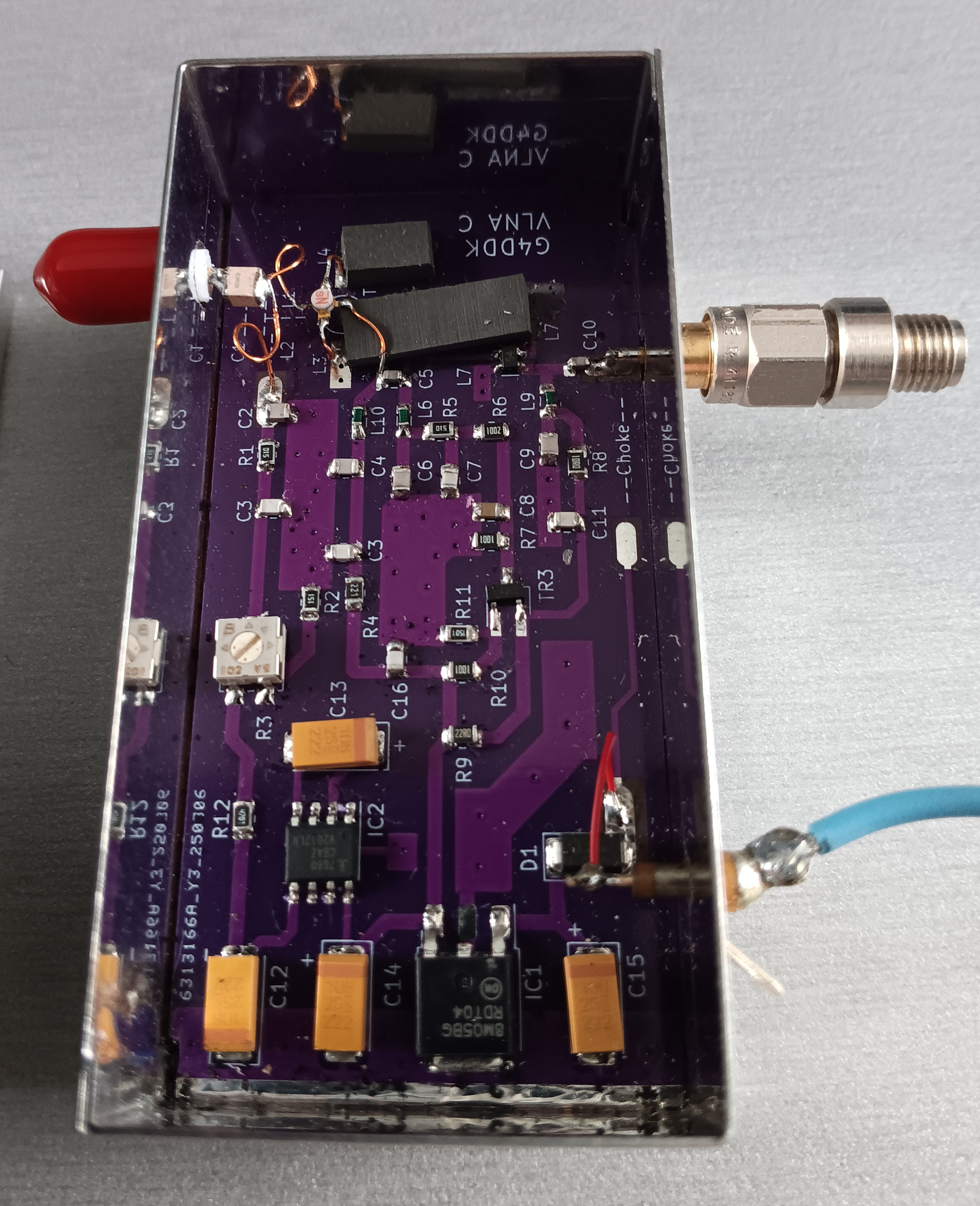 PA0PLY New G4DDK Preamp
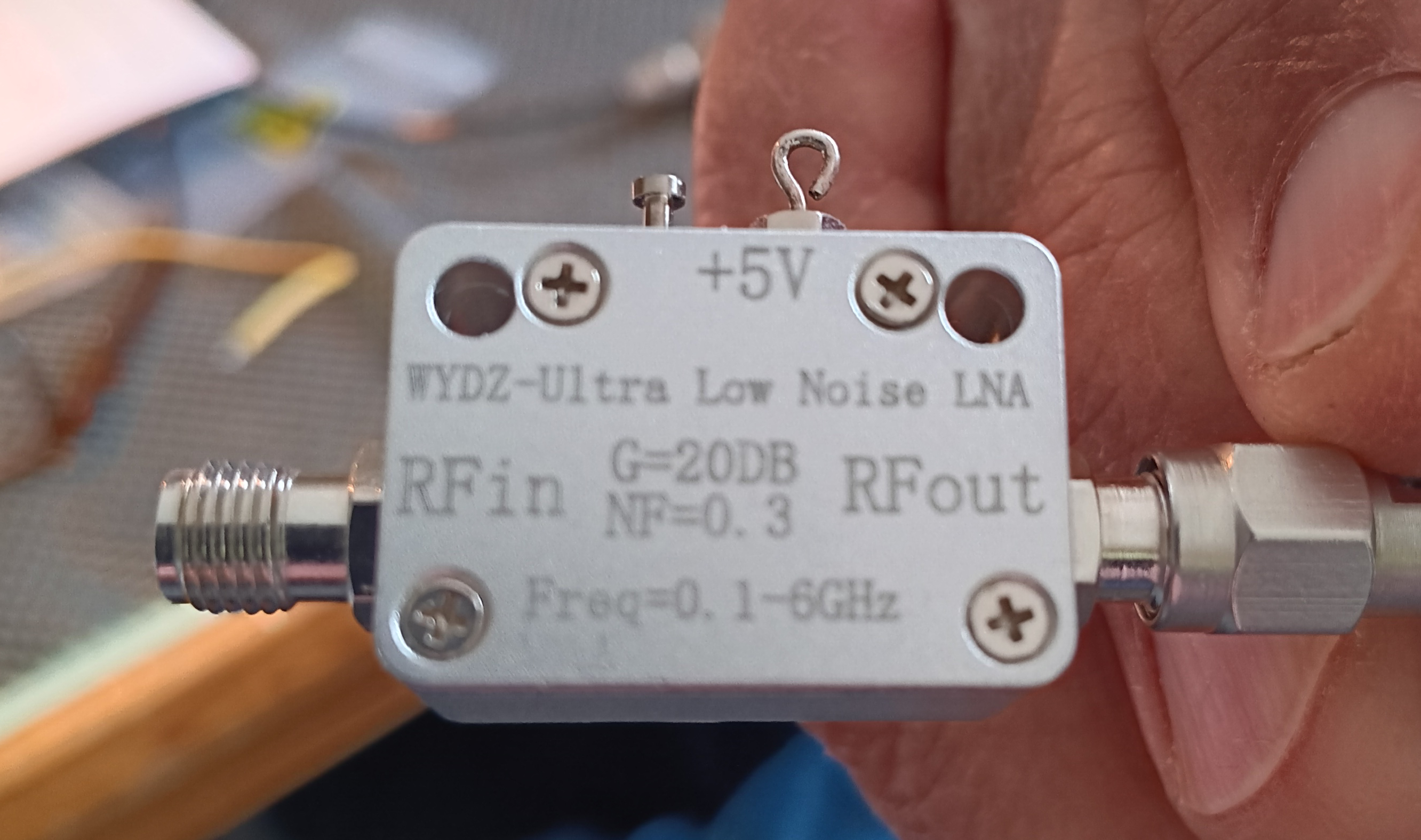 PA0PLY New Aliexpress Preamp
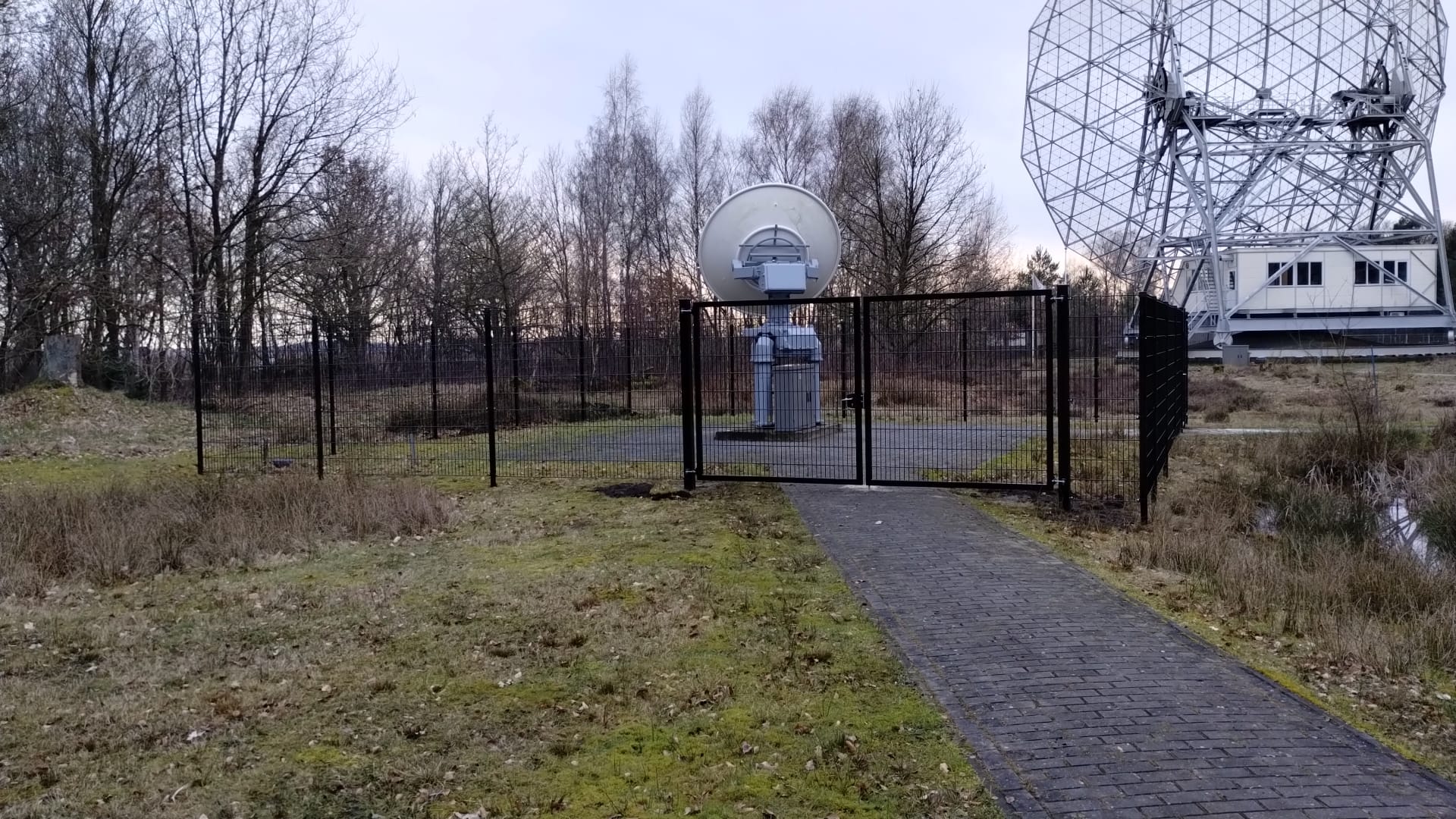 PA0PLY New 2.4 m PF Dish at PI9D
PA0TBR Ton
The last few weeks of March were quite exciting in which I had 23 cm QSOs with 4 DXpeditions:
T7/IW2BNA - San Marino
CY0S - Sable Island - New DXCC
ZL/LY3UM - New Zealand - New DXCC
9J2EME - Zambia - New DXCC
To top it all I also worked BV3CE Taiwan for a new DXCC in that 8 day period. What a feast with thanks to all the excellent operators to make these QSOs possible!
I had my doubts if I could work ZL/LY3UM because the low elevation was well below what I needed to get over the roof of my home. It seemed to be a mission impossible. Fortunately I noticed that there was that very tiny gap during my MR, which happened much further north than usual.
I copied Alex through that gap for 5 minutes, during which the QSO was made. It was the 2nd last QSO for Alex before he run out of moon and went QRT. It was also the only 5 minutes that I copied Alex from ZL. I was extremely lucky.
I participated in the ARI contest which was again a lot of fun. I worked 56 stations on 23 cm with Q65, 7 Italian stations for multipliers and 6 new initials: DL6ZG, LU1HKO, OE100OEVSV, OZ9AAR, SP5MS and WI0JK.
PA2DW Dick
It was great to have two consecutive Contest-weekends, although I think many of us are a bit tired now…
For the occasion I cleaned my dish from a green layer of algae and moss, as I believe this avoids absorption of RF. Or is this overdoing it? hi!
I had limited time and was only going for a few CW QSOs. In the DUBUS-REF contest I worked three stations on Saturday, OK2DL (L O U D!), SA6BUN and UA3PTW. On Sunday I joined PI9RD and made some nice QSOs. Thanks Peter, SM2CEW for the nice QSO in my best Swedish hi!
I was going to be active on both days in the ARI contest, but had problems with my sequencer on Saturday… I fixed it and on Sunday I noticed that the moon was a bit lower again than Saturday and that activity on CW was a bit less.
But the main problem was that my window was obscured by too much green stuff, so there is work to do! See the pictures below, of the position of the dish when I stopped at 22:30 GMT. It is a miracle that I worked G3LTF, G4CCH and IK2DDR with good but less strong than usual signals!
Rig: Elecraft K3, Kuhne TR1296H, both locked on GPSDO, SSPA 300 W (building new one for QRO :)), 2,4 m dish, G4DDK LNA
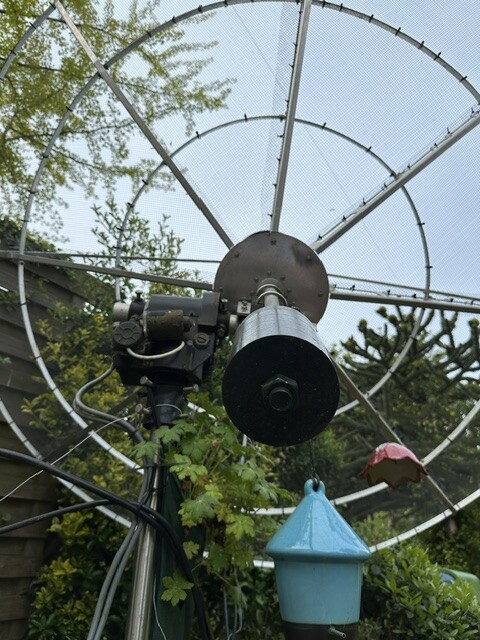 PA2DW 2.4 m Dish at End of Window
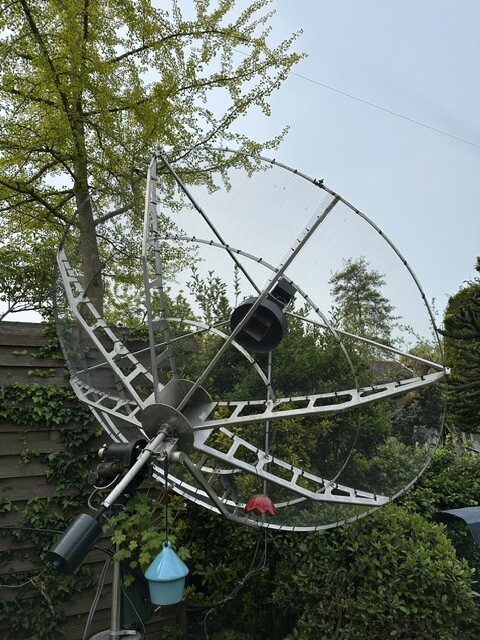 PA2DW Dish Work Needs to Be Done
PA2V Peter
It's been some time since I sent some information for the newsletter. I moved my 432 MHz EME gear to the clubhouse location a while ago and set up antennas for terrestrial contacts for 6 M up to 23 cm.
The home QTH suffers a lot from RF pollution and VHF is sometimes hard to work. I looked for more 23 cm material and acquired a broken Kuhne 250 W amp. I was able to repair it and have some nice results with it. So I wondered if I could do some EME with my micro sized setup.
I have an IC9700 GPS locked, G4DDK preamp in the shack and a 36 el. YU1CF Yagi 2.9 meters long. The LCF12-50 coax loss is 0.8 dB. I have around 200 watts at the antenna.
HB9Q was the first one I would like to try. His monster dish and power should be enough to work me I thought. On our sked time the moon was not fully clear from the mountains but we easily completed. While we made the QSO some others also saw my tiny EME echoes and in the next few weeks I was able to work 5 more stations. All of them were worked just after MR or before MS, as I have no elevation rotor.
In the meantime I also figured if it will be possible to set up a dish at the clubhouse, my EME QTH. At the end of the year there will be enough space to put it there. Up until then I will do 432 EME there and 23 cm from my home QTH with my micro moonbounce setup.
I am very interested in more big stations to try. My last victories on EME over the last month:
1296 MHz My His
3 Jan HB9Q -22 -23
26 Mar NC1I -21 -27
26 Mar W2HRO -26 -25
27 Mar OK1KIR -26 -24
27 Mar UA3PTW -21 -21
29 Mar OZ9AAR -22 -23
13 Apr ZS6JON XX -24 Not complete
432 MHz
27 Mar NC1I +6 -10 Never seen Frank this strong of the moon. Amazing!
28 Mar VK4AMG -24 -21 New initial
28 Mar 9J2EME -25 -21 Lots of cross polarisation. They did a great job. Tnx!
PA3DZL Jac
HIGHLIGHTS were some GREAT DX-Peditions
• Alex from ZL/LY3UM for a NEW DXCC and worked from 2 Grid squares
• Bernie, John and Lins from 9J2EME worked on 3 bands: 144, 432 and 1296 MHz all NEW DXCCs, great signals on all 3 bands.
• Adelio and Walter T7/IW2BNA worked on 5 bands, 1296, 2320, 5760, 10368 and 24048 MHz 4 of these were NEW DXCCs, amazing signals on all bands.
432 MHz QSOs February 20nd up to 31st of March:
OK1IN, OK2CMZ #, VK4AMG #, YO5TP, DF6LH, GM8JBJ, W3TI #, AA5C, VE6TA, W5ZN, NC1I, NY1V, JO4KVP, JF6CTK, IWØRNA, K3SK, WQ5S, PJ4MM, G4YTL, 9J2EME # for NEW DXCC # 88 FIRST QSO ever PA-9J, BA4QNR #, BA4TGI #, DDØVF and OK1JG. I have 466 initials on 432 MHz now.
1296 MHz QSOs March 2nd up to April 26th:
DF7KB, OE3GWC #, 9H1BN, PHØV, IQ2DB, DL6ZG, IK2DDR, KA6U, AA4MD, CYØS # for DXCC # 124 FIRST ever PA-CY, VK2CMP #, VK4CDI #, I2FAK, BV3CE, A71AW, DM9LSB, T7/IW2BNA # 700, ZL/LY3UM # for NEW DXCC # 125 from RF72PG, LU1HKO, OZ9AAR, SM6CKU, K6EME #, KB2SA, W2LPL, K6FOD #, NC1I, ZL/LY3UM # from RF73FX, 9J2EME # for NEW DXCC # 126 FIRST QSO ever PA-9J, F1DPX #, UA3MRE #, OK1UGA, SO5AZ, DC1RDB, DM2CFH, SP4DX, N8ECI #, RN1W, DC1RDB, LA3EQ, KGØD, OK2AQ, W4AF #, SP9VFD, PA1PS, LU8ENU, I have 712 initials on 1296 MHz now.
1296 MHz during the DUBUS CW/SSB contest I had 42 QSOs and I am very pleased with two initials JH5LUZ # and OM6AA #
1296 MHz during the ARI contest I made 17 QSOs: 12 in Q65-30sec and 5 in CW.
2320 MHz QSOs February 27th up to April 26th:
F1RJ, OH3LWP, some very nice SSB QSOs G3LTF SSB, DF3RU SSB, PAØPLY SSB, JJ1NNJ X-band CW/SSB, CT1DMK SSB and G4CCH SSB, T7/IW2BNA # for NEW DXCC #60 FIRST QSO ever PA-T7 and 4Z5LV # I have 181 initials on 2320 MHz now.
2320 MHz during the DUBUS CW/SSB contest I made 14 QSOs, no new ones.
3400 MHz QSO on April 17th:
BA7NQ # for NEW DXCC #35 - I have 90 initials on 3400 MHz now.
5760 MHz QSOs on March 21st
T7/IW2BNA # for a NEW DXCC #42 & the first QSO ever between PA-T7. I have 108 initials on 5760 MHz now.
5760 MHz during the DUBUS CW/SSB contest I made 10 QSOs, no new ones.
10368 MHz QSOs March 21st up to April 25th
W3TI #, T7/IW2BNA # for NEW DXCC #46 first QSO ever PA-T7, UT4UWR #, IK3HER #, PA3BYV #, I4TTZ, OH3LWP, LZ4OC, IZ4BFA, N2END #, NJ6D #, IZ4BFA, OZ1LPR, VE4MA, OE5VRL, I6YPK, YO2LAM, SM5DGX #, G4HSK, OH2DG, ON4CDU, OK2AQ, ON5TA, EA1IW, G4YTL, IKØHWJ, OZ1FF, IK3GHY #, DF7FJ, OK2AQ, VK7ZBX, VK4WYM and G8RWG. I have 168 initials on 10368 MHz now.
10368 MHz during the ARI contest I made 14 QSOs: 14 in Q65 and 1 in CW
24048 MHz QSOs March 21st
T7/IW2BNA # for NEW DXCC #12, IZØJNY #, LZ4OC and PA7JB # - I have 16 initials on 24048 MHz now.
I was also QRV on 144 MHz during the ARI Contest and made 27 QSOs, 26 in Digi mode and 1 in CW.
During the ARI contest last weekend on 10 GHz I tested and made 3 QSO using 30 SEC periods. Model Q65-30 SEC Submode D: although it looked more like Submode E !!! is that correct?
I worked: ON5TA R-04 / -07, IK3GHY R-07 / -13, G8RWG R-08 / -13
It was a very nice test!!
Ed Note: From DL3WDG - Indeed, perfectly feasible. 60s submodes are what folk historically use, but nothing wrong with 30s if you have signals that are strong enough.
The tone spacings etc are all in the user guide, so what the signal looks like really ought to be no surprise....
On 1296 MHz, 30B is widely used now, reverting to 60C (or 120D) if signals are too weak. QMAP of course can decode 60s and 30s periods.
T7/IW2BNA Mini-Expedition
Report on the T7/IW2BNA Mini-Expedition – March 2026. A compact yet ambitious microwave expedition was conducted by IW2BNA (Walter) and IZ2DJP (Adelio). The activity took approximately three weeks to prepare and was initially planned as a three-day operation, from March 21st to 23rd, with four bands planned: 13, 6, 3, and 1.2 cm. Once on site, encouraged by favorable conditions and operational momentum, the team extended the activity for an additional day (March 24th) and successfully added the 23 cm band, which had not been part of the original plan. This brought the total number of activated bands to five.
Given the complexity of the setup and the fact that this was their first experience with such a challenging multi-band microwave expedition, the overall result can be considered a great success. The bandwidth change was performed dynamically, adapting to propagation and activity conditions, while maintaining continuous coordination via the HB9Q data logger, which proved essential for managing schedules and monitoring demand in real time.
Operational Results A total of 205 QSOs were completed across five bands:
• 23 cm (1296 MHz): 107 QSOs (6 CW), 28 DXCCs
• 13 cm (2320 MHz): 22 QSOs (7 CW), 9 DXCCs
• 6 cm (5760 MHz): 14 QSOs, 10 DXCCs
• 3 cm (10 GHz): 51 QSOs (4 CW), 20 DXCCs
• 1.2 cm (24 GHz): 11 QSOs, 8 DXCCs
Observations
The only significant problem encountered during the expedition occurred on the 6 cm band, where heavy Wi-Fi interference severely affected operations. After a few initial QSOs, continued activity on 5760 MHz became impractical. Despite this limitation, all other bands performed well, and the station remained active and responsive throughout the expedition.
It's worth noting that, aside from the 23 cm band, which had seen relatively recent activity, many of the QSOs on the higher microwave bands likely represented the first-ever contacts with T7 for several stations.
A key strength of the expedition was the station's highly modular design, which allowed for extremely rapid reconfiguration between bands. Each configuration was designed as an independent "plug-and-play" module, allowing operators to switch between bands in minutes with minimal mechanical intervention. This flexibility proved invaluable in maximizing QSO opportunities, as the team was able to react immediately to changing propagation conditions and activity levels on HB9Q.
Rather than being tied to a fixed band schedule, the station operated dynamically, seamlessly "hopping" between frequencies to meet real-time demand. This modular approach significantly increased overall efficiency and was a key factor in achieving such a large number of QSOs in a limited amount of time.
Conclusion
This expedition demonstrates that, even with a small team and limited preparation time, it is possible to successfully activate multiple microwave bands, provided operational flexibility and effective coordination are in place. Special thanks to all the stations that participated, made calls, and supported the effort.
QSL request of T7: To request the QSL, please send your contribution of 5 EUR via PayPal to the QSL manager Walter IW2BNA (
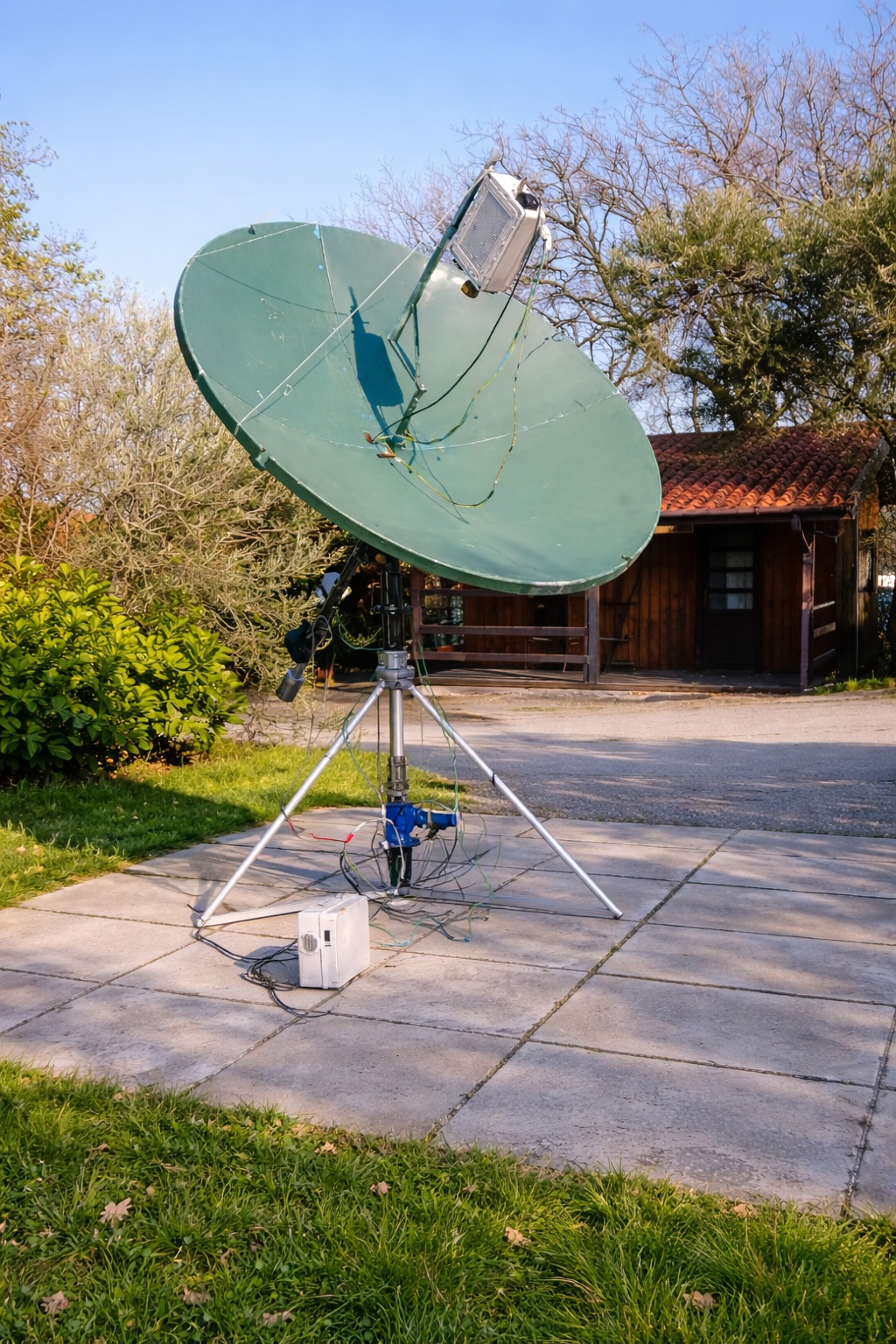 T7/IW2BNA 1.8 m Dish
 T7/IW2BNA Configured for 24 GHz
 T7/IW2BNA Operating Position
VE4MA Barry
I was very happy to work T7/IW2BNA -17/-18 on 13 cm on March 24th. It’s unfortunate that I did not resolve my 24 GHz 14 kV cable issues in time to work them.
My weather has been very unstable this spring, my snow has finally disappeared but the overnight temperatures are still below zero C with chances for snow, so not suitable for leaving the 47 GHz system on the dish. I have replaced the 24 GHz HV cable assembly so hope to be QRV frequently now.
The weather was very bad on April 18 for the DUBUS 23 cm contest. VE4SA is 1 km away to the east and operates only on 23 cm, so we agreed that only he would operate.
I did get QRV on April 19 on 10 GHz and QSO’d IW2FZR, G4HSK, ON4CDU, ON5TA, G4YTL, G8RWG, and N1AV. Signals were excellent, even from the many 1.2 m dishes with low power. My moon noise was 2.8 dB.
I was QRV on 10 GHz again on Monday April 20th and QSO’d SM5DGX, OZ1LPR (he was -1), IK3GHY, IZ4BFA, DJ7FJ, SV3AAF and OE5VRL.
On Tuesday April 21 on 10 GHz I QSO’d YO2LAM, N2END, NJ6D -16 with new 50 W SSPA and 1.2 m dish, PA3DZL. The beacon was only -6 but I am not sure how much power they are running now, as they used to be -2?
On Wednesday April 22nd on 10 GHz I QSO’d W3TI, DG2YK gave me an SWL report of -15 with his 2 ft. (60cm) dish, SM5DGX, G4HSK -15 with his 1.2m dish and 12W, OH2DG , EA1IW, ON5TA, ON4CDU, and OK2AQ.
I really enjoyed the random activity on 10 GHz and the variety of stations that were active on successive days!
I was active on 10 GHz for the ARI contest on April 25/ 26. The moon window was late for EU stations but I did work OZ1LPR on digital and CW, IK3GHY, DL4DTU, IK3HAR, ON5TA, OK2AQ, IK3HWJ, F4HSK, NJ6D and N1AV all on digital.
 VE4MA DG2YK 60 cm 10 GHz A
 VE4MA DG2YK 60 cm 10 GHz B
VE6TA Grant
It has been a while since my last update. So here is a report of my activity over the last month or two.
432 EME Q65 unless otherwise noted (5.5 meter dish, dual dipole feed, GS-23b tetrode amp)
2026-02-20 VE3CIQ, PA2V, #G4BWP, K3SK, AA5C, #VK4AMG
2026-02-21 #IZ6MVK, G0JDL, #DF6LH, PA3DZL
2026-02-23 K3SK, PA3FWV, SV3AAF, GM8JBJ, (#328)4X1AJ, VE3CIQ, KL6M
2026-02-24 PA3DZL, G0JDL, VE3CIQ.
2.3 GHz EME Q65 unless otherwise noted (5.5 meter dish, Round CP septum with .55 IMU launcher, combined Spectrian PAs at 350 W)
2026-03-01 #OK1USW, #G4SDG, (CW for the following) G3LTF, G4CCH, OH2DG, OK1KIR, W5LUA, CT1DMK, SP9VFD, (Q65 for these QSOs); DF3RU, VE4MA, #KN2K, N0AKC.
2026-03-02 Q65 (#131) PE9GHZ
1296 EME Q65 unless otherwise noted (5.5 meter dish, round feed with screw polarizer, W6PQL at 600 W)
2026-03-18 NC1I, #K6EME, #LU1HKO, KG0D,
2026-03-19 #WI0JK, KA6U
2026-03-20 #CY0S DXCC 89, #KV4J, #KV7E
2026-03-21 #DL6ZG, VE4SA, IK2DDR, IZ8GGF, #F1PDX
2026-03-22 #BV3CE DXCC 90, #UA9FA, HG5BMU, #OZ9AAR, W2LPL, #F1RJ
2026-03-23 #T7/IW2BNA DXCC 91, #DC1RDB, M0FXX, SM6CKU, #YU1DA DXCC 92, ES3RF, OE3JPC, #W8TN
2026-03-24 SV3AAF, K1WHS, #DJ7FJ, #PA3JRK
2026-03-25 N5BF, #ZL/LY3UM DXCC 93
2026-03-26 OZ3Z, WW1X, LU1HKO, AA5C
2026-03-27 #9J2EME DXCC 94
2026-03-28 W2LPL, N1AV, NY1V, #N8ECI, #ZL/LY3UM RF73, KV7E
2026-03-29 KB7Q
VK3UM CW CONTEST
2026-04-18 KL6M, IK3MAC, PA3DZL, OK2DL, UA3PTW, SP6JLW, OH1LRY, #558
RW6HM, SA6BUN, AA4MD, SP9VFD, OK1DFC, G0LBK, G3LTF, SP6ITF, OK1KKD,
WA9FWD, VA7MM, WA6PY, CT1FGW, VE4SA, K0PRT, JH5LUZ, VK5MC
2026-04-19 NQ7B, G4CCH, PI9RD, I2FAK, NC1I, WB8HRW, G4RGK, CT1FGU dupe,
ON5GS, I5YDI, F6ETI. for 34 QSOs.
There were many exceptional signals on the band with great activity this year. I suspect the good moon window during normal waking hours had something to do with it. Also many 599 reports were given out and lots of super strong stations were on over the weekend.
The ability of CW contacts to provide messages with GM, GA, GE, GL, TU, CUL, SK, and Dit Dit brings back to me the essence of a personal EME QSO. This may not be for everyone but I certainly enjoyed it.
3.4 GHZ EME Q65 (5.5 meter dish with round septum feed IMU launcher, 140 W in shack)
2026-04-20 #BA7NQ DXCC 26 1st VE-BY QSO, #64 OH3LWP.
222 MHz EME Q65 (5.5 meter dish with linear loop feed and plane reflector, polarity control, modified Henry 3002 using a 8877)
2026- 04-21 K1WHS, N0AKC, #40 AA5C, K3SK
VK2CMP Mick
I worked the ARI contest on 70 cm over the weekend and while not a heap of activity and late nights it was still good fun. The highlight was working Jan DL9KR on CW again. Other stations worked via Q65 were VK4AMG, DL1VPL, OM4EX, SP2WRH, R1NW, PA3FWV & PA2CHR.
Over the weekend of 18/19th April I operated 1296 portable from the vineyard QF46LR about 4.5 hrs west from home again. The aim was to try and work some CW stations, however I spent most of Saturday getting my head around using the new 9700 on CW and the best way to combat some local noise. It’s only the 3rd time I used the new rig as the home station is a transverter and K4D. I nearly made some contacts but between not reading the manual (!!!) on the intricacies of the 9700 and my very average CW operating experience they got away.
So I started Sunday with low expectations and headed off to a wine tasting lunch with the XYL and daughter at the vineyard we were camping at. After lunch I made a couple of digital contacts when G4CCH suggested we try CW. I was very happy to complete CW QSOs with Howard G4CCH and then OK1KIR and UA3PTW. I did miss my pan-adapter view of the band that I have at home as well as the K4D. However I’m sure it’s a very capable setup and just needs some time to get the best out of it. It's either that or my now preferred option, which is to have some more wine before I try to attempt my next CW QSO. Stations worked via Q65 were YB2MDU, BV3CE, OK1KIR, UA9FAD, PA3DZC, G4CCH, RW9G, R1NW, JS6UJS, DF2VJ & OK2AQ.
On 70 cm at the home QTH I was very happy to work my 200th initial by the way of 9J2EME in Zambia. Many thanks go to the Ribbetjies EME Team for another successful activation.
During the weekend of the 21/22nd March I operated 1296 portable from Kangaroo Valley QF55GG about 2.5 hrs south of my home QTH. It poured with rain from the time we arrived on Friday until we packed up in the rain on Monday morning. I did manage to work most of the Sunday when we actually saw blue sky for a few hours and a few hours on Saturday to make 26 contacts. Fortunately Plan B in the form of Miroslav’s ”Reception of Weak Signals from Space” book finally arrived during the week so I had plenty to do during the rain. The rain was such that it was too wet to leave the radio, dish and PA etc. out even under awnings and tarps so I did manage to improve my pack / unpack times for portable ops.
It was a great location from the RF noise perspective as I only had S2 noise levels which is pure bliss compared to my home QTH. We did camp in a very wet paddock of which the owner thought we were mad to do and also told us that if we got bogged down, everyone was away for the weekend at a big football match so there would be no one to pull us out.
I worked the following stations on 23 cm over the weekend RY4C, RA4HL, JA4LJB, IK2DDR, OK1USW, RD4D, DF3RU, ZS5Y, NC1I, KB2SA on 1m dish, YL2GD, RW9OG, VK4CDI, OK1UGA, PA3DZL, OK2DL, OK1VUM, PA1PS, DL1SUZ, UA9YLU, I2FAK, OK1IL, HB9Q, F1RJ, HG5BMU & DF2VJ.
The picture is the setup at QF55GG when the sun came out for a while on Sunday.
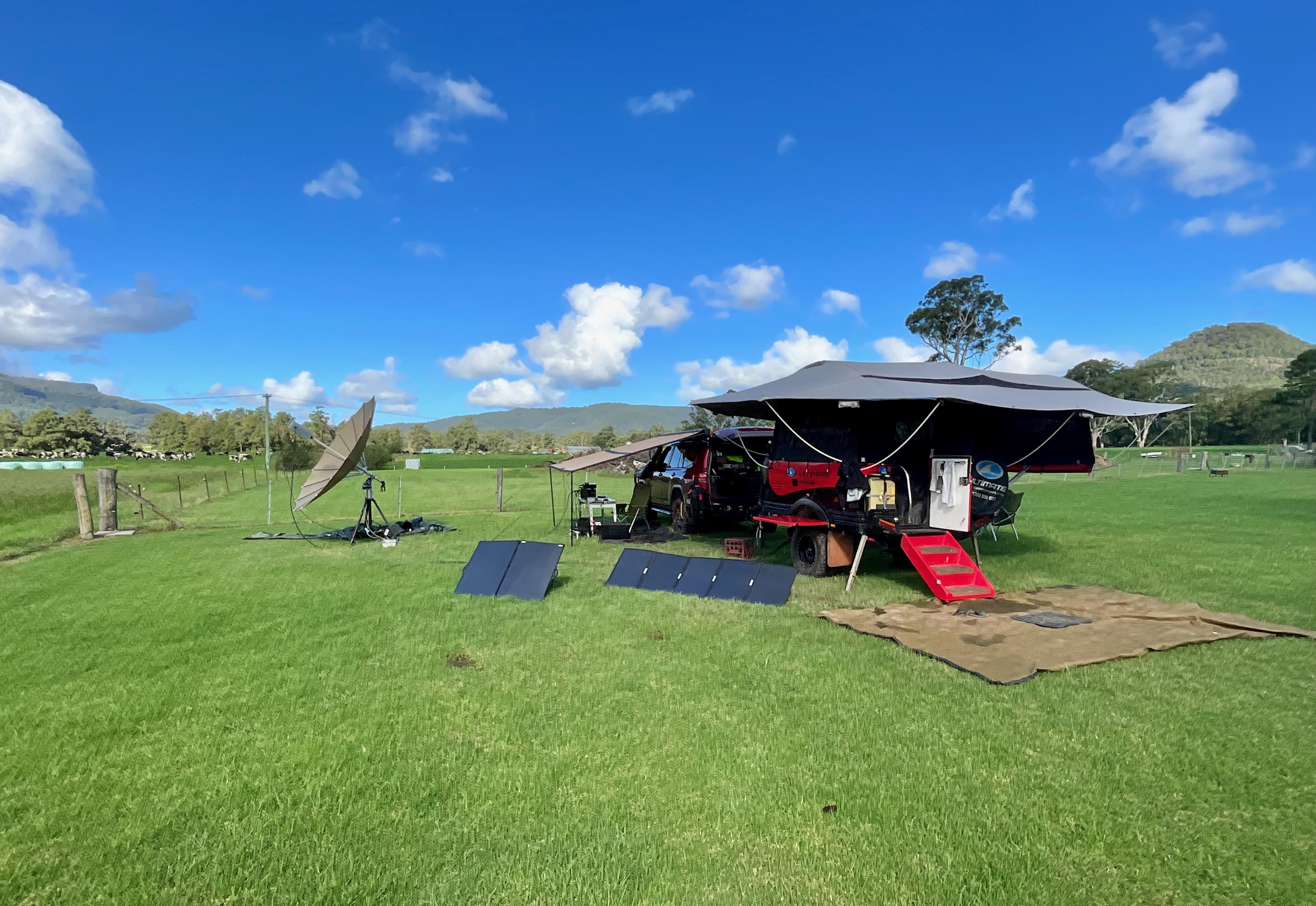 VK2CMP Portable Setup
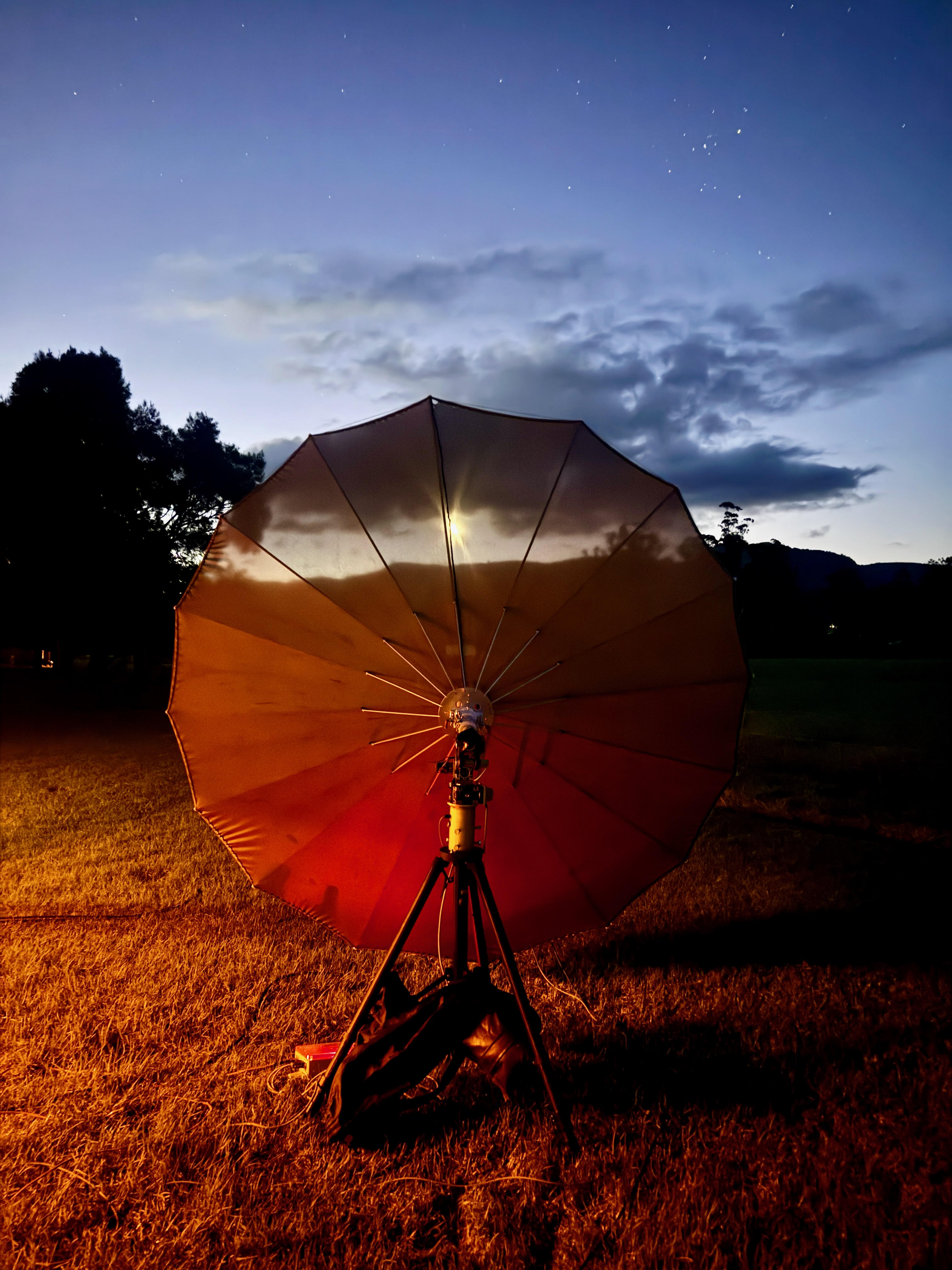 VK2CMP Dish at Moonrise
VK4AMG George
My new 70 cm EME station is still coming together and I am getting better with operating it. My "Moontrack" with Az/El data from WSJT works great.
Over twenty contacts including initials NC1I, HB9Q, PA3DZL, VK4EME, JO4KVP, OK1VUM, VK2CMP, DL5FN, ON7EQ, PA3FWV, DL1VPL, VE6TA, and K3SK. Activity has been low. Mick VK2CMP has helped me test. Consistently quick QSOs with reciprocal -23 to -21 reports are resulting.
I am having better performance from MAP65 (& Aferdi dual channel SDR) since switching off deep search. It is interesting watching the polarization rotation, confirming a difficulty of working this band.
I've built a copy of OK1DFC's lightweight septum feed and added a 100-240 flare. It is currently installed on a solar cooker 1.5 m dish with a 0.2 dB NF Minikits EME179 LNA (NE3512S02, SAW BPF & PHA002 2nd stage). Sun noise test and focus adjustment swill happen when the rush dies down. Initial testing shows good return loss (>20 dB) and isolation (>30 dB). A W6PQL very high power PA deck will provide the transmit power.
I've been experimenting with a range of the latest low noise devices TQP3M9037, QPL9547, SKY67150, SKY67151, SAV-541, SAV-331, and some older devices NE3512S02, CE3512K2, and MGF4919. On FR4 PCBs most are <0.5 dBF on 70 cm but 0.8 to 1.2 dB NF on 23 cm. These figures are not as good as on manufacturers EVBs using multilayer Rogers substrates. I have tried to replicate G4DDK's design but even with Sam's personal guidance I have not been able to get to his remarkable figures <0.3 dBF
I have found the "Gold eBay RF Amp 04A" interesting. When modified for a single frequency it achieved 26 dBG 0.55 dBF on 432 MHz and 21.5 dB G 0.65 dB NF on 1296 MHz. On 1296 MHz when the manufacturer's guidelines are followed the return loss was -16 dB, surprisingly good for a FR4 PCB. Not good enough for 23 cm EME but I've had comments that some have found it can perform well enough for 144 MHz.
A x-Marine Satellite TV dish is waiting in the wings for addition of 10 GHz LNA and transverter. Moon tracker controller reads WSJT.dat and driving stepper motors.
The embedded hyper links are Moon Tracking for EME Digital Modes – VK4AMG EME Stepper Control 10GHz dish – VK4AMG Stepper Motor Controller – VK4AMG
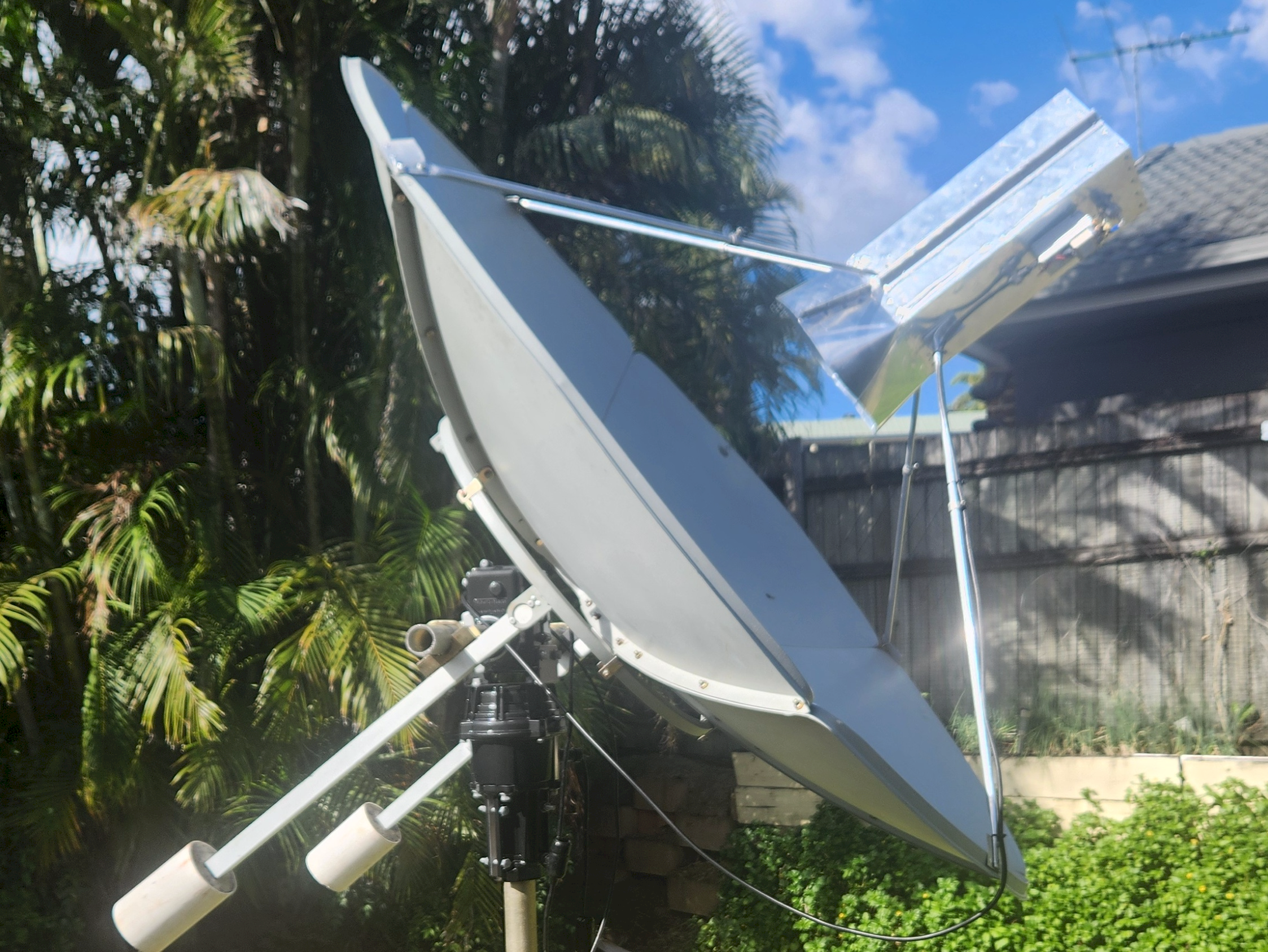 VK4AMG Cooker Dish With Flared Septum Feed
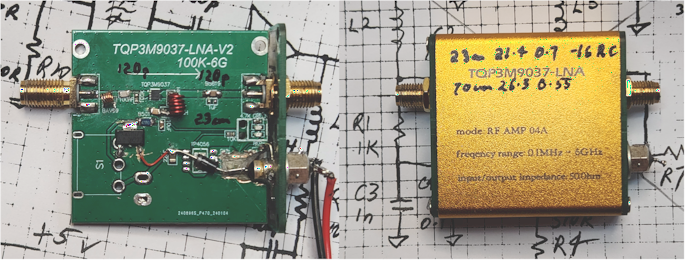 VK4AMG Preamps Tested
VK7ZBX Richard
Last Tuesday of the 14th April I was really happy to make my 1st contact into Greece on 3 cm EME. I worked Petros SV3AAF at 05:25 with around 5 deg. of elevation at my end. I arrived home early from work for a sked at 04:00Z, but I was in a rush and of course all the things happened. The windows PC decided that an update was in order, and then somehow the radio wouldn't talk to the PC.
Finally after this we managed the contact which was very pleasing. This was a new initial for me as well as a new DXCC.
I also received the certificate for the ARRL EME contest. I managed 5 contacts which isn't a bad effort for us down under hi hi!
I was also very fortunate to work the team from San Marino for another initial and new DXCC. See the pictures below from the contact
So far I am up to 32 DXCC on 3 cm and 70 initials. I hope to become really active on 23 cm, as I did have a bit of a bad run where I blew up a preamp, then a friend lent me one and yeah well I blew that up too! I also have some yagis for 70 cm so I have plenty of work to do!
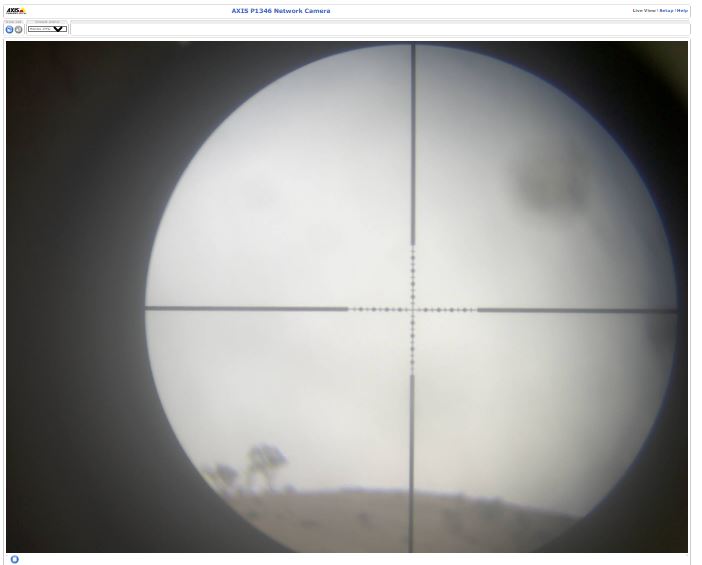 VK7ZBX Low Moon at time of SV3AAF 10 GHz QSO
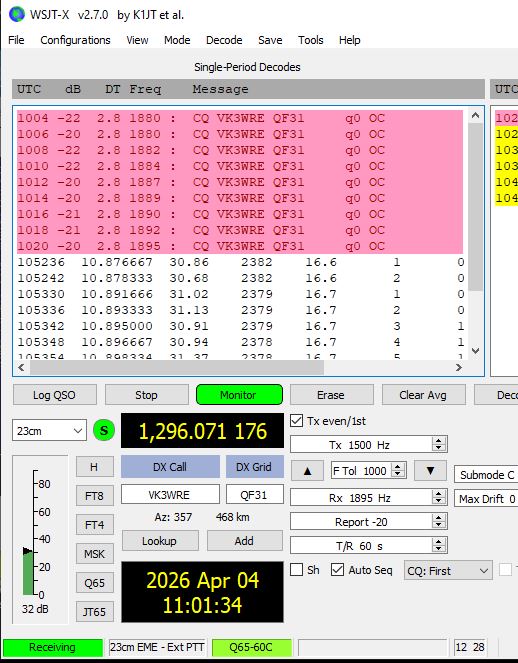 VK7ZBX 23 cm 1st decodes
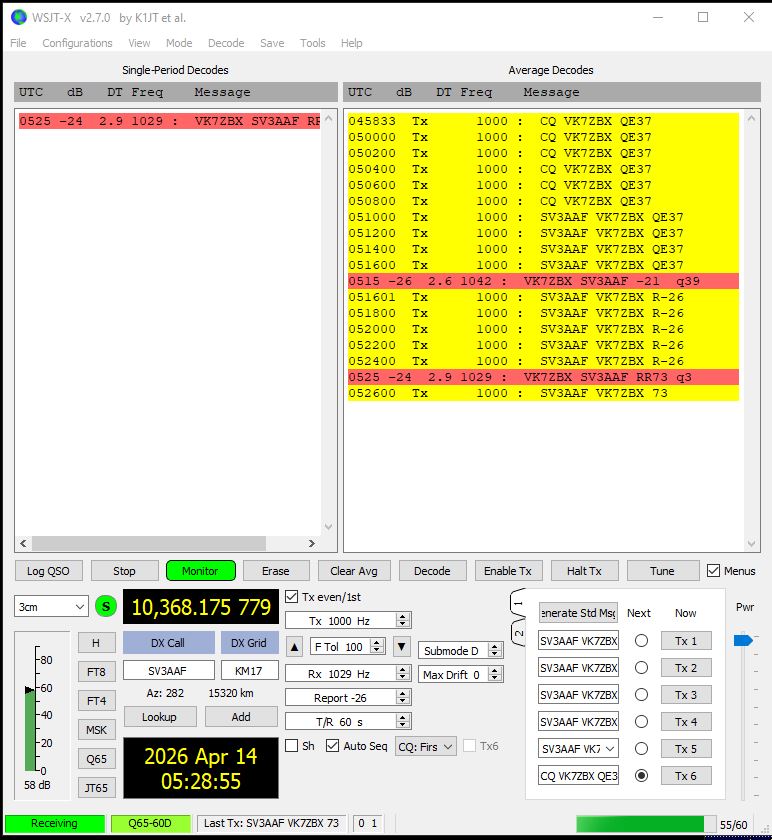 VK7ZBX 10 GHz QSO with SV3AAF
W5ZN Joel
On 432 MHz I worked 9J2EME for DXCC #35 and grid #255. I also worked new initials DD0VF, DJ8MS, IZ6MVK, OZ7UV, and PA3DRK.
I am available most anytime for a sked for those needing the state of Arkansas or grid EM45.
W8TN Clark
Not a lot to report this month since my last report but I operated on March 23rd and 24th of 2026 making a total of 12 QSOs, including two new DXCCs.
All 12 were Initials: F1RJ, VE6TA, N0LWF, W2HRO, PY2BS (DXCC #29), K3SK, W1FKF, N5BF, DK3EE, LA3EQ (DXCC #30), DL1SUZ, and OE3JPC.
I was not able to work CY0S despite trying. This brought my standings to: 116 QSO’s, 30 DXCC’s, 83 Grids and 99 Initials after 8 Operating Sessions.
Due to wind, rain and some physical issues, I have not been back on 23 cm EME for 4 weeks. So I’m getting anxious to bounce some more signals!
WA6PY Paul
I was QRV in the DUBUS contest on 432 MHz and worked on 31 January DL9KR, UA3PTW and VE6TA.
On 2304 /2320 MHz 28 Feb worked W5LUA G4CCH G3LTF OK1KIR SP3XBO OH2DG OH1LRY SP6JLW SP9FVD CT1DMK. I called CQ for my western window for one and a half hours but unfortunately I didn't hear other stations.
On 5760 MHz 21 March UA3PTW SA6BUN OH1LRY OH3LWP G3LTF SP6JLW SP3XBO OZ1LPR G4CCH
I was active in the 1296 MHz part of DUBUS-REF EU EME Contest on 18-19 April.
I QSO'd: OK2DL SP6JLW G3LTF UA3PTW OM6AA SA6BUN F5KUG SP9FVD OK1KKD OH1LRY G4RGK SM3BYA VE6TA KL6M WA9FWD OH3LWP NQ7B JH5LUZ K0PRT G4CCH ON4BCB SP6ITF RW3HM SP3XBO SV3AAF I5YDI NC1I ON5GS.
Conditions were very good and signals were quite strong and easy to copy.
I plan to be QRV in the contest on CW on 10 GHz in May and 24 GHz in June.
First 47 GHz QSO
OK1DFC Zdenek
After five years of preparation and research, I finally managed to establish a real EME QSO in the 47 GHz band. This was preceded by the construction and modification of four versions of transverters, the replacement of the dish, and many other tasks. Finally, on the already functioning system, I replaced the dish drive control developed very well by Jose EA3HMJ unit with one offering a resolution of 0.001 degrees. Yes, this is truly essential. The radiation pattern of my antenna is 0.16°.
In addition to the technology, favorable weather conditions and low lunar libration are also very important. I made my first attempts back in October of last year with Miguel CT1BYM, but they didn’t work out — rain, clouds, and high water vapor content in the atmosphere prevented it.
The most painful was the first attempt at 47 GHz. I didn’t realize that I needed to set a longer PTT hold time than it takes for the waveguide switch to switch, and I ended up damaging a very nice LNA from Iban EB3FRN that had given me a solar noise figure of 12 dB. After repairing it, I got the figure down to just 7 dB, which is clearly insufficient for the signals present at 47 GHz EME. (NF is 4.2 dB, measured at OK2AQ lab, thanks to his help and consultations.)
Currently, I’m using a replacement LNA—also not as good as the previous one made by JA8CMY, but my solar noise is now 9.4 dB. MAcom will send me a new chip, so I have one more LNA repair coming up in May, and I hope it will work properly this time.
I made my first attempt on April 20 and 21. Everyone heard me perfectly, but I couldn’t hear anyone. This is described, including screenshots, in a post from the DUBUS contest. So, I replaced the LNA with a JA8CMY and chose an even better time for the contact on April 23.
Klaus DC7KY was ready. He uses a 2.4 m prime focus antenna and 15 W of power. After the contact began, he decoded me immediately. I didn’t decode him until AVG decoding occurred because, after all, 3 dB of solar noise is still missing. The contact became a reality. I received a report of -16 and transmitted R-32, because the AVG decoding didn’t evaluate it any better. Klaus used “SH, the short message” mode in WSJT for the confirmation, which I didn’t like very much, but okay — I saw both RRR and 73 on the corresponding frequencies in the waterfall.
We have another sked scheduled for May; hopefully he won’t do something like that again and the contact will go as planned. By May my LNA should be repaired, and conditions will be even slightly better than in April. Hopefully the amateur radio gods will have mercy and grant us good weather as well. A screenshot of the contact and a few pictures follow.
In closing, I would like to express my sincere thanks to Mirek OK2AQ for giving me the opportunity to measure the noise figures on the LNA for 47 and 76 GHz, as well as for his expert advice and assistance. I’d also like to thank the guys from OK1KIR, who have been my inspiration for EME operations since 1978, and last but not least, Franta OK1CA, with whom I actually began my entire EME endeavor in 1996 and Manfred DL7YC for other hints and tips.
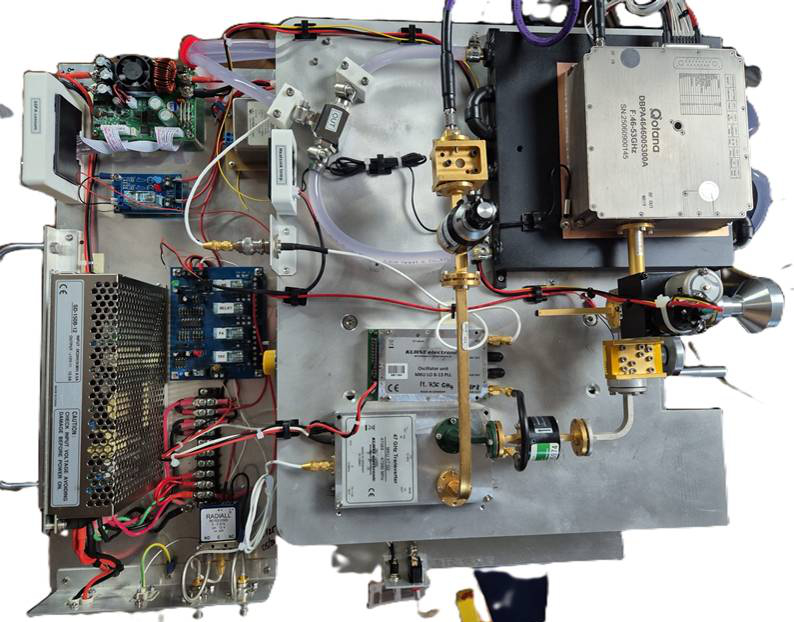 OK1DFC 47 GHz Transverter Used in Tests with DC7KY
Equipment used during the contact with DC7KY
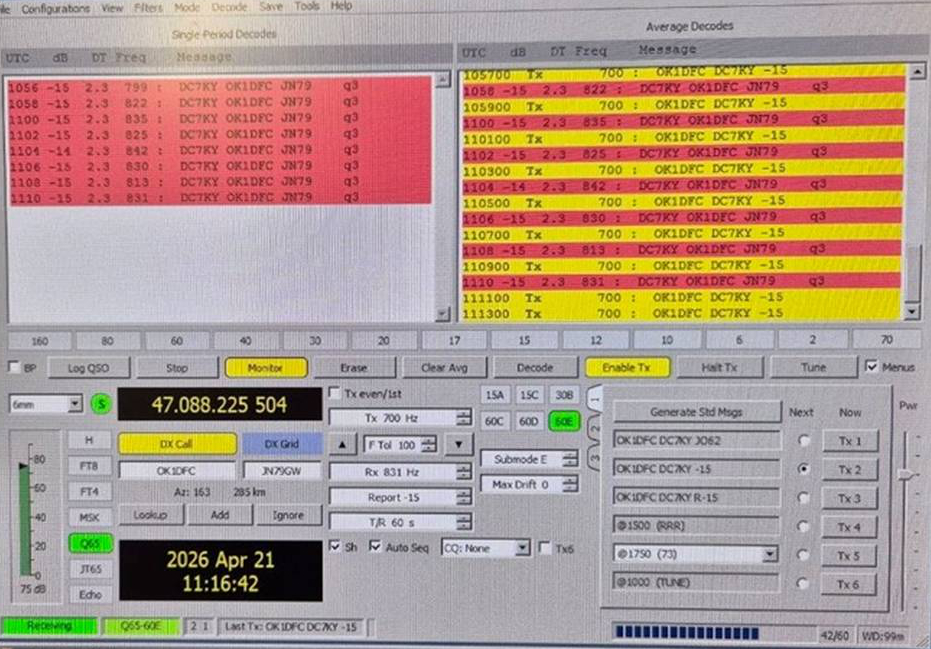 OK1DFC Screen Shot from April 21 47 GHz Tests with DC7KY
Screen shot from the attempt with DC7KY on April 21.
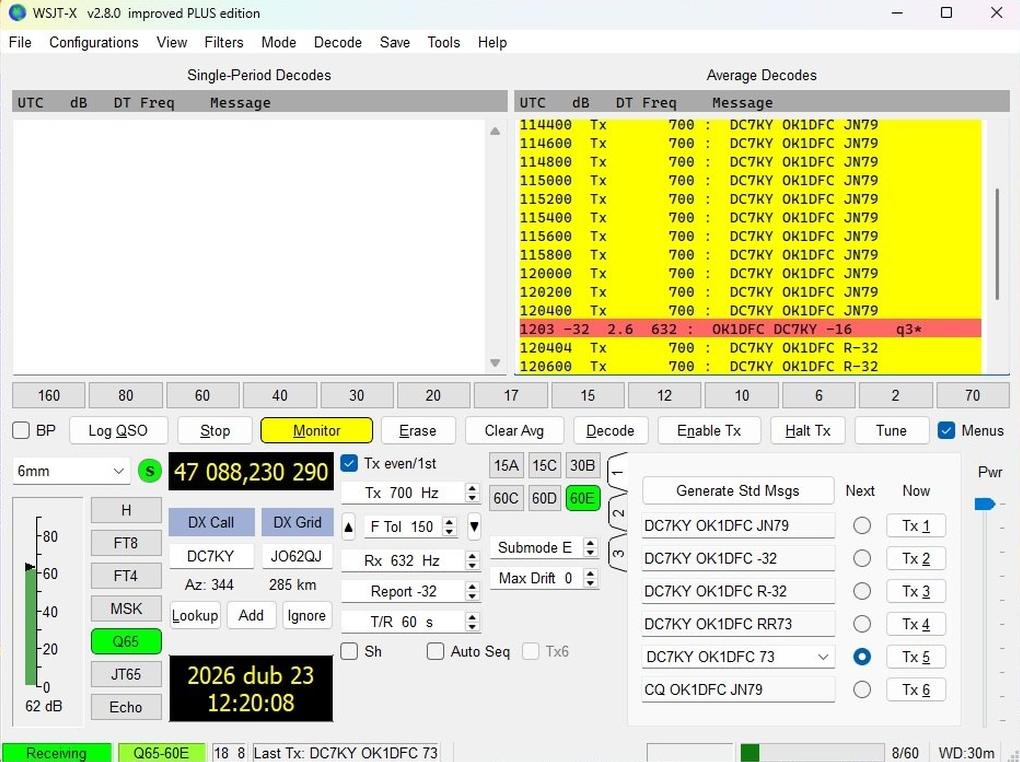 OK1DFC 47 GHz Decodes of DC7KY in AVG
Decoded DC7KY signal in AVG
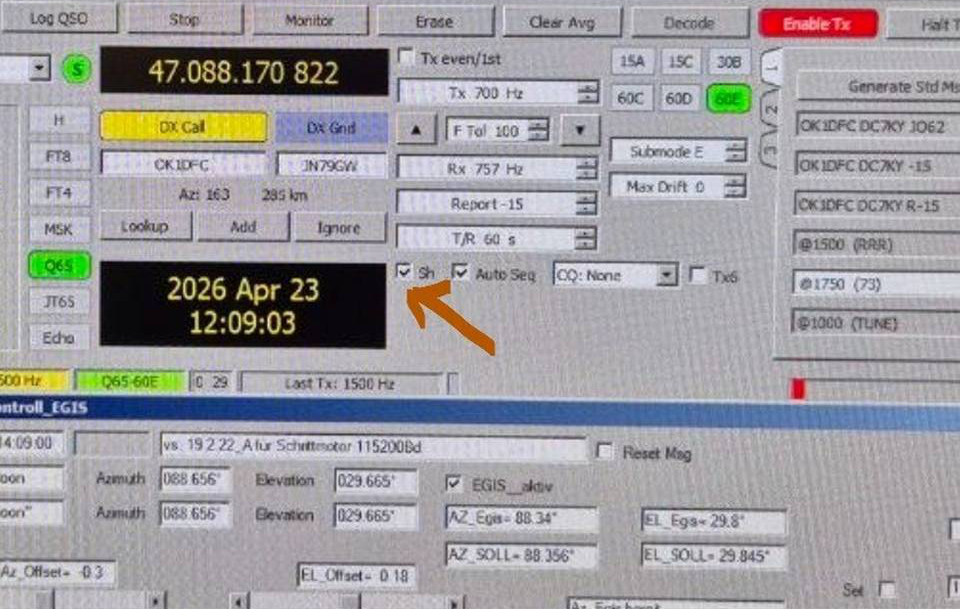 DC7KY Screen During OK1DFC 47 GHz Test
A screenshot from Klaus's screen showing the "Sh" checkbox selected. This causes a single tone of 1500 Hz to be transmitterd as "RRR" and a 1750 Hz as "73" - Hopefully next time it will include the full text.
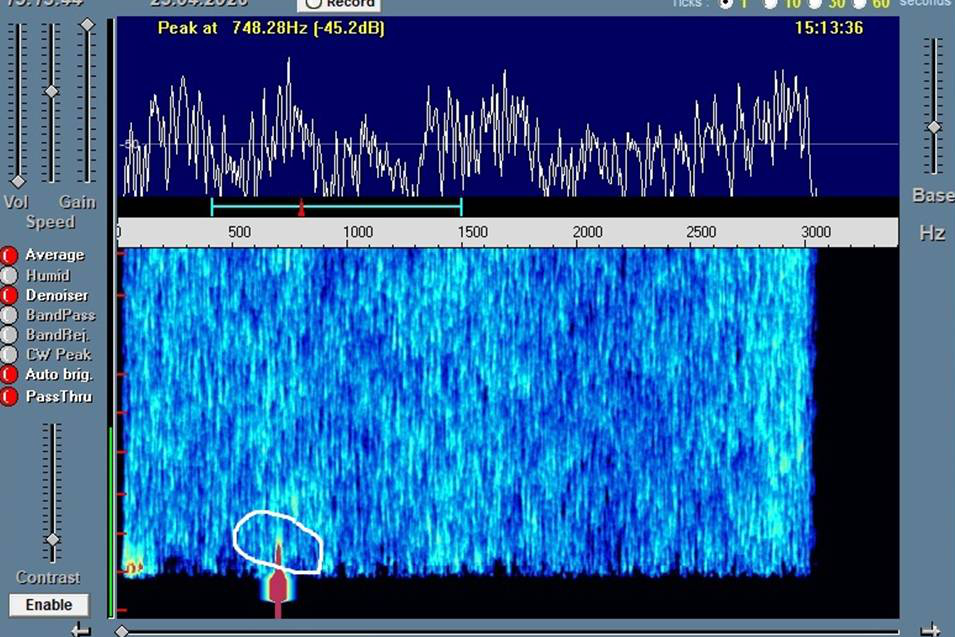 OK1DFC 47 GHz Echo in Spectran
My own echo at 47 GHz; only a small portion is visible, but it's quite strong. The shortest reason because the switch time to RX is set long for better LNA protection.
The First Lunar Reflection Communication at 76 GHz
Sergei RW3BP and Manfred DL7YC
The first ever EME QSO at 76 GHz took place on April 22, 2026, between RW3BP (KO85) and DL7YC (JO62). The transmission mode used was Q65-60E, during which “single decode” reports of -14/-15 and -17 were exchanged, respectively.
DL7YC, Manfred, used a 2.4 m prime-focus parabolic dish with an f/D ratio of 0.385, equipped with an optimized feed for 76 GHz, designed to minimize spillover and maximize efficiency.
The 2.4–2.5 dB noise figure low-noise amplifier (LNA) is located directly behind the feed, avoiding waveguide losses ahead of the preamplifier.
A highly stable frequency reference (GPS-disciplined OCXO) is used for the station and temperature stabilization is used for the entire RF input stage. The resulting system sensitivity is sufficient to detect signals in the range of only a few dB signal-to-noise ratio.
A 5.0 W solid-state power amplifier (SSPA) is used. The amplifier contains 16 single amplifiers with MMICs from gotMic / Sweden.
A unique feature of this operation was that, due to the high losses at 76,032.1 MHz, no waveguide relays were used; instead, separate feeds were employed for receive and transmit, each feed is “slid” into the focal point with a precision of 0.1 mm.
The RX feed return-wave protection is “automatic” by the “out of focus position” of the RX-feed at TX times (prime-focus configuration).
RW3BP, Sergei, used a 2.4 m offset Gregorian dish, driven by a high-efficiency 76 GHz SSPA with an RF output power of 8.1 W.
Sergei's LNA is slightly better (2.2 dB NF) than the one currently used by Manfred, but very similar in design using OMMIC (now MACOM) MMICs.
Both SSPAs and both LNAs were built by Sergei, who, immediately after the contact, commented:
“Today the weather was excellent for EME. Clear sky and light wind, with a temperature of +12 °C. Most importantly, the humidity was low at 25%. This is very rare in Moscow. It only happens when Arctic air arrives quickly. The 76 GHz band is not 24 GHz, but humidity still has an impact.”
In Berlin, the sky was clear and blue, +13 °C, 1021 hPa.
Further adjustments to the highly precise positioning of DL7YC`s TX feed will be required for upcoming tests. After some time had passed during testing and no codes appeared on his end, Sergei came up with the idea of shifting his dish by just 0.1 degrees—but only during the RX periods—in order to receive the DL7YC signal.
A first shift to the left side by 0.1 deg / then another 0.1 deg shift resulted in NOTHING!! Then a 0.1 deg antenna shift to the right (from its original steadily tracked moon position) immediately resulted in a -17 decode of DL7YC`s signal.
What does this mean? The beam from DL7YC at TX times generated a 0.1 deg spot, 0.1 deg apart from RW3BP original 0.1 deg wide spot. Both of them looked at the moon, but at a point differing by 0.1 degrees.
We believe that when DL7YC's TX feed “travels” into its TX position, there is a 1 mm combined position error. This error will be part of further investigations, because precision laser measurements on the bench did not show this... Probably due to the mass and the high travel speed of the SSPA/LNA combination (1.7 kg), the security end stops will “back bounce” a bit??
These and additional technical details are available at:
https://pa0ehg.com/76ghzperformance.htm
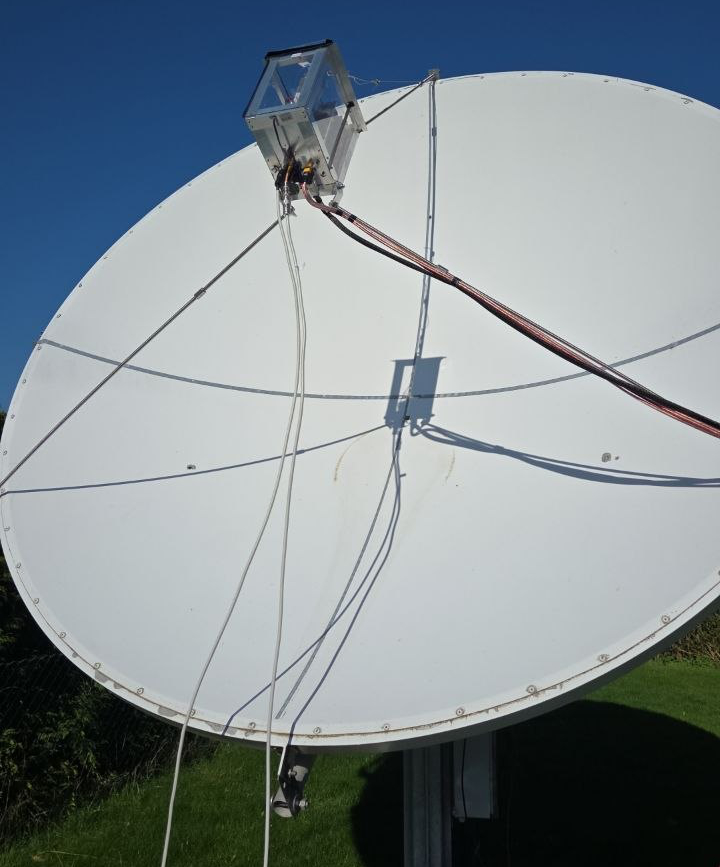 DL7YC 2.4 m Dish for 76 GHz
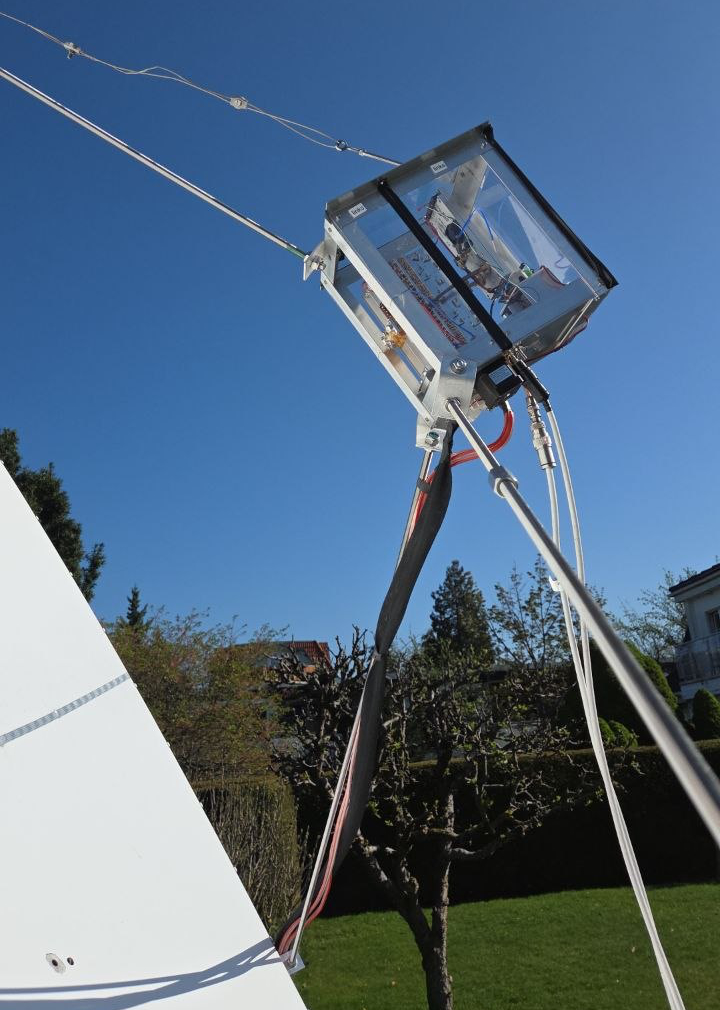 DL7YC 76 GHz Transverter at Feedpoint
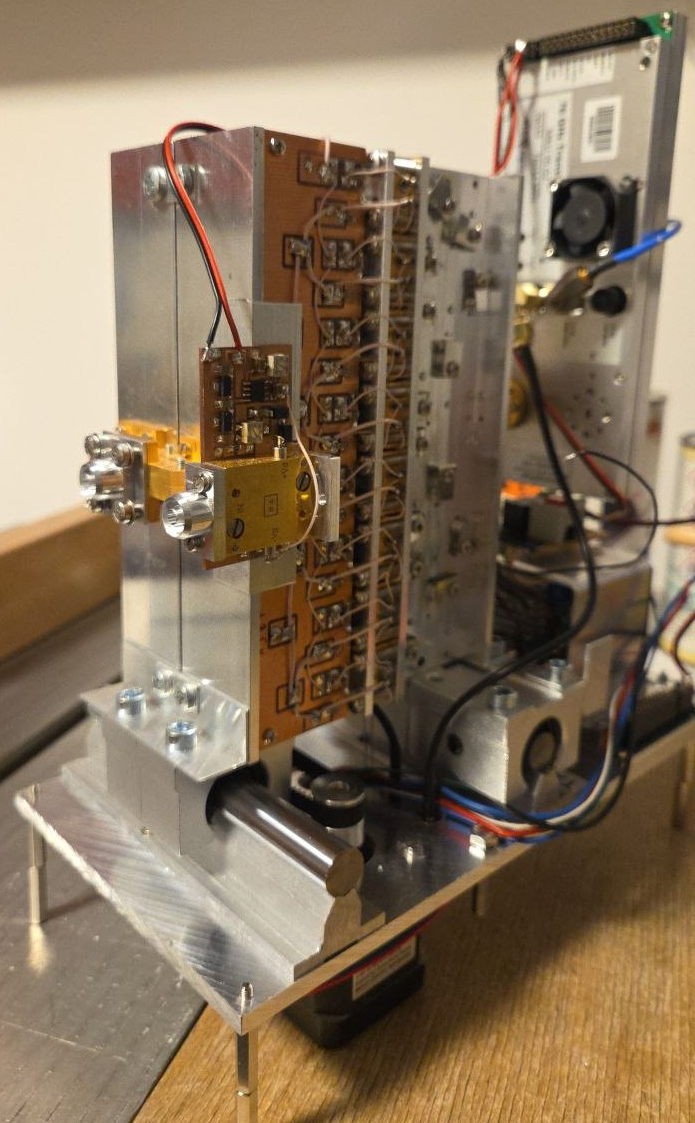 DL7YC 76 GHz Transverter Closeup View
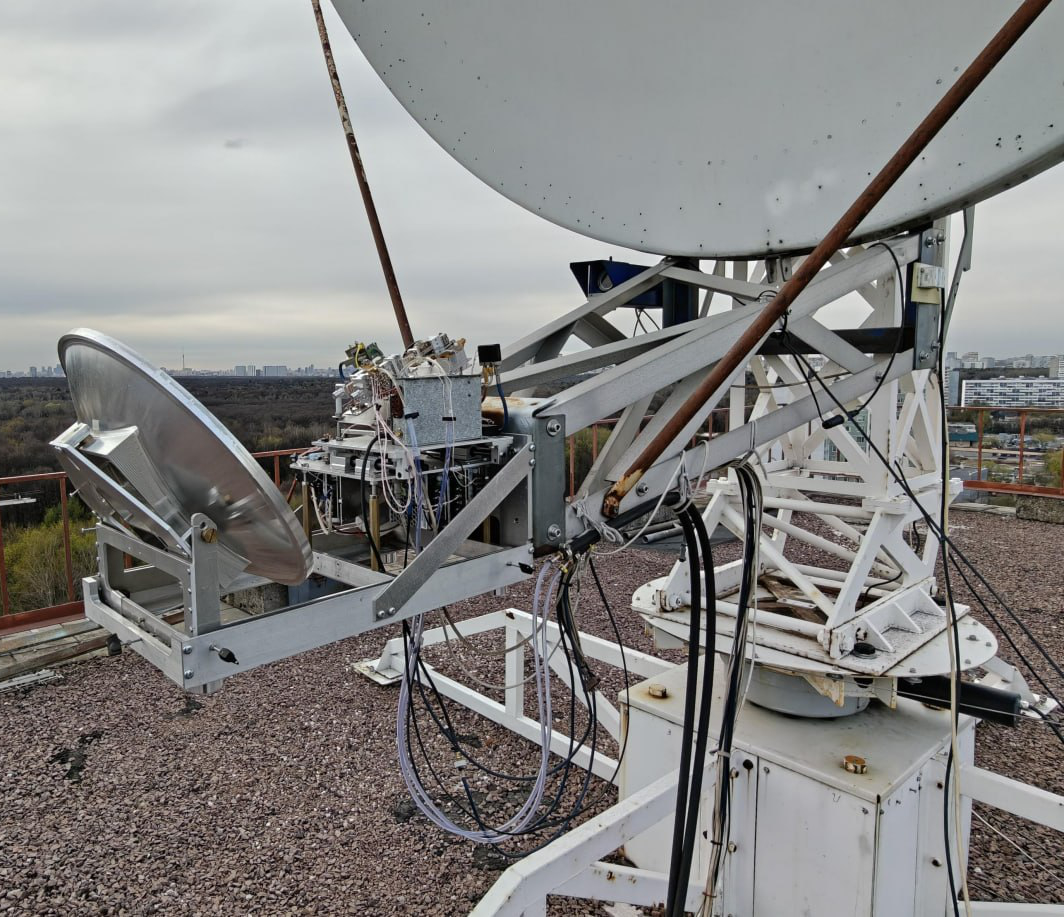 RW3BP 76 GHz Transverter at Feedpoint
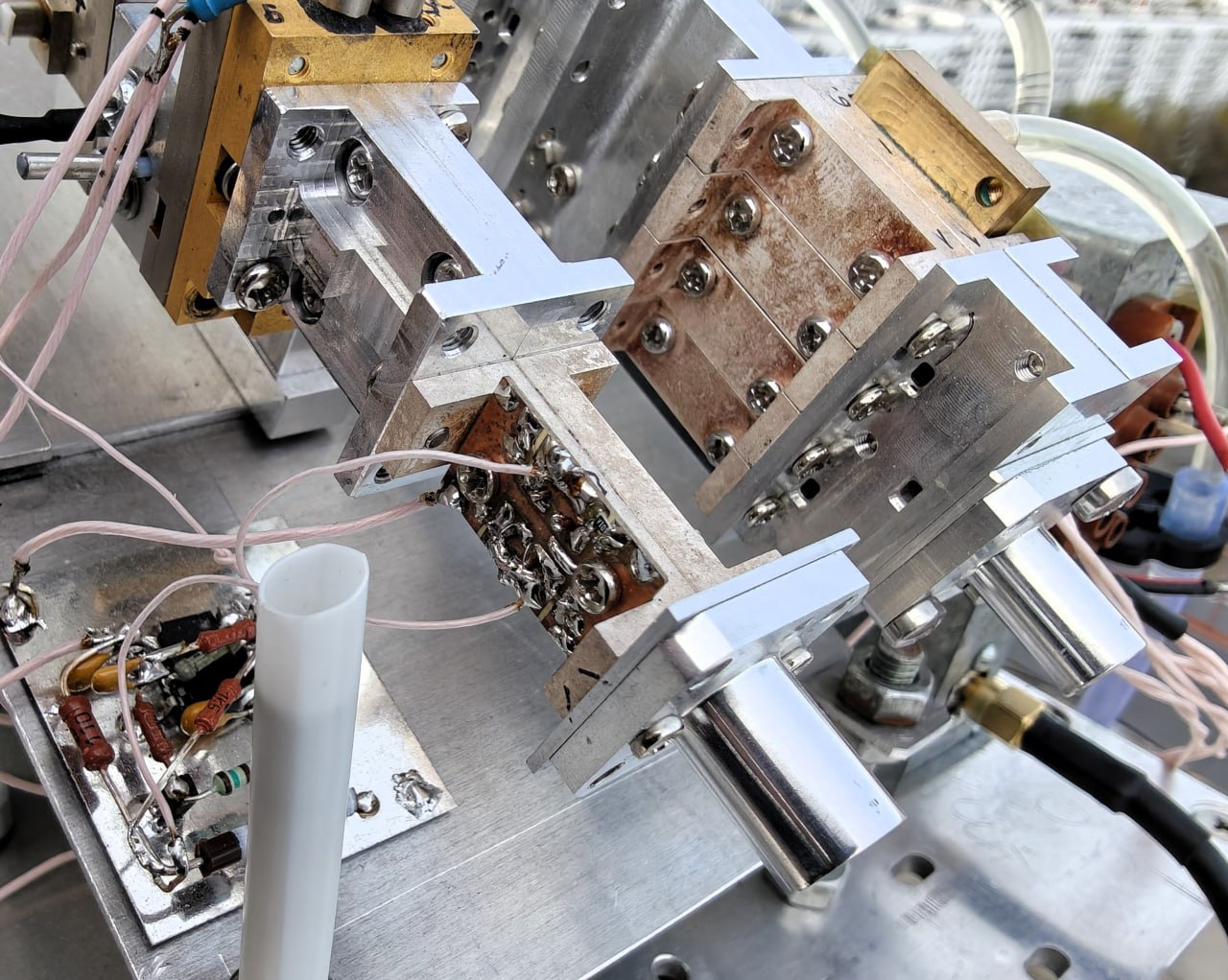 RW3BP Feedhorn RX Preamp Closeup View
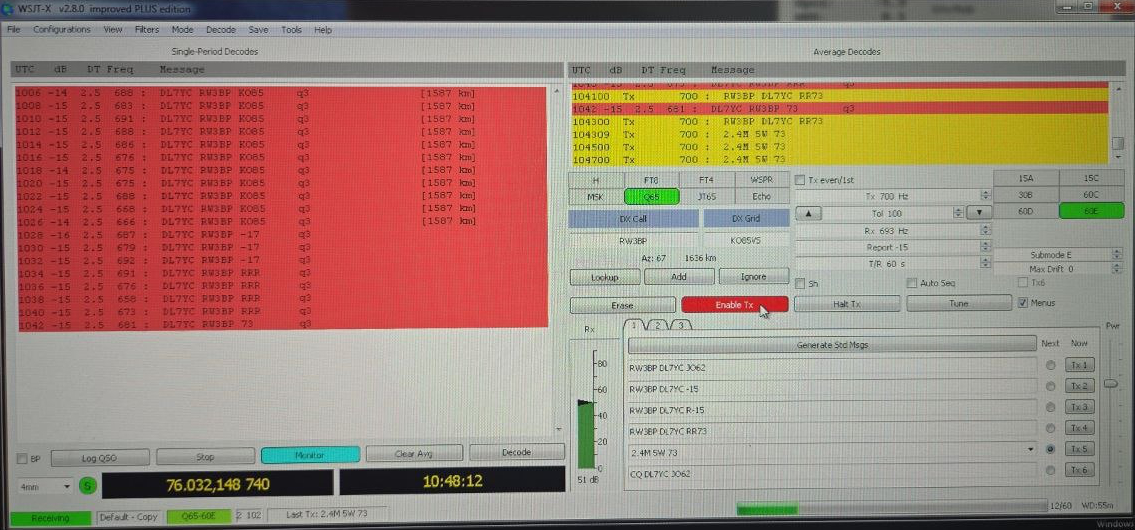 DL7YC Screen 76 GHz QSO with RW3BP
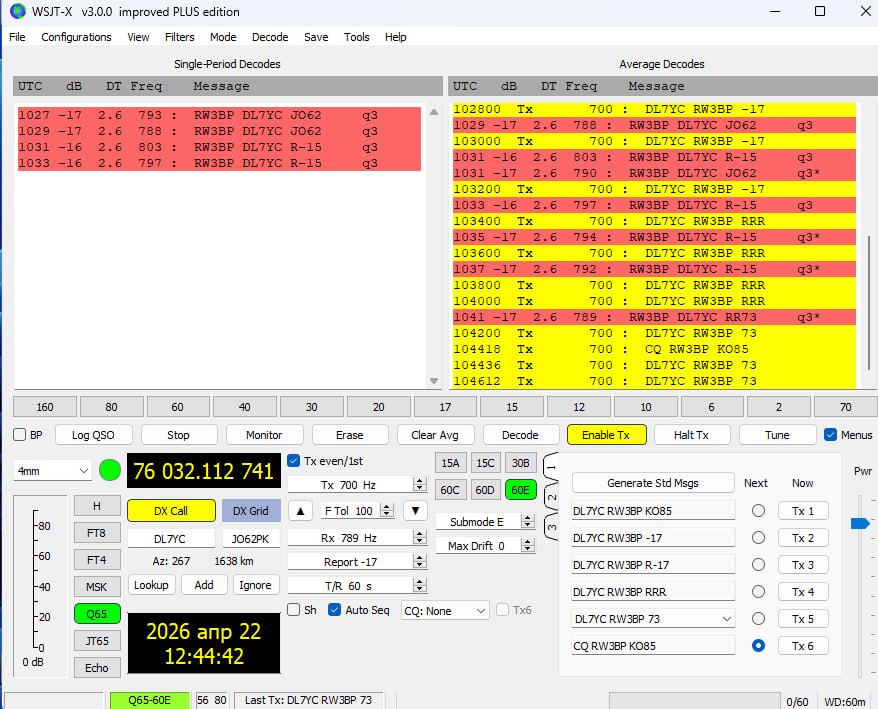 RW3BP Screen 76 GHz QSO with DL7YC
Fold Up Septum Feed
KN0WS Carl
In the past few days I have cut a few sheets of aluminum down to make a taped-together short 23 cm septum dish feed. After my Trenton EME presentation on taping the lining of 3D feeds, I may become known as the guy who tapes together feeds! I have had an idea of putting together a feed that could be collapsed flat and stored in luggage for transport. Once patch feeds became popular, there seemed to be little use for my idea. But since OK1DFC has put together his 23 cm “short” septum feed, I was interested again.
In Figure 1 you see the four aluminum sides and the sloped septum. Next to it is a steel back onto which the N connectors and feed probes are to be mounted. The idea for transport is to have the back steel with the probes and the rest flattens to what you see next to it (although the septum stays inside).
I did not have any dimensions from Zdenek OK1DFC’s project, but measured and estimated from various pictures. As shown in Figure 2 I took a 5/32” brass tube from the hardware store and cut a test length. Nothing soldered into place - just crimped onto the center conductor of the N Jack.
Figure 3 shows the feed slapped together using aluminum duct tape, no conductive adhesive or anything else. I had thought to use some “Faraday tape” from eBay, but started with this, since it is cheap and available.
Figure 4 shows the assembled feed under SWR test.
Figure 5 shows a 1.042 SWR at 1296!!! It was a good guess on my dimensions, it seems. I have not put the RX probe in to test for isolation. I thought I would quit for now while I am ahead.
After getting home from my weekend ARI efforts, I put a second probe into the feed.
Figure 6 shows the two probes in place and the slot in the back that the septum slides into when assembled.
Figure 7 gives a better visual idea of how the feed collapses when the back is removed.
Figure 8 shows results on my cheap vector analyzer once I had taken the feed apart and re-assembled. The SWR is no longer perfect, but is still very good at 1.23:1. The isolation is not ideal at -23.5 dB, but I tend to use a CX350 relay which has an additional 65 dB of isolation to protect my pre-amp on the RX side, anyway.
This summer I will put 400-600 watts through it to see how the tape holds up!
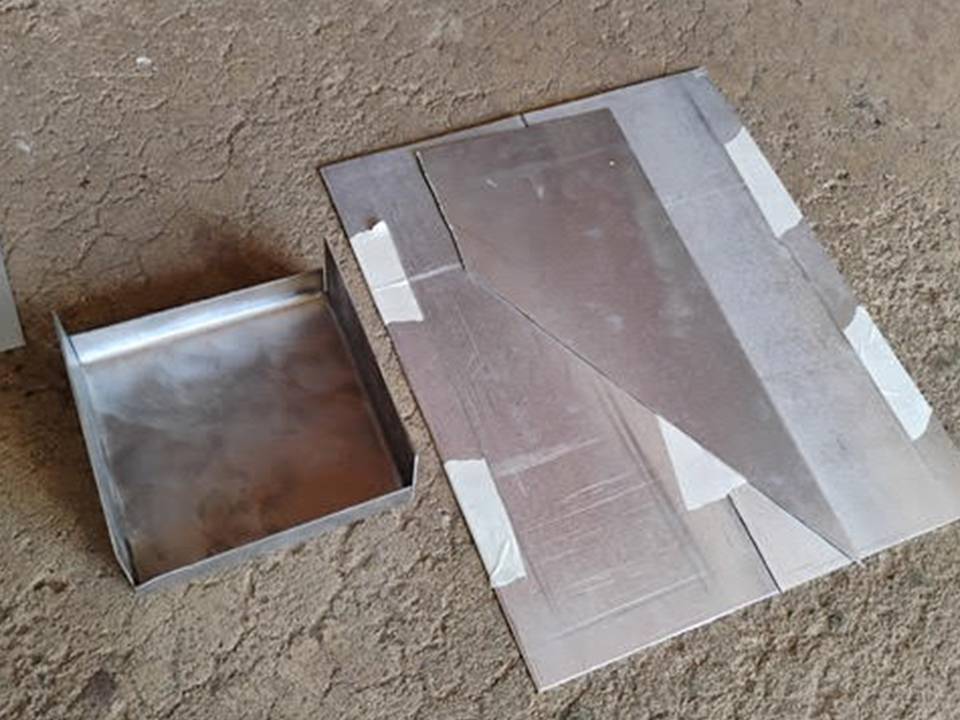 KN0WS 1 Aluminum Sides and Septum
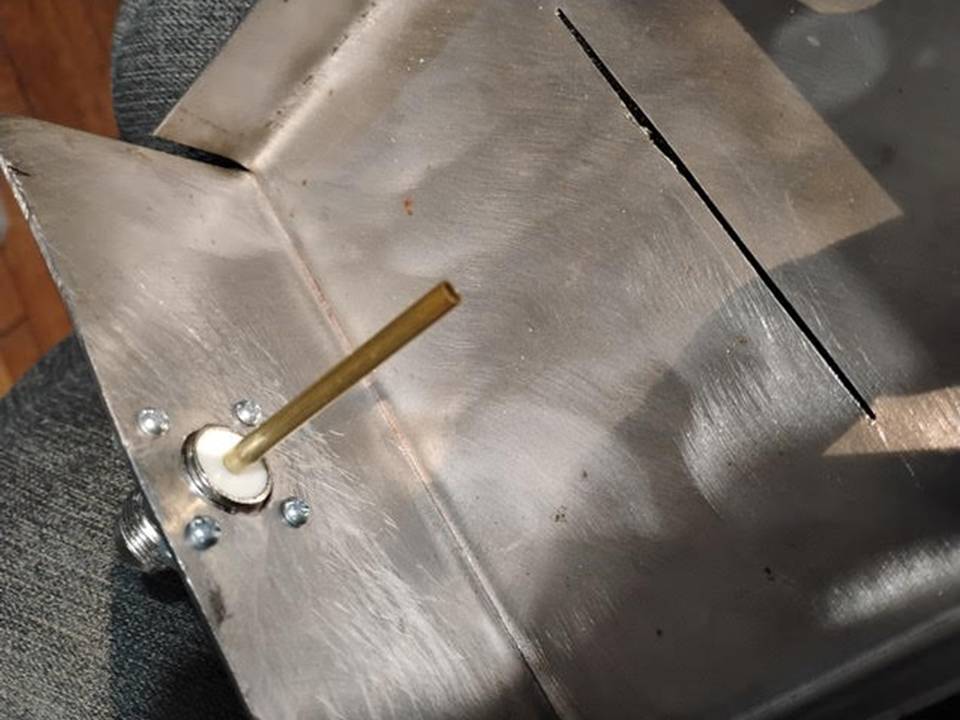 KN0WS 2 Test RF Probe
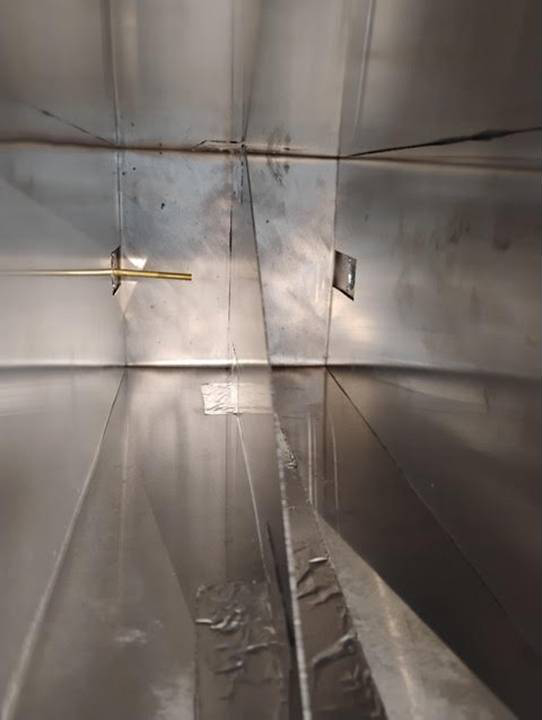 KN0WS 3 Feed Assembled with Aluminum Tape
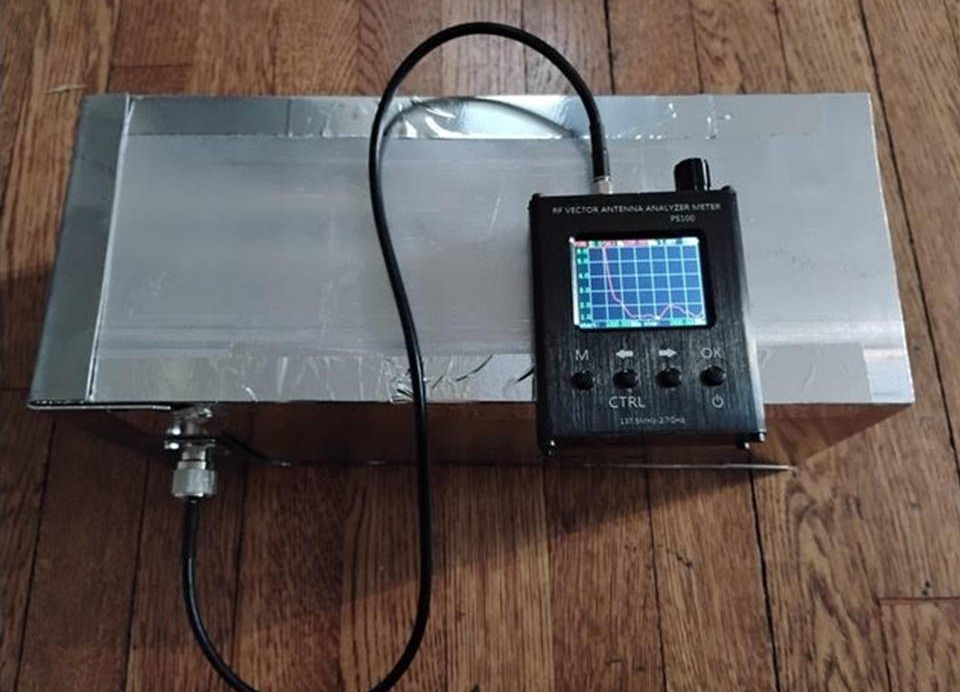 KN0WS 4 SWR Testing of Assembled Feed
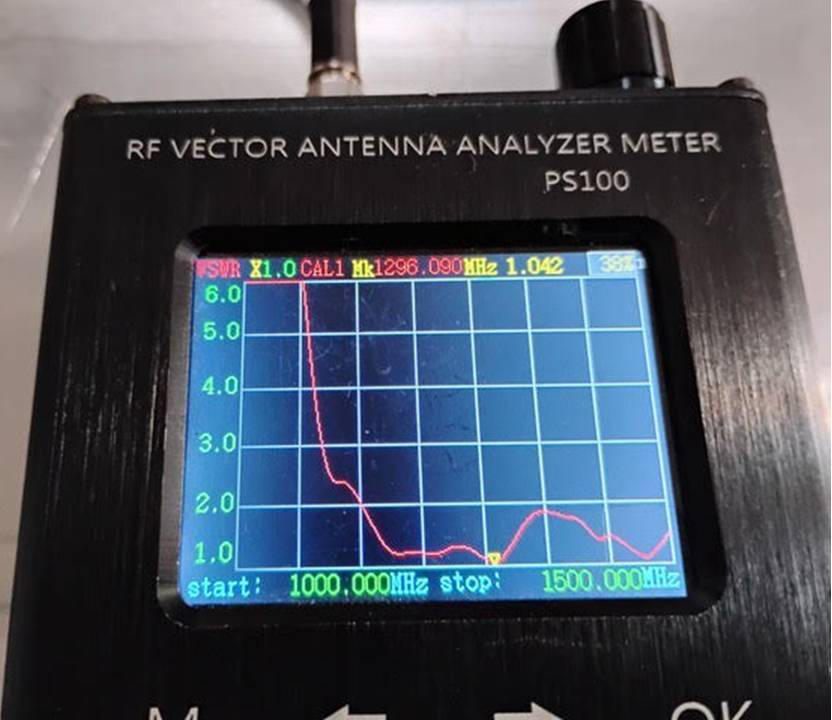 KN0WS 5 SWR Test Results
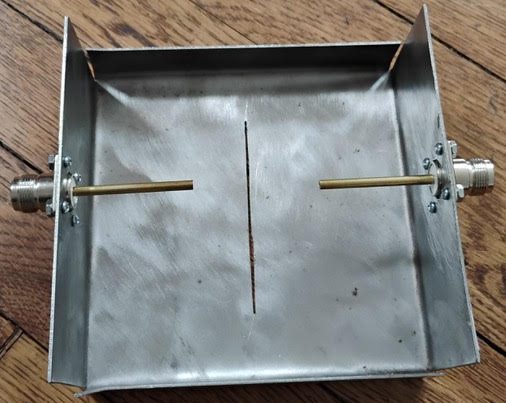 KN0WS 6 Two Probes in Place
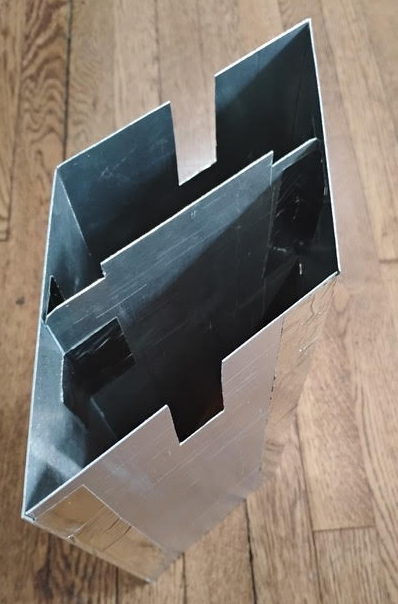 KN0WS 7 Feed Collapsed
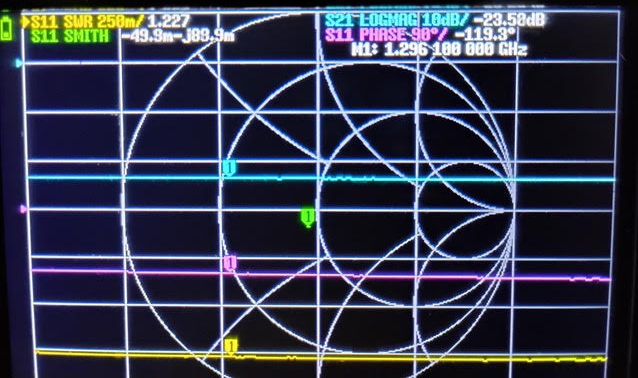 KN0WS 8 Test Results After Reassembly
3rd Annual 23 cm Appetiser Contest
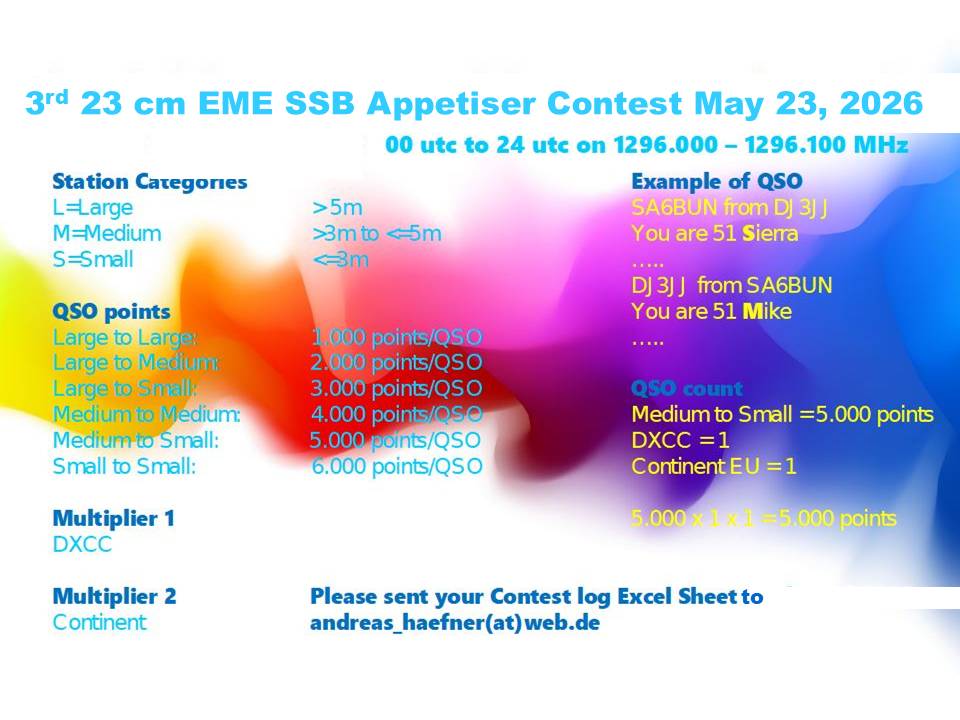 3rd 23 cm appetiser contest
CP7DX EME Activation
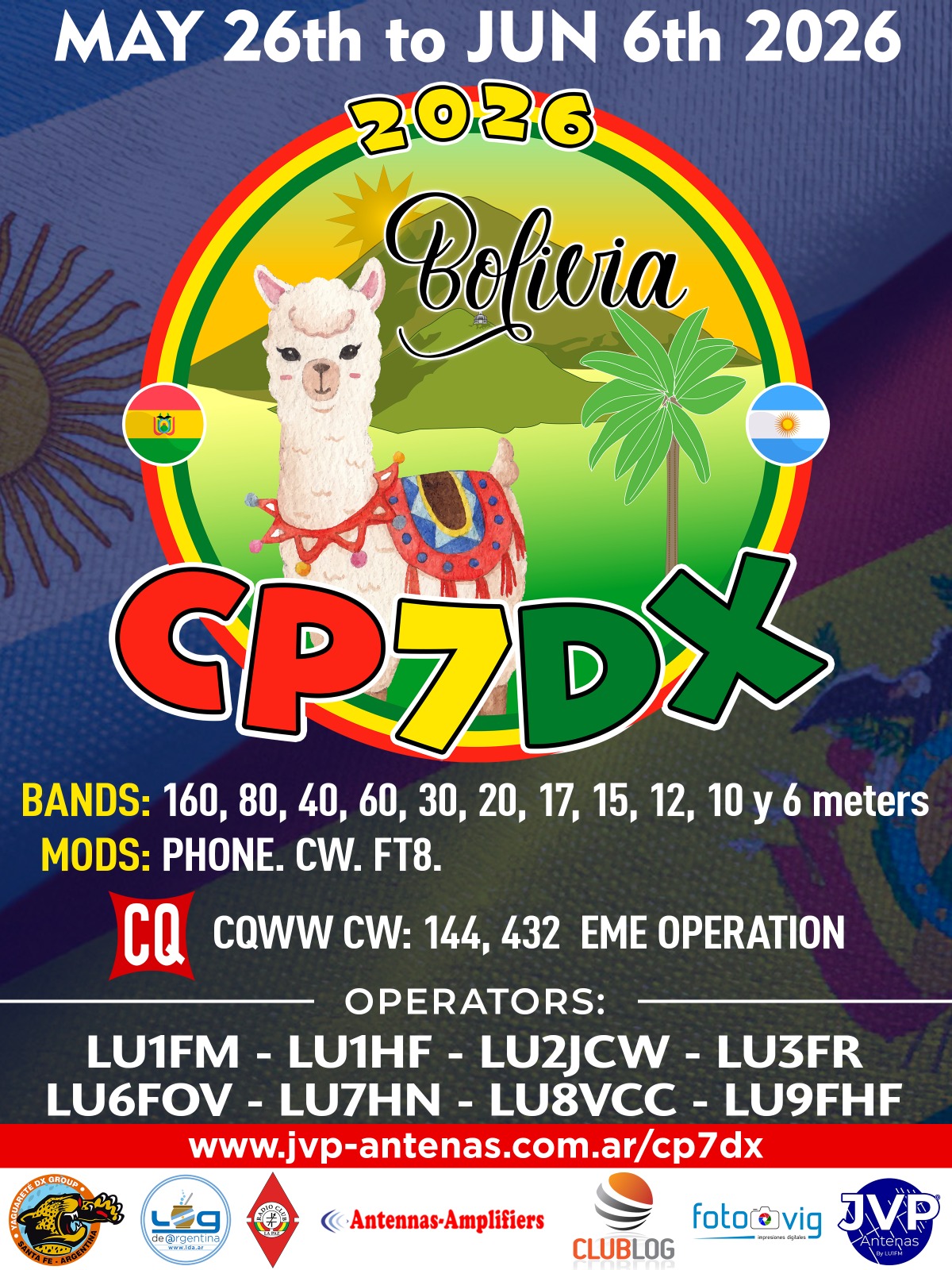 CP7DX DXpedition Flyer