

432 AND ABOVE EME NEWS
September 2026
Volume 55 Number 9
Editor: Barry VE4MA
Production Assistance: Peter G3LTF, Frank NC1I & Bob W1QA
News, Contests and DXpeditions
This has been a very busy month for microwave EME activity with the ARRL EME contest. The activity levels were very high on both 13 cm and 3 cm as you will see in the reports below. The activity has grown very significantly on 3 cm with all stations reporting a large number of QSOs and OZ1LPR taking the prize with 80 stations worked.
This is without the benefit of a simple and cost effective SSPA option for new stations to use and hopefully that situation will only get better in the near future. It also occurred during some very hot and humid weather in parts of Europe and North America and that was certainly hard on people, equipment and did have some effect on EME activity levels.
Now that the ARRL EME contest activity is going to shift to the “low bands” from 50 MHz to 23 cm, I expect to see very high activity on 23 cm with the proliferation of “cooker” and “umbrella” dishes and that 70 cm activity will also be good. However for stations with multiple band capability; it would be good to concentrate the activity by announcing their intended operating schedule for the bands. I expect that there will be some activity on the lesser used and not widely allocated bands (222 & 902 MHz) and coordination is even more important there.
The ARRL contest rules do not restrict the use of other communications means during the contest period, but given the weather & time of day challenges of changing bands, it would help a lot if stations would once again announce in advance their operating plans on the email reflectors or on HB9Q.
This month we have an article by Miguel CT1BYM who describes the 47 GHz SSPAs being used by RW3BP & CT1BYM and which are part of a project to create more units for a small group of “microbouncers”.
There is a lot of good reading in the station reports and articles below!
23cm Frequency Change
The IARU-R1 General Conference held in Vienna from September 19 to 23 2026 has made a recommendation for a change to the 23 cm band plan for Region 1, which includes all of the EU, Russia, Africa, and the Middle East. This will have a big impact on 23 cm EME operations with a shift to 1299 MHz commencing January 1. 2027. See the EME part of the recommended band plan below. There will also be power and antenna restrictions so please see the official details when it becomes available.
 IARU 23 cm Bandplan
Contests
ARRL International EME
The 2026 ARRL International EME contest will continue in October. It runs for four full weekend 48-hour periods (0000 UTC on Saturday through 2359 UTC Sunday). The remaining dates for weekends 3 and 4 in 2026 are: 50 to 1296 MHz - October 31-November 1, 2026; November 28-29, 2026.
The complete rules can be found at https://www.arrl.org/eme-contest
As mentioned earlier we can do a better job of coordinating activity by indicating our plans on EME email reflectors or on HB9Q before and during the contest period for this contest. There is nothing more frustrating than to get set up to operate on one of the EME bands in the middle of the night and no one else shows up. It can be very difficult to make quick band changes!
DXpeditions
EA8DBM/LY Alex
After returning from Moldova (nearly 5,000 km on the road), I’m back in LY (Lithuania), where I’ll likely stay for a while until the cold weather sets in.
The dish is a bit worn out, and my 23 cm amplifier output has dropped to 300 W, but it’s still workable. Over the past couple of years, I’ve already been active from Lithuania with 88 QSOs in the log, so my question is: is there still any interest out there, or has everyone already worked LY on 23 cm? If anyone still needs it, I can set up the station.
I also have a question regarding 13 cm. Last summer, I managed to complete 6 QSOs on 13 cm (with stations capable of transmitting on 2304 MHz). The issue is that in Lithuania, the 2320 MHz band is allocated to LTE, which produces a solid S9+20 dB carrier across those frequencies. However, there is an enclave along the Belarusian border located in a low-lying valley where the noise floor might be lower. That said, it requires driving out there, deploying the gear, and testing on-site.
Does anyone need LY on 13 cm? Please let me know via email at
T7 San Marino
Walter IW2BNA and Adelio IZ2DJP are still considering returning to San Marino and operating on 5.7, 10 and 24 GHz. They are also considering a 5 band operation at a new DXCC. Please see IW2BNA’s report below and consider providing the requested feedback if you are interested. The response so far has been small.
KH0W Saipan Northern Mariana Islands
Tom KH0/ KC0W is getting set up for operation on 2 m and 432 MHz and is still waiting for equipment to arrive. He has set up a Blog at:
https://kh0w-moonbounce.blogspot.com/
DL8EBL Olaf
Two years ago I started EME activity on 23 cm using a single 70-element Yagi configuration, 200 Watts from two combined MRTF6S9130 PAs (DF9IC Design) and a G4DDK LNA (and others). As I am living in an urban area, I had to learn that there is a lot of RFI around me, even above 1 GHz.
I experienced that the proximity of not less than four GSM/LTE Base Stations (0.2-0.4 km distance), two commercial Radio / TV Transmitters [one 160 m (0.8 km distance) the other 320 m (3.5 km distance) in height] is a real challenge in terms of cross-modulation. Most problematic seemed to be a POCSAG transmitter around 450 MHz and the LTEs. I built a cavity filter for more selectivity, but even with only 0.27 db insertion loss, that is not desirable between the antenna and the front-end especially when working only with the limited gain of a single Yagi.
Finally I decided to move up to 10 GHz. I was able to get a 2.4 m offset dish (General Dynamics/ Prodelin 1244). So I started the work in April 2026 building the foundation for the mast, designing the mechanics for azimuth and elevation etc. To me it is amazing what kind of different skills (mechanical & metal work, power electronics & controls for the motors, sensors, 3D-printing, software either MCU & High level, signal processing and of course RF) are required to set up the station. This to me really makes EME & Ham Radio! And it is really a continuous learning experience, at least for me.
In July I was ready for the first reception tests, after aligning and calibrating the azimuth and elevation setup, optimizing the tracking, measuring sun-Noise, finding the focus for the feed etc. Finally I was able to have my first 10 GHz EME QSOs with OZ1FF Kjeld, OZ1LPR Peter and ON5TA Eric between the 4th and 6th of September. Thanks to all of you for your patience with the newbie!
Please find a few pictures from the station. At the moment I am limited to a rather small operational window between 120-200 degree in Azimuth and 20 to 80 degree in elevation. Probably I will change this next year with a higher mast, however at the moment I keep it due to the good accessibility.
I am using a 3D-Printed Skobolev horn (based on Paul's, W1GHZ publications) that I coated with copper tape, as I am waiting for the machined full metal part. The Input section is a PE1RKI septum for circular polarization. [Ed Note: I have explained that CP is not used on 10 GHz]
I have a Kuhne LNA and 10G5 transverter with a PE1RKI PA delivering 12 Watts - 8.5 Watts at the septum due to cable losses. The transverter is GPS-disciplined and controlled by a remote operated ICOM IC705 & PC located in my garage. The Rotor controller is a K3NG design, and the actuators are simple linear drives.
A very small footprint ESP32C3 controller is used for temperature/humidity monitoring (through MQTT) inside the transverter box. In addition it is used to connect (Telnet) the Kuhne transverter, so that I am able to remotely configure it for either EU-EME-, JA- or QO100-use.
Next will be further “stabilization work“, installation of the full metal horn as well as probably increase of available power, and of course more QSOs in the next operating window at my QTH. I am looking forward to meeting you all.
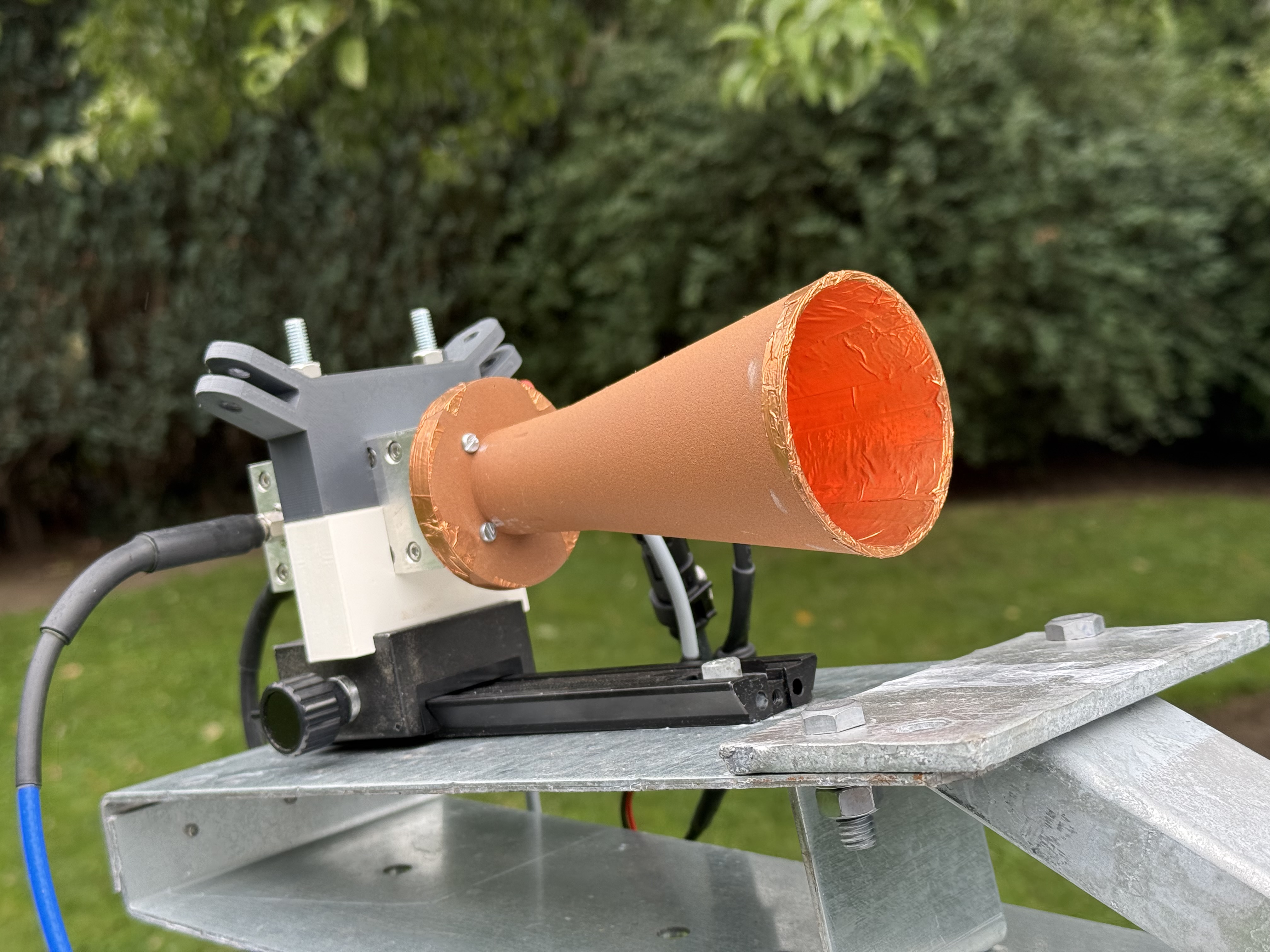 DL8EBL 3D Printed Skobelev 10 Ghz Horn
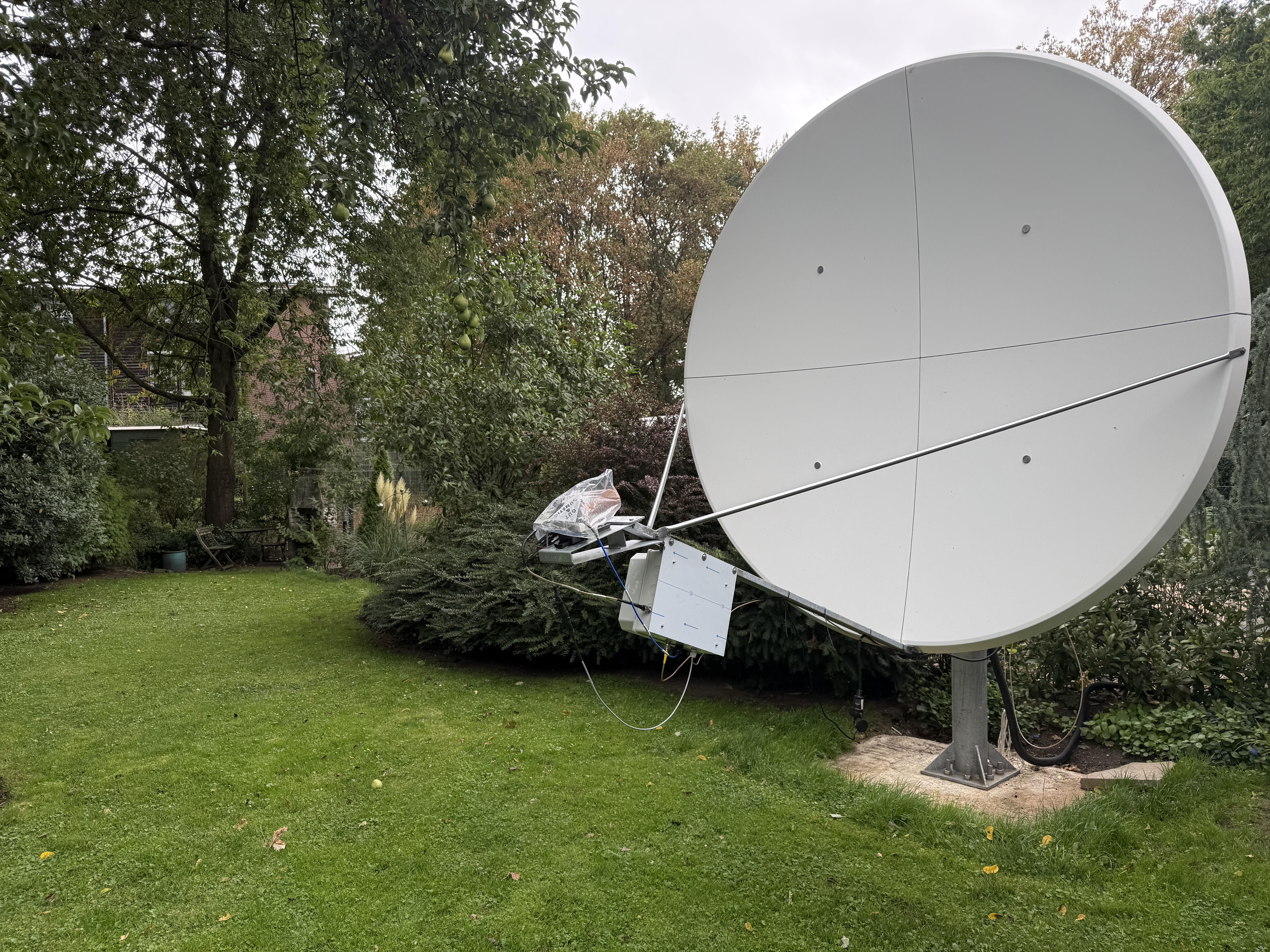 DL8EBL 2.4 m Dish
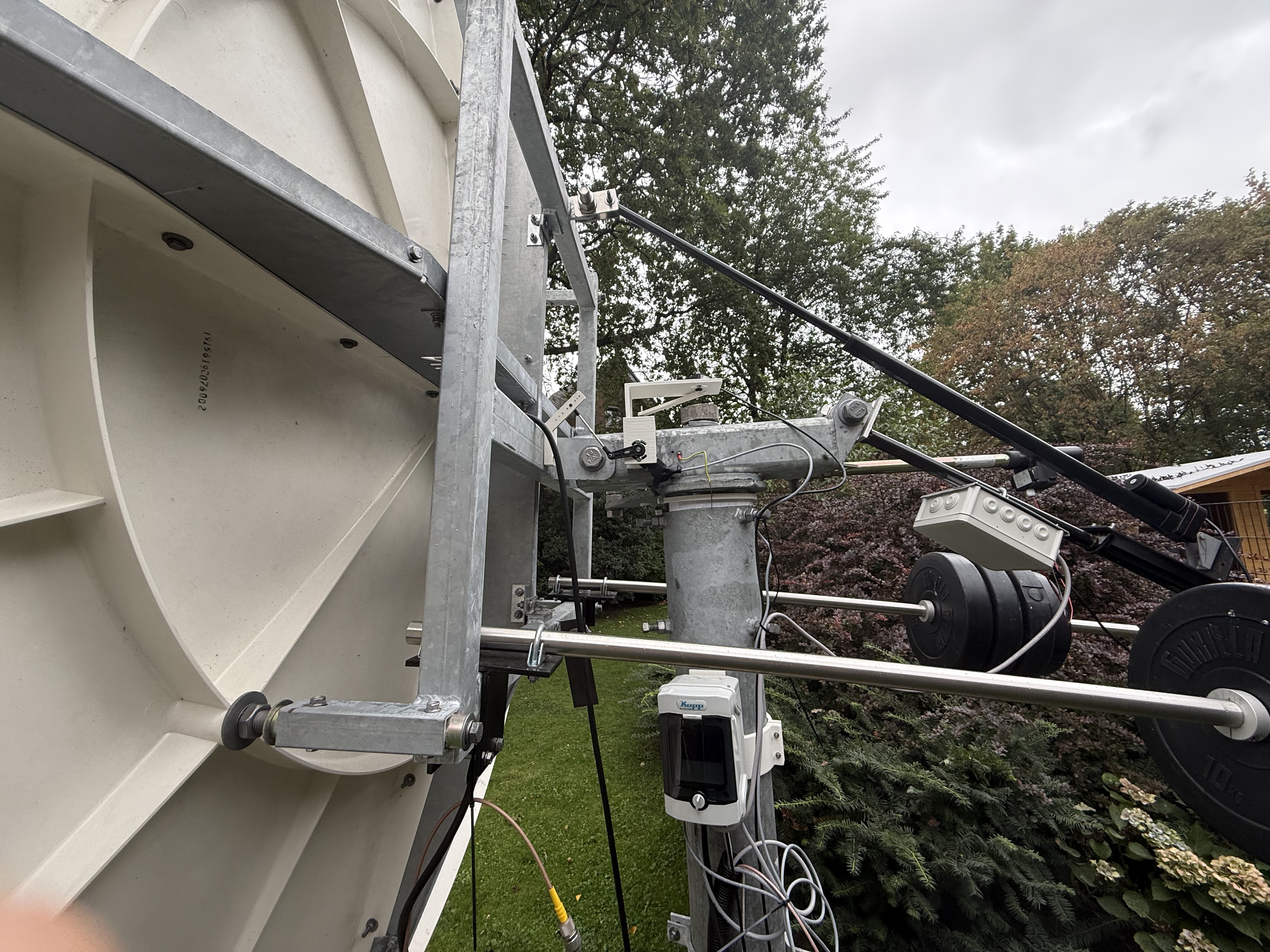 DL8EBL 2.4 m Dish Rear View
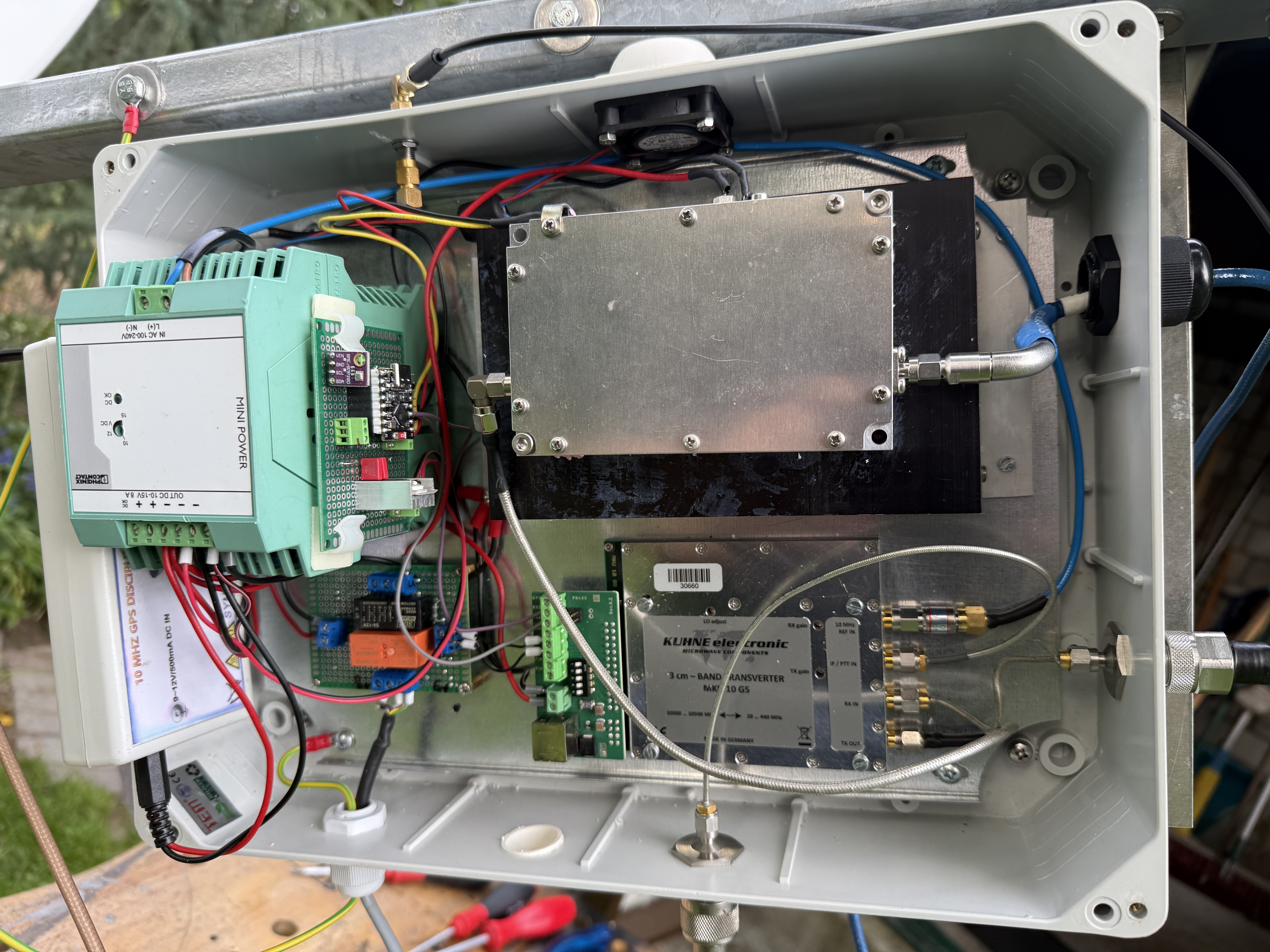 DL8EBL 2m4 Dish Back Side View
EA8DMF Rainer
On the 9th of September we had a nice reunion with Massimo, XE1XA.
Massimo had to cancel his trip for the EME Conference 2026 due to illness, but he wanted to see Tenerife and so he came now to visit the Island. We met him in the Hotel Botanico and he was very satisfied and highly praised the hotel. He also found the climate here very pleasant.
Thank you very much Massimo for the visit to Tenerife. It was very nice to meet you for the first time!
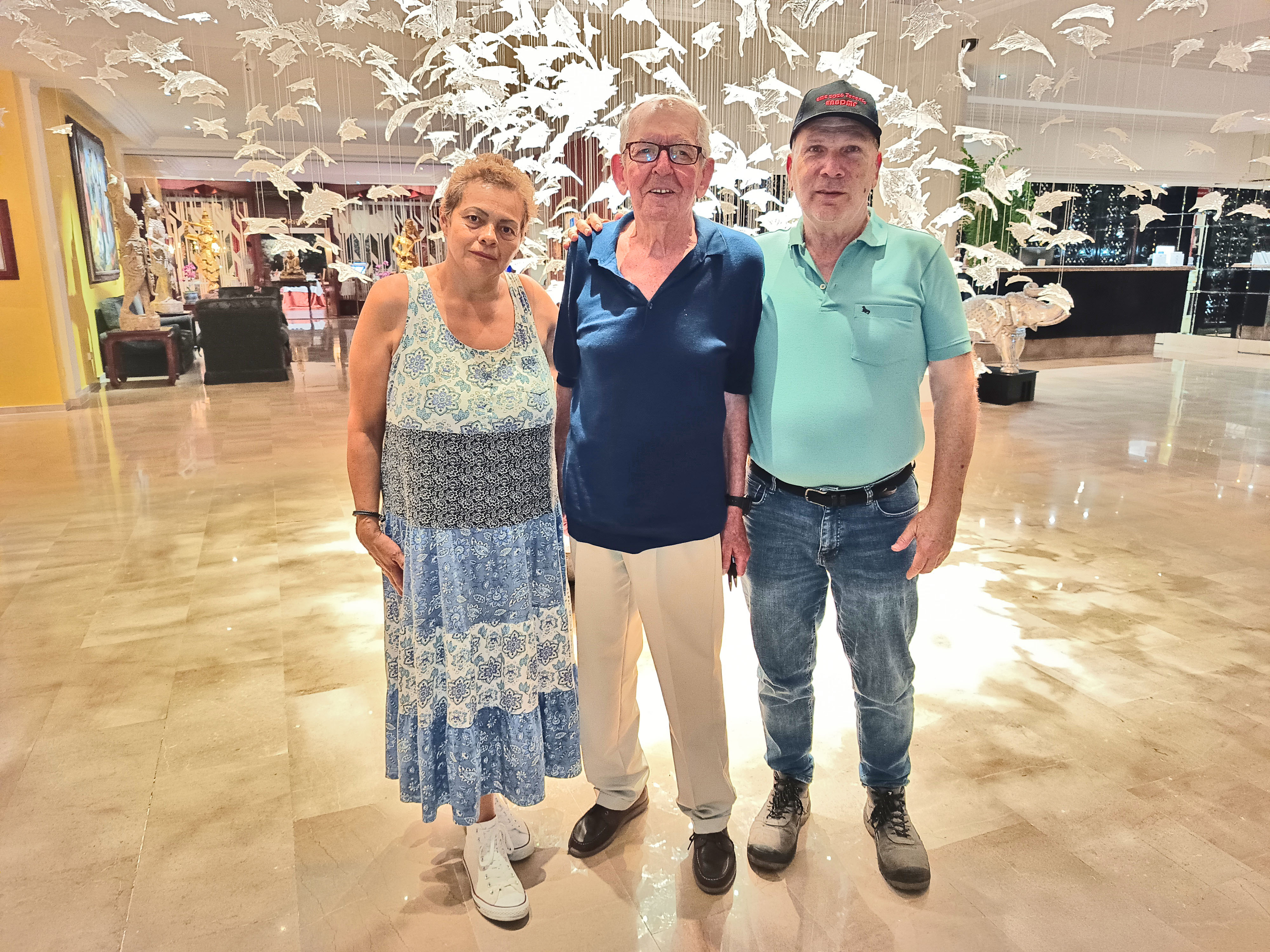 (l-r) Elizabeth XE1XA XYL Massimo XE1XA Rainer EA8DMF
G3LTF Peter
My plan for the second ARRL microwave weekend was to operate on 6 and 9 cm having worked most (18) of the 13 cm stations who have CW capability on the first weekend.
Unfortunately I found that the large 50:1 worm drive on my dish mount has failed big-time and will take some time to repair / rebuild. I hope I will be QRV for the next section of the contest.
Looking at the 6 and 9 cm activity on the logger however, it appears that we must depend on the DUBUS CW-SSB contests, where there were 15-20 stations active this year, to promote activity on those bands.
But as they say “It’s an ill wind that blows no good...” and so instead of EME I had a great time in the European 2 m tropo contest which was blessed with an excellent opening, I had 10 QSOs in the range of 800-1060 km including working Guy, F2CT and Andreas, DJ3JJ.
G4RGK Dave
I have not found much time to get on 70 cm this year. I am still using the 8x27 DJ9BV yagis feed with open wire built in the early nineties but I have worked the following new stations:
70 cm
28/03/2026 20:54 9J2EME DXCC# 114
23/06/2026 16:45 VK0DS DXCC# 115
09/08/2026 05:36 C37EME
23 cm
25/01/2026 20:44 OA7/LY3UM
29/01/2026 22:28 HI3/LY3UM, 22:37 A71AW
23/03/2026 19:08 CY0S
24/03/2026 13:22 T7/IW2BNA, 13:40 BV3CE
19/04/2026 18:24 CT1FGW, 19:06 WB8HRW CW
14/06/2026 10:01 FP/EA8DBM
07/08/2026 11:59 C37EME
04/09/2026 07:01 ER/EA8DBM DXCC# 94
This makes a total of 94 DXCCs on the band all made with a 4.6 m stressed reflector which was built as a temporary means on getting on 23 cm almost 20 years ago, it is getting close to the time to make something to replace it.
13 cm
In the second leg of the ARRL contest, I was only QRV for one moon pass and I added the following stations, making a total of 21 initials:
05/09/2026 04:35 SV3AAF, 04:43 PA0PLY, 05:07 DF3RU, 05:11 DL1SUZ, 08:49 IK3COJ, 10:05 PI9RD CW
06/09/2026 07:23 F5JWF
CW QSOs on all bands have been much harder to find this year, a sign of the times I guess.
G8RWG Niels
On September 4th, 2026, the day before the second weekend of the ARRL EME contest, I took some sun noise measurements using Bob, KA1GT’s new EMETest software with the IC-705 at 10 GHz. I also made a measurement using the RSP1a and SDR Console, giving two independent measurements to compare with the predictions from EMECalc and SimpleCalc. The two measured values are in very close agreement, differing by only 0.10 dB, and they also agree well with the predicted values.
Tsun/Tsky using RSP1a / SDR Console 8.75 dB
Tsun/Tsky using IC-705 / EMETest 8.85 dB
EMECalc 8.2 dB
SimpleCalc 8.89 dB
SFU @ 10 GHz = 320
On September 5th, 2026, at moonrise, there wasn’t much activity and I heard nothing from JA, so I decided to get a few hours sleep. I returned to the band around 04:15 UTC and, although there was a good level of activity, progress was slow as there were only a handful of stations I hadn’t worked during the first weekend. For the second moon pass, I arranged a test with JA8ERE via the HB9Q logger, but unfortunately nothing was received at either end. Once again, it was slow going, but I was pleased to add another 10 QSOs, including 5 new initials, bringing the total to 44 QSOs on 10 GHz over both weekends.
The highlight for me came the following day, September 7th, 2026, when I successfully completed with Terry, BA7NQ for a new DXCC. We had arranged a sked for 03:00 UTC and whilst I could copy him at -20, he could not see my signal. David, G4YTL, worked him shortly afterwards, and once my dish had cleared the 2 m array and the tree behind it, I was able to complete the QSO without difficulty.
September 5th, 2026: IT9EQO (#70), DL3WDG (#71), UN6PD (dup), DL5CN, ON4CDU, G4YTL, IT9CJC (#72)
September 6th, 2026: S57NML, IK3GHY (dup), ON7FI (#73), W3TI, W5LUA
September 7th, 2026: BA7NQ (#74 & DXCC #27), UN6PD
All QSOs were completed using digital modes with a 1.2 m offset dish, 20 W PA and DU3T LNA.
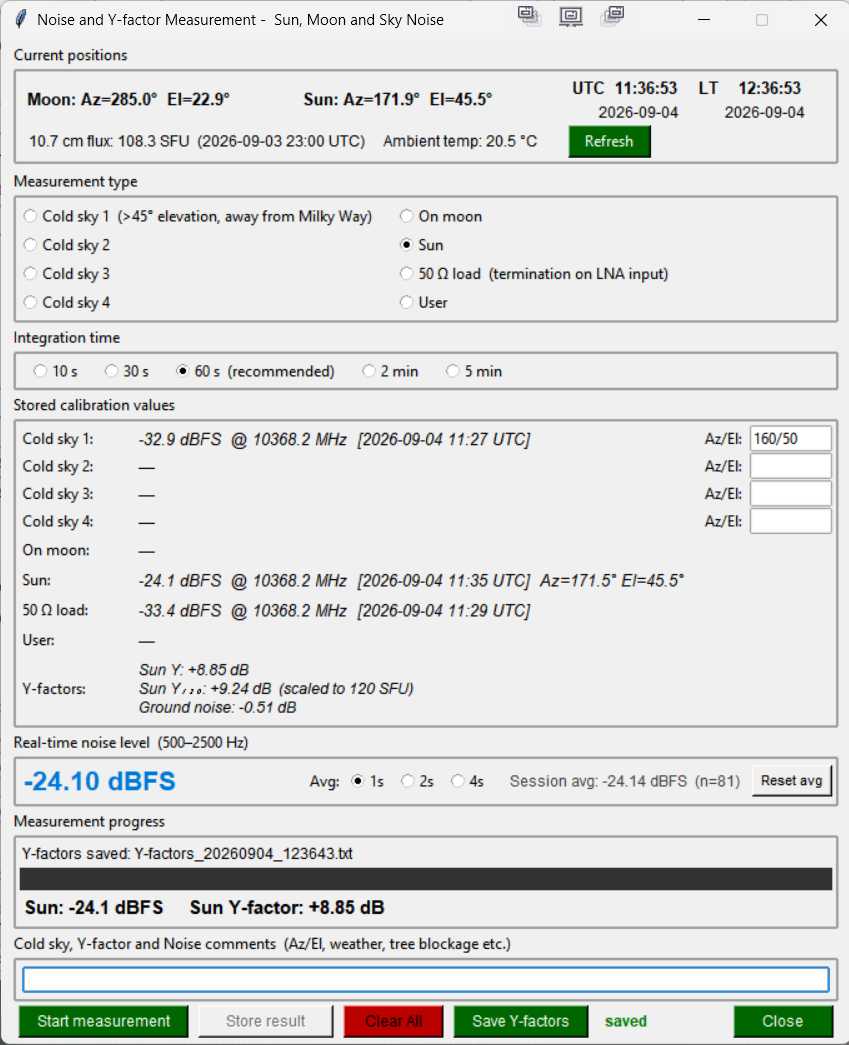 G8RWG Sun Noise 2026-09-04
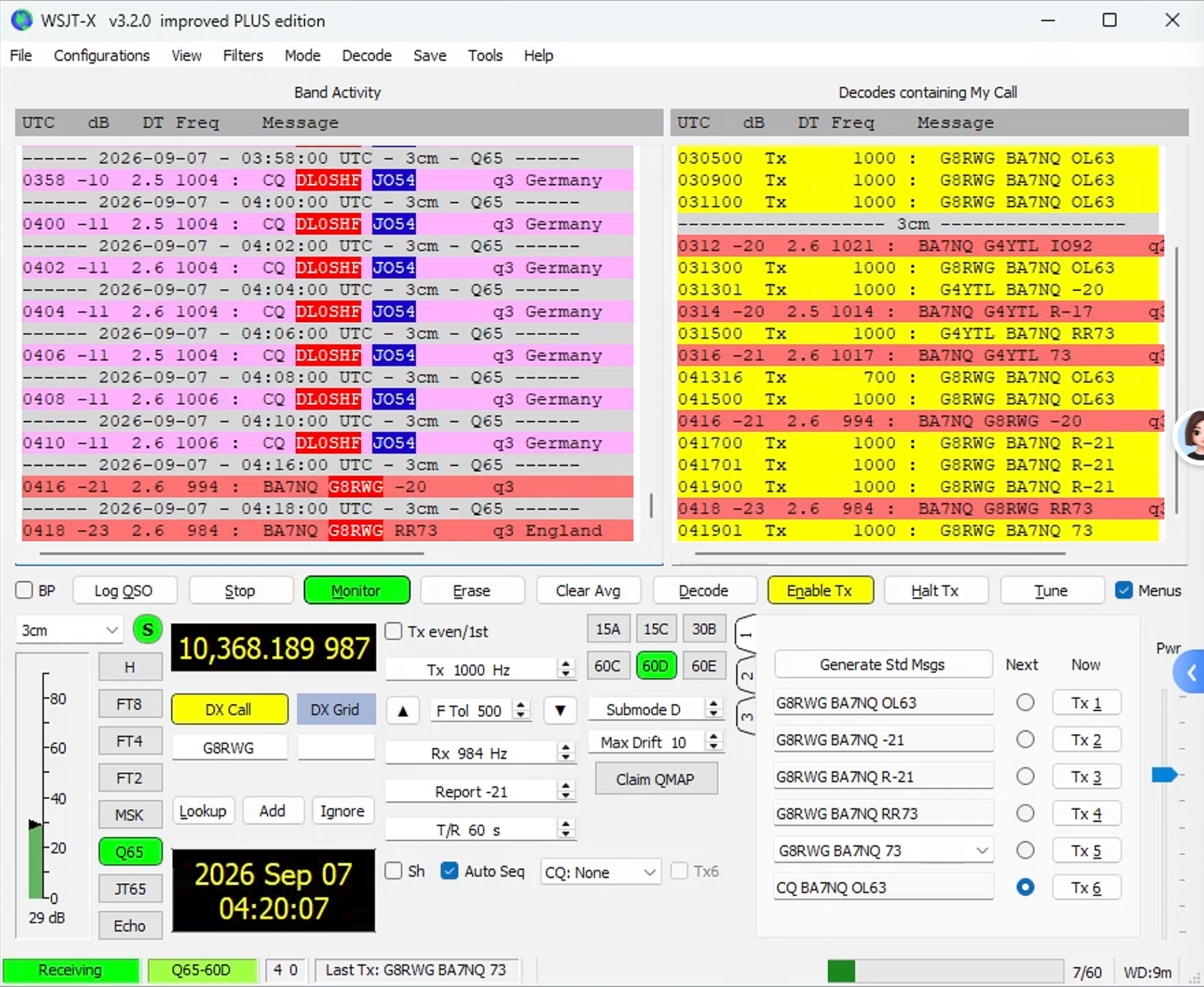 G8RWG BA7NQ QSO
HG5BMU Csaba
On the occasion of the 80th anniversary of the Zoltán Bay team's successful moon radar experiment, we will operate a special callsign HG80BAY until 2026.12.31.
Those who complete the EME QSO can download a commemorative card from HamAward after the activity.
We apply on the usual chat sites. We wish everyone good luck!
IW2BNA Walter
After fixing the tracking problem I had a few 10 GHz QSOs in September. My AZ limit of 210 degrees is really frustrating as I cannot work the Americas.
On September 5th I QSO’d: OH3LWP, IK6CAK, IT9EQO, OK1DFC, OZ1FF, ON5TA, LZ4OC, OZ1LPR, DL3WDG, AC0RA and DL5CN
On September 6th I QSO’d: September 6th: DF5MO and OE9ERC
On September 8th I QSO’d: JA8ERE, and BA7NQ
Regarding the interest survey for reactivating T7 on the 5/10/24 GHz bands, I have received only four requests; let's see if a decision can be made.
IZ0JNY Ivan
After three months of extremely hot weather and an unavoidable period of QRT, I have finally completed the installation of my new antenna: an Andrew 243 offset dish with a diameter of 2.4 metres.
The dish is motorised by an SVH7 azimuth/elevation system and equipped with high-resolution encoders. Tracking is managed by the excellent EA3HMJ software, using an arrangement similar to that of my previous installation.
I have not yet had the opportunity to perform convergence tests or sun and moon noise measurements, as the installation work has only just been completed. During the entire project, particular attention was given to mechanical reliability and safety.
I hope to carry out the first tests shortly and return to QRV, initially on 24 GHz. The main purpose of the new antenna is to continue and further develop my EME activity on 24, 47 and soon 76 GHz.
More technical details and measurement results will follow once the system has been fully commissioned.
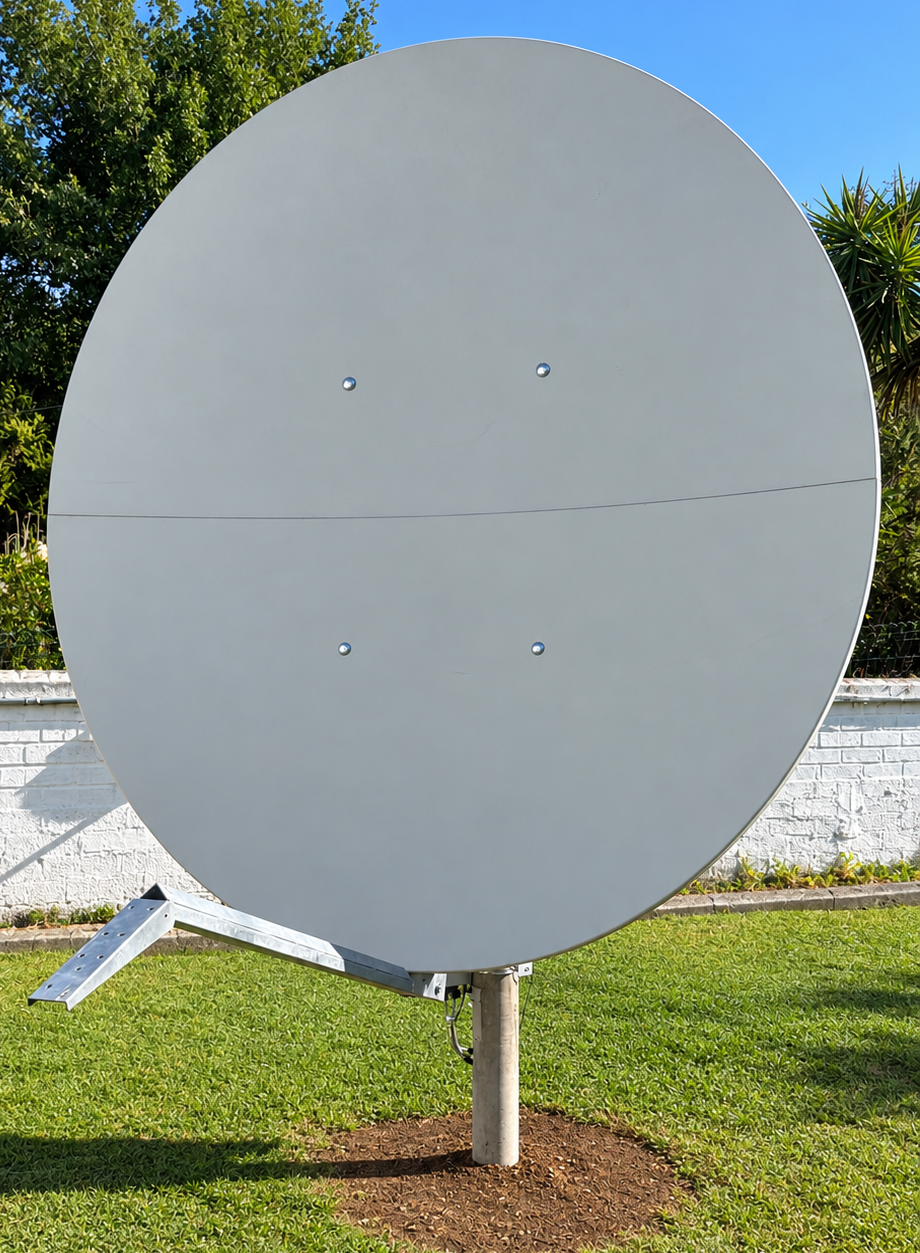 IZ0JNY 240 cm Andrew 243
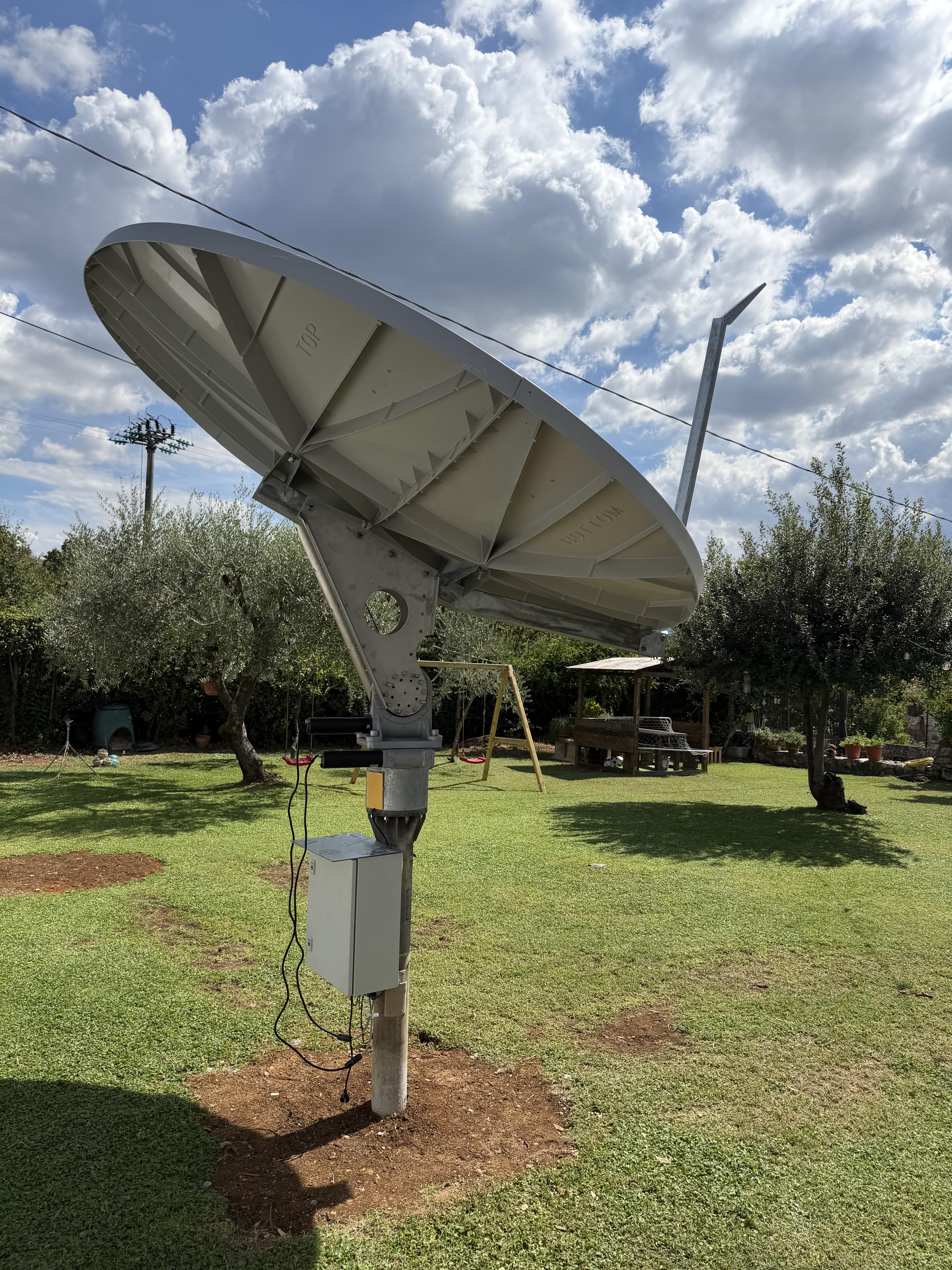 IZ0JNY New 2.4 m Dish
KB7Q Gene
It was another great month of 23 cm moonbounce activity here in Montana. I added seven new stations to the log including two DXCCs. Initial stations added were: CT8/W6PQL, LU1HKO, EA5Y, SQ7D, KV7E, ER/EA8DBM, and NN3Y. That bumps my total to #285. I took advantage of the good weather to re-route the dish's feed cables and change the 240 mm square to round septum feed transition to 200 mm.
Murphy did sneak up on me and failed a pre-amp in mid-contact with NN3Y. It turns out my 50 ohm termination had gone to infinite ohms.
My landlord out at the site just added quality Internet for his security cameras. This prompted me to explore running my station remotely with the idea of doing EME from my warm den versus the cold barn this winter. After figuring out the RemotePC software I made several contacts using my iPad via local cell service, while sitting in my car, as proof of concept.
I still need to add the niceties of powering the station up/down, and power/SWR monitoring. The parts are on the way. Discovering how to make the rig change frequency from within WSJT-X was a key piece of the puzzle keeping the project simple (K.I.S.S.principle).
KL6M Mike
My 2026 ARRL EME performance so far is less than stellar. I did operate on 13 cm, but unfortunately my moonset window is nearly unusable now due to terrible RFI from the city, and tree growth. I did manage to work 4 CW on moonset, and later 9 CW QSOs on moonrise with two new initials: OH3LWP and N1AV.
My 3 cm attempt failed due to a WR75 waveguide relay failure. So I changed feeds to 9 cm and made only one CW QSO.
On the second weekend, I got my WG relay working but made only one CW QSO before it failed again, I believe due to faulty internal relay contacts. I have a WR90 relay and I plan to rebuild my 3 cm feed prior to the DUBUS/REF 3 cm contest next year.
I installed the 6 cm feed and had an RX failure. After all this I finally gave up!
I plan to be on 23 cm in October.
KN0WS Carl
I was looking forward to the second ARRL weekend, since I had troubles on 3 cm during the first. I made an earlier trip to my northern site to modify my dish mount. It only allows declinations to 26 degrees and on 13 cm I would have trouble with a moon at 28 degrees, so a support bracket came off to allow extra movement.
My wife was surprised I left her for the weekend because for years I have made a big deal over celebrating my “N/(N+1)” birthdays, where this equation means the fraction of a century. On Sept 4th I turned 66-2/3, but the idea of some powerful 13 cm signals from my 4.8 m dish plus a chance to make up some 3 cm ground using my portable 4 foot dish was irresistible. It took me 7 hours to set up - due to the multiple dishes and me using more care now that I’m an old man.
Things were working great before moonrise and then I was pleased to see an early powerful signal from OE9ERC. That was where my weekend peaked. When I transmitted to him, my generator died. The weather was foggy and misty and I think the carburetor was aspirating water from the air as if it was being tortured by water-boarding! I switched generators, but then when I powered things up again, my computer would no longer speak to my radio. I would say about half the time I am on 3 cm I can get the laptop to recognize the proper audio stream, but not this time. I was using the same laptop, same software, same radio, same cabling and same settings as before moonrise. So 3 cm operation was not possible.
Unfortunately, I had RX troubles on 13 cm from then on. Signals would fade in and out, sometimes gradually and sometimes abruptly. I spent many hours moving the dish down, climbing my ladder in the dark to reach the 12 foot high feed position, changing gear and then raising the dish again. Each cycle took about 40 minutes. I ultimately traded out the preamplifier, the power cord to the preamp, the RX relay, the N connectors, the coaxial cable and the transverter. Pretty much everything in the receive chain. I secured cables in case there was positional movement and I even tried inserting an attenuator before the transverter in case the preamp signal from my big dish was causing saturation. I tried an attenuator after the transverter in case my radio was being saturated. Nothing worked reliably. I was able to work DG5NFF (-21), which was a great relief, then PA3DZL(-20) who informed me that this was our 6th band that we have QSO'd, and HB9Q (-17). That was all that I worked.
I finally discovered that one toggle switch in a little hand controller to change frequency of the transverter was unreliable. It would switch me from 2320 to 2400 unpredictably. I hoped for the second moon pass that a visible moon would allow better pointing and my switch bypass might give me better luck. But that was not to be. The second moon pass had a big beautiful moon, but my test RF signal was perhaps 20 dB weaker on my screen than with my Friday testing. So I packed up gear and drove home in time for Sunday church. I only do 13 cm on one weekend per year, so maybe 2027 will be happier.
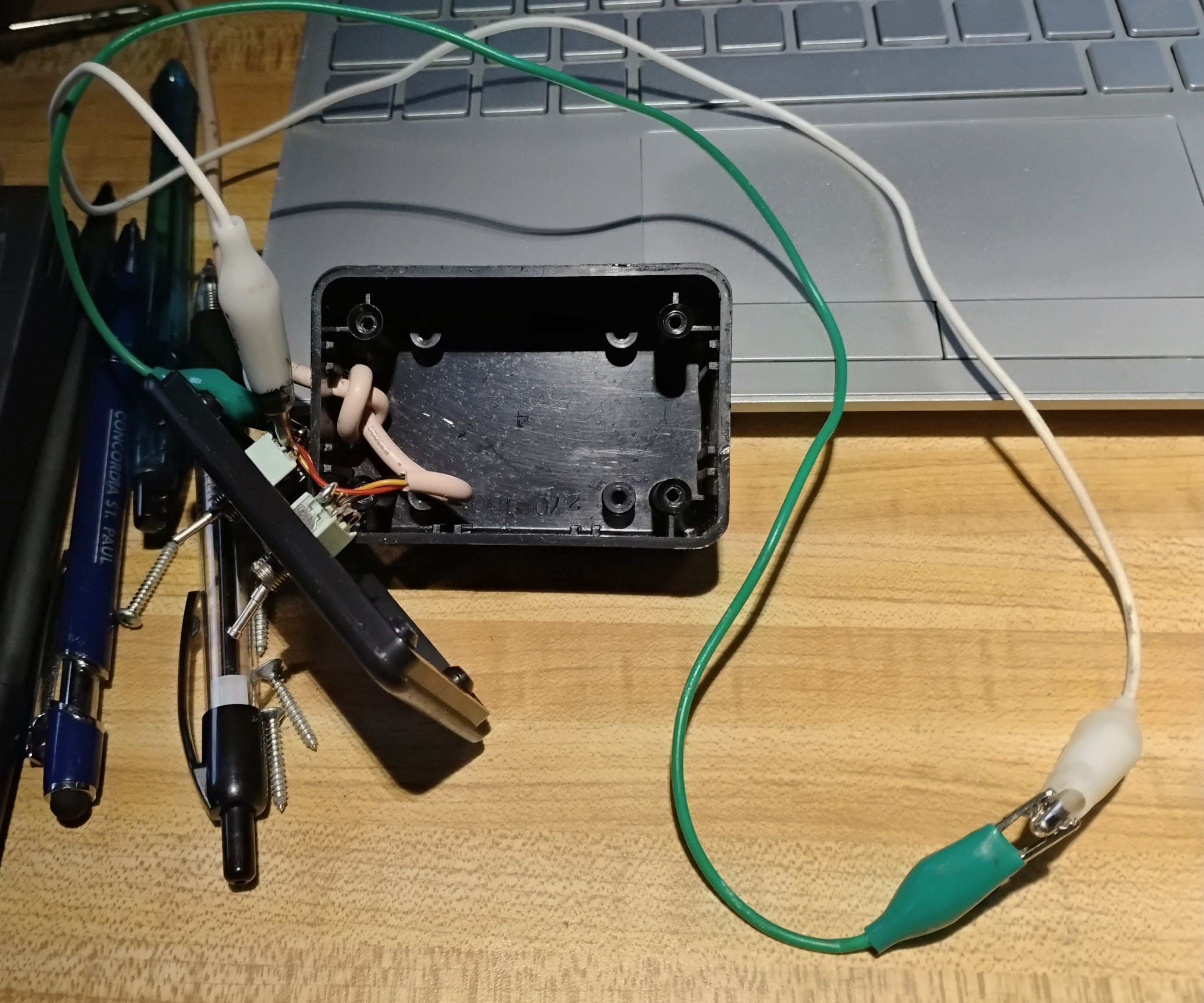 KN0WS Intermittent Switch bypassed with alligator jumpers
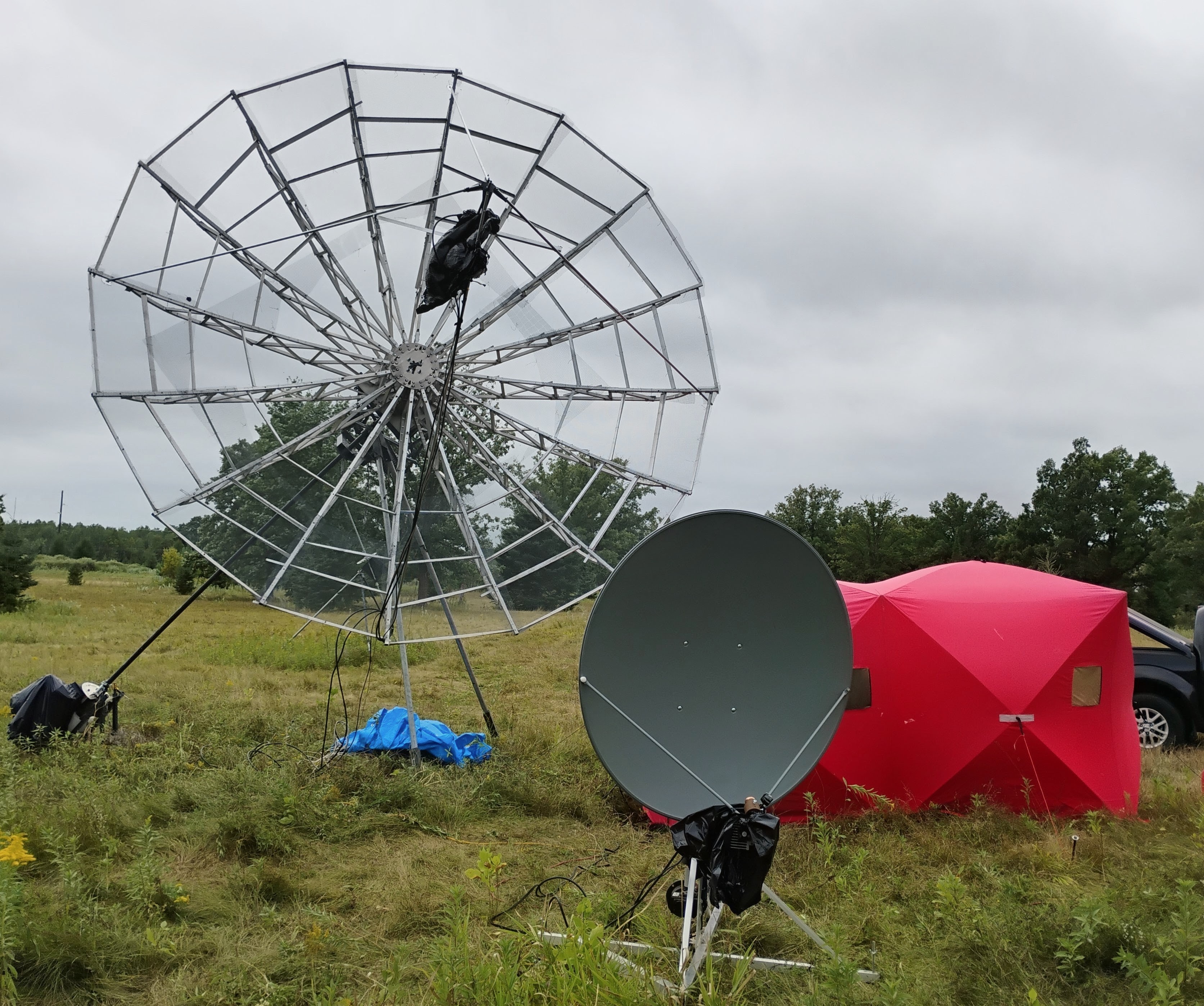 KN0WS Ready for 13 cm on the 4.8 m dish and 3 cm on the 1.2 m dish
KN2K Ray
With advice and assistance from LB6B and W2HRO, I developed a set of S12 disks for the 23 and 13 cm septum feeds on both the 2.3 m mesh dish and the 1.5 m solar cooker. The disks mount on the 32 mm fiberglass center tubes. Their OD governs amplitude and their position the phase.
In all cases S12 is now better than -20 dB. This allowed me to switch back to using the 13 cm AG6EE LNA for the September 2.3G+ contest weekend. Thanks to the following ops for nine more 13 cm QSOs September 5th and 6th: PA3DZL, PI9RD, DF3RU, OK1USW, HB9Q, PA3JRK, N0AKC, PA0BAT, and F5JWF.
During the lunar PM on September 6th, I was also QRV on the west-facing solar cooker on 23 cm and worked KE7NR, KB2SA, and W3TI. I think this is my first time being QRV on two different dishes and two different bands on the same day! On September 9th I moved the 23 cm SSPA to the east-facing 2.3 m dish and worked NN3Y, DL6ZG, OK1USW, N0LWF, and W2LPL.
Thanks to all for the QSOs and 73!
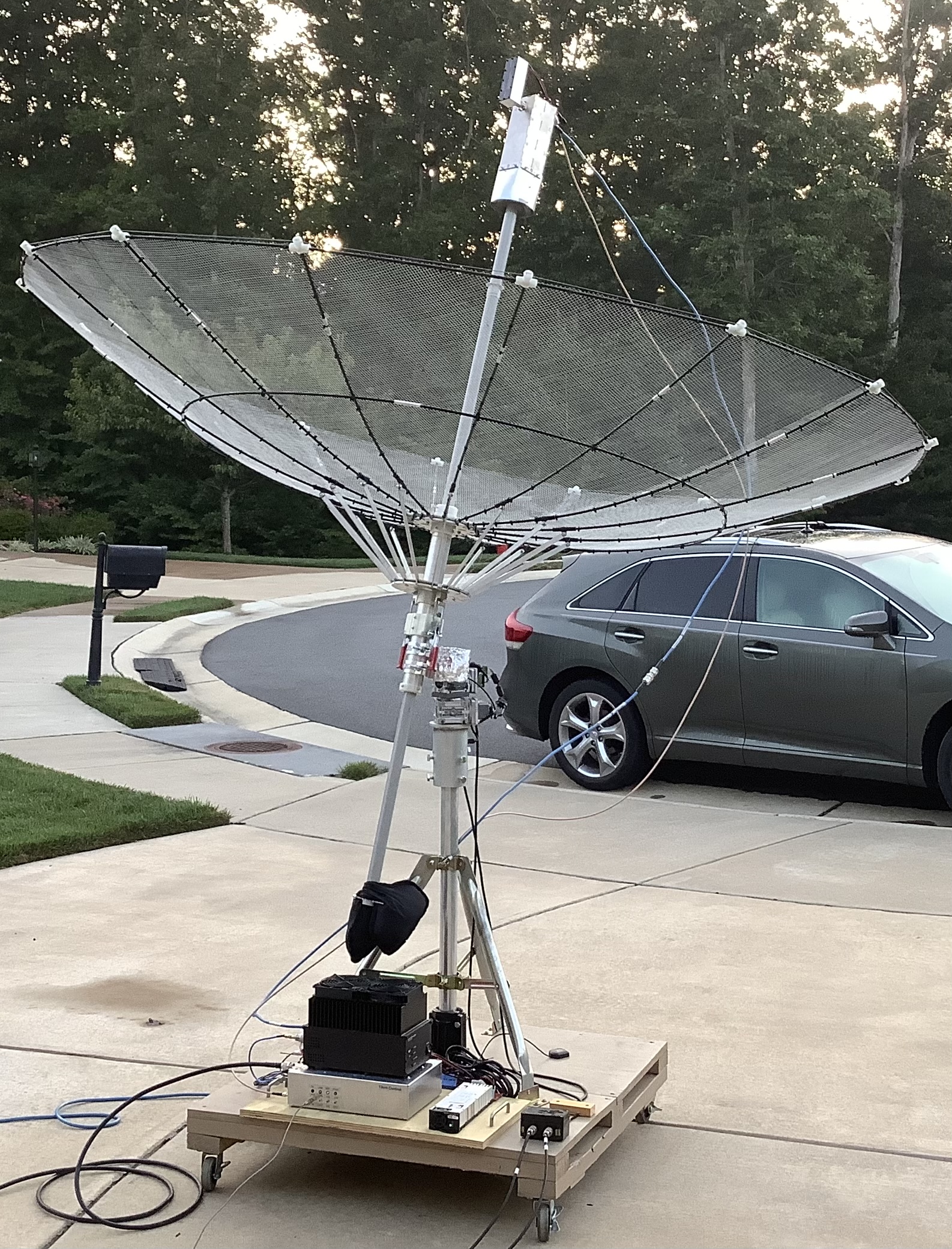 KN2K 2.3 m mesh dish 13 cm Septum Flare and S12 Disk
N5BF Courtney
Early Saturday morning September 5, 2026 at 1134 UTC which is 0434 for me, I had my first successful EME reception on 13 cm.
My Station is a Sub-Lunar 2.4 m dish, RF Ham Design septum feed, RX side (thanks N6MN) was a Kuhne MKU LNA 232 AH to an IC-905, but I have no TX yet.
I copied SP9VFD, OK1KIR, HB9Q, and OH3LWP as follows:
260905_113400 2304.110 Rx Q65 -26 2.9 1480 CQ SP9VFD JN99
260905_113500 2304.110 Rx Q65 -22 2.6 1512 SP9VFD OK1KIR JN79
260905_114800 2304.076 Rx Q65 -14 2.6 1503 CQ HB9Q JN47
260905_115300 2304.076 Rx Q65 -24 2.6 1452 HB9Q OH3LWP +00
I have a lot of QRM on 2304 (and 2400) presumably from Wi-Fi. Turning Wi-Fi in my house completely off didn't help much or at all. I assume this is ubiquitous in the modern city. This is one reason my SNRs are low even for the big stations. In all the “chit-chit-chit” QRM it's hard to even find traces, much less decode them. So no, I didn't even try listening for CW stations although HB9Q was speaker copy.
IC-905 does 2304 and 2400 but not 2320. Would have been nice to have looked at 2320 also but I can't do that today.
So I'm mulling over the idea of adding a transmitter on 2304, the usual configuration with a few hundred watts, relays, sequencers, etc. This will be non-trivial unless significantly working around or reverse engineering inside the 905 paradigm.
The question for the group is: is it likely to be worth the trouble to do this in my backyard, which overlooks the Los Angeles basin? Or would this have to be a portable operation somewhere far from the city?
Later that same Saturday morning at 1252 UTC (0552 for me) I had my first successful EME reception on 3 cm.
My 3 cm station is a 0.68 m offset dish, a Chaparral feed, a Kuhne MKU LNA 102 S-EME, Kuhne G3, to an IC-705 and on TX I have a Kuhne MKU PA 3CM-8W.
This is my terrestrial contest station. I just set it up on the tripod and used "moon shadow of the feed on cardstock below the dish as previously calibrated to sun shadow" to point close enough to the moon to start seeing signals.
I copied DL0SHF beacon, OH1LRY, and HB9Q as follows:
260905_125200 10368.024 Rx Q65 -12 2.8 1004 CQ DL0SHF JO54
260905_125800 10368.220 Rx Q65 -20 2.9 1143 CQ OH1LRY KP11
260905_130800 10368.185 Rx Q65 -17 2.9 1557 W3SZ HB9Q RR73
I answered OH1LRY unsuccessfully a few times then switched to HB9Q but by then the dawn was bright enough that I couldn't keep the moon-shadow-based pointing working.
It occurred to me that for about a $20 trip to the hardware store, I could mount the 3 cm system on the SL-1 system that aims the Sub-Lunar folding dish. Once I was calibrated on the moon shadow and seeing signals I could then use the SL-1 to auto-track for another few hours.
I spent part of Saturday afternoon implementing this and was back on early Sunday morning to give it a try. Through a completely overcast sky I only saw the moon once, briefly through a hazy break in the clouds and there were no shadows. Undeterred, I guessed at an initial aiming and started into a systematic raster scan to find DL0SHF beacon in the waterfall display, expecting about a 50% chance of success for such a technique.
At 1220 Z the downpour started. I quickly moved everything back indoors and was QRT. None of this stuff (including me) is "all weather." The $20 mechanical adaptation is not a long term solution anyway. I need to rethink and rework it but it was working well enough for a try.
I realize this is a QRP system and I'm not likely to ever go bigger than a 2 foot dish on 3 cm. QRO on the other hand would just be money, though a lot of it. (Or a loaner ?)
The question for the group is this. Who among the QRV would likely be workable from a 68 cm station at 10 W or at 50 W? The choice is presumably between a few "bucket list" QSOs on the band versus being a longer term "player" of some sort.
I have 10 years of experience and hundreds of QSOs on 23 cm EME. This and the prior report on 13 cm reception are the very first time I've tried anything else.
NC1I Frank
The 23 cm initials I have added over the last month include WB1BQE (2.4-meter & 125-watts), DF6LH (1.5-meter & 350-watts), and OM0MS (2.6-meter & 50-watts).
The 70 cm initials I added over the last month include HA2NP (4 x 18-elements & 200-watts), HA9MDN (1 x 14-elements & 30-watts) for his first 70 cm EME QSO, and JE3GRQ (4 x 18-elements & 400-watts) for his first 70 cm EME QSO.
This past month my activity has been limited due to problems with my 70 cm station. Right after my QSO with JE3GRQ on September 8th I developed a high SWR (infinite) which caused significant damage to my amplifier. Unfortunately, I had no SWR protection in the system. This is complicated by the fact my station is remote. Strangely when W1QA and I went to my station a few days later to troubleshoot, the SWR was completely flat. Neither of us climb towers anymore but from the ground (15-meters below the array) it did appear as though some of the flex-line cables had been stressed. I am trying to schedule a climber to get a better look at things and at least start any necessary repairs.
The amp is repairable but will require at least three new LDMOS devices. Before it goes back on line we will be adding in an OZ9AAR REPAM box to add SWR (and other) protection and better monitor amplifier operating parameters. All of this will take time so I will not be QRV on 70 cm anytime soon.
Chuck - NJ6D / N7KU
It has been another busy month of 10 GHz activity from Arizona. The second weekend of the EME contest proved to be enjoyable and productive with another 17 QSOs in the log. The Rillito River Contest Club (N7KU) was brought on line to provide some additional activity. In the end I made a total of 55 QSO during the two weekends of the microwave portion of the EME contest with 43 from NJ6D and 12 from the club N7KU.
Work also continued with the refurbishment of a 1.2 m offset dish to fine tune the shape accuracy and surface properties. I used the dish wetted and the image of the sun projected on a reference screen to hone the surface until there was a clean circular "image" with very little extraneous scattered light surrounding it. The dish was then re-meshed with #200 copper "cloth" and sealed. A final round of wet sanding to clean up any minor surface imperfections was followed by a coat of white glossy paint. The glossy paint gives enough reflection to critically determine true focus and global shape properties from the sun (with care) or the full moon. The surface is easily usable to 24 GHz. This will be the dish for my upgraded transportable EME system.
Lastly, at the invitation of Al Ward W5LUA, I presented "On The Road with 10 GHz: Small Dish EME" to the North Texas Microwave Society. In this presentation I discussed my design-build approach, how I planned for hitting the road and results from two different outings. I concluded with future work to upgrade my transportable system (see above). The presentation is available here: On The Road With 10 GHz
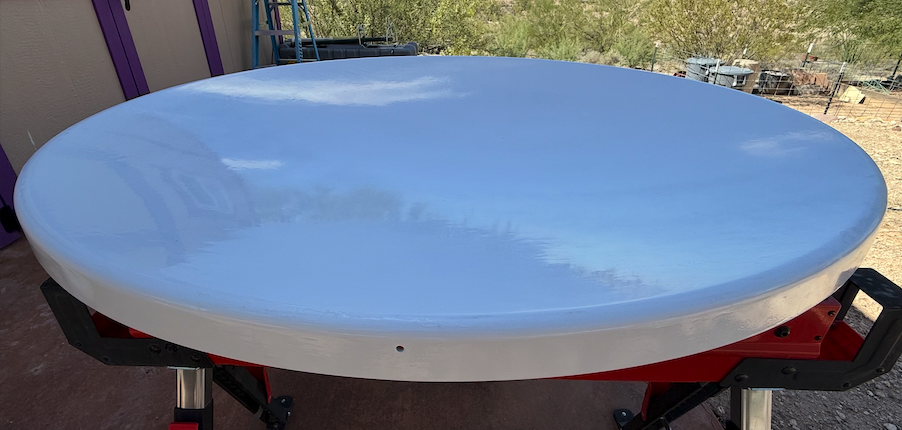 NJ6D Upgraded Dish with Reflections from the Surface
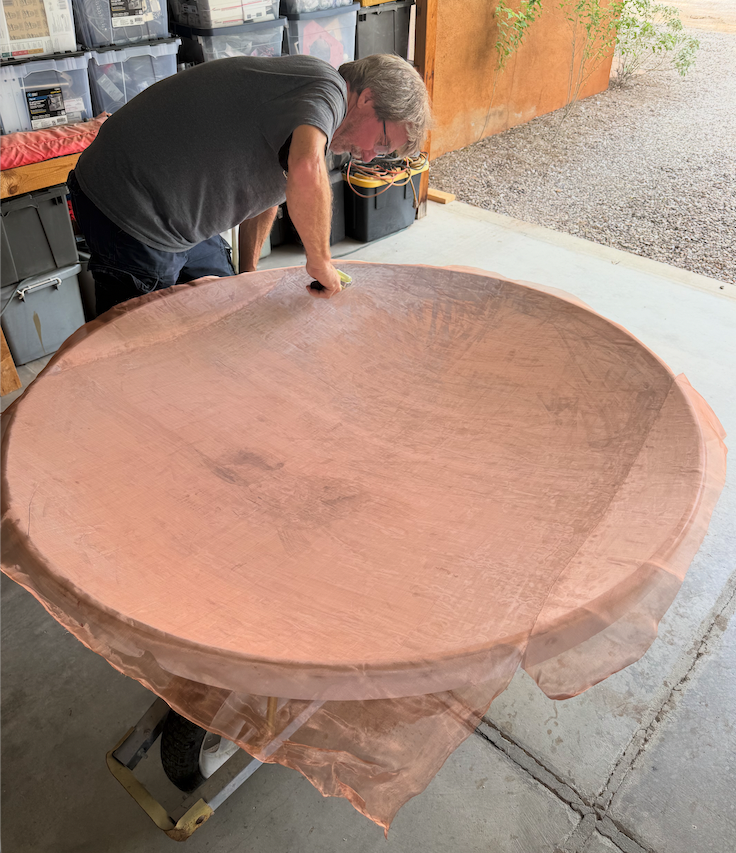 NJ6D Rolling Out the Copper Mesh on the 1.2 m Dish Surface
NN3Y Nick
Typically, in the beginning of the summer, due to the beginning of the Atlantic hurricane season, I usually take down my antennas and arrays until the end of the season. However, this time, in June 2025, after success on my 3 cm EME with my 1.2 m dish, I wanted to take advantage and upgrade my station. After 14 months of hard work, I transitioned from a 1.2 m offset dish to a 3 m C/KU PF dish.
I used (2ea) Rohn 25 rotor plates, inverted with each other, mounted on top of the 14’ Rohn 25 tower as a base for the SDD3 AZ/EL Slew drive controlled by a home-built RazTrak controller.
In the process of the dish upgrade, I had planned to build a 23 & 13 cm station, as well as to replace my 4X19LFA antenna array with 70 cm patch feed for 70 cm.
I started with 23 cm by building a 1296 to 144 (W1GHZ) transverter, followed by building a G4DDK LNA and last but not least, a 23 cm SSPA based on MRF13750 with PCB acquired from Texas Microwave and SSPA controller from (60dBm.com), a company in Ukraine which offers single and multi band SSPA controllers. I had a similar SSPA build for my 70 cm station and was very happy, so I decided to implement the same controller for the 23 cm SSPA. The entire 23 cm SSPA was built on a 10.5” X 14.5” X 1” (267 x 368 x 25 mm) aluminum heatsink with all components including the copper spread on top of the heat sink (see photos of the 70 cm complete and work in progress of the 23 cm SSPA.
Well, even though I have an IC9700 which covers the 23 cm band, I needed the transverter with 144 MHz output to feed my home built DB6NT sun/moon noise meter for measuring RX performance including the positioning and calibration of the rotator controller. I had utilized my own design of a FET SSPA switch, Sequencer and the device driver for various relays and LNA.
Just to mention that during the testing of the SSPA I ran into inconsistency of RF power measurement. I had previously acquired 500E and 1000E Bird slugs for the 400-1000 MHz frequency range. Initial testing indicated much lower power than expected. With my question to the Moon net forum, I had numerous feedback that the “E” slugs are typically indicating lower power at 1296 than the actual. Barry, (VE4MA) suggested that the “E” slugs are usually showing 1.2 dB lower than the actual. To find out what the actual difference was, I purchased a brand new 950-1350 MHz slug. So here is the table of the actual measurements and results.
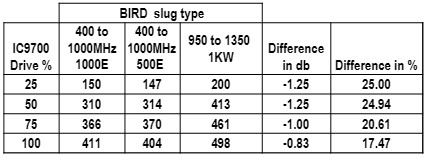 NN3Y Bird 43 Slug Comparison Table
Based on the data above, Don, (VE6HQ) had actually created the comparing graph:
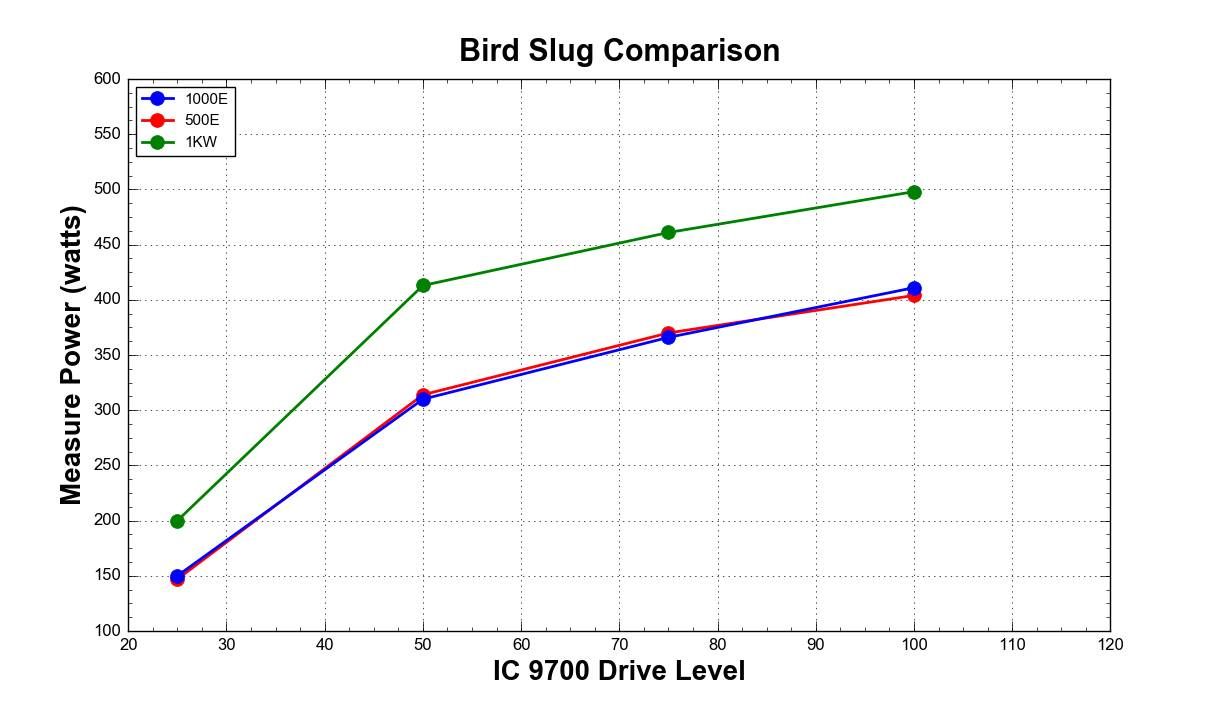 NN3Y Bird 43 Slug Comparison Graph
I was ready to go on the air with 23 cm for the ARRL contest, until I realized that my rotator had frozen and I received a report from another ham that my frequency was drifting. I discovered that I must have experienced lightning discharge which took down my RazTrak rotator controller as well as my frequency standard box. Finally, last Monday, September 8th all the work paid off. It was a pleasant experience working every station on the air from that day until Sunday, September 13, excluding September 10th on which the sun and the moon were so close that it was impossible to make any QSOs.
Overall, I logged more than 50 QSOs. During this time, I noticed some problems such as RFI and EL inaccuracy due to small flexing on the rotor base. I was happy with the RX as well as SSPA performance which ran very efficiently with very low temperature rise. Unfortunately I had to keep the power below 300 W to prevent RFI which I did not experience with the offset dish.
I have also built a 70 cm dual polarity patch feed per drawing shared by Steve (K5DOG) so I plan on installing it on the dish in the very near future. Getting back on 3cm with the 3 m dish is also on my list.
Lessons learned:
- To minimize a RFI as well as lightning damage to the rotator components, I need to replace the RS485 data bus (RJ12) line with fiber optic.
- To prevent warping and EL errors, need to replace the (2ea) ROHN 25 rotator plates with custom built 5/16” solid steel plate.
- When you think you have enough chokes on your wiring, put some more!
Special thanks to JC (N4IS), Raul (W4AWI) and my other friends from the Microwave Society of South Florida.
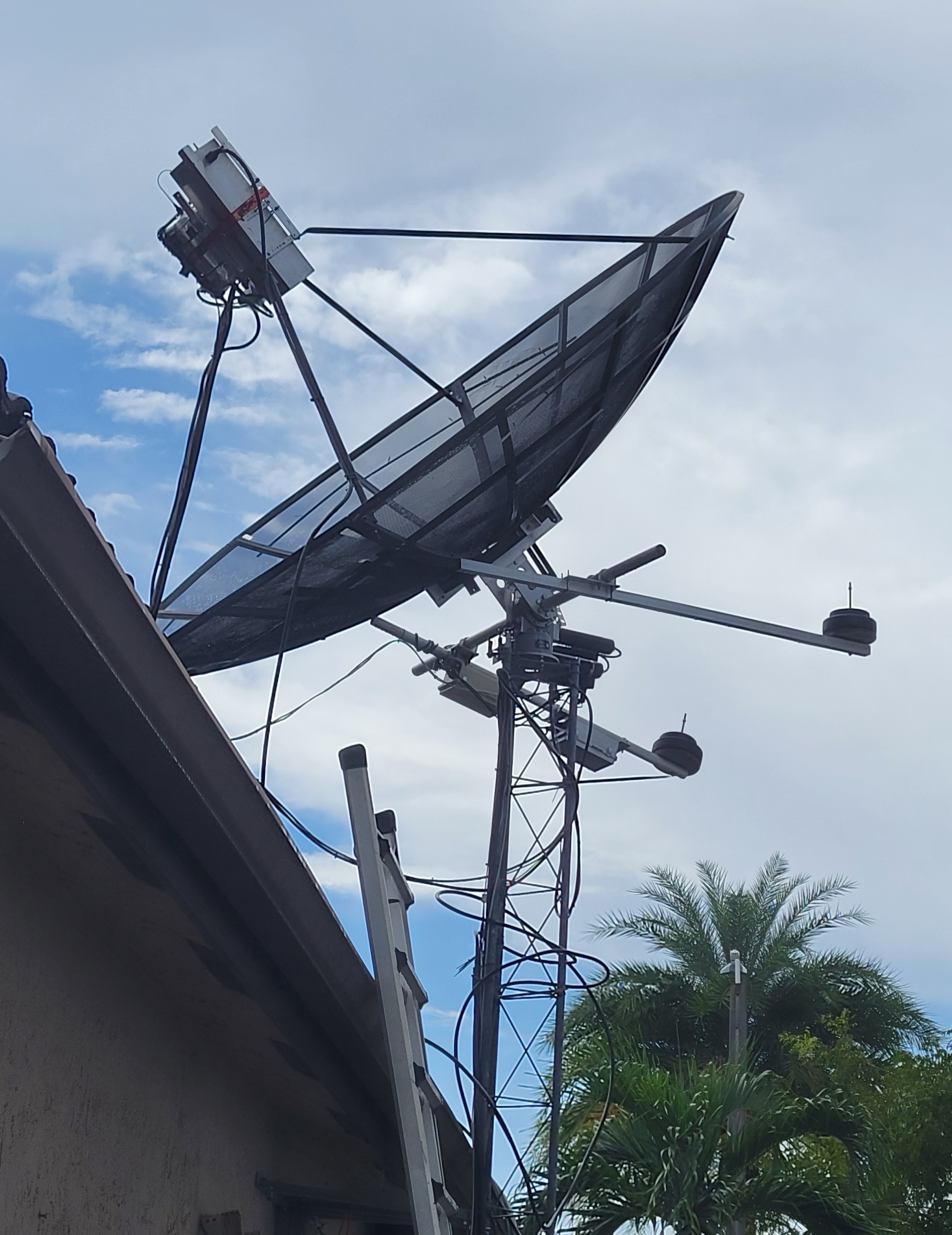 NN3Y 3 m Dish
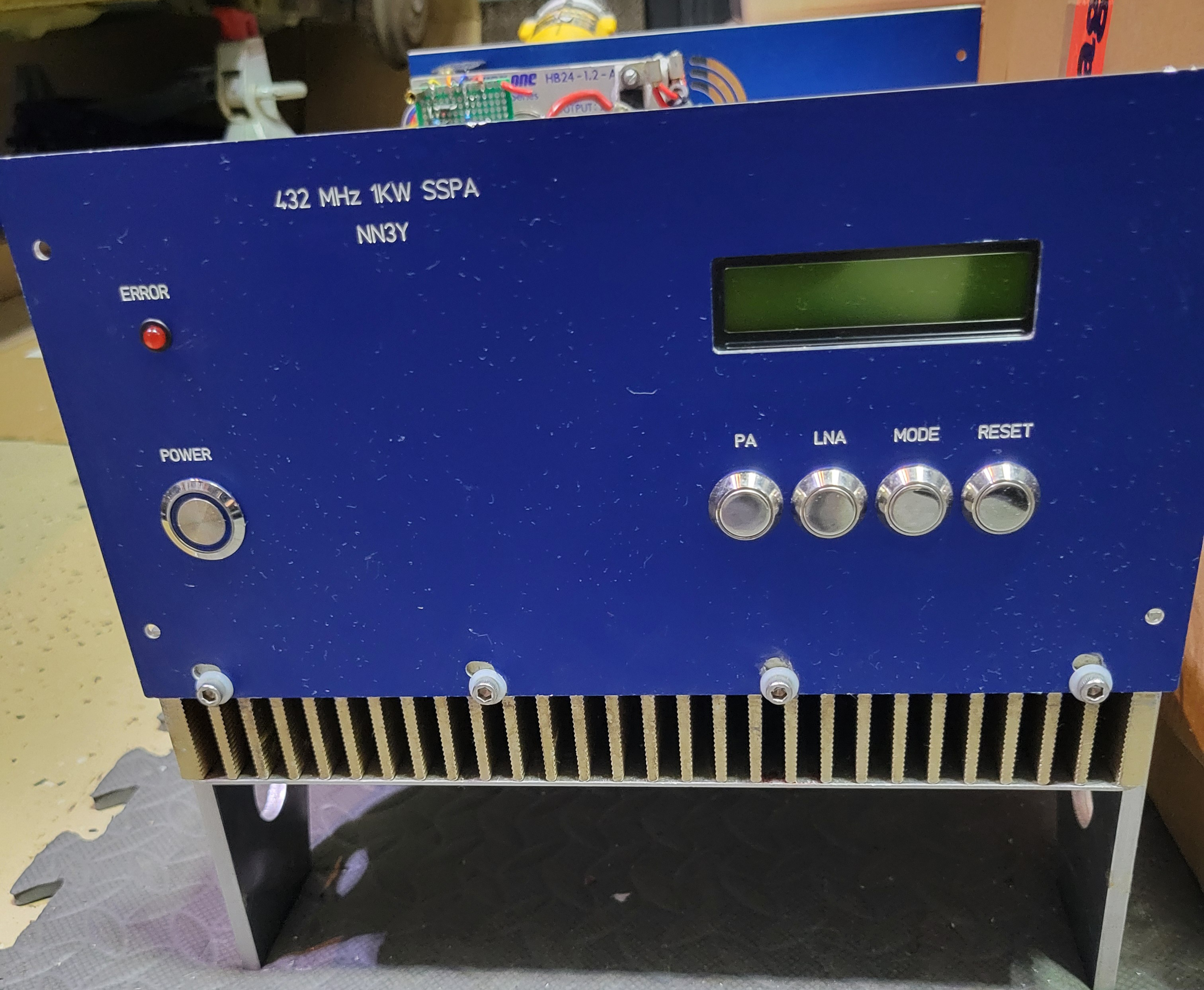 NN3Y 70 cm SSPA
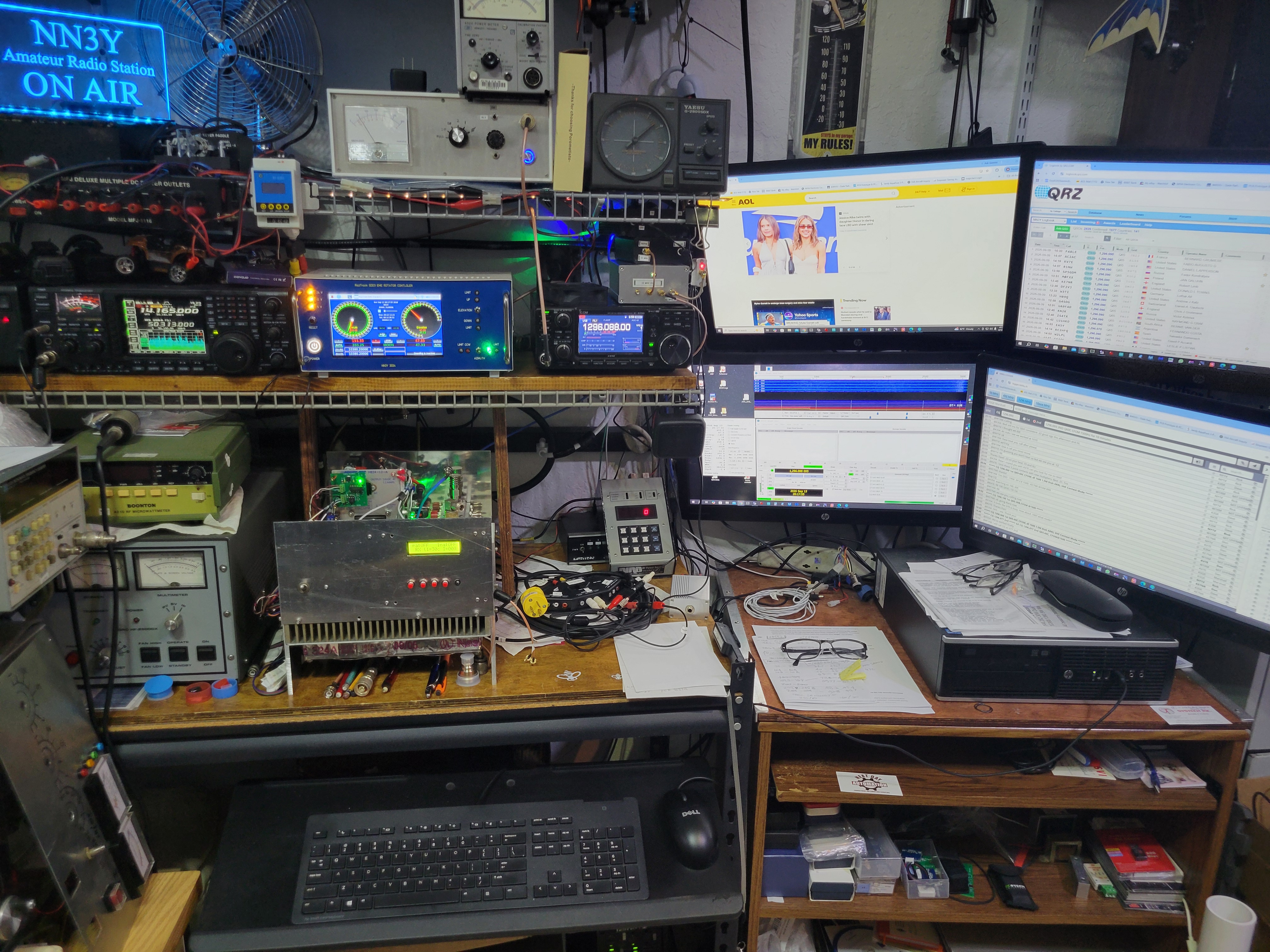 NN3Y Operating Position
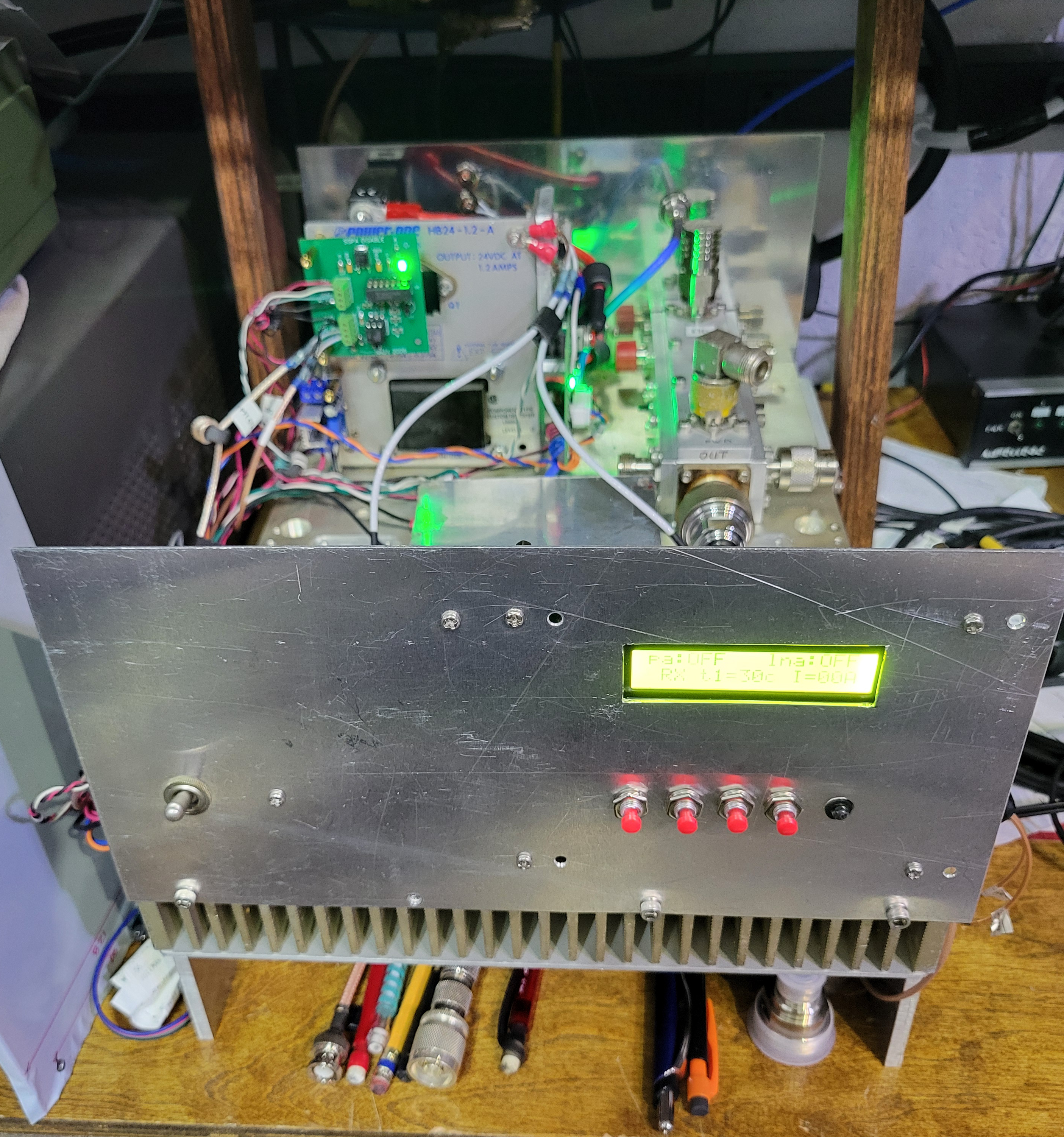 NN3Y 23 cm SSPA in Construction
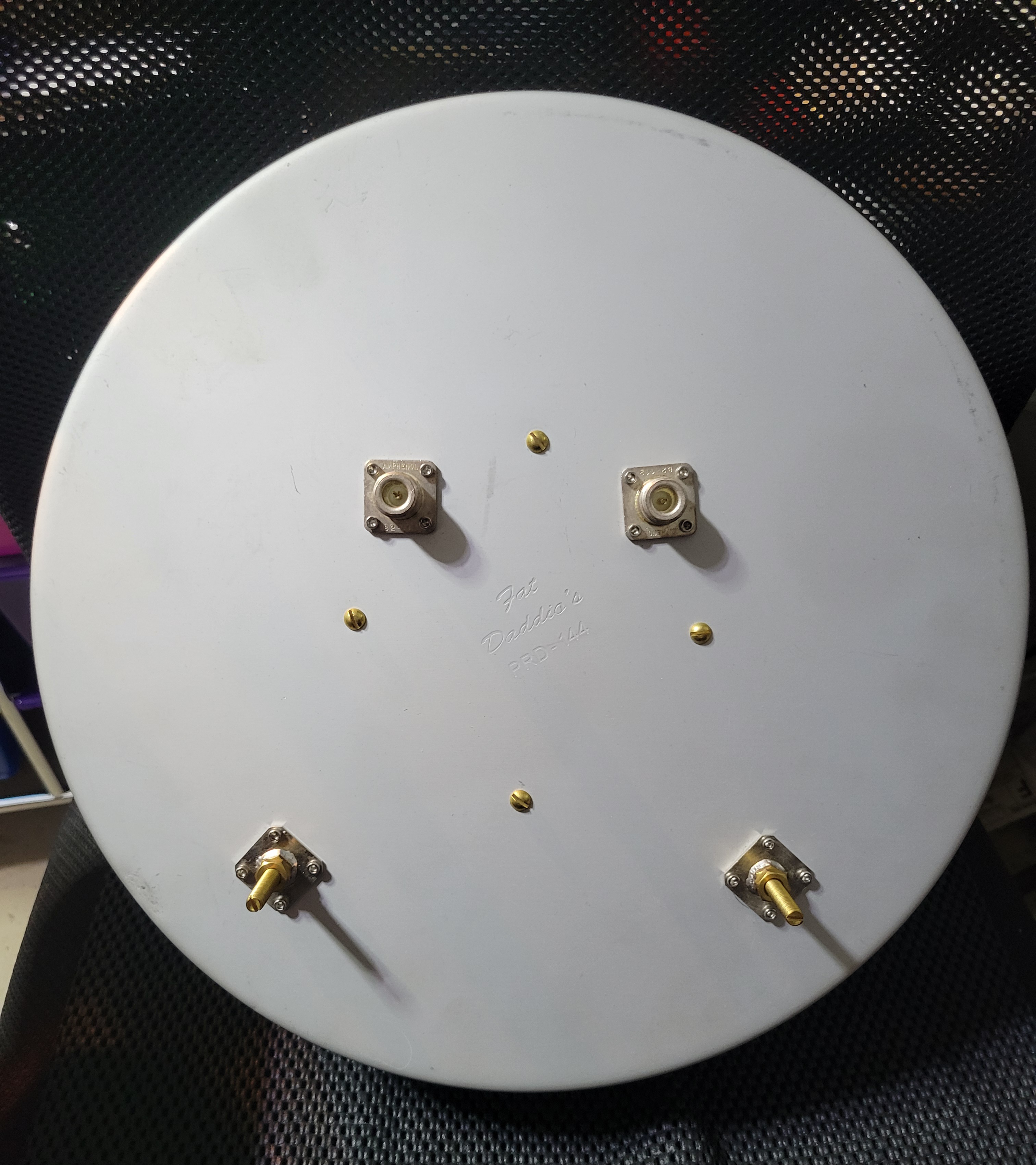 NN3Y 70 cm Patch Feed Rear
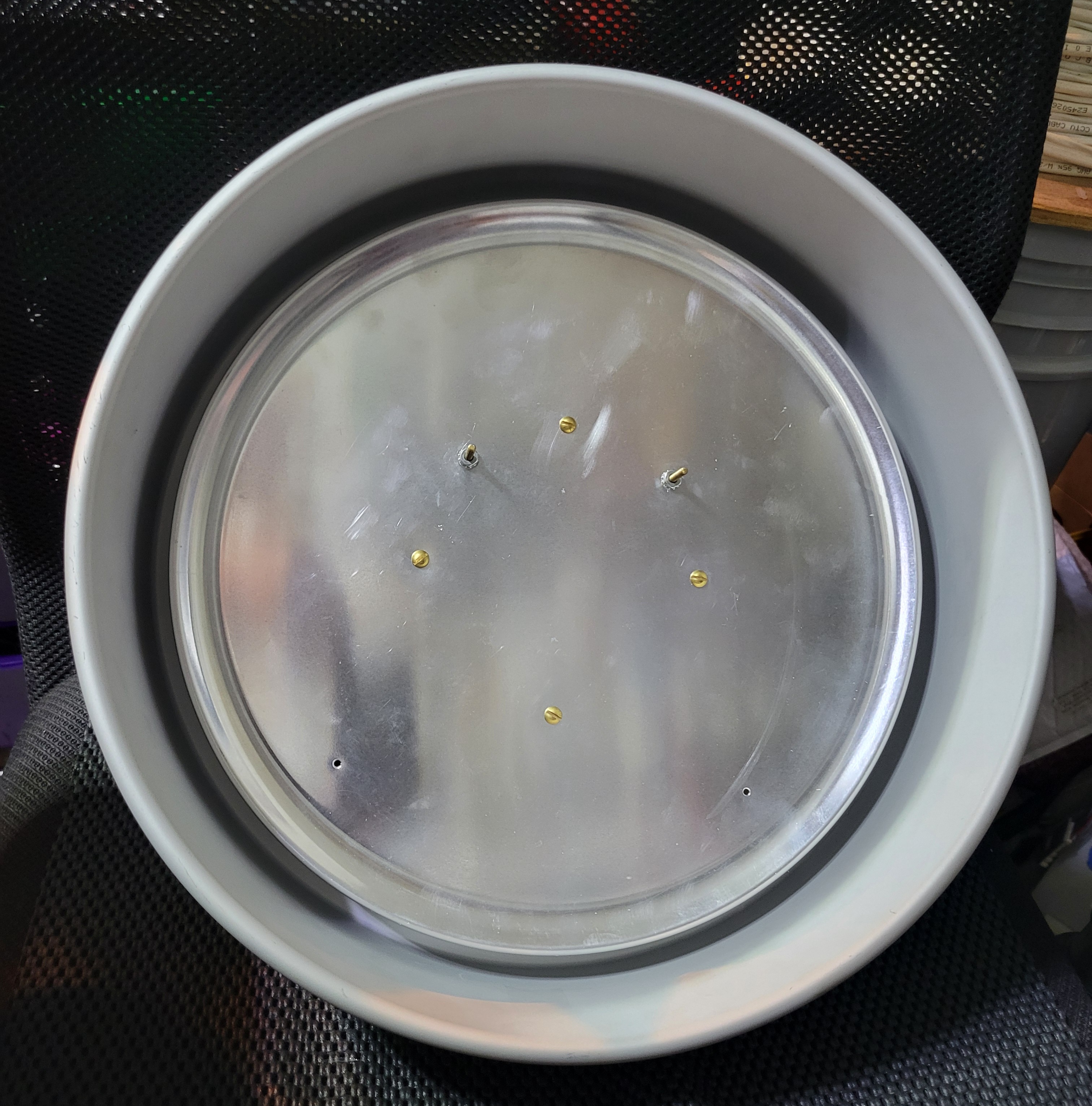 NN3Y 70 cm Patch Feed Front
NY1V Rick
I had a great time in the ARRL September VHF contest. It was the first time including EME QSOs during the contest weekend.
432 QSOs included: N1AV, KD2LGX, W5ZN and VK4EME
1296 QSOs included: KD5FZX, W1XM, G4YTL, EA5Y, K3SK, GM0PJD, KE7NR, NN3Y, KB2SA, and AA6I
The highlight was working the MIT club station W1XM (18 foot dish 15 watts) on 23 cm with my 1.5 m cooker dish (540 W), The VHF contest was a good practice for the upcoming EME contest weekends.
OE3JPC Hannes
On May 4th I attempted an 8 or 9 m flight from my tower down to the garden but without a parachute (see also my blog). I landed on my left foot which fractured in several places as well as my ankle. The recovery after 3 surgeries is slow, and I miss my other hobby (hiking/ mountaineering), but thankfully I am still alive!
My radio room is upstairs and I haven't been able to access it for a long time. To make matters worse, I noticed that a mounting bracket for the elevation drive had slipped and the 70+23 cm array was being held in a near horizontal position by a thin 13 VDC cable that powered the 23 cm coaxial relay and the LNA. Fortunately, OE3KEU could climb my tower and fix it. I hope there aren’t other problems up there until I can climb again myself.
After some maintenance in my radio room I was back on EME on July 11th, so the “OE3JPC 23 cm Yagi Challenge” can continue. So far 3 new stations have been logged (as of September 2nd): K6EME, DF6LH, KV7E (#233 to 235). I am working with 2x56 element YU1CF Yagis and 400 W at the antenna.
OH3LWP Ari
This year I had time to be active in both moon passes of ARRL EME contest 2nd weekend. The local weather was better on Saturday than Sunday, so most activity was on Saturday. There was nice activity especially on 3 cm and on 13 cm during the contest. I tried with OZ5G on 9 cm and VK2CMP on 13 cm but no QSO was completed during the contest.
I worked the following in ARRL EME contest 2.3 GHz & Up 2nd weekend (digital if not marked CW, duplicates not shown):
3 cm:
5/9/2026 OH2DG, IT9EQO, UA4AAV, ON4MU, IW2BNA, ON7FI, DL5CN, DL3WDG, S57NML, G4YTL, IK3MAC CW, IT9CJC, CX2SC, G4BAO, EA1IW, VE6TA, HB9Q
06/09/2026 JA8ERE, SM5DGX, BA7NQ, OZ7Z
6 cm:
6/9/2026 OH1LRY, SA6BUN CW, W5LUA, PA3DZL, IK0HWJ
9 cm:
5/9/2026 OK1DFC CW, PI9RD, W5LUA
13 cm:
5/9/2026 DF3RU CW, JJ1NNJ CW, 4Z5LV, PE9GHZ, OK1KIR, PI9RD CW, HB9Q, N0AKC
6/9/2026 F5JWF, PH0V
Outside of the contest, the highlight was the ER/EA8DBM expedition, thank you Alex.
New inits and new DXCC worked in 22/8/2026 to 22/9/2026 time window are as below (digital if not marked CW):
New 23 cm inits:
02/09/2026 DF6LH
07/09/2026 ER/EA8DBM (also new DXCC), UF3D
New 13 cm inits:
06/09/2026 F5JWF, PH0V
New 3 cm inits:
01/09/2026 DG5NFF
02/09/2026 ON4MU
05/09/2026 IT9EQO, UA4AAV, DL3WDG
06/09/2026 JA8ERE
11/09/2026 UT4UWR (also new DXCC)
OK1DFC Zdenek
I am sending you a report on my activity on the EME bands from August through September of this year. Between the two rounds of the ARRL contest, I spent time preparing for the second round and building a new system for the 144 MHz band. At the same time, I was also working on modifying the TRV mechanism for the 24 and 47 GHz bands. I hope to get everything done in time so that I can resume my experiments on these bands. I have finished the mechanical parts for the 76 GHz TRV, and the device is already operating in RX mode. I still need to fine-tune a few minor details so that I can try measuring the sun's noise on this band as well.
For the second round of the ARRL microwave section, I didn’t prepare anything fundamentally new. I just made a few more hardware adjustments to the feed point of the microwave dish. On 13 cm, I replaced the LNA with one that has a better noise figure. Now I have NF 0.3 dB and I’ve slightly improved the signal-to-noise ratio for the sun against a cold sky. It seems to me that the WiFi interference on the 13 cm band has also eased up slightly, at least in my area.
The weather looked promising, though it rained just a little bit during the night from Saturday to Sunday. This only affected the 3 cm band, causing a slight increase in noise when directing the signal through the rain clouds. There was again a lot of activity on the 3 cm band. I tried to track down stations I hadn’t made in the first round. In the second round, I made another 22 QSOs. A total of 66 contacts on 3 cm is the most I’ve ever recorded on this band. Considering that I was also operating on other microwave bands and the 13 cm band simultaneously, the results exceeded my expectations.
The 13 cm band also surprised me. I made another 11 QSOs, and I think I did everything I could on 13 cm this time. A highlight was the EME expedition by Alex EA8DBM, who set out from Moldova. His signal was -21/-21/-22, so I was able to add a new DXCC country to my list on the 13 cm band. The 6 cm and 9 cm bands didn’t surprise me. At 9 cm, I made 3 contacts this time, and the 6 cm band added another 6 QSOs, so I was generally satisfied.
New initials I worked with during the ARRL EME Contest 2nd part.
13 cm:
OK1JG #112 JT, ER/EA8DBM #113 JT, VK2CMP #114 JT
9 cm:
OH3LWP #43
6 cm:
PA0HRK #62 JT
3 cm:
IT9EQO #151 JT, ON4MU #152 JT, DL5CN #153 JT, IT9CJC #154 JT, BA7NQ #155 JT, ON7FI #156 JT,
That’s a total of 131 QSOs for both rounds: 13 cm – 46 QSOs, 9 cm – 5 QSOs, 6 cm – 14 QSOs, and 3 cm – 66 QSOs. I did about as much as I could on all bands. The only stations I’m missing—and I know were QRV—on 3 cm IK3MAC, SP6JLW, F2CT, WA6PY, and 9 cm OZ9G, DF3RU. So my final score could have been 6 stations better.
After all the adjustments to the parabolic reflector’s focus, 10 GHz is now working very well. The sun noise was 16.5 dB and the Moon noise was 2.8 dB. We’ll see how October and November turn out on the bands 144 – 432 – 1296 MHz. I’m currently setting up a small 4x7-element G0KSC system on 144 MHz so I don’t underestimate anything. Hopefully, everything will be ready by the start of the contest.
Have a wonderful time and enjoy the last of the pleasant weather days.
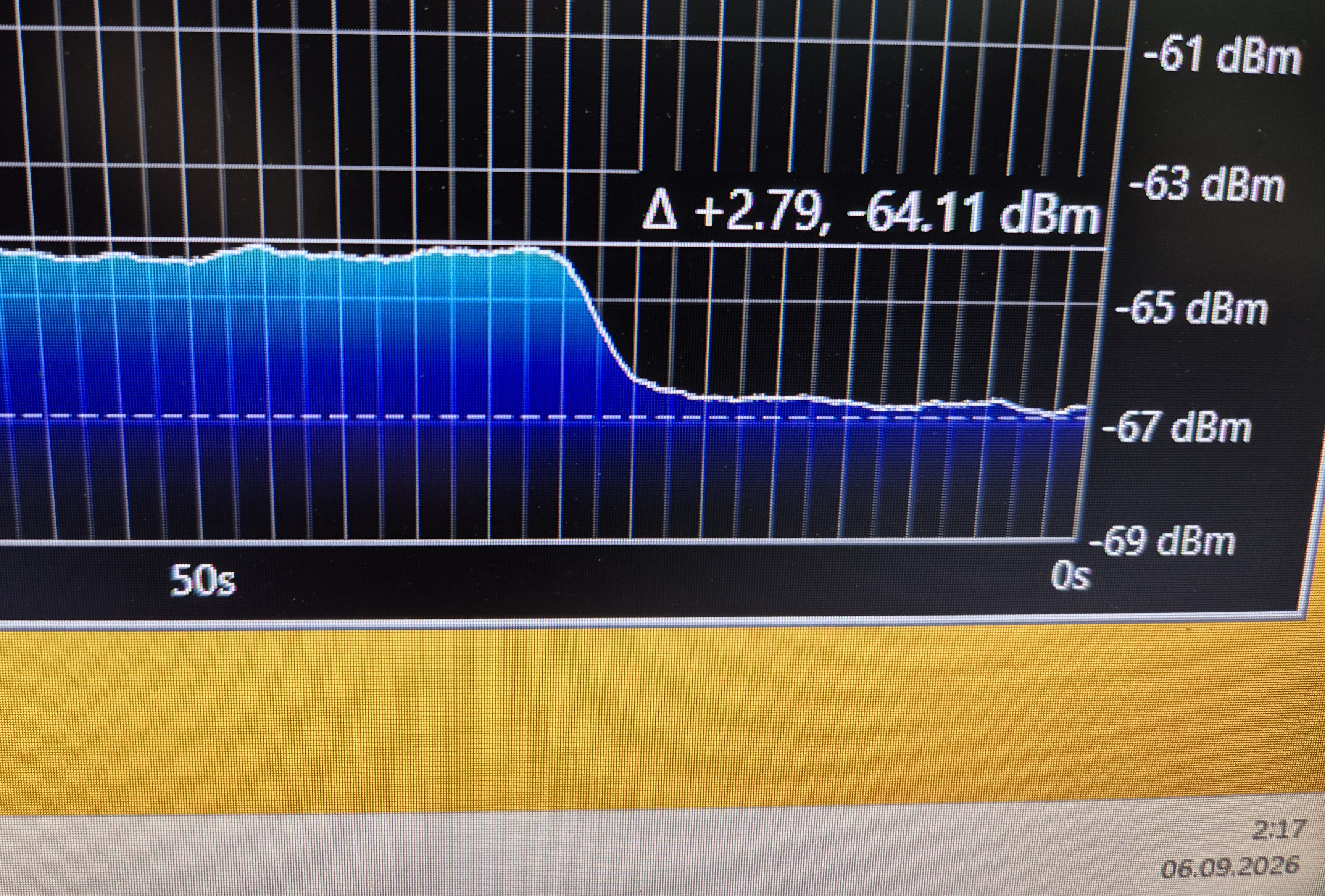 OK1DFC Moon noise at 10 GHz
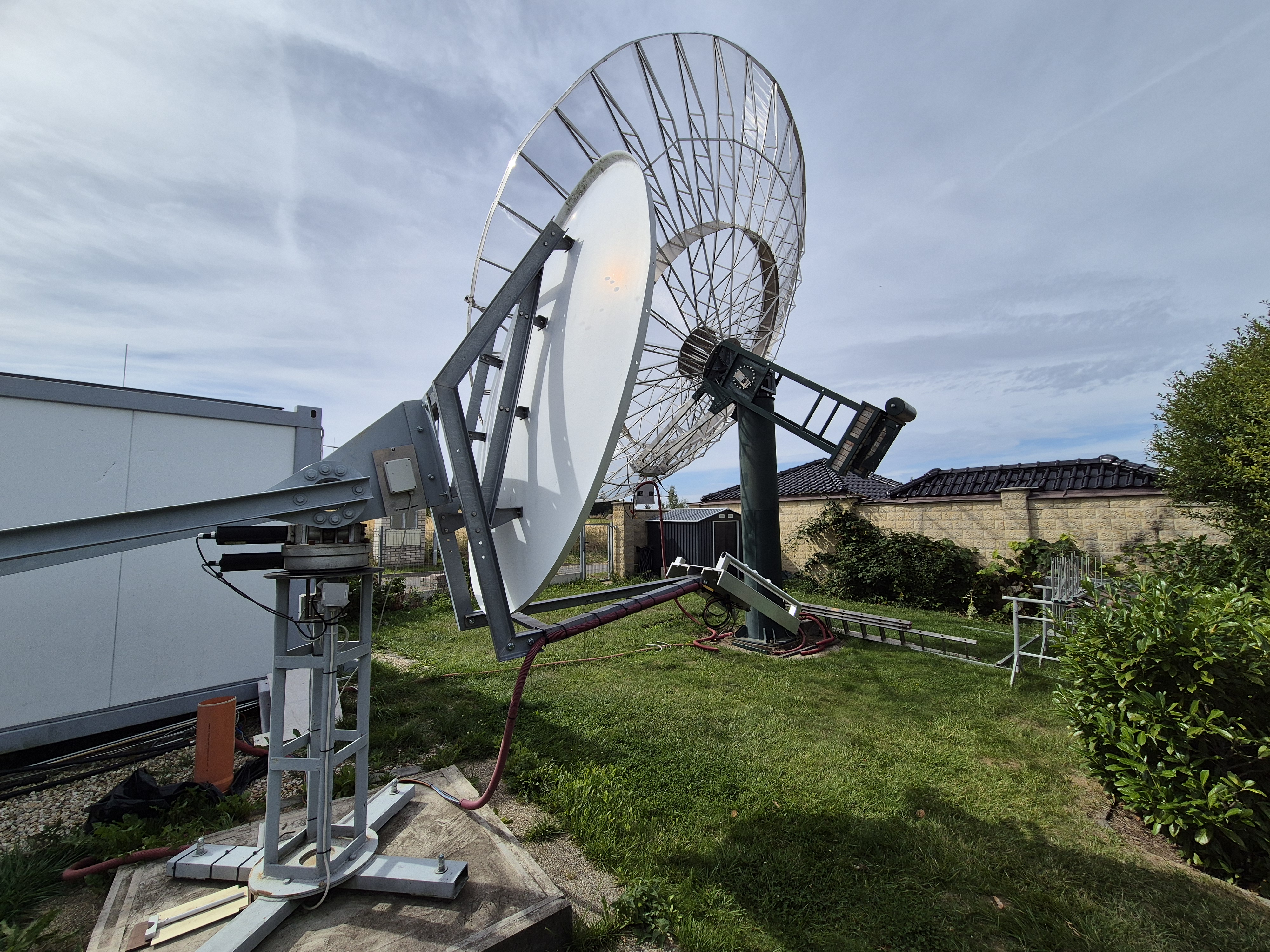 OK1DFC 2.4 m dish and 8 m dish conflict of position during moonset
OK1KIR Vlada & Tonda
Alex, EA8DBM mentioned the potential of an earlier operation of his expedition in Moldova, so we were active on 23 cm already on Thu, Sep 3 and worked with Q65-60C at 06:00 KE7NR (-12/-14) as #688 and at 06:45 DF6LR (-9/-14) as #689.
On the next day Friday September 4th we QSO’d at 02:58 R4CX (-3/-3) as #690 and at 06:17 ER/EA8DBM (-11/-11) as #691, digi DXCC #145 and 1st ER-OK on 23 cm. At 10:29 we added W2LPL (-9/-9) on his NJ expedition as our #692. Due to the continuing digi crowd of callers Alex was postponing our CW test request all day but finally we QSO'd at 22:58 ER/EA8DBM (539/559) as CW #540 and CW DXCC #95.
In the ARRL EME contest on Saturday September 5th we installed the 13 cm system and at 06:27 with Q65-60C we worked Alex ER/EA8DBM (-24/-17) as digi #134, mix DXCC #78 and 1st ER-OK on 13 cm. Later at 07:17 we QSO’d OH3LWP (-1/-5) and at 11:58 SP9VFD (-2/-12) as digi #135. In between we made QSOs with CW at 09:04 PI9RD (579/569) and at 09:24 SP3XBO (569/579).
For the next Moon orbit we installed 3 cm and with Q65-60D made as new initials on September 5th at 23:35 IT9CJC (-9/-5) as digi #302, on September 6th crossband (10368/10450 MHz) at 01:55 JA8ERE (+5/-4) as digi #303, at 02:43 BA7NQ (-10/-13) as digi #304, at 03:33 IT9EQO (-3/-2) as digi #305, at 07:28 DL5CN (-7/-1) as digi #306, at 07:57 PA0JOZ (-16/-10) as digi #307 and at 08:01 ON4MU (-19/-9) as digi #308.
In total we made during weekend September 5th/6th with Q65-60D, 27 digi QSOs and on September 6th we added one CW QSO at 11:55 with WA9FWD (O/O) and had an unsuccessful CW test with IK3MAC (O/nil). On Sunday, September 6th we measured 3.1 dB of Moon noise during daylight.
OK2AQ Mirek
Between the two legs of the ARRL EME Contest 2.4 GHz and up weekends, I managed to make two initial contacts on 3 cm: ON7FI (-17, -15) using a 1.5-meter dish & 10 W, and ON4MU (-20, -13) using a 1.2-meter dish and 10 W.
The second leg began with a contact with VK4WYM (-20, -21), which went smoothly this time, followed by an initial QSO with IT9EQO (-10, -10). In leg II, I made 16 contest QSOs and several dupes while calling other stations. One contact was on CW with IK3MAC (589, 539). The total number of QSOs in both legs is 61, marking my best-ever performance in the 10 GHz band in the ARRL EME Contest.
Unfortunately, I couldn’t bring myself to get up on Sunday night for the start of the second window, which cost me a few QSOs. However, I managed to make the initial callsign BA7NQ (-13, -18) in the following days.
My overall impression of the contest was excellent, thanks in part to the beautiful summer weather. The online log is here
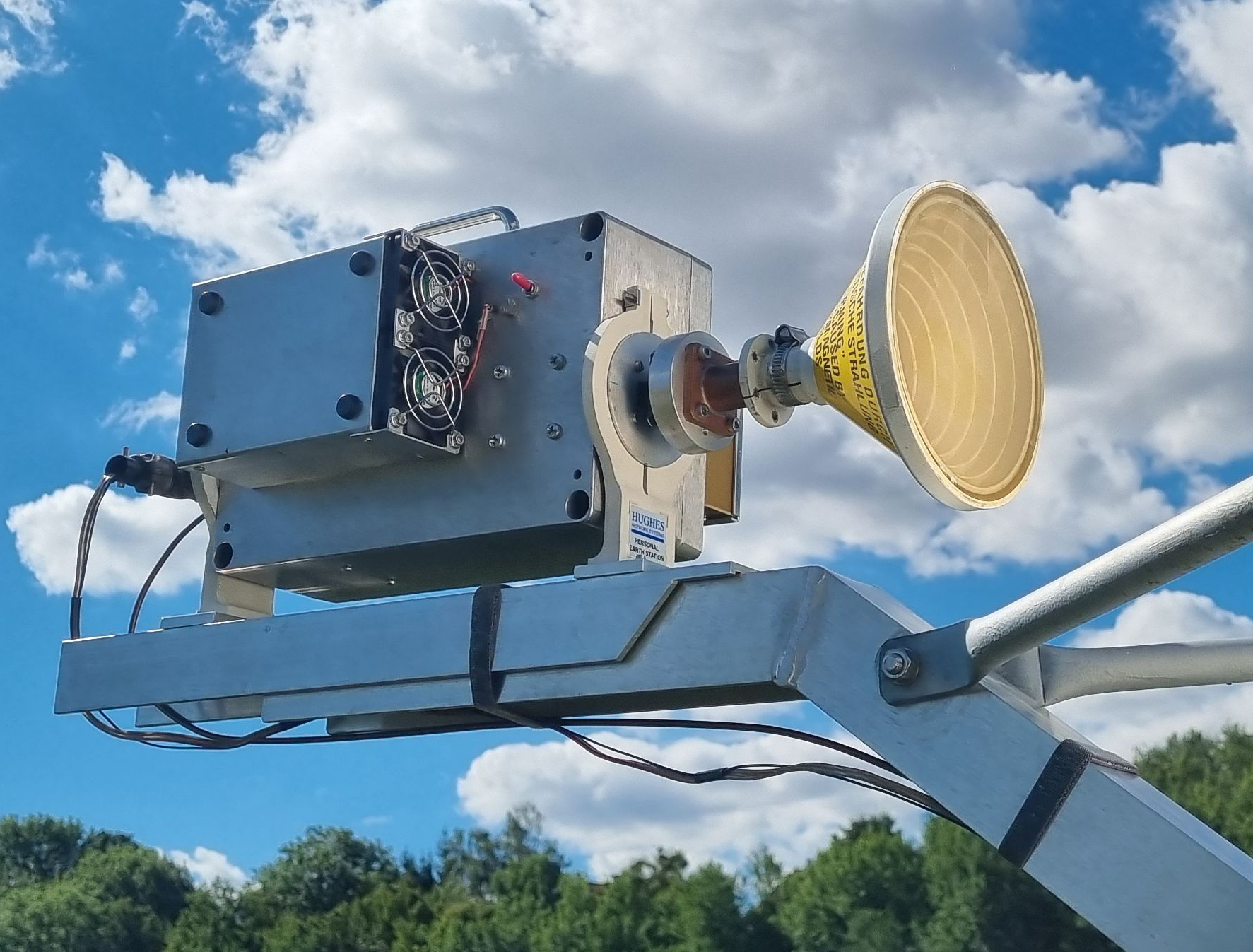 OK2AQ 3 cm Rotary Feed with 42 W SSPA 0.8 dB LNA and WG SW
ON4CDU Hans
I made the following 10 GHz QSOs during the ARRL EME contest.
On September 5th: KM0T, G8RWG, IZ2DJP, DL3DWG, AC0RA, PE1CKK, UN6PD, G4YTL, HB9Q, PA7JB, IT9CJC, and OH1LRY.
On September 6th DL5CN, OE9ERC, PA0JOZ, S57NML, IK3GHY, IT9EQO, W3SZ, VE6TA, W3TI, N1AV, SM5DGX, and CX2SC.
ON4MU Denis
My first 10 GHz EME contacts took place on September 1st, 2026, with OE9ERC and on September 2nd with ON5TA for a special DX of 3.75 km, followed by OH3LWP, OZ1FF, OK2AQ and OE5VRL. All these signals clearly visible on the waterfall with speaker copy.
The station is made of a 1.2 m offset dish (CAS124), an SVH3 slew drive with HH12 absolute sensors and a remote HB9DRI controller. My TX power currently is limited to lessthan 10 W into a Sector Microwave WR75 switch and a WA6KBL Pickett Potter feed. On the receiving side lies a DU3T LNA. For the time being, everything is driven by my tri-band portable station so there were actually 2 dishes, 3 transverters, 3 feeds and one operator on the flat roof…
I worked 27 stations during the second leg of the ARRL contest, with many more stations heard. It was great fun and a waterproof station with a 25 W GaN PA should be ready before winter comes in. A 6 cm station with a 30 W SSPA is also in the making and will use the same dish.
I worked on September 5th from 00:44 until 12:44 UTC with Q65, mostly new initials:
OZ1LPR -04/-21, OK1DFC -11/-22, OH3LWP -11/-32, OK2AQ -14/-20, ON5TA -16/-18, OE9ERC, -09/-20, PE1CKK -11/-18, KM0T -11/-24, OZ1FF -11/-21, F5JWF -13/-18, G4YTL -18/-22, OH1LRY -14/-22, AC0RA -18/-22, W3SZ -18/-21, DL3WDG -13/-20, IK6CAK -12/-12, IT9CJC -14/-18, N1AV -13/-23, and HB9Q -15/-20.
I worked on September 6th from 06:08 until 11:29 UTC with Q65 and again mostly new initials:
IK3GHY -18/-24, OE9ERC -08/-21, OK1KIR -09/-19, S57NML -19/-23, VE4MA -13/-19, IT9EQO -14/-18, ON7FI -21/-14, LZ4OC -15/-32, and W5LUA -11/-20.
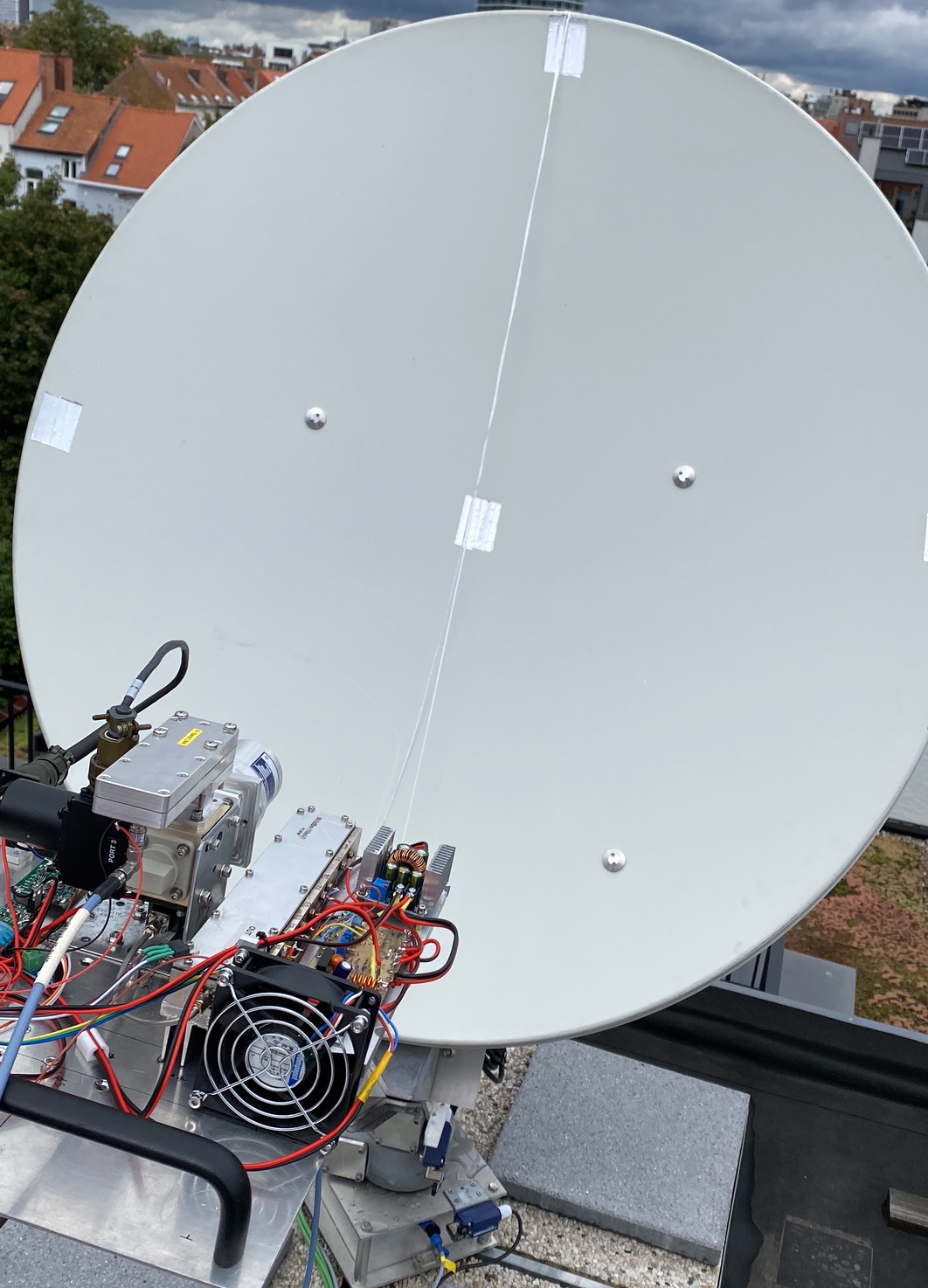 ON4MU 1.2 m 10 GHz Dish
ON5TA Eric
I ended the 3 cm ARRL contest with 71 QSO with unique stations: 63 with Q-65 and 8 in CW.
Compared with last year's result (53 QSO), this is a 34% increase, using exactly the same station as before. This shows a remarkable growth of activity on 3 cm!
Quite a lot of stations were very clearly audible in Q-65 and could have been easily contacted in CW. I hope there will be more CW activity in the future 3 cm ARRL EME contests.
The very last QSO was done in CW with WA9FWD # with the moon behind my neighbour's fence. Very weak signals, it took time but we made it... Thank you for your patience John!
OZ1FF Kjeld
After a successful repair of my WG switch I could participate on 10 GHz in the second leg of the ARRL EME- 2.3 GHz & Up contest in September 2026.
I worked the following 26 stations: IT9EQO, IW2BNA, DL3WDG, HB9Q, DL8EBL, DL5CN, S57NML, ON4MU (1,2m dish/<10W), GW3TKH, W3TI, IT9CJC, CX2SC, G4BAO, PA7JB, VE6TA, EA1IW, OZ7Z, JA8ERE, BA7NQ, UA4AAV, VE4MA, SM5DGX, WA9FWD, W5LUA, IK3MAC, and N7KU.
There was good activity in both legs and it was nice to work 11 new initials.
My station is a 2.4 m offset dish, 50 W and 0,6 dB NF LNA at the feed.
OZ1LPR Peter
I was active in the ARRL EME contest on 3 cm both in August and September. So there were 2 weekends with less sleep!
I was able to log 80 unique callsigns located in 63 grids in 29 DXCCs. There were also some dupes not counted in the number. I think that is the highest number ever worked on 3 cm in the ARRL EME contest. First of all it was very much fun and only on the last Sunday did the new QSO numbers drop significantly as there were only 4 new stations worked.
Conditions were great and the equipment worked flawlessly on all 4 moon passes. Most of the activity was using Q65. I wish more would use their super stations and also work some stations in CW. Only 9 of the 80 stations worked were in CW mode.
Stations worked in total in both weekend:
VK7ZBX, VK4WYM, JA1WQF, GW3TKH, OK1DFC, OK2AQ, SP3XBO (cw), IK6CAK (cw), OH3LWP (cw), LA4ANA, G8RWG, ON5TA (cw), IK3GHY, LZ4OC, OZ1FF, YO8RHI, YO2LAM, G4HSK, OM4XA, DJ7FJ, W3SZ, IK0HWJ, SA6BUN, DL4DTU, AC0RA, SP6JLW (cw), SV3AAF, KM0T, PA0JOZ, ON7FI, G4YTL, N1AV, PA3CSG, N6RMJ, IK3HAR, NJ6D, ON4CDU, WB6CWN, KN0WS, DF5MO, WA9FWD, IZ2DJP, W3TI, UN6PD, OE9ERC, PA3DZL, OH1LRY, OH2DG, F5JWF, G4RFR, IW2FZR, OK1KIR (cw), PE1CKK, VE4MA, IT9EQO, DL6SH (cw), IK3MAC (CW), W5LUA, N7KU, KL6M (cw), ON4MU, UA4AAV, HB9Q, DL3WDG, IW2BNA, S57NML, DL5CN, DL8EBL, IT9CJC, PA7JB, CX2SC, VE6TA, WA6PY (cw), G4BAO, EA1IW, OZ7Z, SM5DGX, JA8ERE, BA7NQ, and 5P6F.
Dupes worked G4YTL, DL4DTU (cw), OE9ERC (cw), UN6PD, IK3HAR, IK3GHY, PE1CKK, IK0HWJ, IT9EQO (cw), PA0JOZ, and W3TI.
The Station used was my usual 2.4 meter offset dish setup.
I am always open for any skeds on 3 cm, 6 cm and 24 GHz or just to act as beacon just write to
PA0JOZ Joz
During the contest weekend of September 5/6, I could be active only on the 6th. I worked on 10 GHz: DL5CN, OE9ERC, OK1KIR, DL3WDG, AC0RA, ON4CDU, IK3GHY, LZ4OC, VE4MA, N1AV, OZ1LPR, PA3CSG, OK1DFC and KM0T.
My station is mostly home-built (transceiver, transverter, feed, antenna control), except for the 120 cm Kathrein dish, the DU3T preamp, the Elisra PA and the slew drive. The TX output is approximately 15 W at the feed.
My moon window is rather limited by my own house and the buildings and trees around me, so I can only work EME when the moon is between 145 and 300 degrees azimuth and above 35 degrees elevation.
Please see the picture of the antenna and outdoor unit containing preamp, PA and waveguide switch.
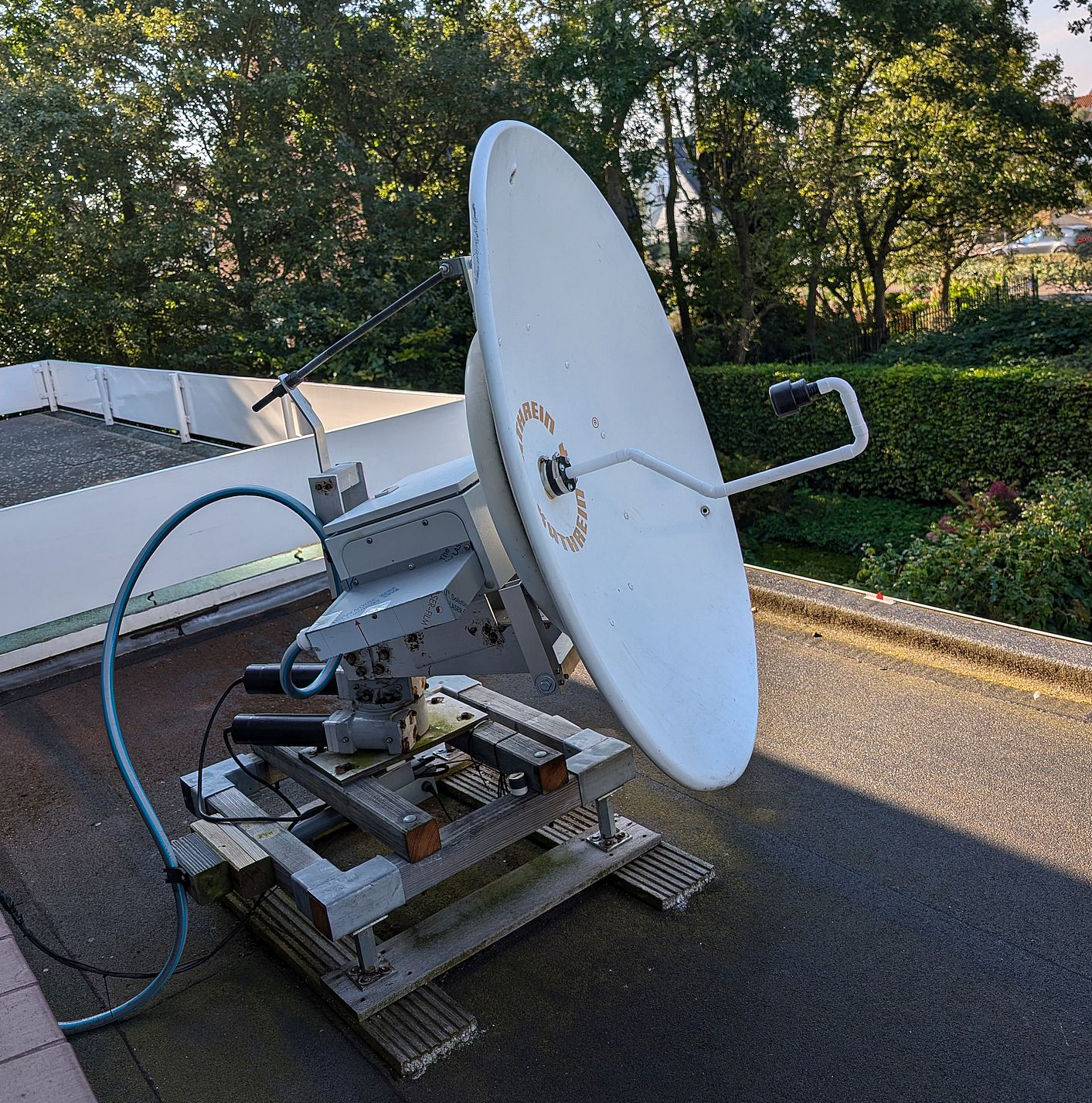 PA0JOZ 10 GHz EME 1.2 m Dish
PA3DZL Jac
It was another great DXpedition from Alex EA8DBM and I was very pleased to QSO Alex on 3 different bands: 2 m, 23 and 13 cm.
September activity was very nice with a good number of initials on different bands.
Worked on 432 MHz: BD8AIS, VE6BMX #, W3TI, WA1FXK #, PA3DRK #, VK4EME, JF6CTK, IWØRNA, DDØVF, HA2NP # and YU7C.
Worked on 1296 MHz: ER/EA8DBM # and new DXCC.
Worked on 2320 MHz: ER/EA8DBM # and new DXCC
During the ARRL contest I worked: N1AV, DG5NFF, PE9GHZ, PA9RD, KNØWS #, KN2K, DF3RU, F5JWF and IK3COJ.
Worked on 3400 MHz during the ARRL contest: Only one QSO with OK1DFC.
Worked on 5760 MHz during the ARRL contest: OK1DFC, W5LUA, YO8RHI, SA6BUN, OH3LWP, IKØHWJ and SV3AAF.
Worked on 10368 MHz: IK3HER, OH3LWP and DG5NFF #.
PA3GUO Henk
Below is my very report, a bit long as it is my first report since I started on EME about one year ago. Last year (October 2025) I started my EME endeavour, when I got two 35 elements Tonna antennas for 23 cm and wondered what to do with those. On the 9th of November I was able to receive my first signals of the moon (OE9ERC, RD4D). My operation was quite basic with manual pointing, a cheap coupler, old preamp, and a non-calibrated Kenwood TS2000X as a receiver. The main challenge was to get all the settings in WSJT correct. I heard signals on the loudspeaker and Rob PE1ITR gave me the final guidance to get it configured right. Pretty cool!
Next, I added rotors, followed by computer-controlled tracking. I did quite a lot of LEO satellite operations 10 years ago. I re-calibrated the TXCO in the 23-year old Kenwood TS-2000X, which is now stable and spot-on frequency. I added separate RX and TX lines and decoded on November 29 SM5DGX (-19), UA3PTW (-16) and DF3RU (-18) and on the next day NC1I (-19). This proved that the improvements worked and encouraged me to proceed!
At the end of December 2025, I modified the PA stage in the TS-2000X, as the earlier versions of the radio had too high bias voltage to the RF module resulting in poor SSB quality. After this TX related change I did another test and the RX still worked on 28/29 December as decoded NC1I (-15), OK1UGA (-18), ON5GS (-22), ON4BCB (-19) and OE9ERC (-13), DF3RU (-23), OH3LWP (-21), and DF7KB (-21).
In January 2026 I finished the 3-year-old 23 cm PA project, a DF9IC design that provides 150 W, via a 10-meter long H2010 coax to the antenna outside. I had my first TX (only) success on February 23 when UA9FA decoded me at -19 dB. There was a lot of happiness for the first time I got a signal transmitted via the moon! March through April 2026 was spent on designing an Arduino based sequencer and outdoor coax-switch unit, with as the ultimate success on May 15th my very first ever two-way EME QSO with Frank NC1I -19 / -23 dB.
So, what's next? It was clear that my set-up was only marginally OK. With the 2 old Yagis I had no circular polarization, and they were actually tuned to 1240 MHz. Since I just acquired on an old 1,2-meter RF Hamdesign dish, I decided to re-target my EME set-up based on that instead. The main improvements would be: less coax in between the LNA and antenna if I would use a septum feed, circular polarization and maybe a mechanically more stable set-up.
During the summer period I started the mechanical construction to hook up the dish to the rotor and in August I mounted a brand-new septum feed in front of the dish. Honestly, 8 kg of metal in front of such a small dish looks a bit out of balance, but I gave it a go on September 5th . I didn’t do any optimization (e.g. sun-measurements), I just put the feed at 54 cm distance from the dish and tried to see if with an RX only set-up I could decode any signal. Well the results were not bad: OK1UGA (-20), OE9ERC (-16), OK2DL (-17) and NC1I (-15).
Now it is time to modify my sequencer for this dish set-up and try to make actual QSO’s. I am looking forward to that!
PE1CKK Hans
During the two weekends of the Microwave EME Contest, I made some nice contacts on 13 cm, 6 cm and 3 cm.
During the first weekend, I was active for only five hours on both Saturday and Sunday due to the limited moon window. During the second weekend, I was only active on Saturday, again for about five hours.
My station uses a 1.8 m offset dish for all three bands, so I have to change the feed when switching bands. The output power is 200 W on 13 cm, 100 W on 6 cm and 75 W on 3 cm.
On 13 cm, I made my first cross-band contact, 2320/2304 MHz. I had never tried this before, so it was a nice first!
My results were:
Saturday August 8th:
13 cm – 19 contacts, 6 cm – 1 contact
Sunday August 9th:
6 cm – 7 contacts, 3 cm – 28 contacts
Saturday September 5th:
3 cm – 28 contacts
With my “small” 1.8 m station, I was also able to work LA4ANA, who is using a 90 cm dish with only 15 W output. That was a particularly nice contact!
SV3AAF Petros
I have been QRV for the two microwave legs of ARRL EME 2026 contest for approximately a half of each pass, which was nice to be able to do this year. I found the activity to be good on 13 & 3 cm and lower on 6 cm. The CW traffic was low. EME path conditions were no surprise, and in line with near perigee & high declination geometry.
Stress on equipment and operators that needed to go outdoors was very high for the warmest regions of the temperate zone. In the August leg the local ambient noon hour temperature (under shade) was at 42 C (107 F), while in the September leg it was at 36 C (96 F). It was demanding conditions here, with temperature exceeding 50 C on the heatsinks of outdoor equipment that, in my case, are not exposed to direct sunlight. The good part was that I didn’t have to work on equipment outside.
Significant interference from rogue hilltop Wi-Fi emissions was experienced on 6 cm with moon noise blanked out; so inevitably my QRV time on this band was limited.
Stations worked during both microwave legs were: (Q65 mainly, unless otherwise noted)
13 cm:
G4CCH (CW), OE9ERC, DG5NFF, OK1DFC, 4Z5LV, OK1USW, F1RJ, PA3DZL, PE1CKK, OH3LWP, SP9VFD, OH1LRY, WA3RGQ, G3LTF (CW), G4RGK, DL1SUZ, DF3RU (CW), PA0BAT, PE9GHZ, PI9RD (CW), N1AV, VE4MA, SP3XBO (CW), F5JWF, IK3COJ, PH0V.
6 cm:
OK1DFC, DL4DTU, IK0HWJ, OH3LWP, UA3PTW, PE1CKK, OH1LRY, W5LUA, PA3DZL, YO8RHI.
3 cm:
OZ1LPR, SA6BUN, OH3LWP, OZ1FF, ON5TA, KM0T, OK1DFC, AC0RA, PA3DZL, F5JWF, G4RFR, OM4XA, G8RWG, IK6CAK, PA3CSG, W3SZ, IK3GHY, N1AV, OE9ERC, OK2AQ, DL3WDG, PE1CKK, UN6PD, IT9EQO, DL5CN, OK1KIR.
VE4MA Barry
For the September weekend I was hoping to operate on 24 GHz but there was no activity, so I continued on 13 cm, 6 cm and 3 cm. Last month I had only 18 QSOs on 13 cm due to some down time for PA problems but I had 29 QSOS on 3 cm.
On 13 cm I added DF3RU 559/559, DG5NFF -15/-11, IK3COJ -20/-13, PE9GHz -19/-20, PI9RD 559/559, SV3AAF -15/-17 and HB9Q -8/-13.
I was on 6 cm briefly and I worked SA6BUN 559/559, and OK1DFC 559/ 559 & -14/-13.
On September 6th I operated only on 3 cm as the activity was again very high as it was in August. I QSO’d: UA4AAV -17/-20, DL3WDG -10/-12, IT9EQO -11/-11, OZ1FF -11/-11, ON7FI -18/-14, DF5CN -9/-11, OK1KIR -6/-9, S57NML -16/-13, UN6PD -10/-10, SM5DGX -15/-14, ON4MU -19/-13, W3SZ -13/-10, PA0JOZ -17/-14, CX2SC -17/-11, W5LUA -5/-13, W3TI -17/-17, WA9FWD 569/O, IK3MAC 579/539, VE6TA-15/-18, IT9GJC -10/-8 (same station as IT9EQO), IK3HAR -21/-17 Dup, OK2AQ -9/7 Dup, SP6F -20/-10, and OZ7F -21/-21. I missed WB6CWN, G4BAO, EA1W and G4YTL.
That left me with microwave band totals of 25 stations on 13 cm, 2 stations on 6 cm and 50 stations on 3 cm.
My plans for the next ARRL contest weekend are to operate on 432 MHz with 300 W and my 3 m dish with polarity switching. I will also be pursuing 24 and 47 GHz QSOs which will take priority now that the oppressive summer heat is dissipating in the EU and winter is not here yet. I expect that Shawn VE4SA (1 km from me) will be operating on 23 cm and weather permitting on 3 cm with a 1.2 m dish and 45 W.
VE6TA Grant
There were pretty good conditions on 10 GHz with low EU spread the first pass and lower NA spread on the second pass.
The stations worked on the September 5th pass were: OK1DFC, KM0T, OZ1LPR, #PA3CSG, ON5TA, #PE1CKK, LZ4OC, DL3WDG, OH3LWP, OZ1FF, #IT9CJC, OK2AQ, #AC0RA, N1AV, and HB9Q.
On the September 6th pass I worked: ON4CDU, VE4MA, W5LUA, OE9ERC, and OK1KIR.
A few very loud CW stations were on as well that unfortunately only gave me QRZs. OZ1LPR, and IK3MAC... Big sigs!
After the contest On September 8th I had a sked with WB6CWN. He was an easy copy and is initial #67 in the log.
VK2CMP Mick
I used the 2nd weekend of the ARRL contest to try out my 13 cm portable setup from the front driveway in the home QTH. I only had 20 W from an old Spectrian PA that I put together during the week but I thought “why not have a crack at it”.
I was very happy to work OK1DFC at -16 on his 8 m dish using just 20 W at my end. I also received OH3LWP at -19 but alas we could not complete. So it was great to finally work my 3rd EME band and play with my different LNA and filter/frequency combinations. I do have plans for a 200 W PA.
My 13 cm station consists of a 2.4 m folding dish, OK1DFC septum feed, AGO LNAs and filters, Kuhne MKU 23 G4 transverter, IC9700 locked using a DF9NA board. And in the near future I will have a 200 W PA. My RX capability is 2300-02, 2304-06, 2320-22 & 2400-02. In VK I can only TX on 2300-02 and 2400-02.
At my home QTH I have 5G LTE carriers that wipe out 2304 and 2320 RX. Amazingly 2300 is clear and I have a small notch of clear air at 2400 as well as a very sharp filter from Tommy WD5AGO. I have attached a picture from the Pluto SATSAGEN Spectrum Analyzer that shows the activity between 2300 and 2400. Due to the intermittent nature of the carriers you need to look at the red max hold trace. The plan is to take this setup portable with us on our outback travels where there is no mobile network hence we should be able to work 2320 and 2304 sometimes.
On the 70 cm home station I have been disappointed by my RX performance over the last 6 months. My noise during the recent ARRL VHF/UHF contest while trying to give a few folks some points, was S7 for the first 35 degrees elevation. This used to be "just OK" between S3 and S5. I know I have missed many stations that were once easy into the log. I will have to spend some time with the new Portapack H4M Mayhem Pro SDR wandering the neighbourhood as well as looking at even more filtering etc. in the RX chain.
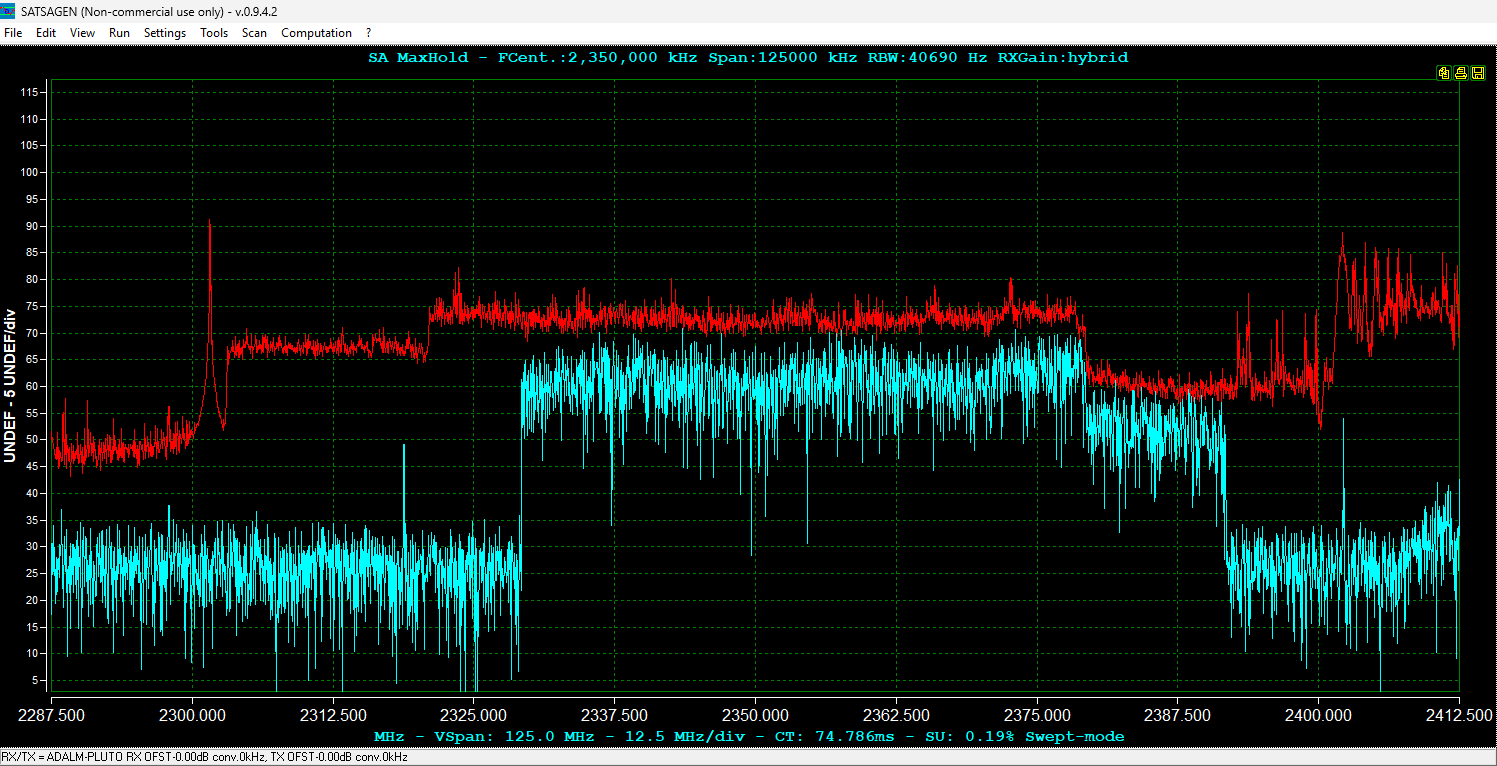 VK2CMP 13 cm 5G Mobile Signals
VK7ZBX Richard
It was a busy month at my station. Work was pretty demanding but I managed to be active for the ARRL EME contest and also managed to have my 1st EME contact on 23 cm.
In the second leg of the ARRL contest signals were very good with very low spreading to VK. I managed to work IT9CJC, IK3HAR, UN6PD, OK1KIR and OE9ERC on 10 GHz. I did try to work SM5DGX but sadly that didn't work out, next time perhaps. My log is submitted for both weekends. I had a great time and next time I'd love to get to work some US/CA stations if I move my system... Next year!
On August 31 I managed to make my 1st contact on 23 cm EME. I worked Ralph VK3WRE for initial #1, then KG0D, JS6UJS, BA7NQ and KE7NR. My system is a 2.4 m mesh PF dish with an OK1DFC style feed, IC9700 with VHF Design SSPA that runs 250 W nicely and Antenna-Amplifiers LNA. Tracking is via a WinTrak controller driving a SDD3 slew drive. There is still some tidying and waterproofing work to complete and I will eventually plant it in the ground instead of the current mobile platform. I am looking forward to working a few on this band.
I have included some photos showing our field day van that is currently in use as a temp / portable shack for 23 cm EME. This is an old outside broadcast van used by our local TV broadcaster. It has a 10 m telescopic mast in the roof that we currently have our VHF/UHF yagis mounted on.
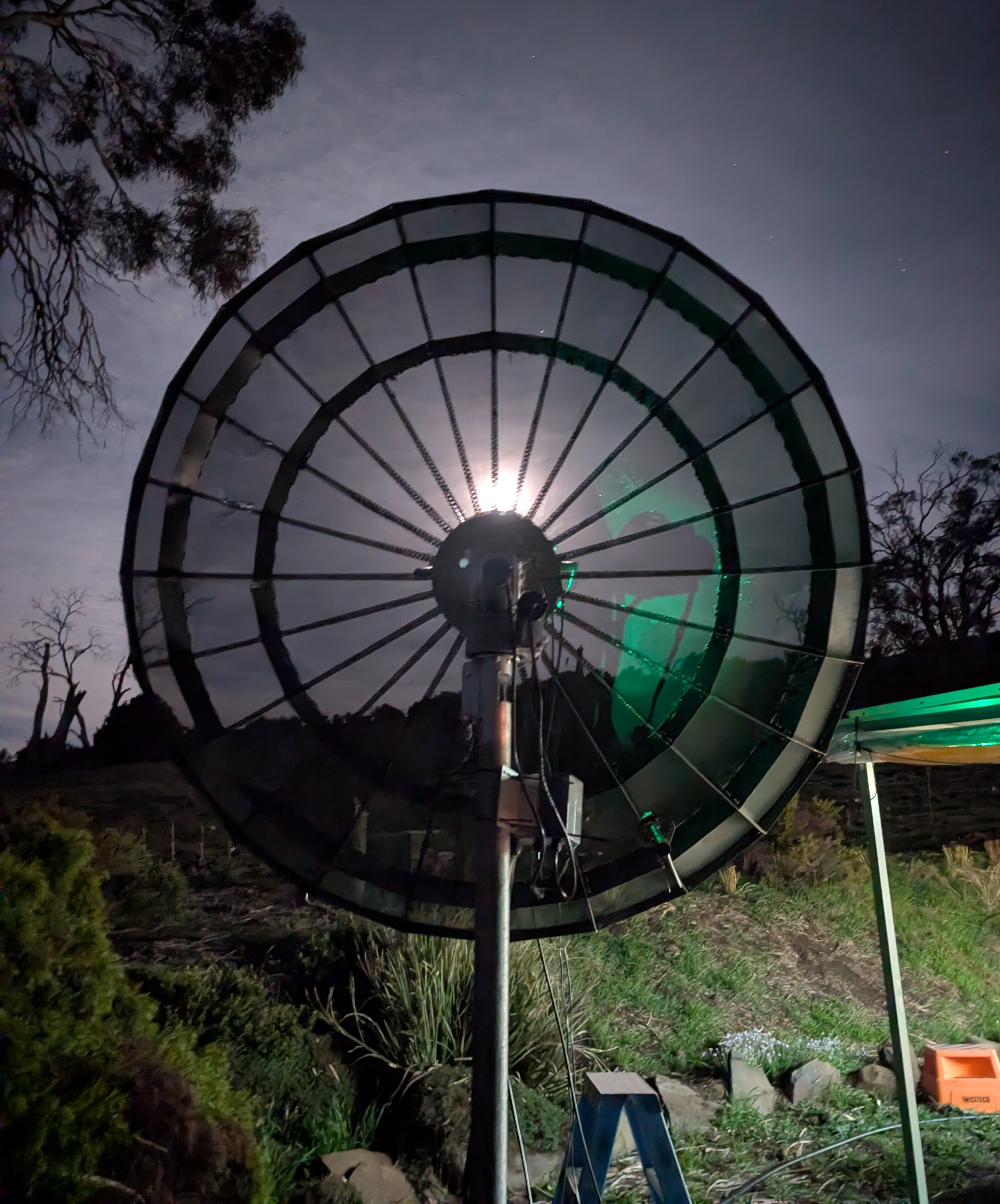 VK7BZX Dish at MoonRise
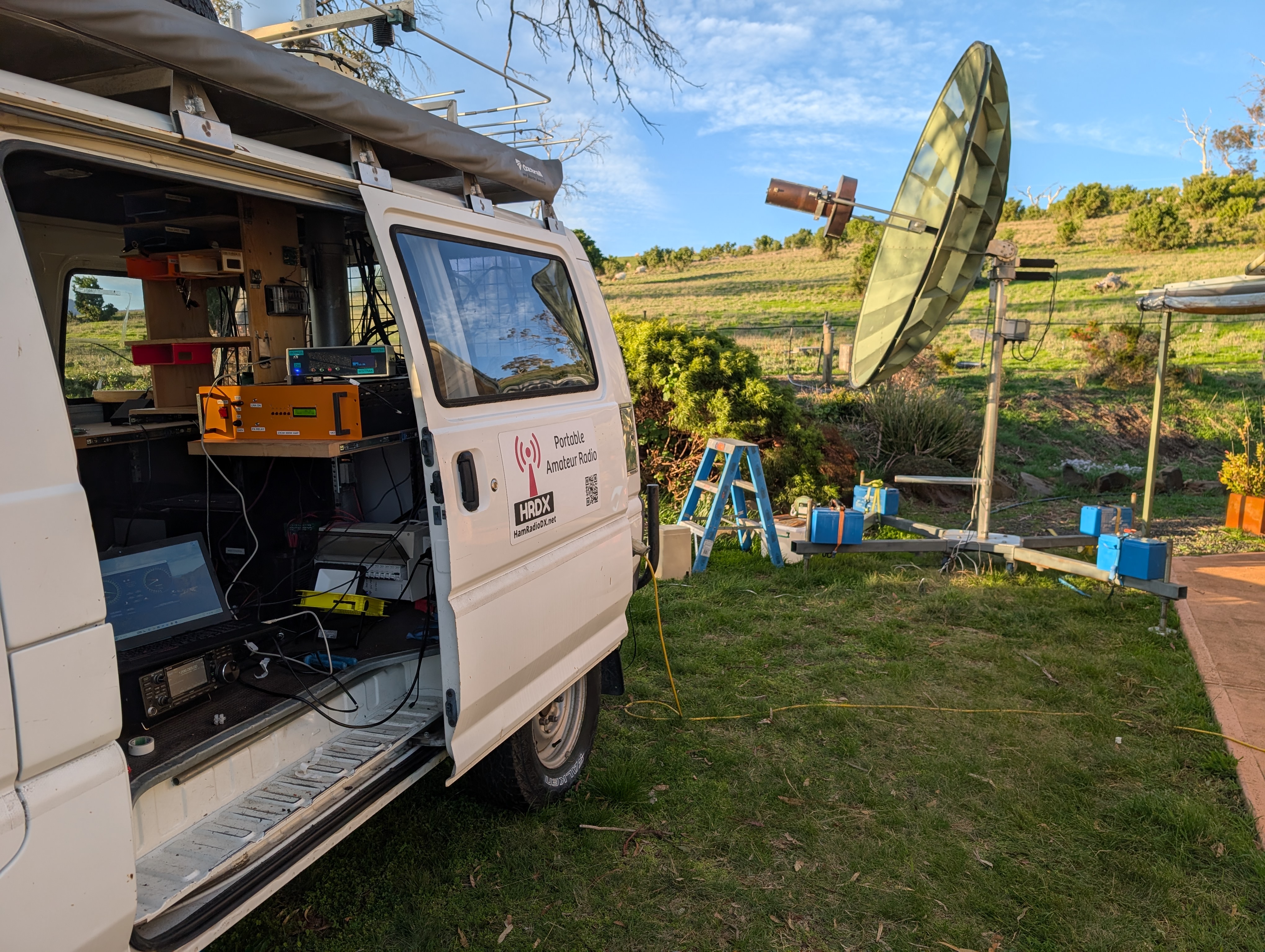 VK7BZX Improved 23 cm Portable Station
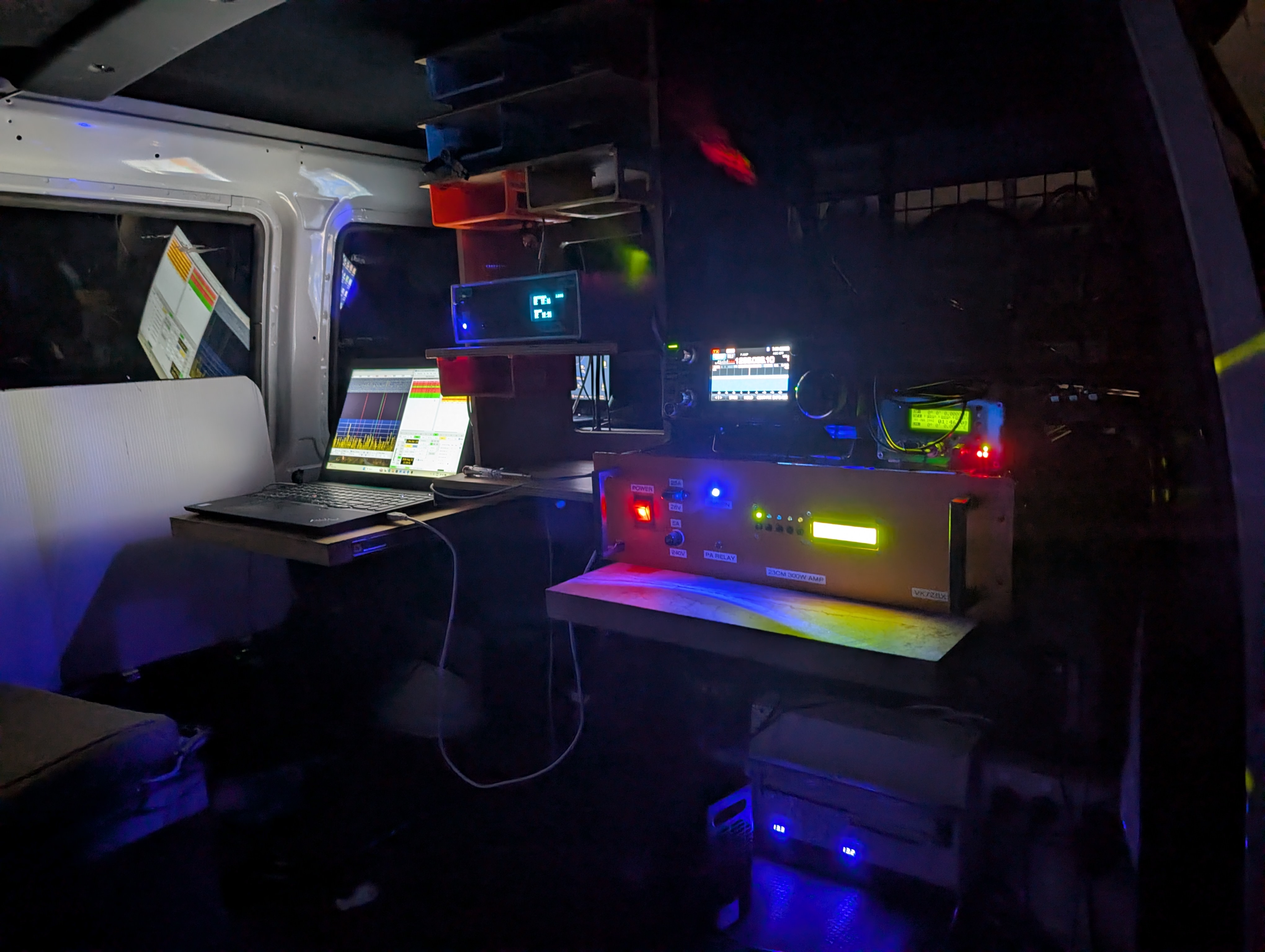 VK7BZX Inside Portable 23 cm Shack
W5LUA Al
Getting up in the middle of the night for moonrise is not fun anymore. As a result, my stations worked list is short.
On September 5th, I worked on 9 cm Q65-60C OK1DFC, OH3LWP, and PI9RD.
On September 6th, I started out on 6 cm using Q65-60D I worked: OK1DFC, YO8RHI, PA3DZL, SA6BUN, OH3LWP, IK0HWJ and SV3AAF.
I then switched to 3 cm Q65-60D and I worked: DL3WDG, VE4MA, OZ1FF, CX2SC, G8RWG, DL5CN, ON4MU, VE6TA, OK1KIR, OZ7Z, and IT9CJC.
Outside of the contest, on 3 cm using Q65-60D I worked: on September 7th UN6PD and G4HSK, on September 11th UT4UWR, and on September 13th IT9EQO.
In summary the stations worked during the microwave portion of the EME contest were: 8 on 13 cm, 3 on 9 cm, 7 on 6 cm, and 37 on 3 cm for a total of 55 stations worked.
I plan to operate primarily on 70 cm on the Oct 31st / Nov 1st weekend.
W5ZN Joel
I was active for two weekends on 70 cm. On September 5th I worked four stations K5DOG, PA3DRK, DD0VF, and VE3CIQ.
During the ARRL September VHF Contest on September 13th I was active to pass out a few QSOs and multipliers. I worked five stations KC0V, N1AV, W3TI, and NY1V plus KC0V and KD2GLX which were new initials on 70 cm.
47 GHz Solid-State Power Amplifier Systems and Control Architecture
CT1BYM Miguel
A solid-state power amplifier (SSPA) operating at 47 GHz was developed using APN318 devices. The architecture employs a single device as a driver stage feeding four parallel output devices combined in phase. The unit was constructed by Sergei (RW3BP) upon request of Manfred, DL7YC. A second identical unit was also realized; however, the active devices are no longer commercially available.
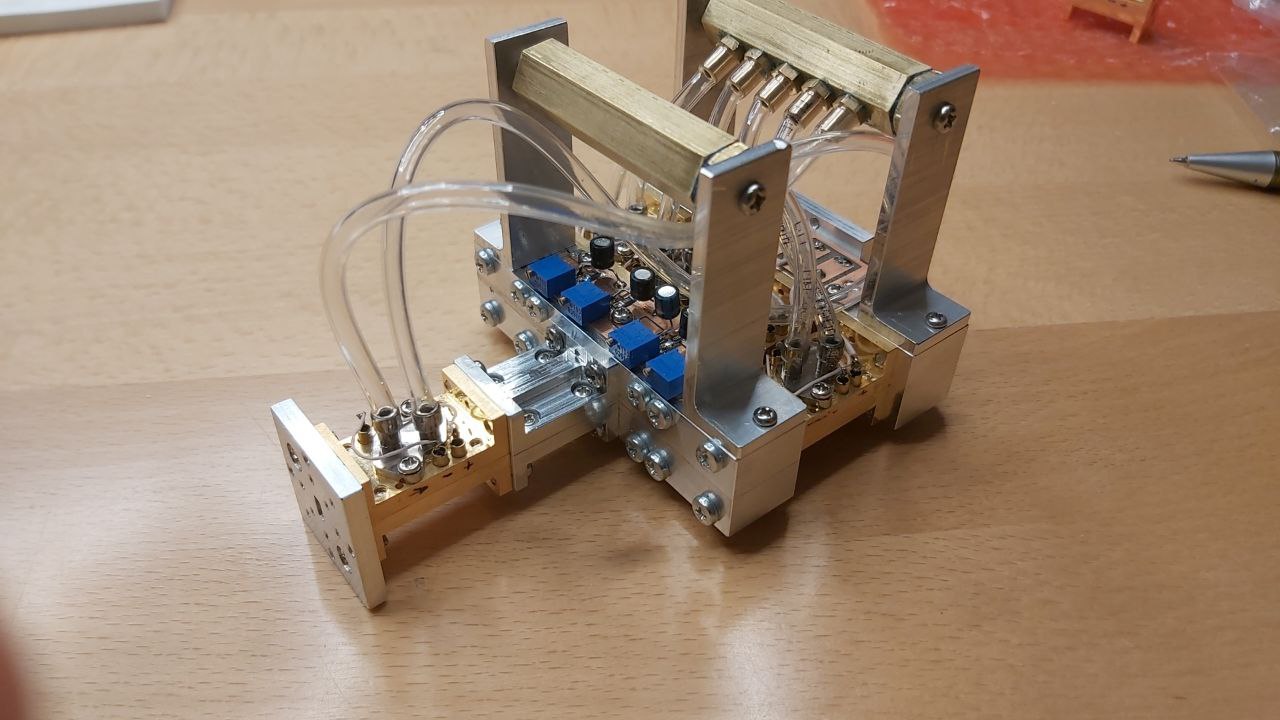 CT1BYM APN318 based SSPA developed by RW3BP
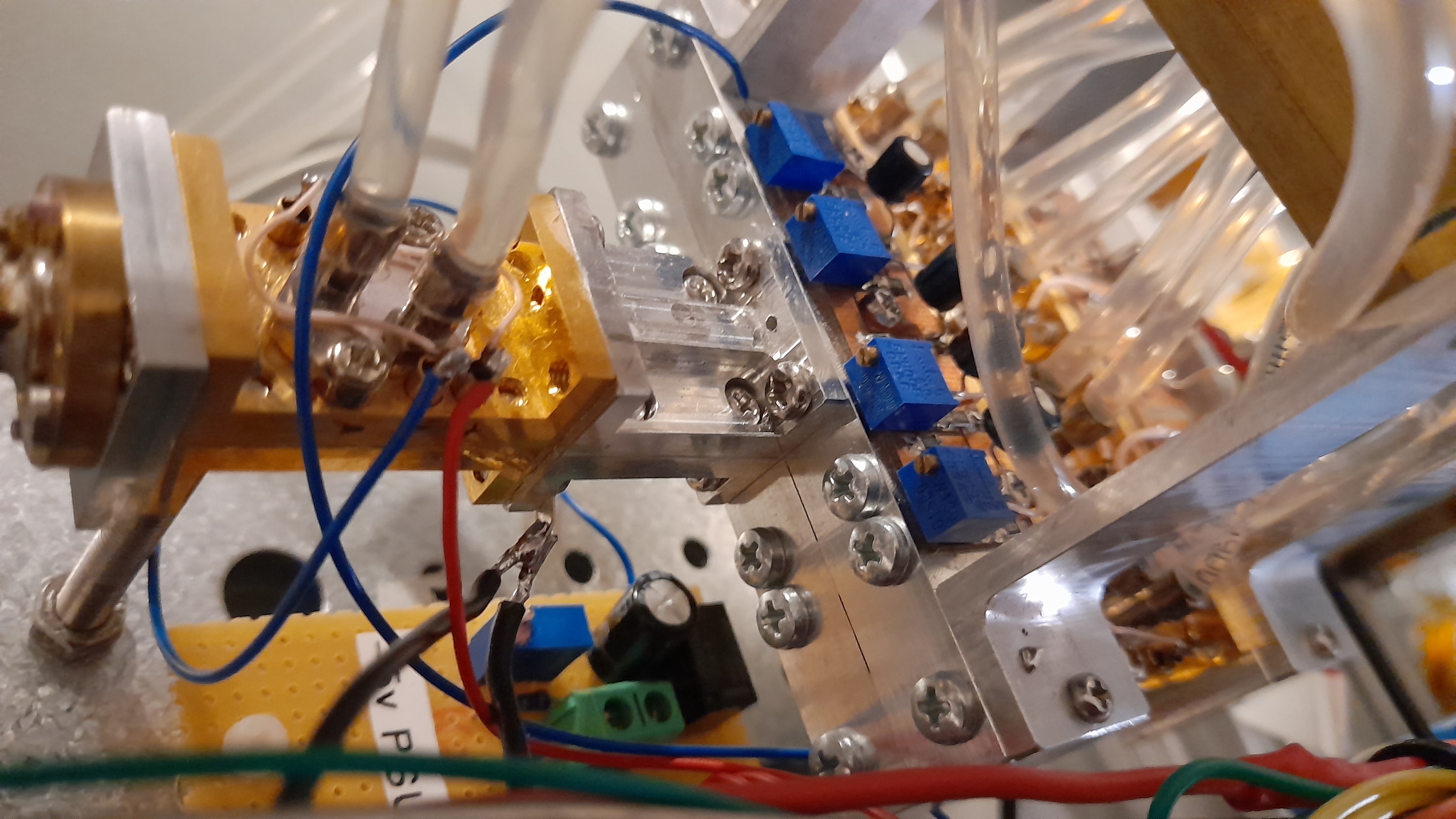 CT1BYM 47 GHz SSPA Closeup
DC Power Control and Protection System
A dedicated DC control module was developed to ensure safe and reliable operation of the amplifier system. The design is based on the LT4256-3 hot-swap controller and integrates the following protection and control features:
• Overcurrent and overvoltage protection
• Controlled supply voltage ramp-up
• Undervoltage lockout
• Fault-triggered shutdown (overtemperature, cooling failure, or bias loss)
Thermal management is achieved through a closed-loop water-cooling system with forced-air heat exchange. An air-to-water heat exchanger is employed, avoiding the use of active thermoelectric or refrigeration-based cooling methods.
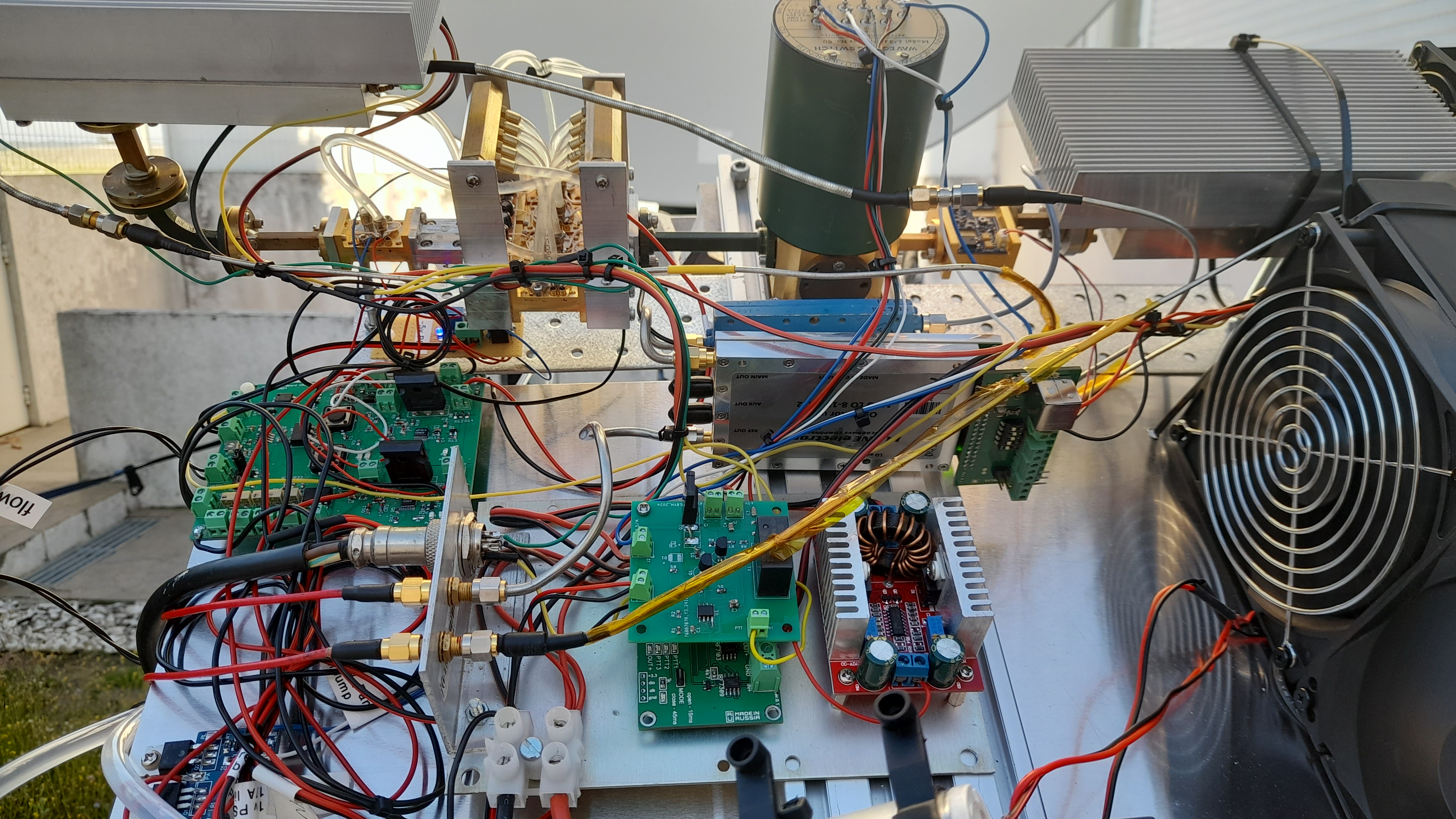 CT1BYM complete system including water cooling and DC control
Under laboratory conditions, the SSPA demonstrated an output power of 18.5 W. For continuous operation, as I am doing now during my QSOs, the output power is conservatively limited to approximately 15 W in order to ensure long-term device reliability and thermal stability.
Next-Generation SSPA: 25 W / 50 W Class at 47 GHz
A next-generation SSPA is currently under development, targeting continuous output power levels of approximately 25 W and 50 W in Q65 operation. The design is modular and scalable:
• The 25 W configuration utilizes two parallel amplifier dies combined in phase and driven by a single driver stage
• The 50 W configuration extends the architecture to four parallel output dies
The selected active device is the YPA47-4653C1 (Sichuan Yi Feng Electronic Science & Technology Co., Ltd.), specified for +41.3 dBm output power at 47 GHz (≈13.5 W peak per die).
In parallel, an enhanced control system is being developed. The new design builds upon the existing APN318-based control architecture and incorporates a dedicated bias control stage. Additional system-level protection mechanisms are being implemented, including transmit inhibit functionality conditioned by the final position of the waveguide switch.
Further experimental results and performance characterization will be reported in a subsequent publication.