

432 AND ABOVE EME NEWS
June 2026
Volume 55 Number 6
Editor: Barry VE4MA
Production Assistance: Peter G3LTF, Frank NC1I & Bob W1QA
News, Contests and DXpeditions
News
Once again it seems to have been a little quieter on the “low bands” as the Moon was very close to the Sun on the weekends near perigee, so the smaller antennas were at a severe disadvantage with Sun noise degrading signals. For the “10 GHz and Up” crowd this past month has again been very good. With the good Moon conditions the activity during the 24 GHz DUBUS-REF contest and the following “activity day” was very good. The stations using even 1.2 m dishes on 10, 24, 47 & 76 GHz were many and all had great success as you will see in the reports below.
The poor weather in parts of the Northern Hemisphere again hindered activity on 24, 47 and 76 GHz but there were some successful 47 GHz receptions accomplished (see the CT1BYM & other reports). I expect that July will have more activity to report on the higher bands as the weather improves and the closeness of the Moon to the Sun will still be an issue.
There was a lot of 10 GHz activity due to the very successful portable operations of Chuck NJ6D in the Montana, Utah and Wyoming USA States. See the NJ6D Report below.
There has been continued activity on 76 GHz EME, and now we are seeing improvements in the systems to where reception is possible with a 1.2 m vs a 2.4 m dish, as has been the case until now. Please see the Article from CT1BYM after the station reports.
EME Conference 2026/2028
The conference was held in Tenerife, Canary Islands and was attended by 53 amateurs and many family members. The facilities were outstanding and the presentations were great! Of course it was really nice to meet so many old friends and make many new ones.
Copies of the presentations will be available on the EME Radio website in the near future and some video has already appeared on YouTube at https://www.youtube.com/@YagiYard
The “Allen Katz Memorial movie: EME”, which was created and produced by Al’s daughter Alisha Hastings-Kimball and Giulio Pico - IW3HVB, is in the process of receiving some further upgrades. It apparently has been accepted at some film festivals and we will be given a link for viewing once the upgrade work is completed.
On behalf of all the attendees, thank you so much Rainer EA8DMF for facilitating the conference in Tenerife!
The location for the 2028 EME conference was not selected at the conference and is going through an RFP and voting process being created by an informal team led by Mike W9IP.
Mike has uploaded the EME2028 Request for Proposals. This document contains instructions for groups who wish to host EME2028.
The sequence of events will be:
• Four weeks for preparation of proposals, with a deadline of Friday, July 3, 2026
• Posting of proposal summaries
• A one-week window during which those who anticipate attending the conference can vote for their preferred site
• The result will be announced Monday, July 13, 2026
Questions should be directed to Mike W9IP at
Contests
DUBUS-REF
The 9 cm DUBUS-REF CW contest will be on Saturday July 11th. The rules for the 2026 DUBUS-REF contest are on the website http://www.marsport.org.uk/dubus/EMEContest2026.pdf
On Sunday July 12th there will be an informal all mode 9 cm “Activity Day” as promoted by Jan PA0PLY.
Dxpeditions
C37EME Andorra
The EME activity is taking place with the URA (Unió de Radioaficionats Andorrans) call sign C37EME from locator JN02sk in August 2026.
The tentative operating schedule is (all in UTC, which is local time -2):
• WED August 05th 23:30 to THU August 06th 12:30
• THU August 06th 23:30 to FRI August 07th 14:00
• SAT August 08th 00:30 - 15:00
• SUN August 09th 01:30 - 16:00
• MON August 10th 02:30 - 17:00 (subject to confirmation - see EA8DBM)
The Moon rise & set times are approximate due to terrain/mountain obstructions. At moonrise, absolute priority is given to Asia and Oceania contacts, and at moonset West coast North and South America. Skeds will not be made, unless requests for 'exceptional' contacts (distance record, first's between DXCC entities, ...)
The frequencies will be announced from on site, and they will be QRV for 2 m on N0UK EME chat, for 70 cm and above on HB9Q chat (both through the EA8DBM web interface). The station on 70 cm will be supervised by ON7EQ, and stations on 2 m, 23 cm, 13 cm (and possibly 3 cm) will be supervised by EA8DBM.
Please note that, in view of upcoming restrictions to the 23 cm EME operation in EU due to Galileo GPS, this might well be the 'last chance' of working this rare DXCC entity in EME on this band!
Modes of operation: 2 m JT65B and Q65A-60, 70 cm and above Q65B-60 - C37EME will always run FIRST.
In JT65B they will always work with 'short messages' and in order to save time - refrain from sending 73 (TX5 sequence). If you see us calling CQ again or replying to another station, consider that the QSO is successful - in doubt check with the EME chat, where we will give your report.
In Q65, we do not work with 'short messages' but complete the QSO with RR73 (TX4 sequence). In order to save time, you can call us directly with a report (TX2).
Be sure to add C37EME with locator JN02 to known DX calls (CALL3.TXT) to enable 'A PRIORI' decoding in WSJT for marginal signals.
In addition to digital modes, CW operation is as well possible, upon prior request.
Look out for their pictures and live info on FaceBook groups 'EME Moonbounce Radio Communications' and 'Earth Moon Earth (EME) Radio Communications' and postings on Moon-Net of Groups.io.
CT1BYM Miguel
The May lunar cycle was highlighted by the successful reception and decoding of a 76 GHz transmission from Sergei, RW3BP. A partial QSO was achieved, although my current setup still lacks sufficient power and requires further optimization. Work is ongoing.
During the June lunar cycle, the focus shifted to 47 GHz, with planned attempts to complete QSOs with Zdenek, OK1DFC, and Klaus, DC7KY.
In parallel, additional reception tests were carried out with other stations active on 47 GHz. These experiments are essential for station optimization, troubleshooting, and identifying performance limitations. Close collaboration within the group continues to be a key factor in achieving successful results.
Tests began on June 12, with OK1DFC transmitting towards CT1BYM. The received signal levels were below expectations. Considering that Zdenek was running 45 W, comparable to DL7YC, similar signal strengths were anticipated. However, most decodes were only possible using the averaging method, indicating that something in the system required further investigation. No decodes were achieved in the reverse direction. My station was operating with 16 W and a 120 cm offset dish, while OK1DFC uses a 240 cm dish.
Despite the lower transmit power, previous decodes of my signal have been achieved by PA0EHG using a similar 120 cm dish, suggesting that the link should be feasible under the right conditions.
Following the resolution of one issue on OK1DFC’s side, a new attempt was made on June 16. DC7KY also joined the activity, although no mutual decodes were achieved between our stations.
At that point, LZ4OC reported successful decodes of my signal while I was calling DC7KY, an encouraging development.
Subsequently, I started calling CQ, and LZ4OC continued to decode my transmissions consistently.
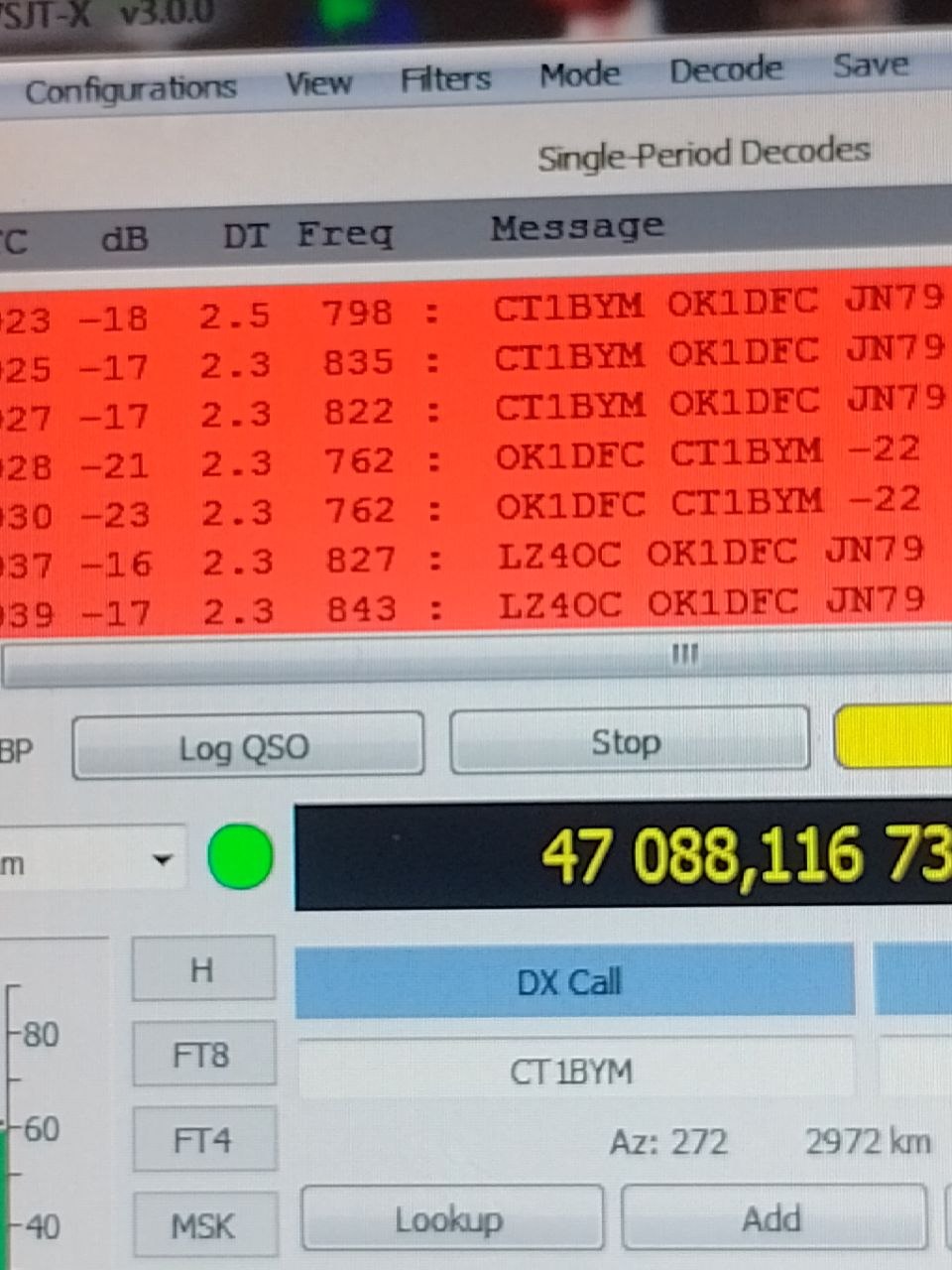
OK1DFC, now fully operational, attempted a QSO with CT1BYM, but was still unable to decode my signal. Meanwhile, LZ4OC successfully decoded both stations. It is worth noting that OK1DFC’s signal level had returned to expected values, indicating that at least one of the earlier issues had been resolved.
Although a complete QSO was not achieved, these tests provided valuable insights into several aspects that require further attention and improvement. Further developments will follow.
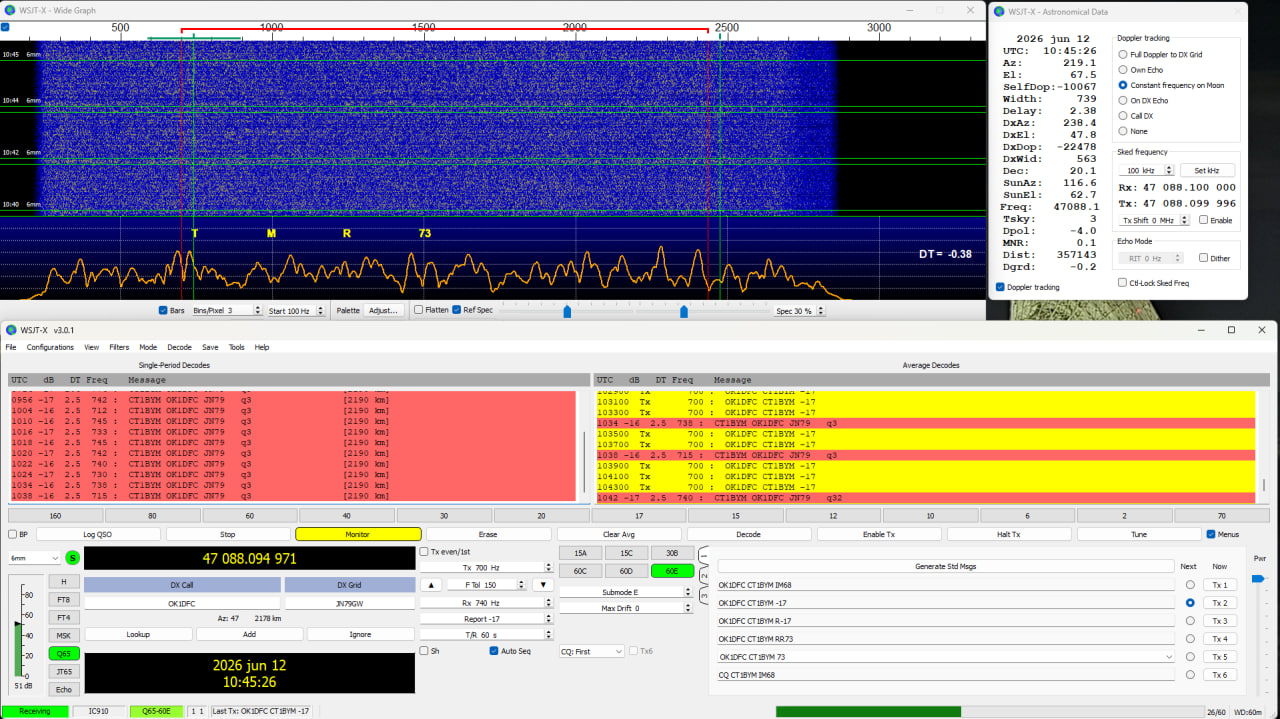 CT1BYM 47 GHz Decodes of OK1DFC
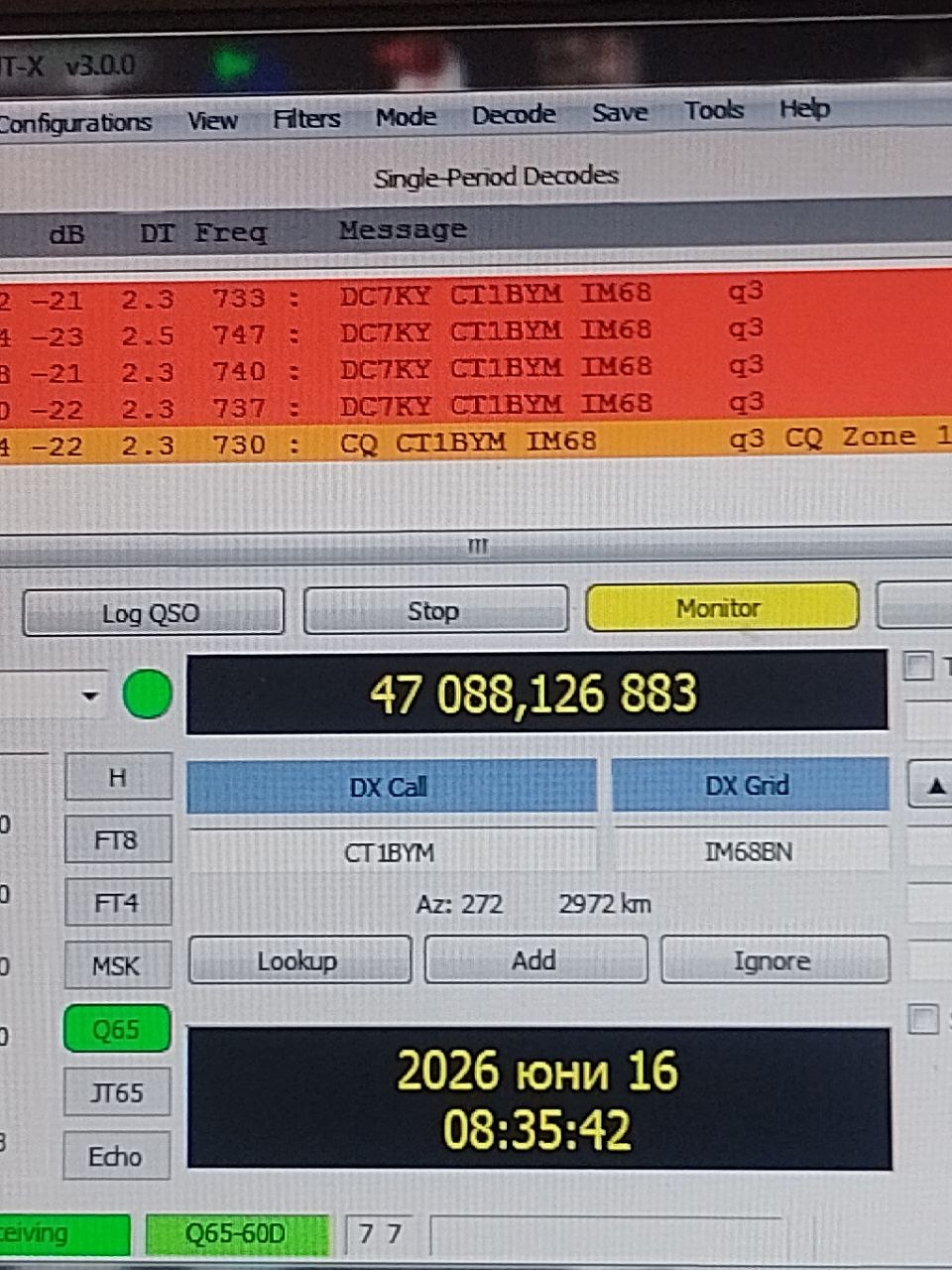 CT1BYM 47 GHz Decoded at LZ4OC
DB6NT Michael
Here's my short report from the DUBUS contest weekend of 13.06.2026. The weather conditions were good.
On 24 GHz, there were 4 stations: SP3XBO (new), OK1KIR, OZ1LPR, and OH2DG
My setup: 3.7 m dish, 1,2 dB NF, 40W RF out.
It was a lot of fun. Unfortunately, I was only able to be QRV for a short time. Thanks to everyone for the great QSOs.
G3LTF Peter
Not much to report this month, I spent some time re-checking the optimum feed position for my 2.4 m offset dish on 3 cm. I also soldered the feed components together (previously they were a pressure fit) and I ended up with 14 dB Sun noise with SF116, and 1.1-1.2 dB moon noise. I also had to do a major repair on the satellite jackscrew as I left the declination motor running by accident and the force shattered the casting!
I went on 23 cm on 18th June and I worked OZ9AAR and DL1AT on CW. The next day I worked OZ9AAR again and I copied NY1V quite well with his 500 W and 1.5 m dish but he couldn’t copy me. I have 2.2 dB less power, so we’ll try again.
I plan to be QRV for the DUBUS-REF 9 cm CW contest next month. I will use my 6 m dish and have 90 W.
G3YEG Nic
Following a burst of new decodes two months ago it has been a quiet time here on the Isle of Wight. Just a couple of new decodes KD2LGX at -29 dB with the 9 element ant 30 degrees off the moon in azimuth (which is about 2 dB down) and, at long last, IZ6MVK at -29 dB with the 9 ele about 40 degrees off the moon. It has taken me a long time to decode Fabio so I am very pleased with this.
This brings my total of decoded stations up to 57.
I continue to try for a QRPP QSO with Frank NC1I using 5 W and the 9 ele but the only recent success has been an easy QSO at best of -30 dB with the 9 ele antenna 50 degrees off the moon while Frank's receive was down by a couple of dB (now thought to be an LNA issue).
G8RWG Niels
Not much to report this month as I haven't been very active on 10 GHz since last month but I managed to add a handful of initials to the log.
20 May 2026 IZ2DJP, YO2LAM, LZ40C, UN6PD (#58)
12 Jun 2026 NJ6D/P (#59), G4BAO, SO5AZ (#60), W5LUA (#61), AC0RA (#62)
13 Jun 2026 OH3LWP, PA0JOZ, IK3GHY, SM6CKU
16 Jun 2026 GW3TKH, PA0HRK (#63), ON5TA, DF5MO (#64)
17 Jun 2026 G4YTL, OZ1LPR
18 Jun 2026 G4YTL
All QSOs were completed using digital modes with a 1.2 m offset dish, 20 W PA and DU3T LNA.
IW2BNA Walter
I'm sending you the results from last weekend on 24 GHz digimode. It was a good weekend for me, with 6 new initials and the first QSO on 24 GHz between Italy and Poland (SP3XBO).
I QSOed:
June 13, OZ1LPR - IZ0JNY - LZ4OC
June 14, SP3XBO - PE1CKK - PA0PLY - OK1DFC
Not much, but now I'm up to 13 initials. I think I'll be QRV on the next pass in July and will be at the summer house until October.
LZ4OC Sasho
On Tuesday 16 June 2026, 47 GHz activity was scheduled between Klaus DC7KY, Miguel CT1BYM, and Zdenek OK1DFC for the morning period starting at 08:00 UTC.
During the night, my station location (locator KN33LG) experienced heavy rainfall accompanied by thunderstorms. In the morning, cloud cover remained extensive, and the sky temperature was approximately +4°C, resulting in very poor weather conditions for 47 GHz operation. After about an hour, the cloud cover began to decrease. I measured a Moon Noise (MN) value of approximately 1.0 dB and a Sun Noise (SN) value of 10.9 dB. The measured Moon Noise was lower than normal, as I typically observe around 1.25 dB MN with my Kathrein CAS-120 (1.2 m) antenna.
At present, my station is operating in receive-only mode. The transmitting system is still under development, and I currently have only a 1 W setup available. The equipment used consists of a Kuhne MKU 47G2 transverter, an LNA designed by Iban EB3FRN, and a feed system built by Luis CT1DMK. For comparison, Miguel (CT1BYM) operates with the same antenna and approximately 17 W output power. Klaus (DC7KY) uses a 2.4 m antenna with around 20 W, while Zdenek (OK1DFC) operates a 2.4 m antenna with approximately 45 W output power.
On the fourth transmission sequence from Miguel, I successfully decoded his signal at -22 dB. After that, his signals were decoded continuously and reliably throughout the session. Unfortunately I was unable to decode any signals from Klaus during this activity period. Hopefully, conditions will be more favourable next time.
During the calls on 47,088.100 MHz, Zdenek OK1DFC joined the activity and arrived with an excellent signal level of -16 dB. At the same time, I was decoding signals from both Zdenek and Miguel simultaneously.
The band was truly alive and performing at its best.
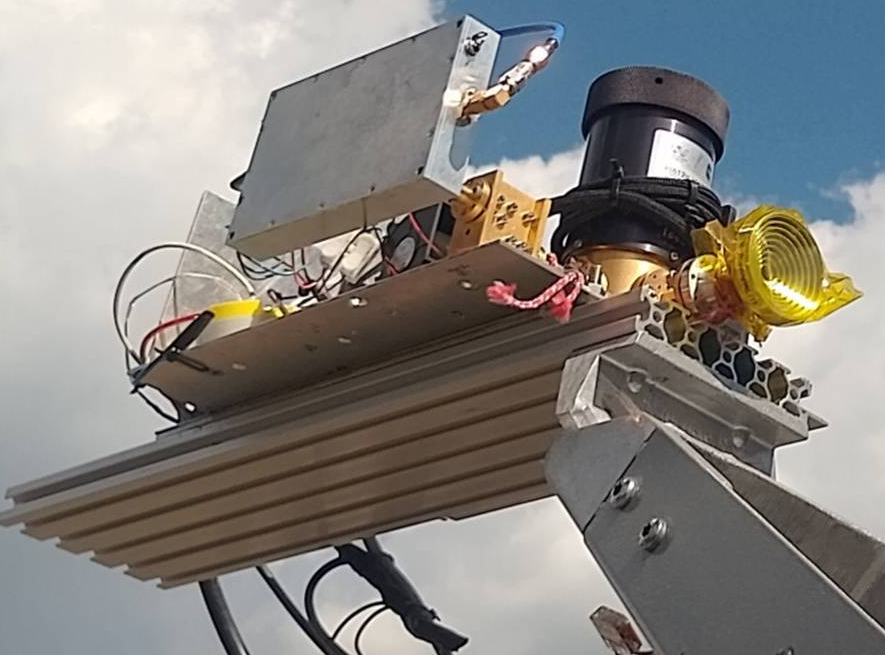 LZ4OC 47 GHz RX
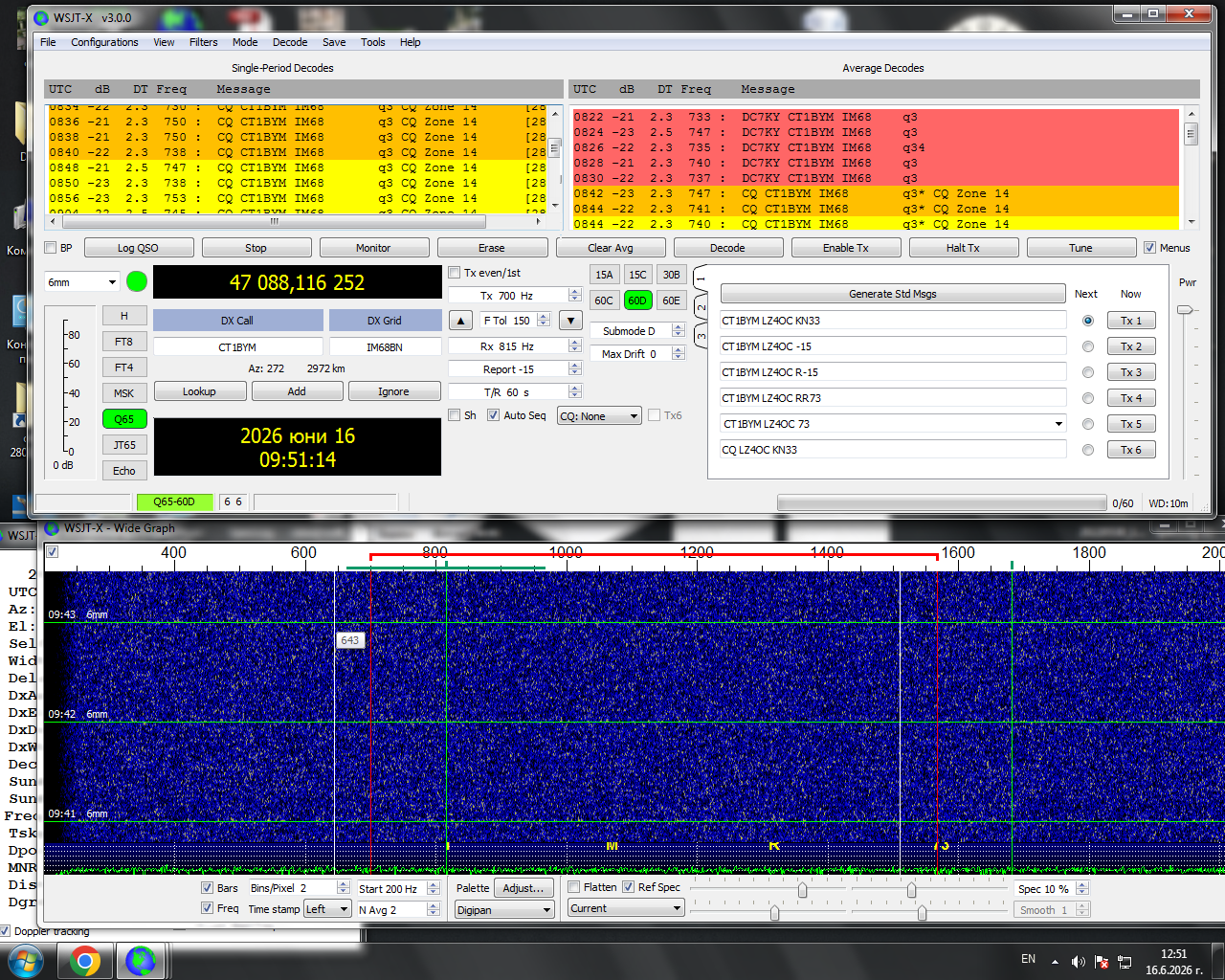 LZ4OC 47 GHz Decodes of CT1BYM
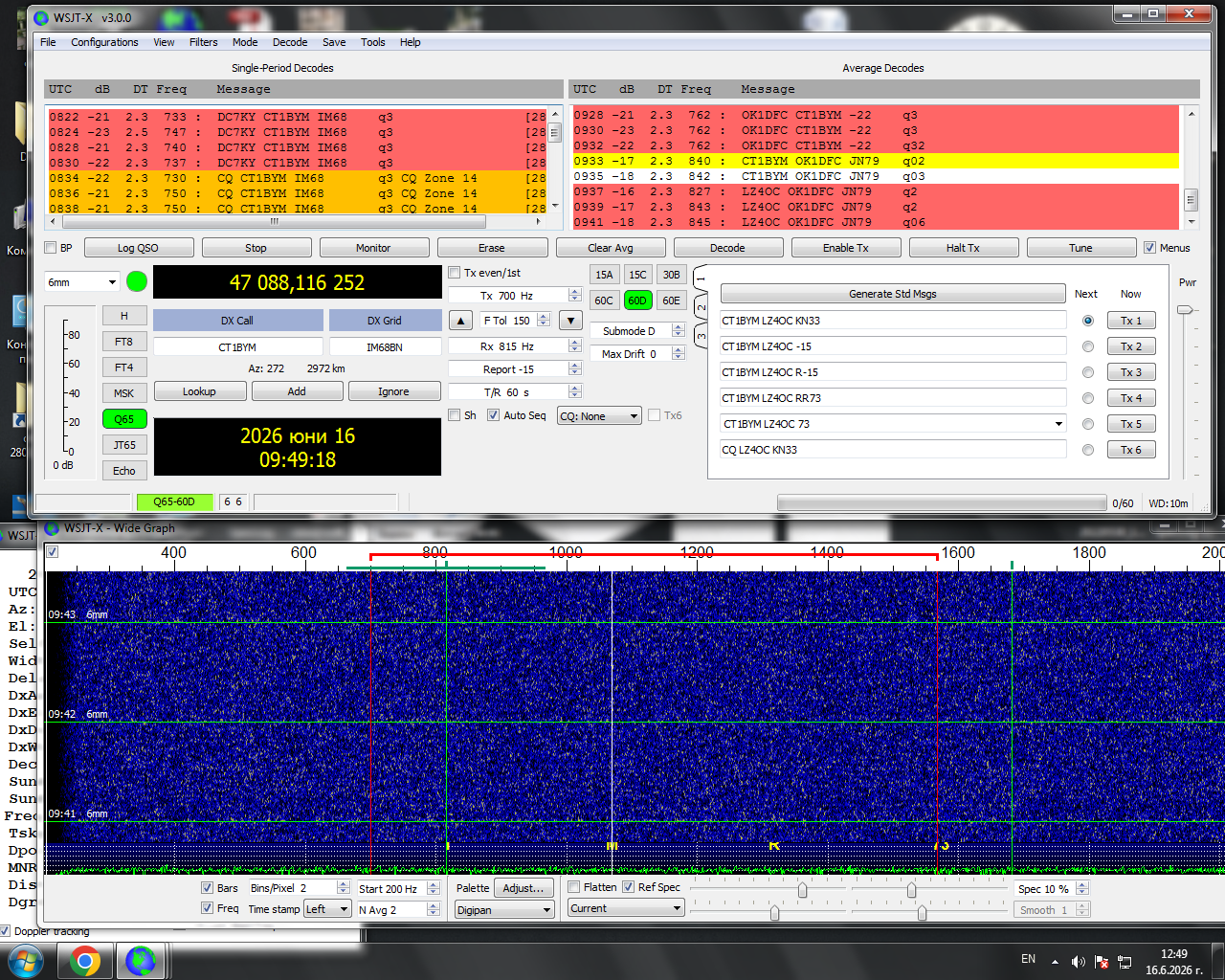 LZ4OC 47 GHz Decodes of OK1DFC and CT1BYM
NC1I Frank
This month's activity was limited due to thunderstorms (or threats of thunderstorms) and some equipment issues, more on that at the end of my report. Since my station is remote, it's not always convenient to disconnect and connect my equipment on short notice so I tend to leave it disconnected for somewhat long periods. My station suffered significant lightning damage about fifteen years ago and I don't want to go through that again so I always opt on the side of caution.
Initials added on 70 cm include KI6WJ (-11dB/-09dB) 4 x 22-element and 400-watts, DG9BFJ (-25dB/-30dB) 1 x 19-element and 60-watts for his first 70 cm EME QSO, HA5UA (-18dB/-15dB) 1 x 23-element and 400-watts, KO4ENU (-21dB/-17dB) 1 x 18-element and 100-watts (I believe this was Steve's first 70 cm EME QSO), and CP7DX for a new DXCC.
Initials added on 23 cm include BA7NQ (-08dB/-08dB), HA5OLA (-15dB/-08dB) 1.9-meter and 140-watts, KE7NR (-25dB/-14dB) 10-foot dish and 200-watts, F4BLE (-09dB/-10dB) 1.5-meter and 500-watts, PA3BYV (-09dB/-04dB) 1.8-meter and 200-watts, W2LPL operating portable in FM29 (-11dB/-06dB) 1.5-meter and 250-watts, SP5MS (-20dB/-02dB) 3.6-meter and 20-watts, UA1CCB ( -16dB/-10dB) 4 x 50-elements and 200-watts, EA8/RD4D (-03dB/-02dB) and FP/EA8DBM (-14dB/-13dB) also for a new DXCC. Thanks Alex for another incredibly successful DXpedition!
Back in May I started noticing degraded RX performance on 70 cm, typically around 2 dB. By mid-June the issue became worse and by the end of the month my RX completely failed. At this point I suspect failure of the SMA isolation relay up at that feed point (with the high-power T/R relay and preamp). Unfortunately, I can no longer climb up there and get to the preamp box. This requires not only climbing the tower but also climbing the polarization mount (very challenging and awkward). I am still trying to find someone to climb up there and remove the box so that I can troubleshoot it. And once repaired I will need to have it reinstalled. Hopefully I can get this done before the upcoming C37EME DXpedition in August.
I am also experiencing RX issues on 23 cm. I am seeing the system gain gradually drop about 5 or 6 dB over the first hour after powering up my station. Interestingly, system sensitivity does not seem to be affected.
NJ6D/P Chuck
I have safely returned from my first serious rove effort on 10 GHz EME. All-in-all I think the effort was a success having completed 43 contacts over 3 days of operating from 3 states - Montana, Wyoming and Utah. Over all 3 days I only had 3 attempted contacts that were not completed - thank you for the efforts! I want to give Per, DK7LJ, a big shout out for putting the DL0SHF on at high power. This proved invaluable to get started each morning and confirm my alignment and pointing calibration, particularly on Day1 and 2 when the mornings started off cloudy. Each morning I copied and decoded DL0SHF at +4 dB SNR, which was amazing! The CW portion of the beacon sequence was armchair copy! Aside from DL0SHF, the best report sent out was to Peter, OZ1LPR, at +3. The best report I received on my signal was from DL4DTU and VE4MA at -11. The smallest station worked was Bruno, I6YPK, with his 1 m dish running 25 W.
The system setup used for the expedition was a 1 m offset dish with a W1GHZ 10/24 dual band feed (only using 10 GHz) with a DEMI LNA at the feed with a Ducommun coaxial 26.5 GHz relay. The transverter is my own build using "RF Lego Blocks". On TX I recently upgraded to a 50 W SSPA built by DL2AM provided by Eric, OE9ERC. The SSPA is giving me 45 W measured at the output of the relay going into the feed.
For the IF radio I am using an Icom IC705. System switching is done with my own microcontroller based sequencer using an RP2040 and Circuit Python. I used a manual QuickSet tripod for this trip, which unfortunately bound up at an elevation angle of ~50 degrees. This did not affect the overall QSO count much if at all. The laptop computer was connected to the radio using Wi-Fi and the open source WFVIEW radio interface software. It is nice not having USB cables to trip over in the field and allows me to easily set up my operating table a few feet away from the system setup.
Each day started with the alarm going off at 3 am and coffee. Day 1 and 2 was a simple setup at my son's place in Dillon, MT. Unfortunately weather and winds kept me away from the border with Idaho on days 1 and 2. On both days the clouds broke up enough that I could periodically confirm visually my pointing on the moon. Thursday's operating was followed by a 5 1/2 hour drive from Dillon, MT to Evanston, WY. A long day to say the least!
The third day, Friday, started from Evanston, WY with a 20 minute drive to the operating site at the WY-UT border. The weather cooperated with calm winds, but on the cool side with the temperature near 34 F. Friday ended with another long drive to the overnight stop in Page, AZ, which followed by the drive to Tucson Saturday.
Each day I stayed with the rising moon until I reached my 50 degree elevation limit. Unfortunately the afternoons were occupied thus not allowing operating with the setting moon. This prevented me from picking up stations to my west in Asia and Oceania.
Here are the summary stats for the 3 days:
Day 1: Dillon, Montana, DN35QF42PJ - 11 completed contacts, 11 unique calls
Day 2: Dillon, Montana, DN35QF42PJ - 7 completed contacts, 4 unique calls, 3 repeats
Day 3: Wyoming - Utah Border, DN41LJ49KQ - 25 completed contacts, 16 unique calls, 9 repeats
This is my initial big rove with 10 GHz EME and I expect there will be more to come covering the western US. I will be making some improvements to my transportable system for the next rove in the Fall of 2026. These improvements will include the following:
- upgrade to a 1.2 m dish
- swapping the DEMI LNA (0.85 dB NF) with a DU3T LNA (0.55 dB NF) and WR90 waveguide switching.
- motorized pointing and tracking with digital encoding.
Regarding the operation on the WY-UT border... According to the ARRL I need to up load 2 logs to LOTW for each state to give credit. However, I have been informed that only one QSO is need, even though the rule wording is a bit unclear on this.
The Montana log has been uploaded in its entirety. The logs for the operation at the WY-UT border have been separated to two logs - one for each state. If you worked me twice the first QSO went into the Wyoming log and the second QSO went into the Utah log. For those that had a single QSO with my on the border, following guidance from Bart, W9JJ, at the ARRL, the original QSO entry went into the Wyoming log and a second entry was created with 10 minutes added to the start-stop times for the Utah log. Stations will only show once in the logs for each state Wyoming or Utah.
I have a more detailed report on this Dxpedition, please see NJ6D/P:
Taking 10 GHz EME On The Road
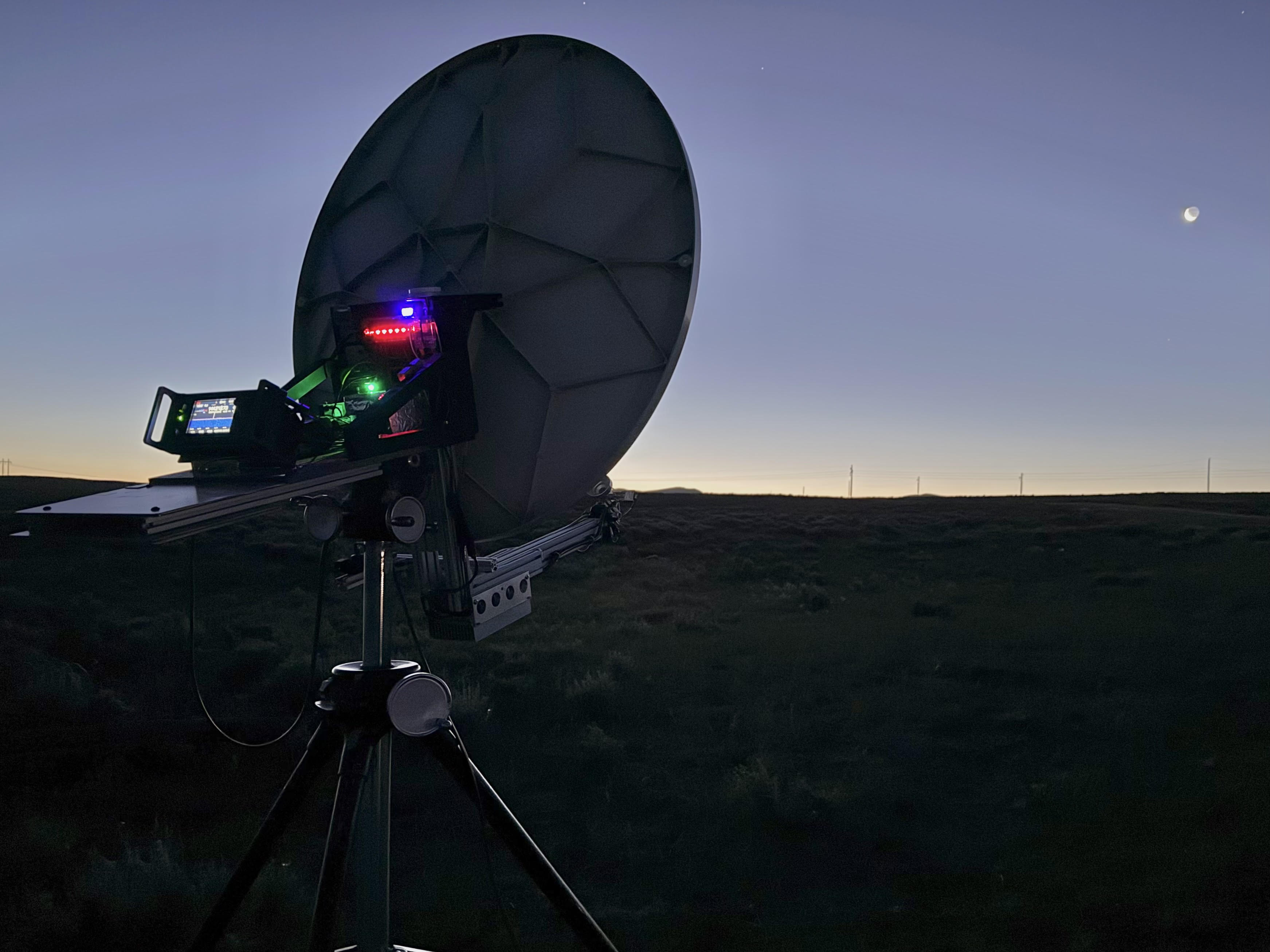 NJ6D Moonrise in Wyoming
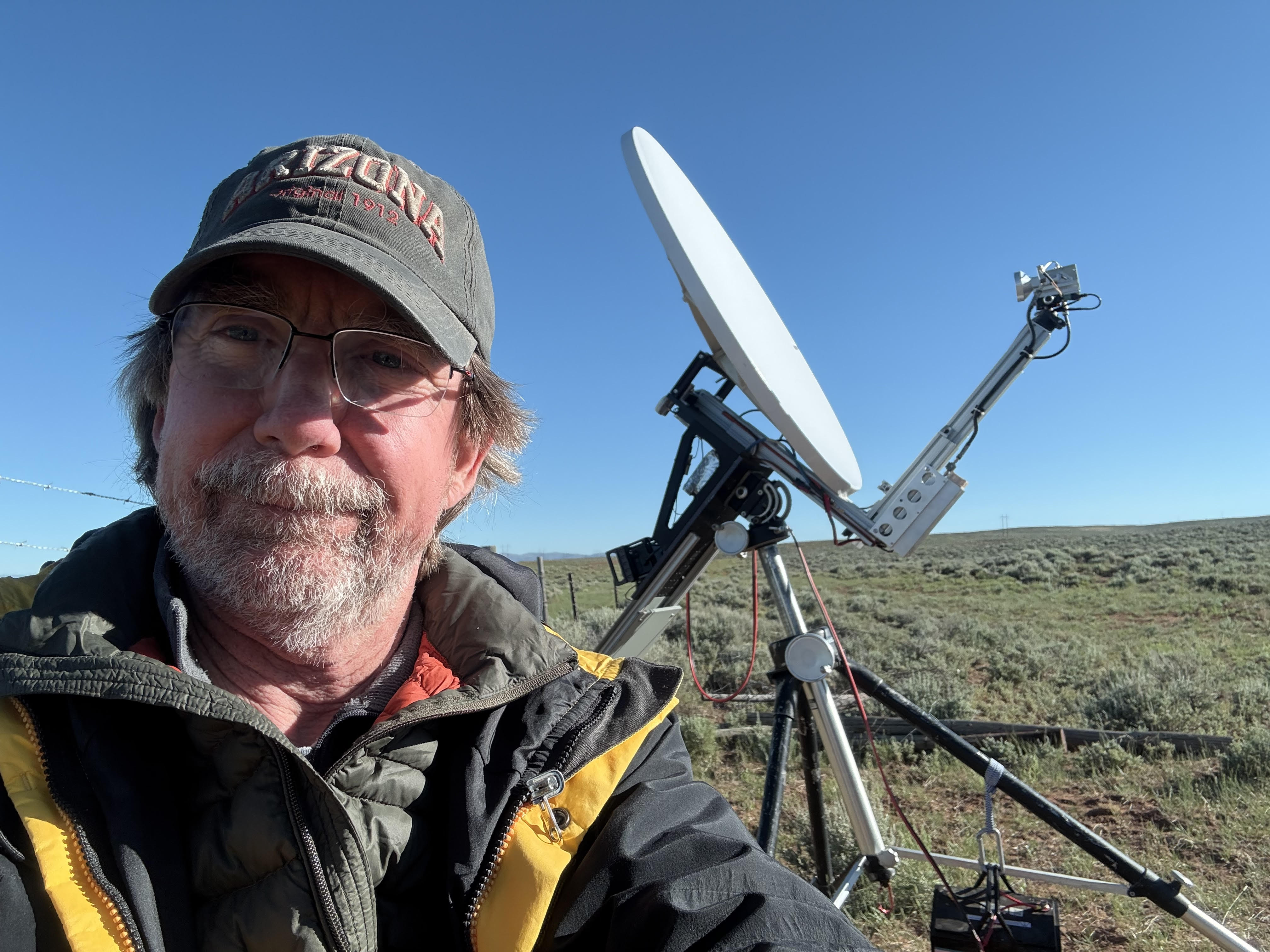 NJ6D Moonrise in Wyoming
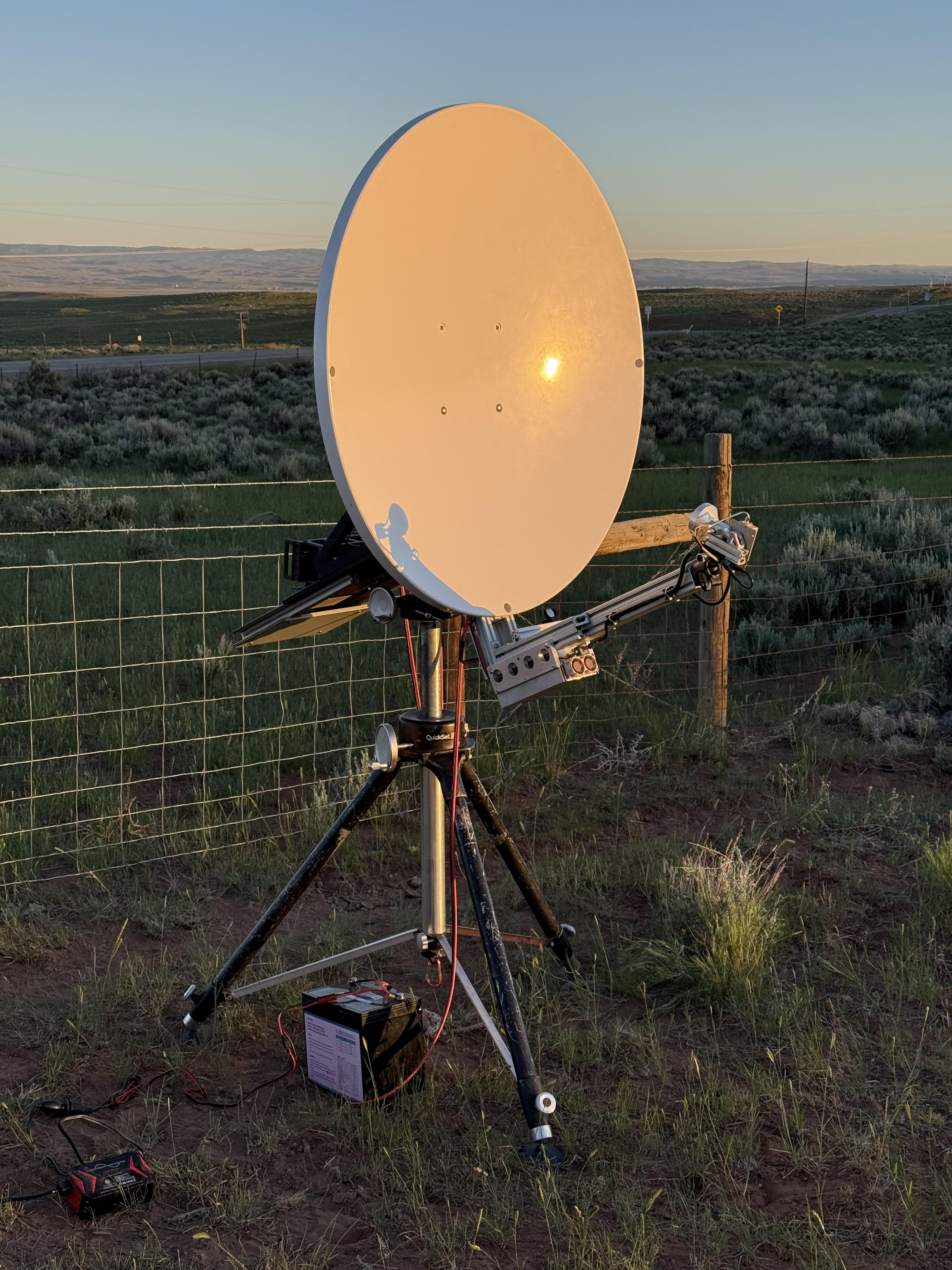 NJ6D sunrise in Utah
OH3LWP Ari
There was a lot of activity at the end of May and into the middle of June time window even without any contest activity on the bands I operate and there were especially a lot of new initial QSOs at 10 GHz.
New initials and new DXCC worked in 19/5/2026 to 22/6/2026 time window are as below:
New 23 cm inits:
20/05/2026 W9KW digital, 21/05/2026 R4CX digital, 23/05/2026 SP2WRH digital, 13/06/2026 OE3GWC, FP/EA8DBM digital (also new DXCC), 14/06/2026 KE7NR digital
New 13 cm init:
14/06/2026 FP/EA8DBM digital (also new DXCC)
New 6 cm inits:
19/05/2026 YO8RHI digital, 23/05/2026 PA0HRK digital
New 3 cm inits:
23/05/2026 DL5CN digital, 12/06/2026 AC0RA, NJ6D/P (rover in WY and UT), SM6CKU all digital
14/06/2026 DF5MO, VE4SA digital, 16/06/2026 PA0HRK digital, 18/06/2026 F5IGK, ON7FI digital, 19/06/2026 LA4ANA digital (also new DXCC)
OK1KIR Vlada & Tonda
While continuously searching for new initial EME signals on seven bands we totally passed our 50th anniversary of the first ever EME QSO from OK land on May 23rd 1976. It was completed on 70 cm thanks to the big dish of WA6LET station. So, nowadays it is just a reminiscence (https://www.ok1kir.cz).
The next weekend, May 29, 2026, the EME expedition in Bolivia was quite a challenge having the Moon just on the edge of our high south horizon together with our quite wide beamwidth on 70 cm. However, when the Moon peeked out from a big walnut tree, we made CP7DX with Q65-60B at 21:48 -19/-20 as #386, mix DXCC 139 and 1st 70 cm QSO CP-OK.
Chuck, NJ6D announced his expedition journey to several west US states on 10 GHz with 1 m dish starting on June 10, so we became QRV on June 10 awaiting his signal. While waiting for Chuck we made with Q65-60D at 08:21 OZ1FF -5/-4 and decoded DL0SHF +5 dB (!) and measured MN 3.4 dB.
At 10:03 we made NJ6D/p -18/-11 in MT as #295 and new field DN #43. Unfortunately, on June 11 due to bad weather Chuck canceled his plan to visit the MT-ID border and stayed in MT. So, we worked a few others, at 09:49 IK3HAR -15/-10, 10:01 I6YPK -15/-11, 10:10 IZ4BFA -11/-6, 10:29 repeated NJ6D/p with by 6 dB better reports -12/-5 and at 11:15 W3TI -19/-12. MN was still excellent at 3.4 dB and DL0SHF +3 dB.
On the next day, June 12 Chuck operated from the border of WY/UT. We worked him from WY at 10:51 NJ6D/p -12/-2 and later at 12:32 NJ6D/p -12/-2 from UT. Then we installed the 24 GHz rig for the upcoming DUBUS-REF CW contest.
During the DUBUS-REF contest on Sat, June 13 we suffered from bad (rainy) weather, MN was only about 1 dB. Together with high spreading among EU stations it was a deadly combination for CW operation. However, we completed 6 QSOs, with no new initials. We worked at 04:25 OZ1LPR 559/539 with an obvious great signal, at 04:45 JA1WQF O/559 (enclosed picture shows OK1KIR’s 24 GHz CW signal received at Mitsuo at predicted max. mutual spreading of only 70 Hz), at 05:31 OH2DG O/O, 06:14 IK2RTI 549/529, 08:22 DB6NT 549/559 (MN improved to 2 dB) and at 08:34 SP3XBO O/O. All these stations have 2.4 m or larger dishes. Using Q65-60E we were decoded at DJ7FJ -13 on a 3 m PF dish and at G4BAO -11 on a 1.2 m OF dish. Both are missing TX power for a test.
Afternoon on June 13 we found that Alex is going to operate on 13 cm as FP/EA8DBM. So we closed 24 GHz and installed 13 cm. We succeeded with Q65/60C at 12:54 FP/EA8DBM -19/-14 as #129. We also requested 23 cm but Alex responded that he was unable to repair the 23 cm rig after the flight. Then we closed the operation as we had family duties on Sun, June 14.
On Mon, June 15 we realized that Alex repaired 23 cm. After installing 23 cm we worked with Q65-60C at 08:15 UA1CCB -20/-18 as #681, 11:38 OZ9AAR +2/+1 as #682. With Q65-30B we worked at 12:21 RW6HM -2/-8 as #683, 14:59 EA8/RD4D -6/-2 as #684 and at 15:10 SP1956POZ -4/-8 (Special Event Station to 70th Anniversary Of Poznań 1956, probably SP3YDE). Finally we worked at 16:06 with Q65-60C FP/EA8DBM -17/-12 as #685. For almost the whole day the Sun noise was stronger than the Moon noise, but it actually created no trouble for the 2.6 deg beamwidth of our 6.15 m dish.
On the next day, Tue, June 16 we installed again 24 GHz and with Q65-60E worked at 15:53 OZ1LPR +1/-9 and at 16:19 PA0PLY -14/-12 as #63 again during a period of high spreading.
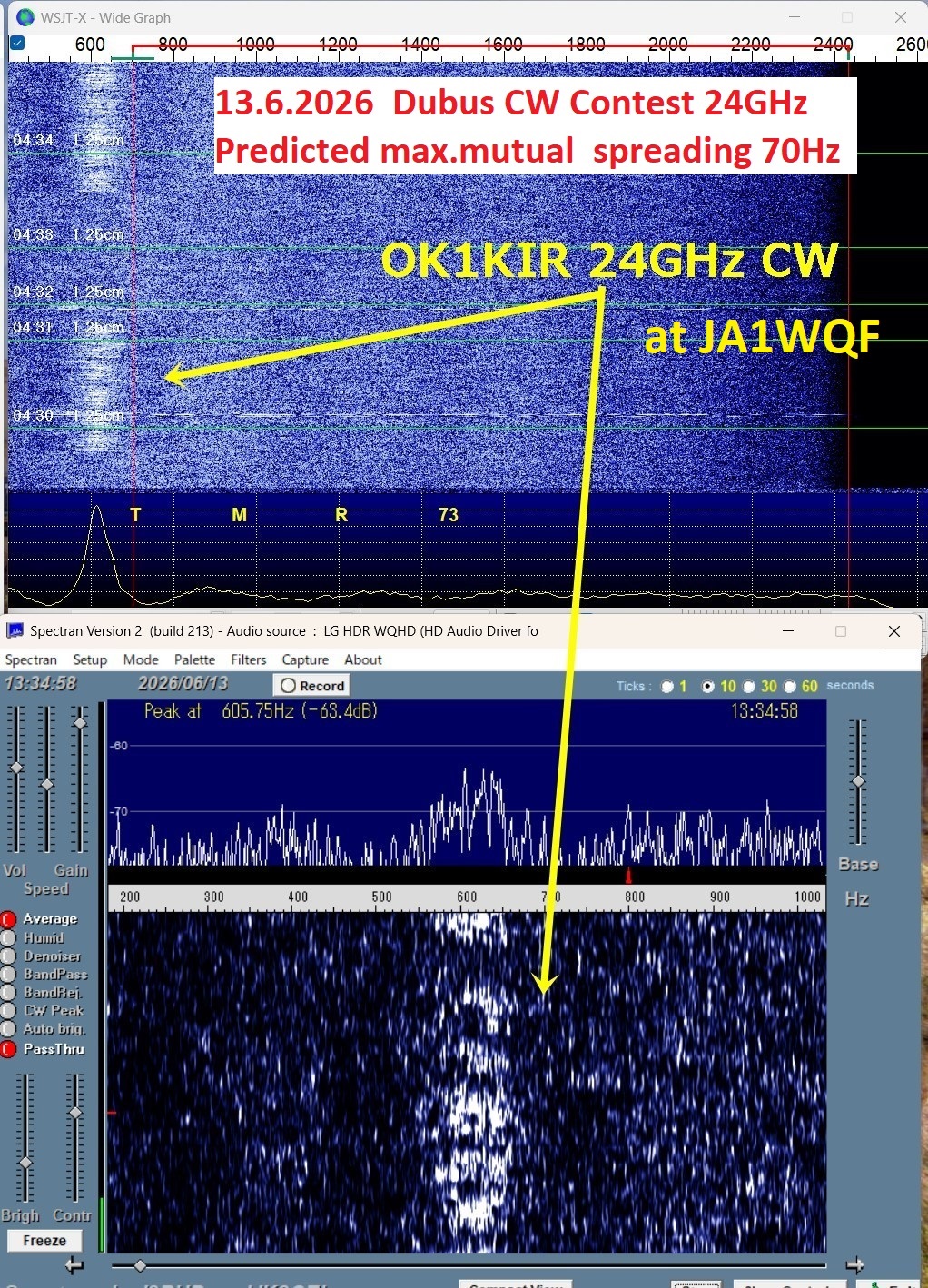 OK1KIR 24 GHz CW max spread with JA1WQF
OK2AQ Mirek
In the 10 GHz band, I managed to work DL5CN (-07, -16) at the end of May and NJ6D/P (-17, -13) {#190} from Montana on June 10. Unfortunately I couldn’t be QRV on June 12, when Chuck was operating from UT and WY.
On June 13, I moved the 23 cm feed to the focal point in anticipation of Alex’s expedition from FP. In the following days, I worked using Q65 the following : HG5BMU (-19, -21), AF6SA (-20, -32), EA8/RD4D (-17, -17), N0FJP (-19, -24), ON4MU (-26, -24), DL6ZG (-13, -17), and KE7NR (-21, -25).
The contact with FP/EA8DBM (-28, -24) using the 120D mode took place when the Sun was very close to the Moon, resulting in significantly higher noise levels. This was followed by contacts with: RY4C (-8, -10), F4BLE (-20, -27), and PA3BYV (-23, -32) {#276}.
OZ1FF Kjeld
In May/June 2026 I worked the following stations on 10 GHz with 50 W at the feed of my 2.4 m offset dish: DJ7FJ, GW3THK, G4HSK, G4RFR, NJ6D, OK2AQ, OK1CS #, DL4DTU, DF5MO #, OK1KIR, NJ6D/P (Montana) #, IW2BNA, OH3LWP, NJ6D/P (Wyoming/Utah) ##, AC0RA.
All OSQs made in Q65-60D. Now I have worked 15 US states but still a long way from WAS.
OZ1LPR Peter
I was QRV in the DUBUS-REF 24 GHz CW EME contest on the 13 of June. It was a bad day for 24 GHz EME due to a lot of heavy rain clouds. Moon noise varied from 1 dB to 2.2 dB in sunny conditions.
I was QRV most of the day and managed to work 9 stations in CW including:
JA1WQF, OK1KIR, OH2DG, IK2RTI, SP3XBO, DB6NT, PA0BAT, VE4MA, WA6PY
In Q65 mode QSOs were made with IW2BNA, IZ0JNY, and LZ4OC (not counting for contest of course)
On the 14 of June I was partly QRV on the Activity day and worked:
PA0PLY as his first EME on 24 GHz, PE1CKK, ZS6JON First OZ to ZS on 24GHz, OK1DFC
My system for 24 GHz is 2.4 metre Andrew offset dish Moon noise which gives with no clouds 2.2 dB Moon Noise and 15.2 dB Sun noise.
For the first time I used QMAP for monitoring and I went by the radio from time to time and checked to see if new ones were QRV. This is where I discovered ZS6JON was actually QRV and me being able to copy him. I can recommend that people look at using QMAP, it pays off!
OZ9AAR Carsten
My wife and I had the pleasure of attending the EME2026 conference in Tenerife at the end of May. What an event! A huge "thank you" to Rainer DF6NA for picking the place, and thanks to Barry VE4MA for running the lottery at the Saturday night dinner — a lot of good laughs 😀
My wife and I stayed for 8 days at the hotel, and the service was absolutely top-notch. The only concern my wife has now is that we have to wait 2 years until the next conference 😄.
It was so nice to connect in person with the many people I have met "on the air" and on moon-net, etc. It was especially nice to meet some of the "old guys" from "back then". I'm still amazed at the knowledge that exists within the EME community — we have some VERY clever and talented people for sure!
I made quite a few QSOs over the last few days (60+ in all), including during the weekend of June 13/14 on 23 cm. As of now I'm at 152 initials (direct QSL cards have been sent to the first 120 initials; the rest will follow soon).
Apart from digital modes, I still continue to work new stations on SSB (and CW), and to be honest, SSB will always make my small (gray) hairs stand up. I still remember the first one I did back in 1994 with Peter OE9XXI (sadly now a silent key). During the weekend, I worked Anders SM5DGX on CW, digital and SSB "back to back" which was great fun 😁
The systems still seem to operate as intended. I still need to do some small optimizations on the 4.8 m dish setup, and I will soon start chasing some "excess loss" in front of the LNA that I want to get rid of, if possible. I also did some adjusting and checking of the alignment of the feedhorn in the dish, I could see with my eyes it was not pointing directly at the center of the dish, so something had to happen. I designed and 3D printed a ring that fits tight around the feedhorn. The ring holds 4 small laser pointers, they are focused, aligned, and then secured with hotmelt glue and I seems to work pretty well.
Let me know if you have an OM6AA feedhorn (outer diameter 190 mm) and you can get the 3D file for the holder.
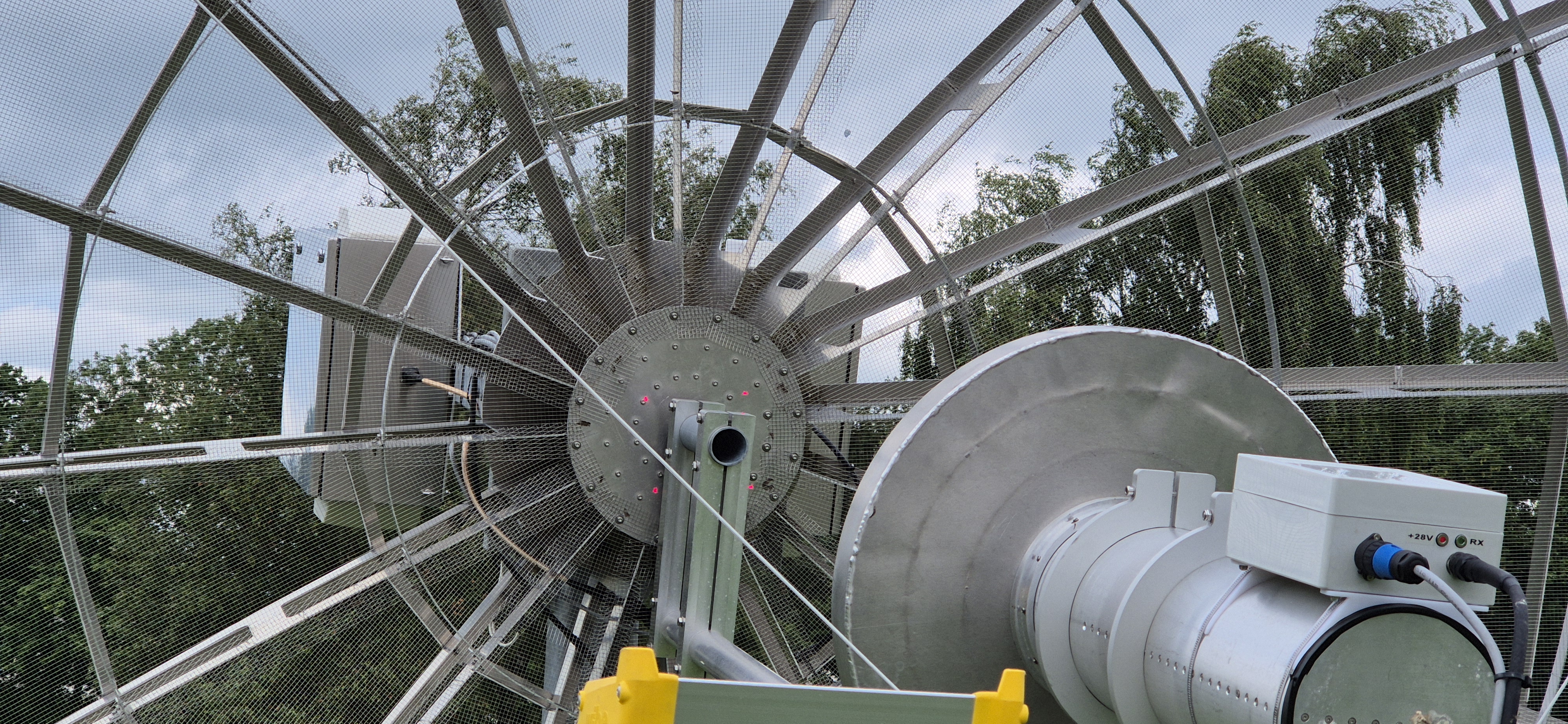 OZ9AAR Feed alignment 1
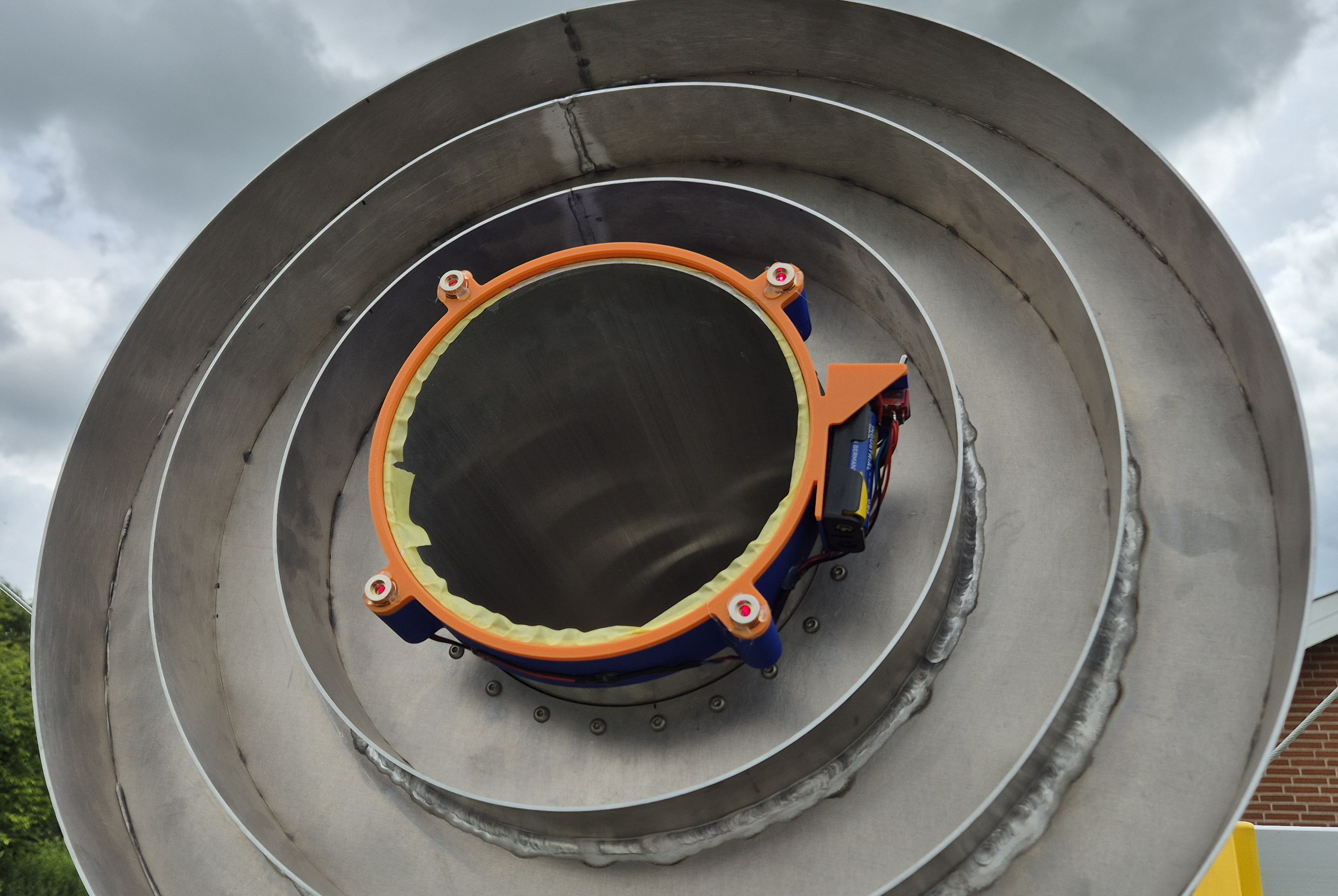 OZ9AAR Feed alignment 2
New projects
I have created a new "family member" in the Dual RF Head family: an Ethernet-connected version. This will allow you to remotely measure forward and reflected power (and SWR) using a directional coupler. Like the other Dual RF Head family members, it covers the frequency range from 1 MHz to 10 GHz. The Ethernet-connected version has a built-in web server, which lets you monitor the power using a normal browser. You can also use a standalone PC application to display the data (source code available). It is also possible to connect to the device using a normal TCP/IP socket, enabling your own programs/setups to display the information.
More information is available at: Dual RF Head Ethernet
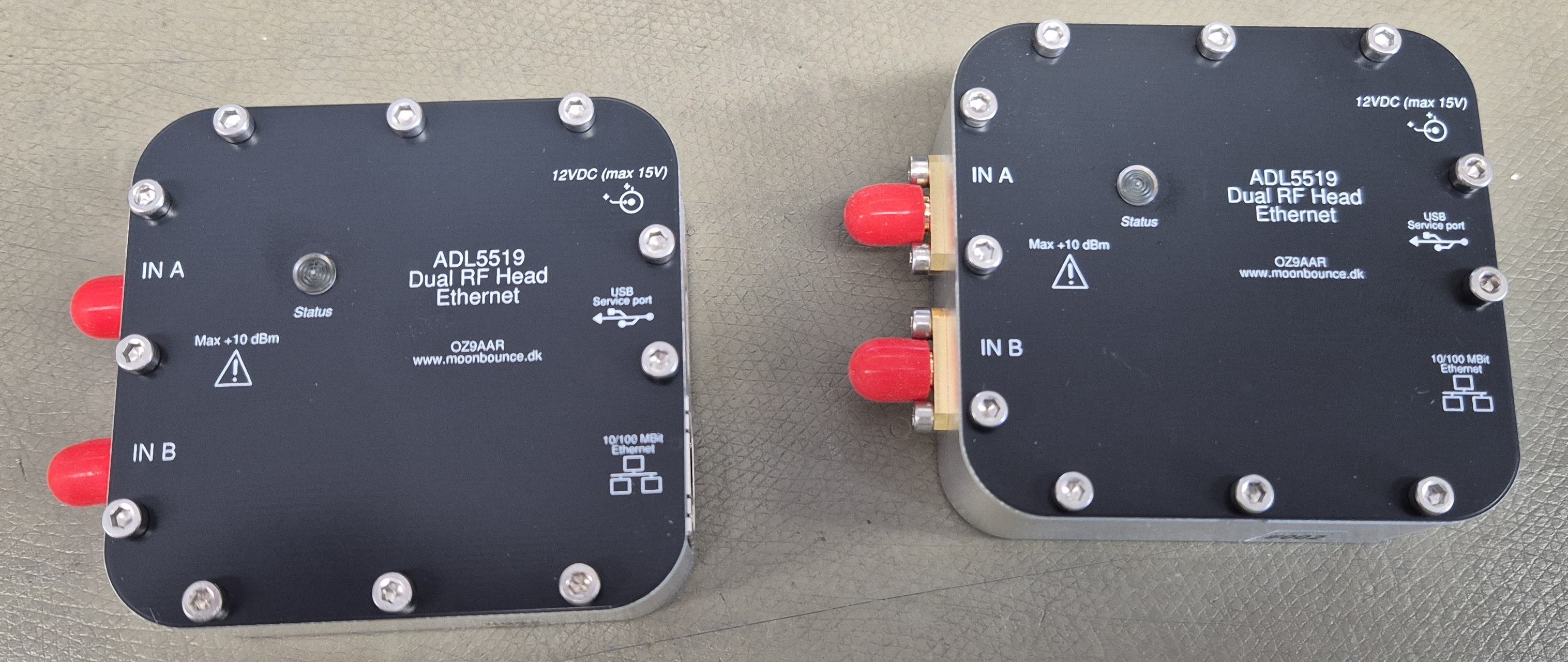 OZ9AAR Dual RF Head Ethernet 1
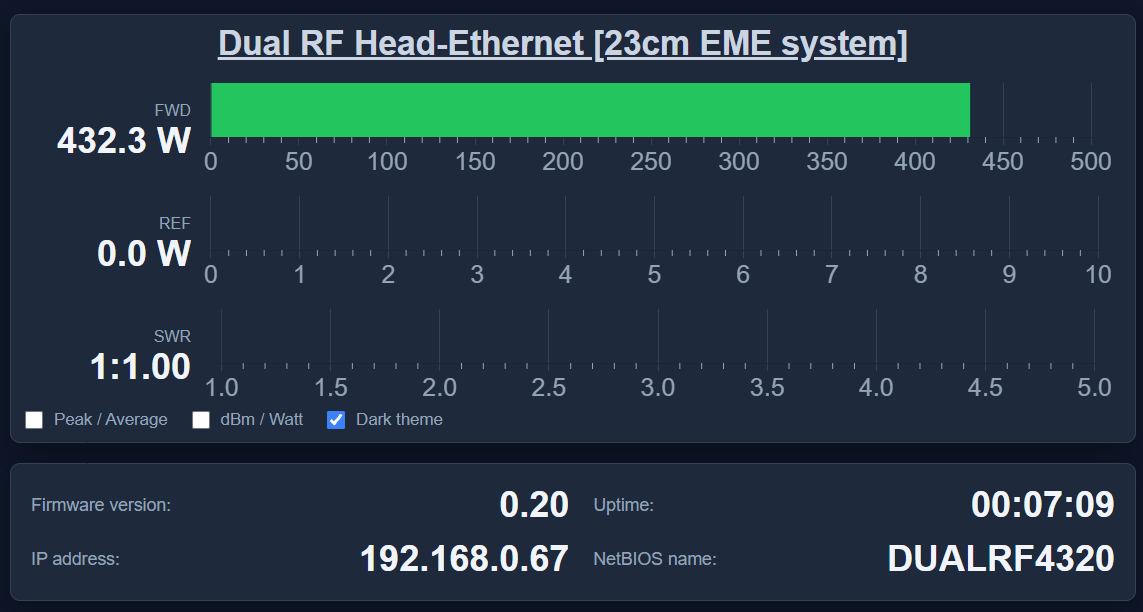 OZ9AAR Dual RF Head Ethernet 2
I have also added a new PC application to my website: the "WSJT Log Viewer". It allows you to view and analyze the ALL.TXT file from WSJT and shows information about QSOs and initials, and most importantly, it lets you produce statistics and graphs of the decoded signal levels. I expect the application to evolve over time. The application can be downloaded for free from: WSJT Log Viewer
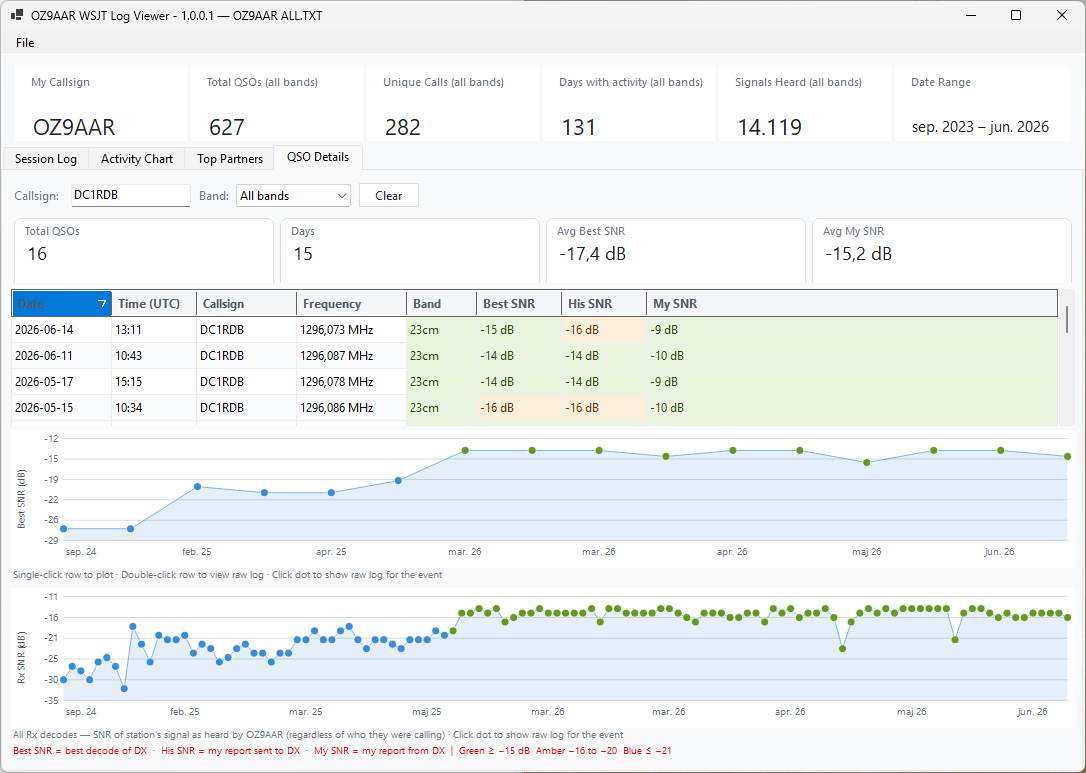 OZ9AAR WSJT Log Viewer 1
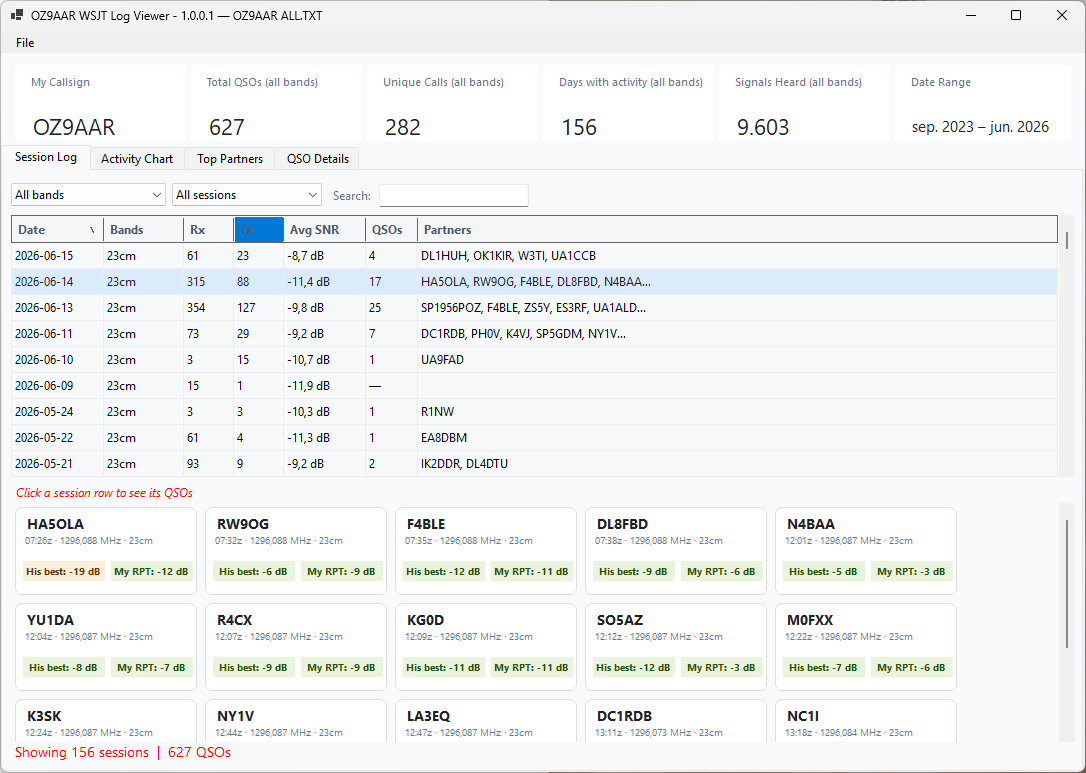
I also added an online "Sun noise predictor" and an (experimental) "Sky noise calculator" to the website.
PA0PLY Jan
This was an interesting month here with OE5VRL on 3400 MHz. We tried in the early beginning of the month with my elevation at 16 degrees but half of the dish was covered by a wooden fence. Rudi is horizontally polarized, so there were multiple of challenges to cope with. I could see him, but had no decodes unfortunately. We finally succeeded on June 10th with much better circumstances: OE5VRL -18/-17.
Then the 24 GHz weekend was coming, so in advance I tested my RX for Sun noise and found it to be 14.5 dB. Also for the first time I fired up my RW1127 TWT in combination with the Wavelab transverter. I was a bit worried about the controller system for the TWT but all went well.
On the Saturday, June 13th (the DUBUS-REF contest) there was no chance to mount my system in the dish due to overcast and rain all day. During the day I decided to give it a chance on Sunday morning and cover the 24 GHz system with a plastic bag. The morning came with dry weather and sunshine, while I was mounting the transverter and TWT power supply at the feed. My Moon noise was surprisingly good at 2.1 dB.
The following QSOs were made on June 14, all in Q65: OZ1LPR -07/-15, SP3XBO -16/-13, IW2BNA -17/-16, PE1CKK -14/-21, PA0BAT-13/-14, IZ2DJP -12/-15, OK1DFC -15/-16.
I also tried with John, ZS6JON but nothing was seen. We agreed another sked date on June 16th but again nothing. After analysing we concluded Dpol (differential polarity) was too far off now. Better conditions between ZS and PA will not come soon.
But on June 16 I worked: IZ0JNY -16/-19, LZ4OC -16/-17, OK1KIR -12/-14, VE4MA -14/-16, OZ1LPR -06/-16, I6PYK -15 RX but no QSO.
For the first time on 24 GHz I was really amazed with the results, but I understand that there is much to learn. Water vapour, Dpol, Spreading are all important factors for success on this band. Studying the additional information on https://www.DXer.site already helped a lot.
My 24 GHz system is: a Wavelab transverter (SP0KKM version, a DU3T WR42 switch and KLNA preamplifier, and a RW1127 TWT modified for 24 GHz with 30 Watts output.
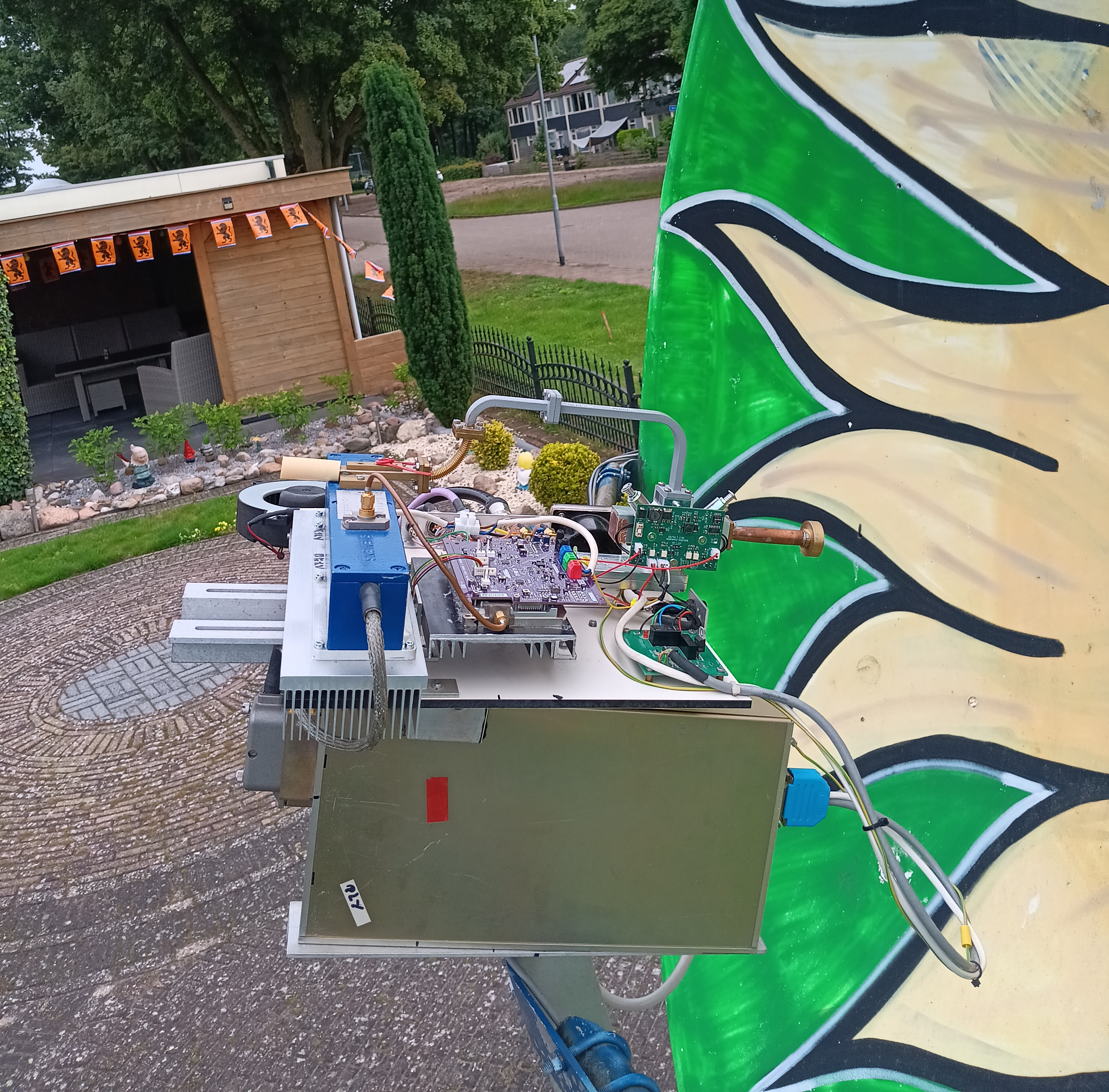 PA0PLY 24GHz Rig at Feedpoint
PA3DZL Jac
My highlights were the 2 new DXCCs on 432 MHz, a Great FIRST QSO with EA8DBM on 2320 Mhz and with the Special Event station on 5760 MHz IUØSAT/2.
Due to my holiday to Italy I missed the FP/EA8DBM DXpedition. Sometimes family is more important :-)
432 MHz wkd:
IWØRNA, SP2WRH, F8DO, CP7DX # and FIRST QSO ever on 70 cm from Bolivia so also FIRST PA-Bolivia, BD8AIS #, W3TI, R1NW, KCØV #, OM3TRN, KI6WJ #, ES3RF, BG7XWF, VK4EME, VKØDS # 471 and the FIRST QSO ever PA-ANTARCTICA and on June 22nd I made a second QSO with Dave. There were great signals from his 2 Yagi station and 250 W.
1296 MHz wkd:
HA5OLA #, NY1V, R4CX #, K3SK, KA6U, MØFXX, PA3BYV # and AF6SA # 717
2320 MHz wkd:
EA8DBM # and FIRST QSO ever on 13 cm from EA8 Tenerife and also the FIRST PA-EA8 QSO. Alex EA8DBM wrote a nice story + screenshots about our tests and QSO.
5760 MHz wkd:
JS6UJS #, PAØHRK # and IUØSAT/2 # 111 There were very big signals from this special event station!!
10368 MHz wkd:
G4HSK, W3TI and IK3HAR
PE1CKK Hans
On Sunday, 14 June 2026, the first-ever 24 GHz EME contact with the African continent was made. John, ZS6JON, and I, PE1CKK, completed a two-way contact over the Moon.
This QSO had a long preparation period. About a year ago, John contacted me to ask whether I had any parts available for building a 24 GHz setup, as such components are very difficult to obtain in South Africa. I had a better solution and offered him my second station, which is a clone of my primary station. The package also included a small beacon transmitter for receiver testing. The transmitter output could be verified simply by holding a hand in front of the feed and feeling the heat.
All the equipment was transported by Lins when he traveled to John for the Zambia EME DXpedition. John installed a 1.8 m offset dish equipped with a rotator system capable of tracking to within 0.1°. The transverter system was essentially plug-and-play; he only had to provide a water pump for cooling and a 10 MHz reference source.
After many emails and chat sessions, John finally had the system operational on Sunday June 14th. He had a decent Sun noise and Moon noise, so we decided to give it a try. On the very first transmit sequence, he decoded my signal, and we completed the QSO. Later, I checked the Dpol and signal spreading conditions and found that we were fortunate to have chosen exactly the right moment. PA0BAT and OZ1LPR were the next lucky stations to make contacts.
Because the system does not include a polarity rotator, the available operating windows are very small. On most days, when Dpol conditions are favourable, signal spreading from Europe is poor, and vice versa.
The setup will remain in South Africa for some time, so John is open to scheduling skeds.
Station details: 1.8 m offset dish, Wavelab PA0MHE transverter, RW1127 TWT amplifier (25 W), and a DU3T LNA.
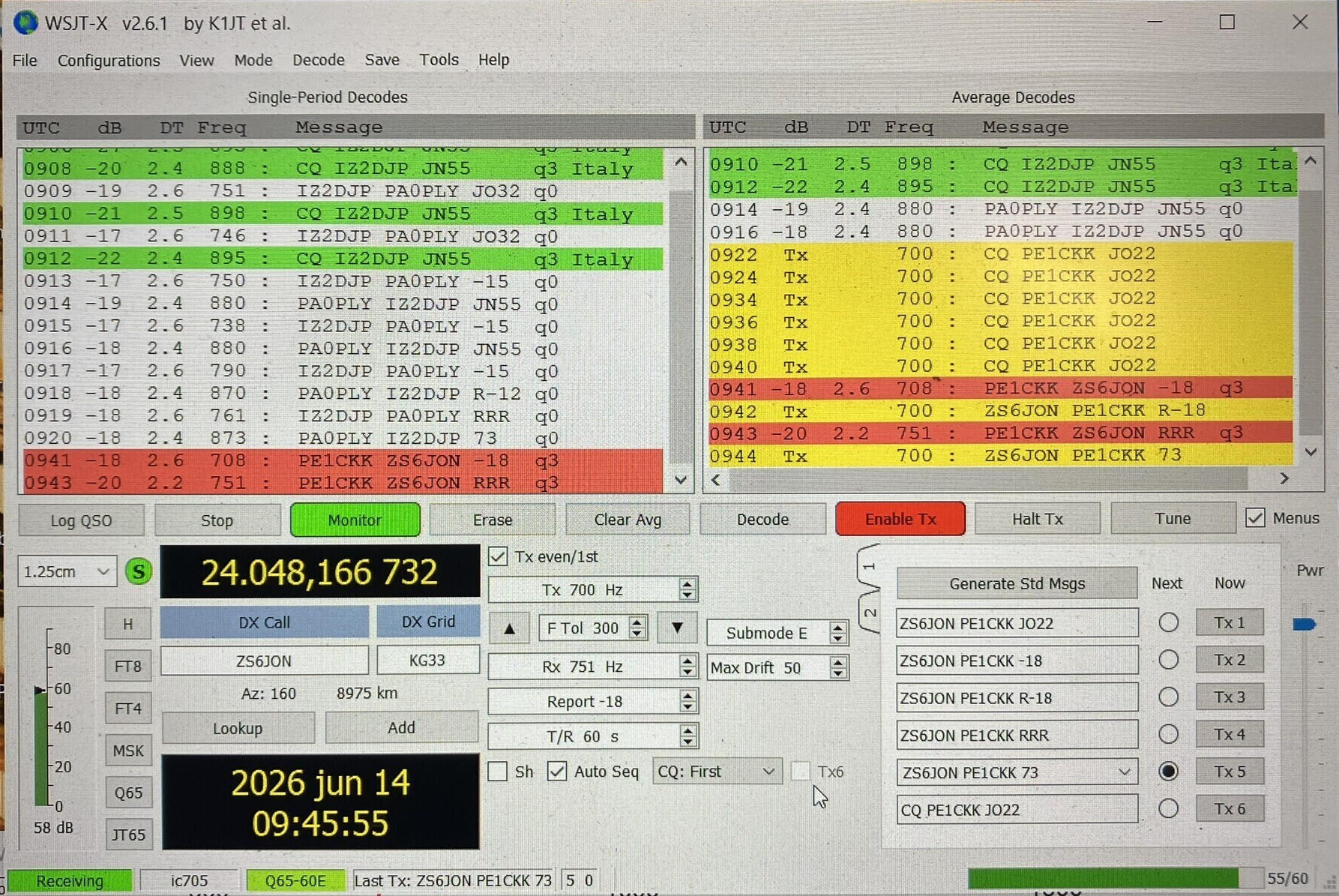 PE1CKK WSJT screen from ZS6JON
VE4MA Barry
The weather has not improved greatly from previous months and it was raining every second day. On June 10th there was a very large rain system with small tornadoes. I only had 50+mm of rain, but nearby they had 255 mm of rain and 100 mm hailstones and flooded fields. I did operate on 24 GHz in spite of this. I want to optically retest my focus on the 2.4 m dish but not enough Sunny days.
I did have a malfunction with my Transverter switchover box that caused a big loss of 10 GHz signals but I did manage to operate on 10 GHz on June 10th and had QSOs with NJ6D/P -13/ -9 UT/WY , SM6CKU -10/ -8, NJ6D/P repeat -11/ -8 , AC0RA -12/-10 and SO5AZ -19/ -14.
I was disappointed in the June 13th 24 GHz DUBUS / REF contest turnout. I did QSO OZ1LPR 579/559, SP3XBO 559/449 (he was having pointing problems and signals varied considerable… but improved greatly at the end of the QSO) and then WA6PY O/O with high spreading (250 Hz) between us. The periods of rain and heavy cloud cover did not help! Sun Noise was down to 11.5 dB and MN was only 1.3 dB. I did not see my echoes!
I know there was some bad WX in EU also.
On Sunday June 14th the weather had improved and I could see my 24 GHz echoes! I QSO’d LZ4OC -14/-10, SP3XPO -16/ -9, ON/ PA0MHE -17/ -10 and OK1DFC -16/ -12.
On June 16 I worked PA0PLY -16/-14 and OZ1LPR -4/ -8.
As mentioned earlier I am trying to check my 2.4 m one piece dish for the quality of the focus. I am not happy with the 47 GHz performance and will also check 1.8 m prime focus and offset dishes. In July I plan to operate on 3.4 GHz as well as 47 GHz.
VE4SA Shawn
June 14 marked the highlight of my ham year so far with the first four 3 cm EME contacts. All were Q65-60D as follows: -Init #1: ON5TA S-15, R-15, Init #2: G4YTL S-22, R-20, Init #3: IK3GHY S-20, R-19 & Init#4 OH3LWP S-14, R-19.
This is my second EME band, starting in 2007 with 23 cm. I began this 10 GHz journey in September 2022, initially with a terrestrial setup, then adding a 1.2 meter dish, security camera AZ/EL drive and 45 watt TWT. My EME setup utilizes WR-90 waveguide to allow indoor TWT and transverter installation. This was only possible with the excellent local supply of WR-90 plumbing, waveguide switch and TWT (all provided by Barry VE4MA)!
The system shares the terrestrial platform consisting of a W1GHZ transverter, DEMI TCK interface and sequencer, as well as a DEMI PLL. I use an old HP OCXO for the 10 MHz reference and an IC-705 IF rig at 432 MHz. The 70 cm IF was needed to provide minimal image rejection for the broadband TWT response.
One of the most time consuming challenges was adapting the K3NG Arduino based controller project to work successfully with the A2 encoders and an AC motor camera AZ/EL drive. My software skills are very rudimentary and this stretched my skill set, finding solutions to work around slow updates from the encoder and fast AC motors. It kept me busy last winter with many trial and error code iterations.
I am fortunate to have access to 10 GHZ return loss test gear from my employer, so this allowed me to test and fine tune the elliptical waveguide sections and feed. The sequencer includes interlocks for the wave guide switch with the added protection of a load on the idle port for the TWT. I try to build in as much idiot protection as possible as crazy things happen at 3 am when working contests!
I am immensely grateful for Barry VE4MA's council and support on this project. This simply would not have happened without his guidance and encouragement. 3 cm EME is NOT plug and play!
Looking forward to many more 3cm EME QSO's!
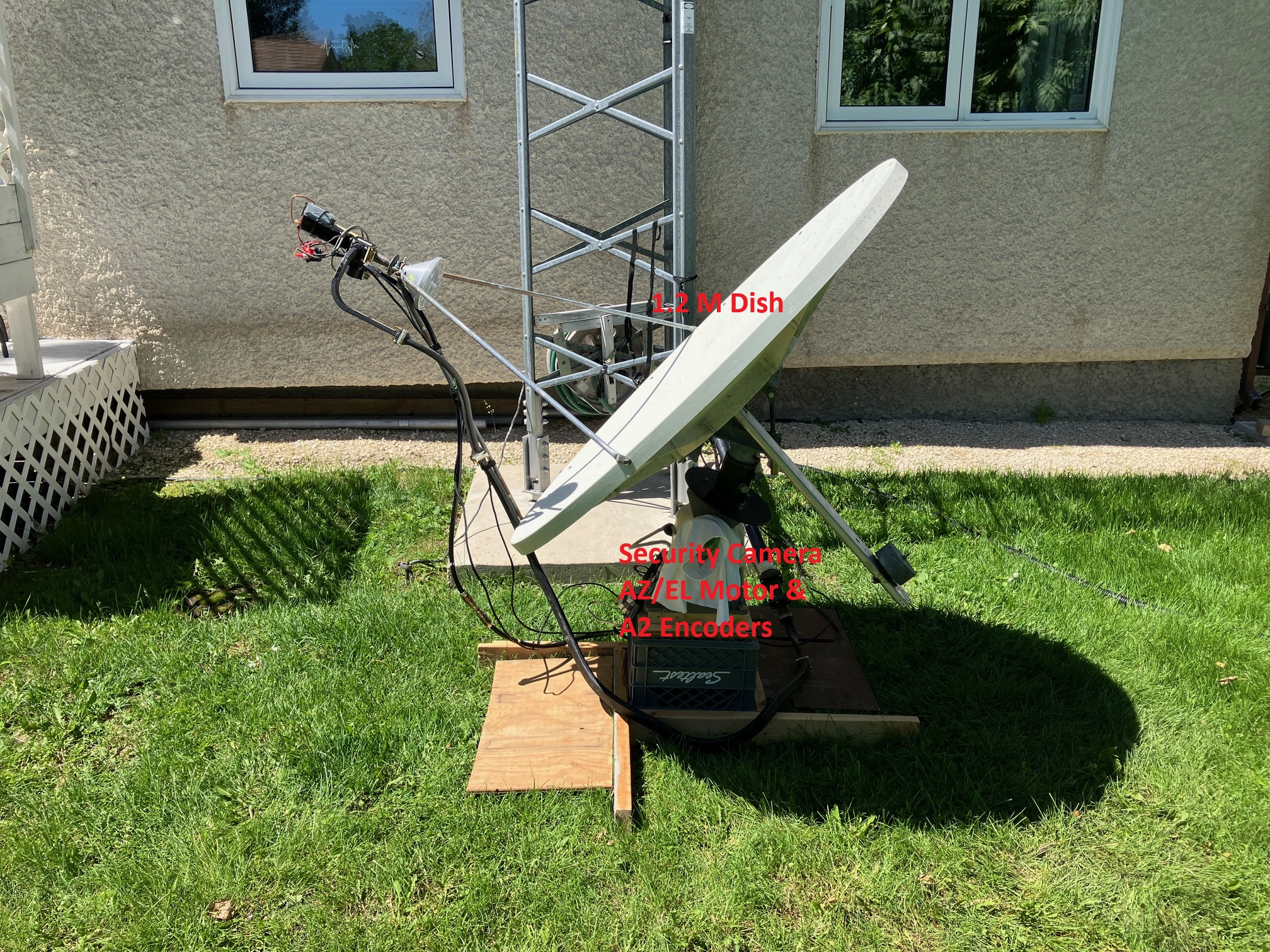 VE4SA 1.2 m Dish
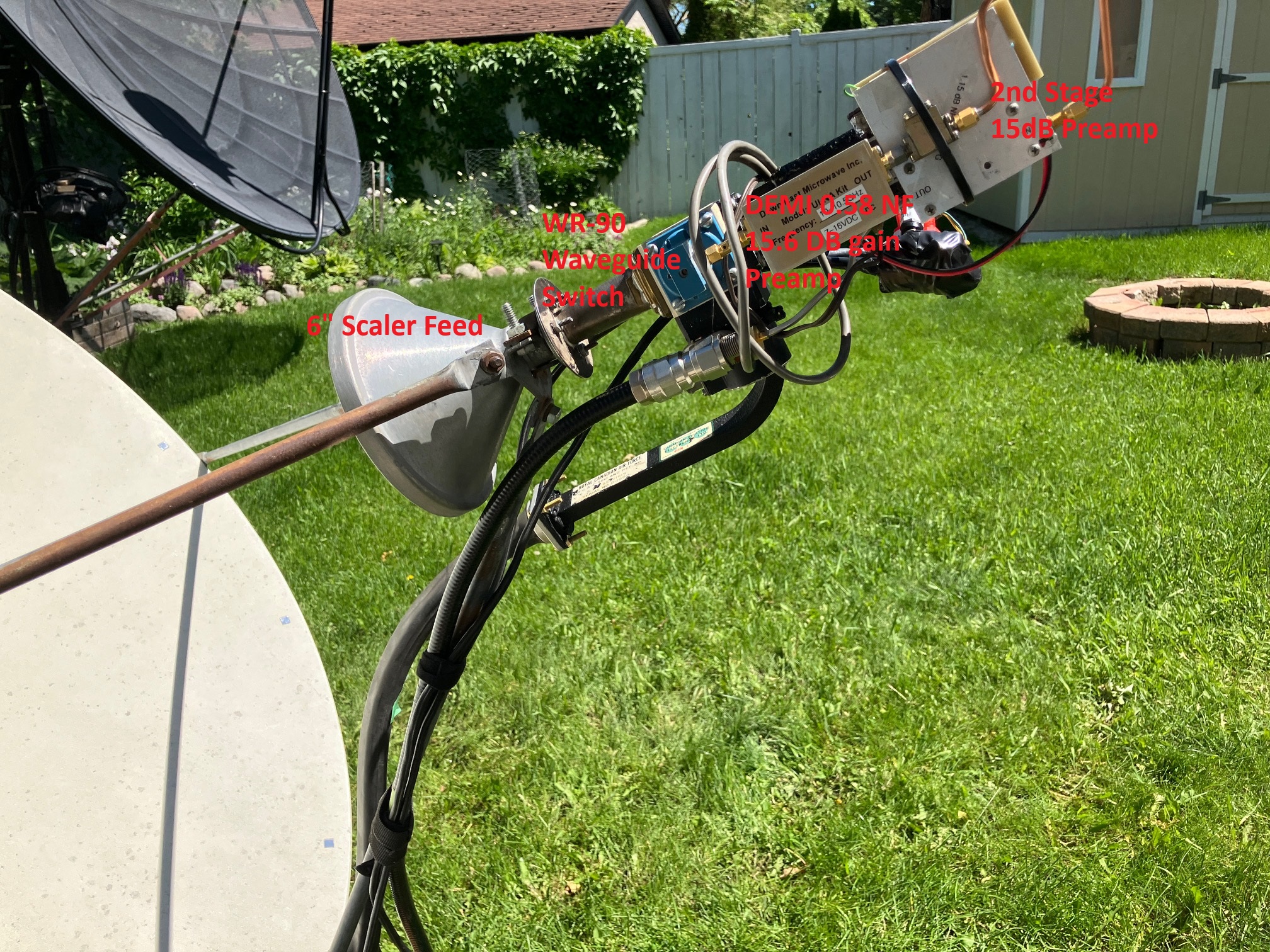 VE4SA 10 GHz feed closeup
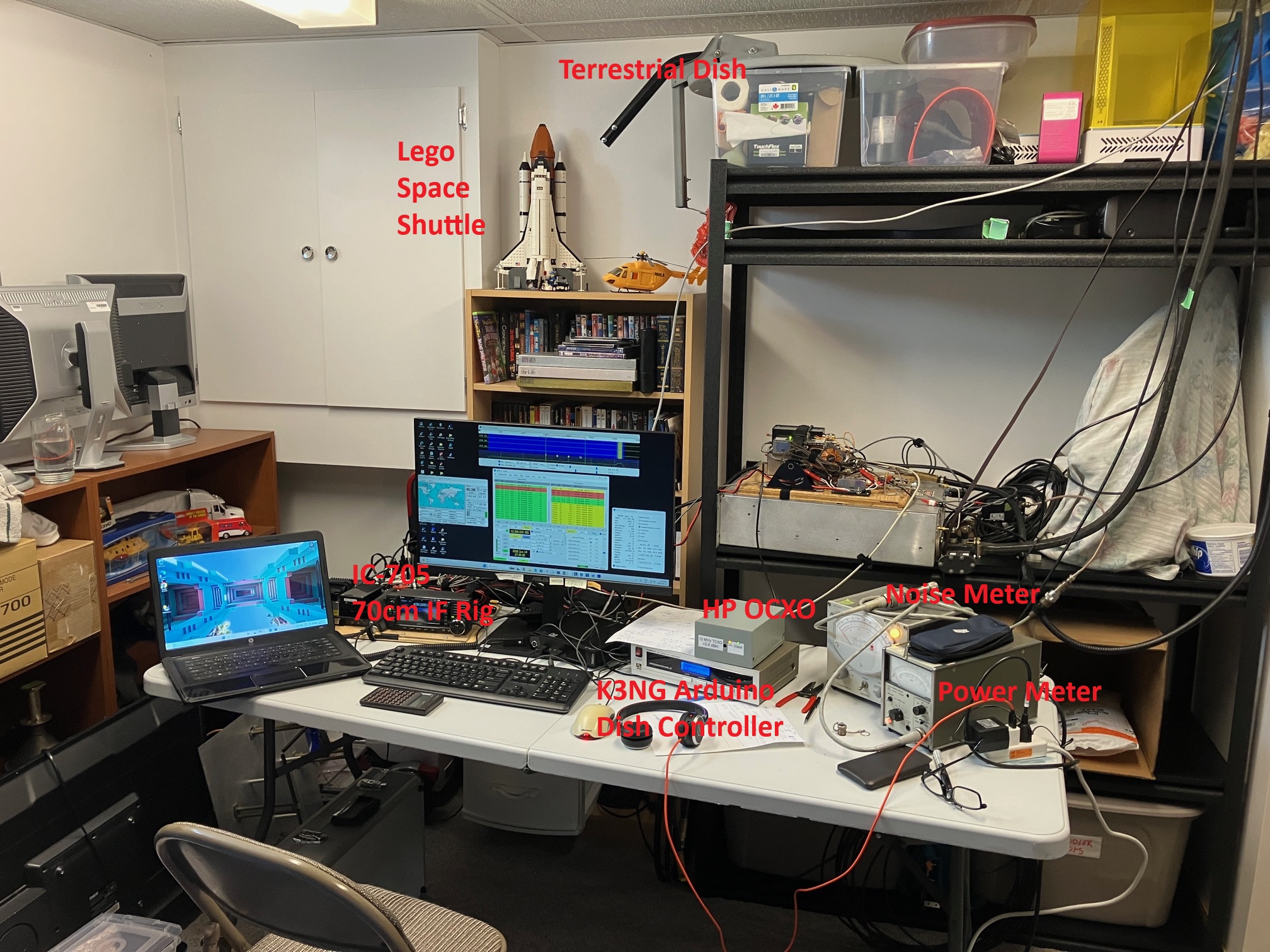 VE4SA Rig Transverter TWT
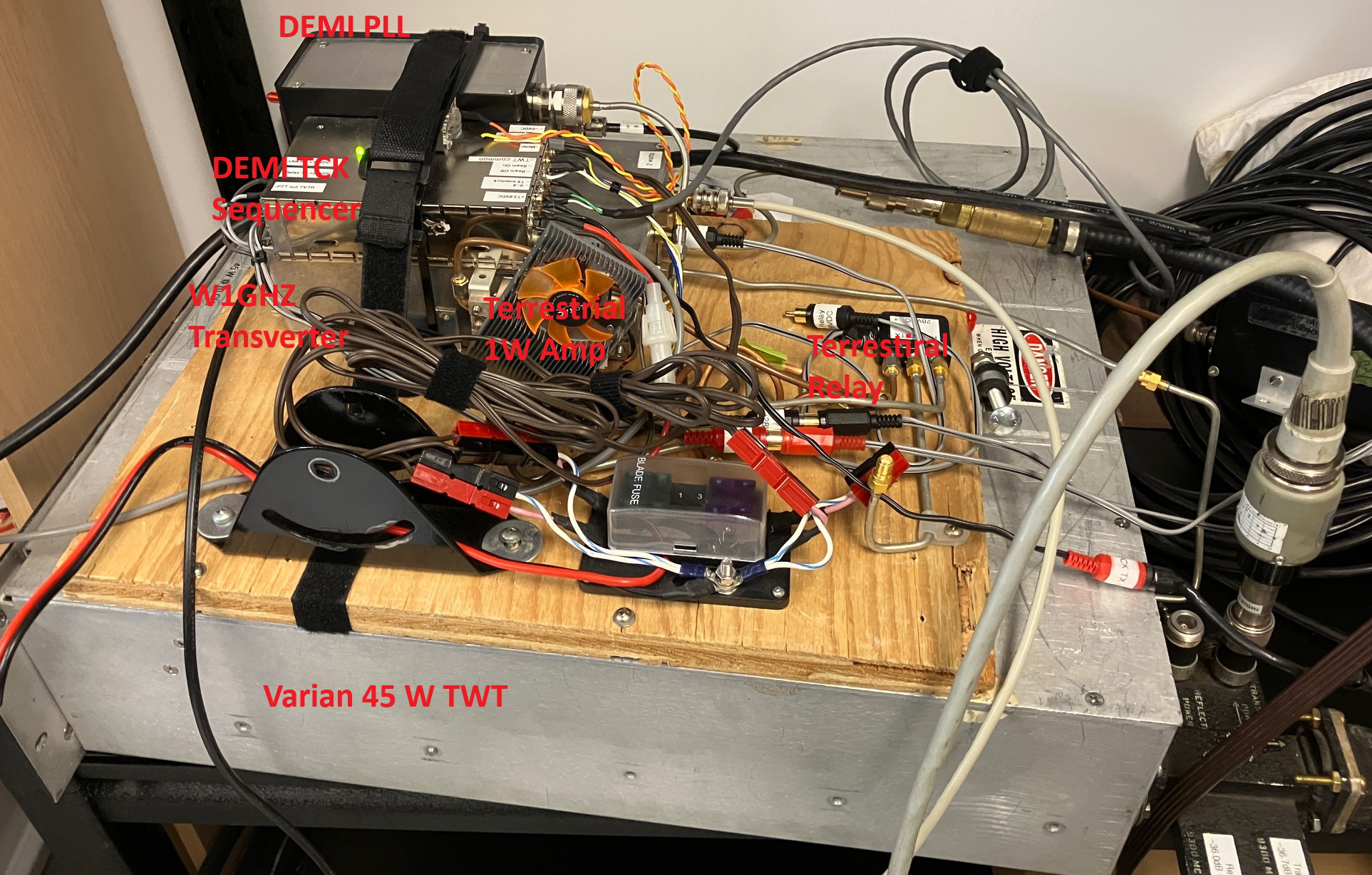 VE4SA Transverter TWT closeup
VK0DS Dave
Antarctica 432 MHz Moonbounce setup:
2 Yagis and 250 W … SSPA cooling is no problem 😆
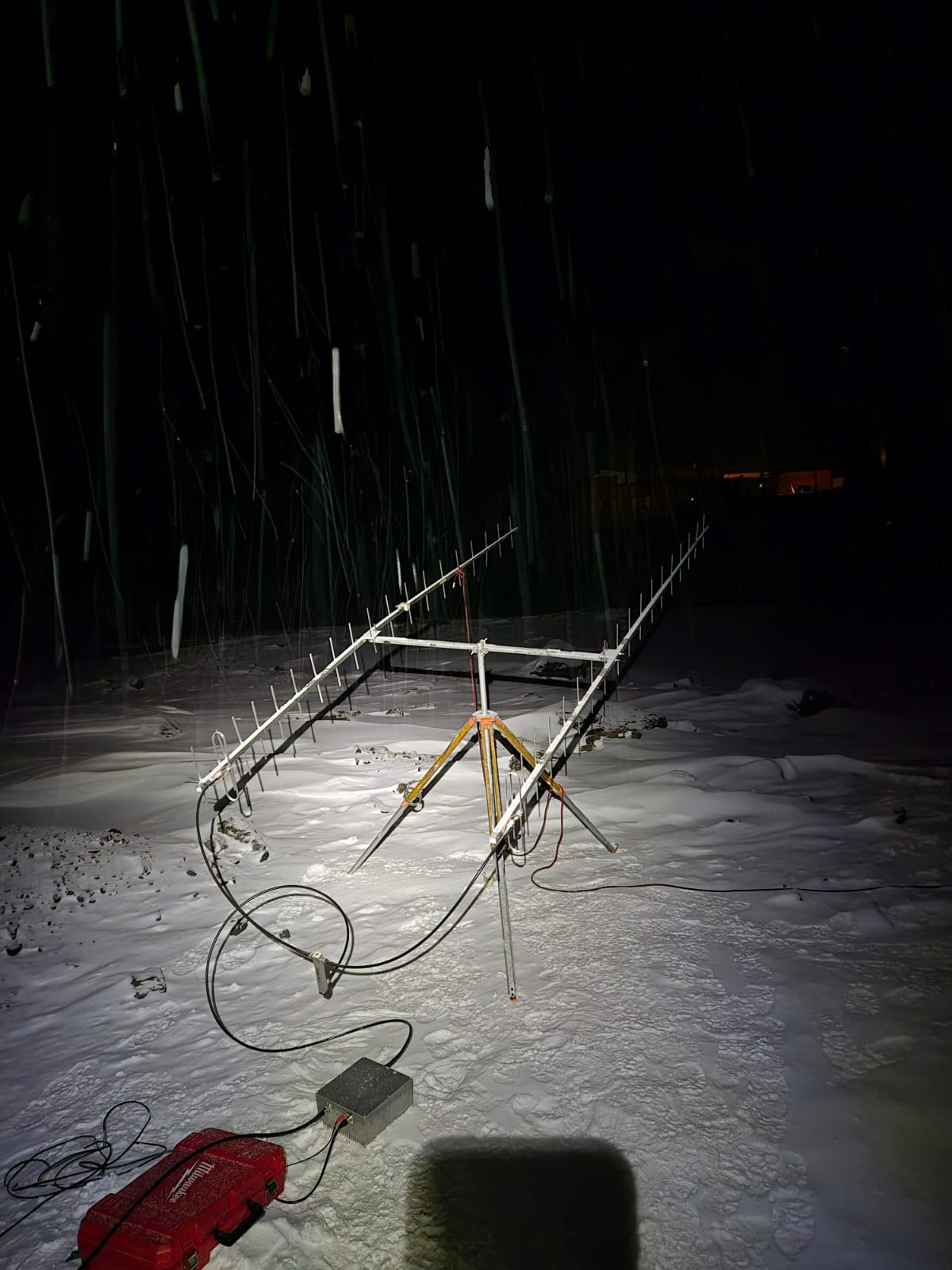 VK0DS 2 Yagi Array
W5LUA Al
On June 10th I worked KL6M on 3 cm CW. I also worked NJ6D/P on 3 cm Q65 in DN35 MT. On June 12, I spent more time on 3 cm Q65 and worked NJ6D/P in both WY and UT. I then worked SM6CKU, G8RWG, SO5AZ, OM4XA, G4HSK, IK3HAR and OE5VRL all Q65 on 3 cm.
On June 13th I worked FP/EA8DBM on both 13 cm and 23 cm for new DXCCs. Then I was back to 3 cm on June 19th and I worked AC0RA in EN32, IA and PA0HRK, both on Q65.
I spent some time repairing my 24 GHz waveguide switch controller. This should be complete for July activities.
W8TN Clark
Since my last report I only operated on 23 cm on June 13th 2026 making a total of 3 QSOs including one new DXCC. All 3 were Initials: OZ9AAR, EA8/RD4D (DXCC #31), and ON4AOI.
This was the 9th time I have set up my 2.4 m folder on the driveway. This brought my standings to: 119 QSOs – 31 DXCCs – 83 Grids – 102 Initials after 9 Operating Sessions. Due to wind, rain and some physical issues, it has been hard for me to get the dish set up. Hopefully that will improve.
WA6PY Paul
WA6PY was QRV on 24 GHz for the DUBUS-REF contest on June 13 and completed QSOs with OZ1LPR, VE4MA, SP3XBO, and JA1WQF. Mitsuo JA1WQF was using a 45-degree WG twist to compensate for spatial polarization misalignment.
I plan to be QRV on 3.4 GHz in July. Stations who are able to be QRV on my western horizon, please let me know on
I will be QRV again on 24 GHz in the ARRL EME Contest in August and I will switch setup to 10 GHz for September.
ZS6JON Jon
After completing a 10 GHz system a crazy thought entered my mind, has 24 GHz even been done from the African continent?
I have some very old equipment from Ivo ZS6AXT. After some enquiries I quickly realized this gear would not suffice. I started to make some enquiries as to what could be available in Europe. Being on the bottom end of Africa things are not easily available for 24 GHz.
Hans PE1CKK made contact and made an unbelievable offer. He had a complete 2nd 24 GHz System that could be loaned to me in ZS. I was somewhat overwhelmed!
Postal services have totally collapsed here in ZS so that’s not possible. Lucky Lins PA3CMC was coming to ZS for the 9J2 expedition and he kindly offered to bring it along.
After the Zambia Expedition I started in earnest to adapt Hans’s system to my existing dish wiring and brackets. All progress took its time but slowly we completed it. I had measured 11 dB Sun Noise and 1,1 dB Moon noise the first time I connected it. Not great but it was at least something.
It all came to a head on Sunday Morning the 14th June 2026. I had contacted Hans and he was ready to make contact. He called and in the first sequence I got a decode, it seemed too good to be true. Gerard PA0BAT followed and a little later Peter OZ1LPR (Massive Signal). We must have had the right conditions at the right time.
I quickly realised that things in the S-Hemisphere work differently. The polarity angle between us (Europe) seems to be critical. Anything more of a 40 deg difference and no QSO was possible.
I now have a “To Do” list to improve things and streamline the system. Equipment and wires were all over the place. The pressure is now off to make the first QSO.
A heartfelt thank you to so many that made this possible by giving guidance and advice to my never ending questions. Special Thanks to Hans PE1CKK, Lins PA3CMC, John PA7JB, Gerard PA0BAT, Jan PA0PLY, and many many others.
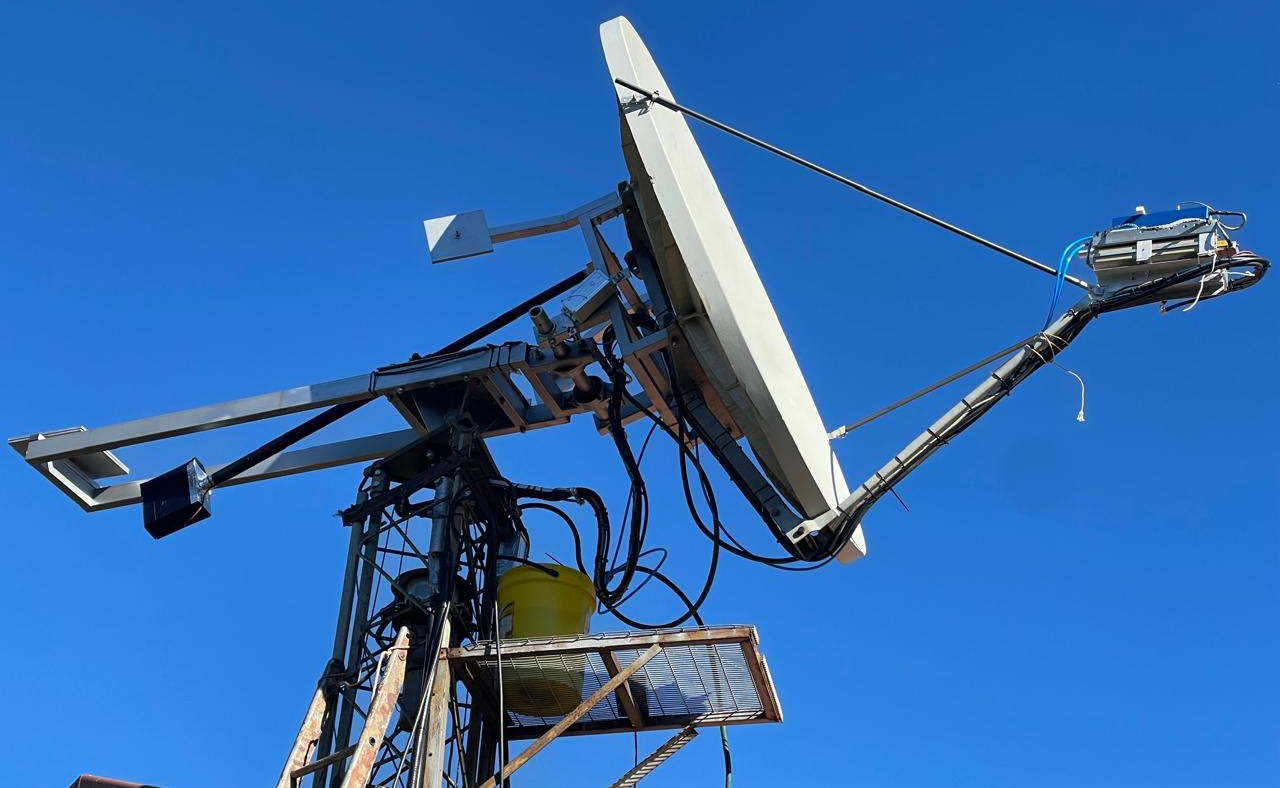
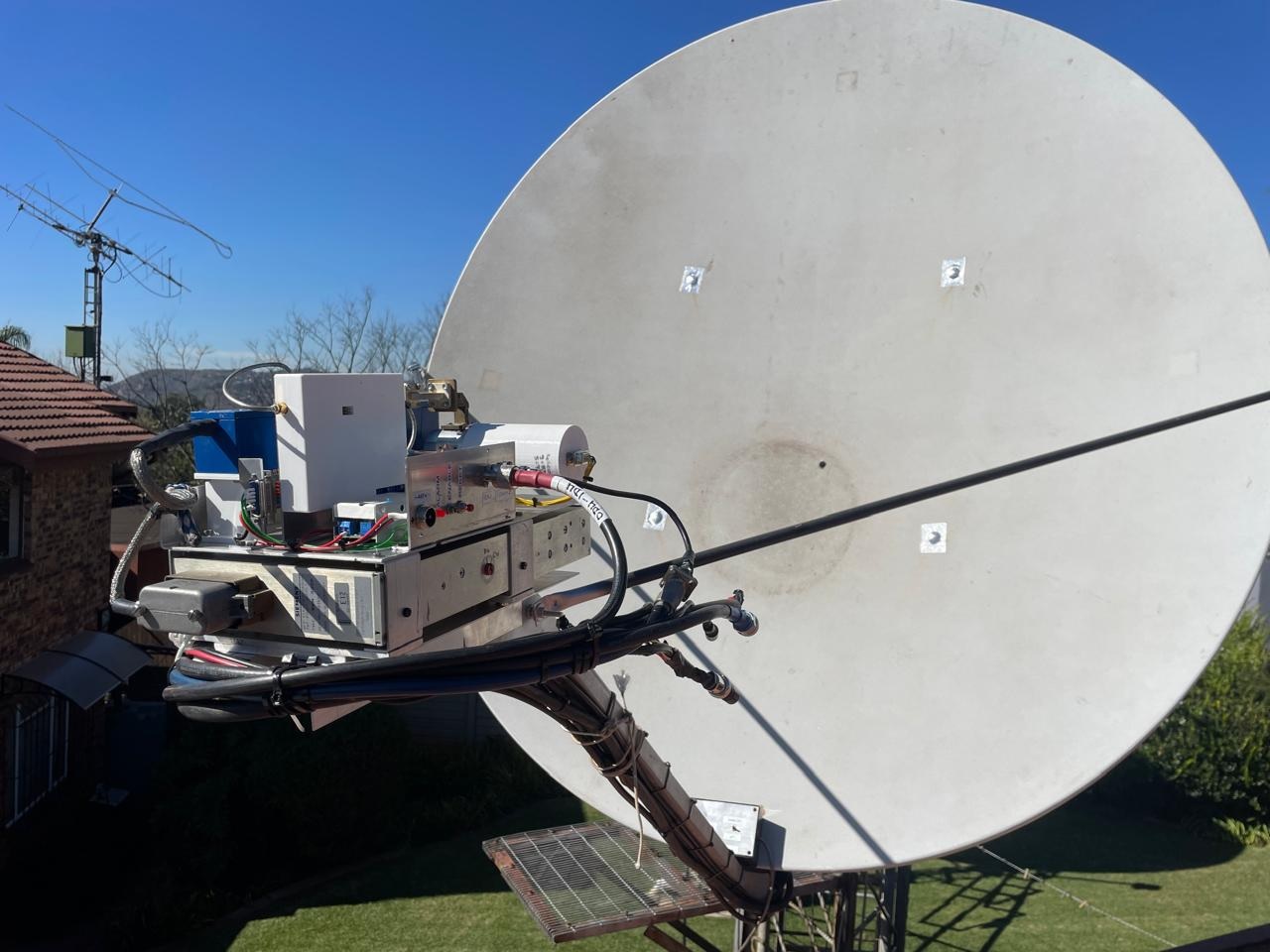 ZS6JON 24 GHz Dish 1
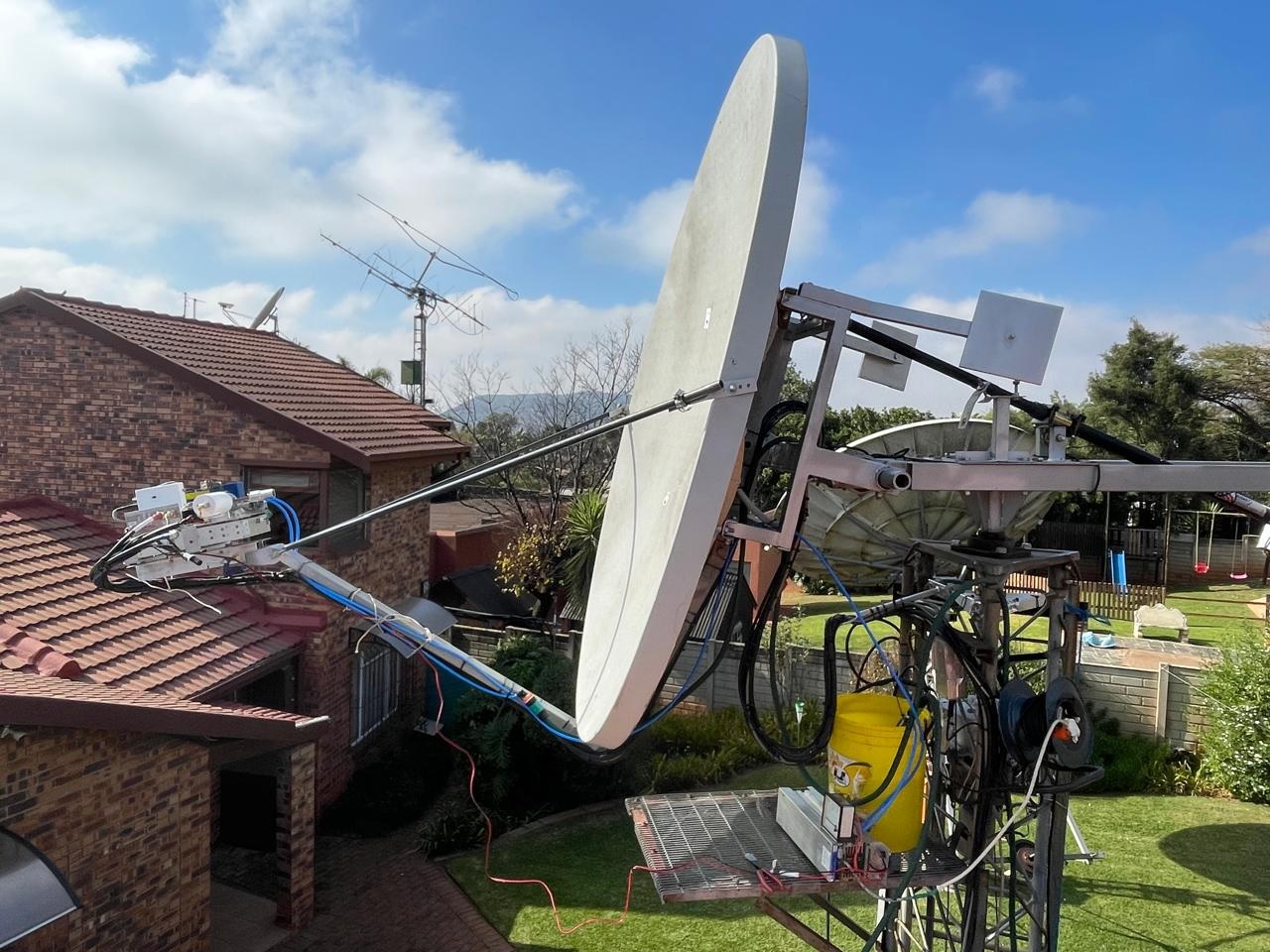
 ZS6JON 24 GHz Dish 2
 ZS6JON 24 GHz Dish 3
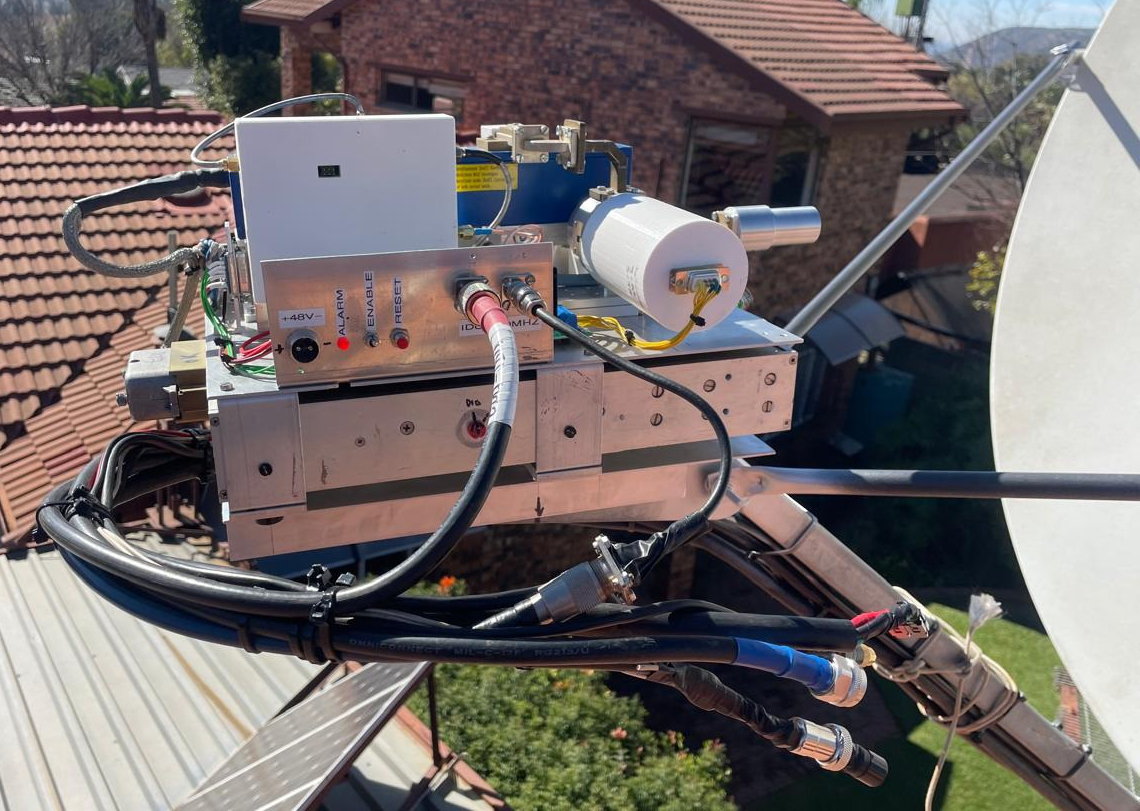 ZS6JON 24 GHz Feed System
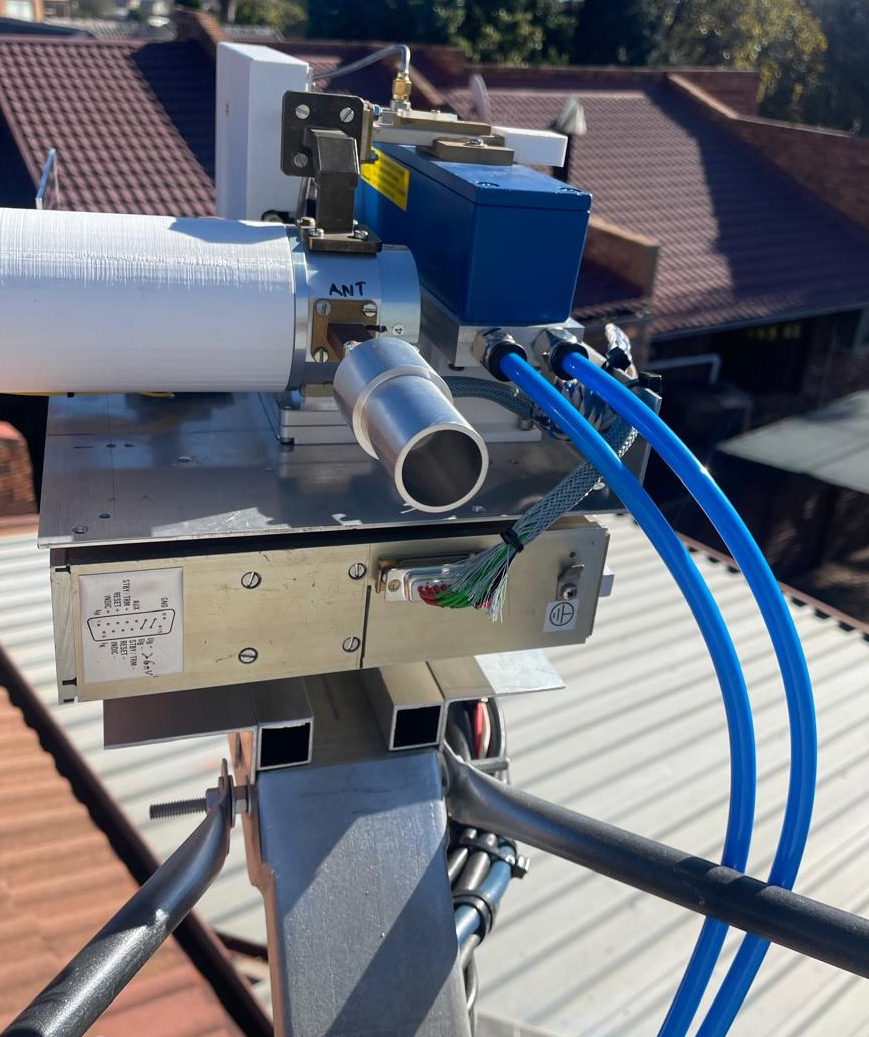 ZS6JON 24 GHz Water Cooling
First 76 GHz EME Reception in Portugal
Initial Results by CT1BYM
1. Introduction
Following the recent breakthrough of the first confirmed two-way Earth–Moon–Earth (EME) contact at 76 GHz between RW3BP and DL7YC in April 2026, interest in this millimeter-wave band has significantly increased within the EME community.
While the feasibility of two-way communication has now been demonstrated under optimal conditions, successful reception at this frequency remains extremely challenging due to high atmospheric attenuation, system noise limitations, and really tight pointing requirements.
This article reports the first successful reception of lunar-reflected signals at 76 GHz in Portugal, achieved by CT1BYM, using a relatively compact station.
2. Station Description
The receiving system is based on a Kathrein CAS120 offset dish with a diameter of 1.2 meters. Despite its modest size compared to larger EME installations, the antenna provides sufficient gain at 76 GHz when combined with a carefully optimized feed system.
The front-end consists of a WA1MBA-type low-noise amplifier, delivering approximately 30 dB gain with a noise figure of about 5 dB. The LNA is mounted as close as possible to the feed to minimize waveguide losses.
The system operates at a frequency of 76,032.100 MHz, using the CFOM (Constant Frequency on the Moon) technique to compensate for Doppler variations.
Signal detection was performed using WSJT-X, in Q65 mode, submode D, with libration spreading below 115 Hz, allowing narrowband integration of extremely weak signals.
D submode was choosen to provide lower detection threshold, as seen in the following graphic, for lower spread.
A lot of trials were also conducted in submode E, when spread was above 200 Hz.
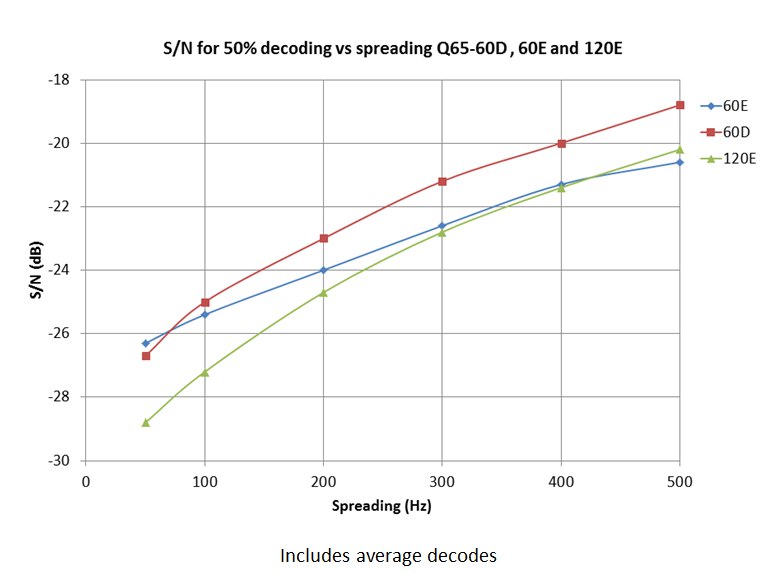 CT1BYM S/N Decodes vs Spreading WSJT
3. Observations and Method
Reception attempts were conducted over a period of three days, from May 18th to May 20th, 2026, targeting signals transmitted by RW3BP.
Careful attention was given to lunar tracking accuracy, as beamwidth at 76 GHz is extremely narrow, even for a 1.2 m dish.
Environmental conditions varied during the observation period, with particular emphasis on minimizing atmospheric attenuation.
Measured system noise contributions included:
Solar noise increase: up to 7.5 dB
Moon noise increase: approximately 0.7 dB
These values confirm proper antenna alignment and system sensitivity.
4. Results
After multiple attempts over the three-day period, successful reception of a lunar-reflected signal from RW3BP was achieved.
The best recorded signal reached approximately –24 dB SNR in Q65-60D, representing a clear decode under extreme weak-signal conditions.
This result demonstrates that even with a relatively small dish and moderate noise figure, EME reception at 76 GHz is feasible when system stability, frequency accuracy, and propagation conditions are favorable.
5. Discussion
The experiment highlights several critical aspects of 76 GHz EME operation:
Atmospheric influence:
Even under seemingly good weather conditions, atmospheric absorption plays a major role. Low humidity and stable air masses are essential.
System sensitivity:
A noise figure of 5 dB is significantly higher than state-of-the-art systems, yet reception was still possible, indicating that further improvements could dramatically enhance performance.
Antenna size vs. performance:
The successful use of a 1.2 m dish suggests that 76 GHz EME is not strictly limited to very large antennas, although higher gain would improve link margins.
Comparison with lower bands:
Compared to 47 GHz, the 76 GHz band introduces noticeably higher path losses and tighter pointing constraints, making operation considerably more demanding.
6. Conclusion
This work confirms that EME signal reception at 76 GHz is achievable with relatively modest equipment, provided that system stability, accurate tracking, and favorable atmospheric conditions are present.
These results support the growing body of evidence that the 76 GHz band is becoming a viable frontier for advanced EME experimentation.
Future work will focus on improving system sensitivity and developing a transmit capability, with the ultimate goal of achieving a full two-way QSO.
The -6 dB gain loss from the 1.2 m dish (compared with a 2.4 m dish) need some more transmit power to overcome the pass loss. Sergei was transmiting with the same 8.1 W that he uses for his contacts with Manfred.
How much power is really needed with a 1.2 m dish will be the task for future/further investigations.
A very special thank you to Sergei and Manfred for all incredible support!
73, Miguel CT1BYM
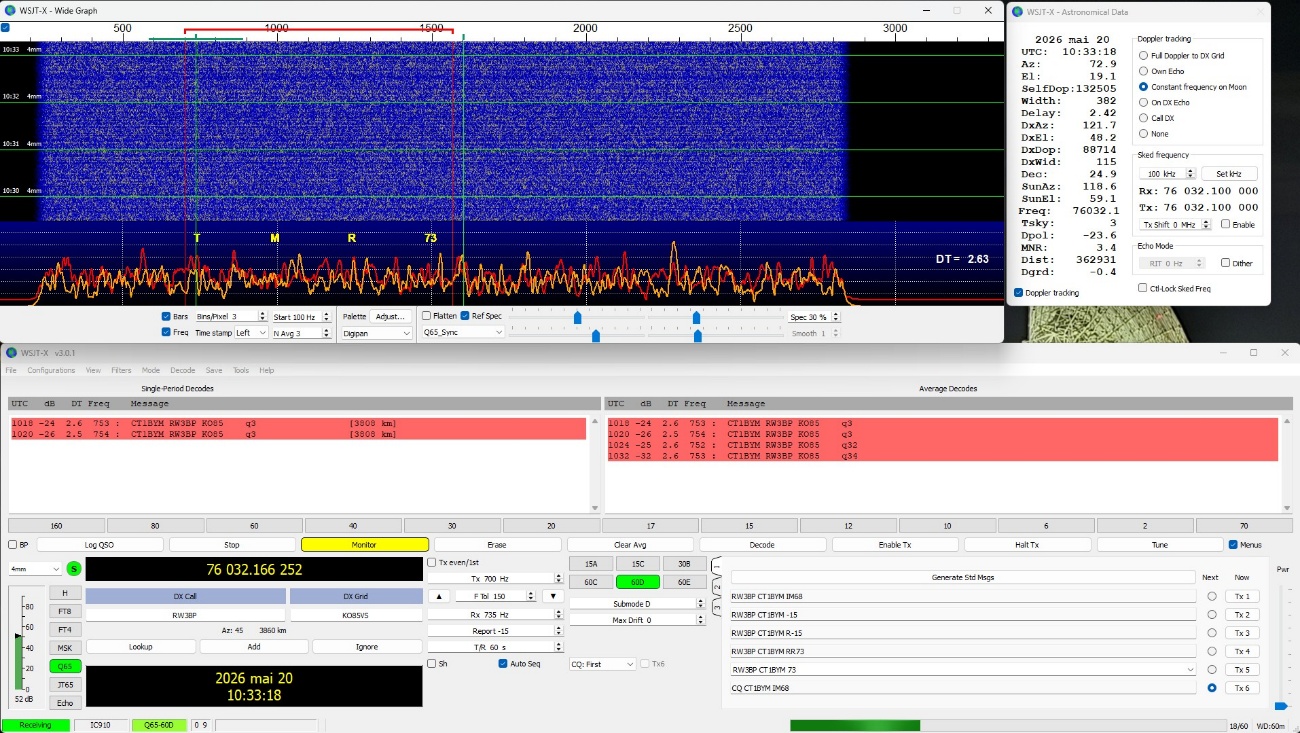 CT1BYM 76 GHz Decode of RW3BP
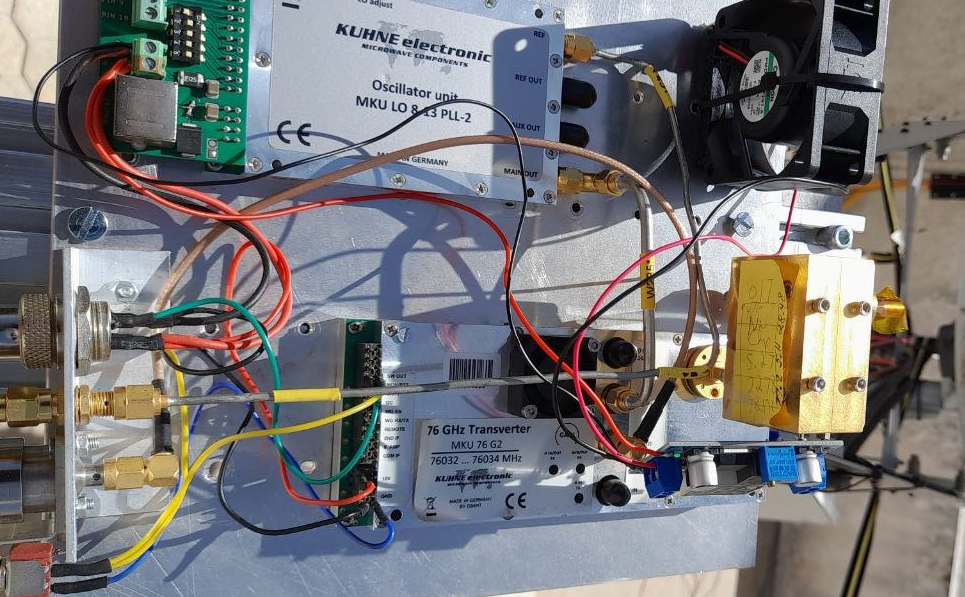 CT1BYM 76 GHz RX
EA8DBM Alex
EA8DBM made the first 13 cm QSO from EA8 working PA3DZL on May 21st with 150 W to his 4 m folding dish. For more detail see DXpeditions first ever EA8 13 cm activation
From June 12th to June 16th Alex was operational as FP8/EA8DBM. He was operational first on 13 cm with an OK1DFC septum feed (Sun noise 4-4.5 dB), his first QSO, 13-06-26, was with W5LUA. Next he got going on 23 cm and between then and the close of the DXpedition he worked 89 stations and with a rapid changing of feed in the dish made the total of 8 QSOs on 13 cm.
He was also operational on 144 MHz with 63 QSOs. In between all this were the “usual” problems like faulty SMA/N adaptors and broken cables that were solved with Alex’s undefeatable ingenuity! For more see FP/EA8DBM activation