

432 AND ABOVE EME NEWS
October 2026
Volume 55 Number 10
Editor: Barry VE4MA
Production Assistance: Peter G3LTF, Frank NC1I & Bob W1QA
News, Contests and DXpeditions
This has been a much quieter month for EME with no contest activity but that will change with the next moon pass.
I am greatly saddened to note the passing of Hans OZ6OL, who was one of the original EME pioneers. Please see the detailed Obituary and photos below.
One of the more interesting activities going on while this newsletter is being prepared is the Earth-Venus-Earth tests being conducted from the Dwingeloo radio telescope (PI9RD). They have received a decodable message (VENUS ECHO) for the very first time! They also sent a QRSS CW message to Venus, but still need to process it. It was the letters EVE spread over a 4 1/2 minute transmission. I have received a late report which is an article at the end of the Newsletter. Please Note there is a QRO Moon Echo Test scheduled for October 24 from 20:00 to 24:00.
There have been continued improvements being made to EME Related software offerings from individual amateur stations and working groups. I encourage you to check out the dialog on the various EME email reflectors.
Now that the ARRL EME contest activity is going to shift to the “low bands” from 50 MHz to 23 cm and with the Autumn Edition of the ARI contest, I expect to see very high activity on 23 cm with the proliferation of “cooker” and “umbrella” dishes and I expect that 70 cm activity will also be good. However for stations with multiple band capability; it would be good to concentrate the activity by announcing their intended operating schedule for the bands. I expect that there will be some activity on the lesser used and not widely allocated bands (222 & 902 MHz) and coordination is even more important there.
The ARI & ARRL contest rules do not restrict the use of other communications means during the contest period, but given the weather & time of day challenges of changing bands, it would help a lot if stations would once again announce in advance their operating plans on the email reflectors or on HB9Q.
DL7APV EME Calendar
The DL7APV calendar is in progress. If anyone would like to have their event included in the calendar, please send it to Zdenek OK1DFC
Contests
ARRL International EME
The 2026 ARRL International EME contest will continue on October 31st. It runs for four full weekend 48-hour periods (0000 UTC on Saturday through 2359 UTC Sunday). The remaining dates for weekends 3 and 4 in 2026 are: 50 to 1296 MHz - October 31 - November 1, 2026; November 28-29, 2026. See the Rules at: ARRL EME Contest Rules
ARI Autumn Contest
The October 31st – Nov 1st weekend is also the ARI Autumn contest. It includes the bands 144 MHz, 432 MHz, 1.2 GHz, 2.3 GHz, 5.7 GHz, 10 GHz, & 24 GHz and can be operated with CW, SSB and/ or digital modes. See the rules at:
All bands and analogue CW/SSB QSOs get 4 points / QSO and it is very simple to put in an entry.
24 GHz Activity Weekend
On December 19th/ 20th there will be an informal all mode 1.2 cm “Activity Day” as promoted by Ivan IZ0JNY and Jan PA0PLY. We have had similar events proposed for other bands in 2026 by PA0PLY and they were very successful. The DUBUS/REF contests concentrate activity on single bands but this is only for one weekend per year, and with the number of stations that are now capable of operation on 24 GHz, this is just not enough. Please see the IZ0JNY report below.
DXpeditions
KH0W Saipan Northern Mariana Islands
Tom KH0/KC0W is getting set up for operation on 2 m and 432 MHz. He has set up a Blog at: https://kh0w-moonbounce.blogspot.com/
The October update is:
We are still waiting for the last few items to arrive so the stations can be QRV. The good news is the phasing lines, Leo Bodner power dividers, fiberglass cross boom, N connectors, 20 large ferrites and Bird watt meter with slugs have all recently arrived. It was a 3+ month wait for most of these items. Currently we are still waiting for items to arrive which include a Panasonic Toughbook, Hardline coax and a 50 Ah lithium battery for the IC-9700, so the Honda generator can be dedicated to only powering the amplifiers. Unfortunately the wait will probably continue well into November.
The 144 MHz home station is 95% complete but it's impossible to be QRV without any coax. The above mentioned hardline is what's keeping the home station off the air.
There is a lot of good reading in the station reports and article below!
OZ6OL Hans Oldenborg SK
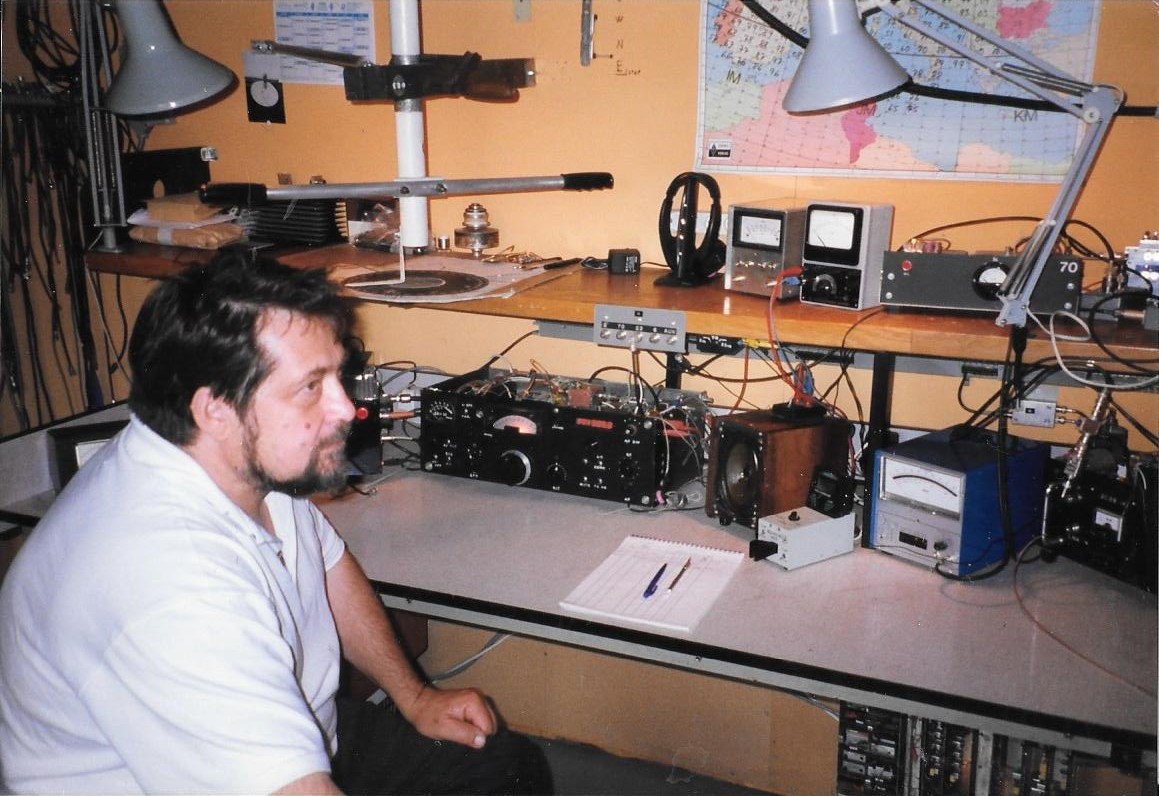 OZ6OL Hans
Hans passed away peacefully on October 3, 2026 at the age of 82.
Hans was a pioneer in amateur radio—not only in Denmark, but on the global stage as well. His first recorded mention appears in QST in 1967, which describes experiments he and OZ9OR conducted using rhombic antennas for EME (Earth-Moon-Earth) communication.
In 1975, OZ6OL became the first person to complete an EME QSO on 144 MHz from OZ, making contact with W6PO using an array of four 14-element antennas and a pair of 4CX250s. His interest in EME persisted throughout the years, and upon moving from Farendløse to Stevns, he began pursuing EME in earnest on the higher frequency bands with dishes from 3 m to 8 m.
OZ6OL was a gifted engineer and technician. Hans built his own stations, power amplifiers, antennas, antenna control systems, and much more. Not only did his equipment work, but it was often among the best that the available components and technology allowed for.
Throughout the 1970s, OZ6OL held the number one spot on the locator leaderboards for both 144 MHz and 1296 MHz. He is credited with no fewer than 24 “first” contacts from Denmark across the spectrum from 50 MHz to 3.4 GHz. He achieved the first-ever QSOs to the USA not only on 144 MHz, but also on 50 MHz and 3.4 GHz. What is most impressive is not merely the number of these “firsts” but the fact that Hans was frequently the very first to become active on new bands, whether following the issuance of new operating licenses or, more commonly, as soon as technology and components made it possible to construct equipment for them.
Many of us have learned from OZ6OL, not only from his technical expertise but also from his extensive experience with operating techniques. OZ6OL was and remains held in high regard. His achievements and dedication helped shape the very best of amateur radio, both within Denmark and beyond. He was a mentor to many, always ready with advice and assistance. His door was always open, and many amateurs visited Hans with a “project” they couldn’t get to work. Problems that others had spent weeks or months struggling with, Hans would often solve in the time it took to chat over a cup of coffee.
OZ6OL is no longer with us, and he will be missed by many. The bands will be a little quieter now. His legacy and his contributions to the worlds of technology, science, and amateur radio will endure for a long time to come. The first EME (Earth-Moon-Earth) signals sent by OZ6OL are still traveling through space and will be among the first to reach the stars—fittingly, in the true spirit of the man himself.
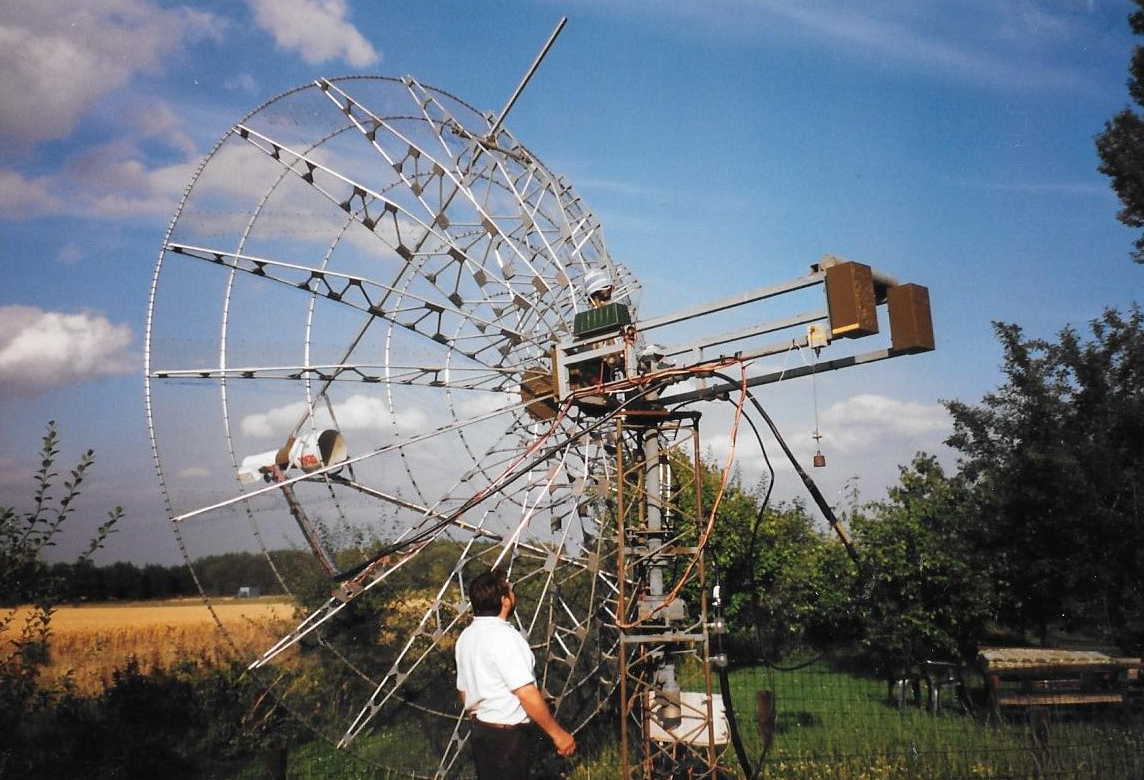 OZ6OL Antenna
BV3CE Tom
Here is an update of my EME activities on 23 cm and 13 cm.
23 cm band
In March 2026 I installed a new 23 cm antenna, a 1.8 m mesh dish with OK1DFC CP feed (older version) and with a 240 mm flare. It really helped to increase the number of EME QSOs compared with my previous 4x30 Yagi array. After I had made ~70 QSOs I found that my TX power (80 W @feed) was the limitation to making more initial QSOs. Even though I replaced the main section of TX cable (12 m length) with 7/8" feedline, it did not make a big improvement, (~90W @feed).
It was time to build a new PA with more power, targeting 4-500 W. I used PCBs that I had on hand, which were built many years ago for my XRF286 PA, but this time the FET would be MRFE6S9160. After looking at other ham's 23 cm PAs using the MRFE6S9160, it took me ~3 months to finish the job. With 4 pcs of MRFE6S9160 on 2 copper decks and with 8 W input, it could output 400 W of power. To simplify the design, I didn't put in a PA driver stage, and it is only driven from IC9700 directly. Considering the little loss from the LPF and power detection circuitry, it still could be enough to get 400 W at the PA chassis N-connector with 10 W input.
Besides the new PA, I also replaced the metal struts with fiberglass, and a light weight OK1DFC feed, 200 mm flare and new holder. With the above changes, I could get my Echo at -18 ~ -20 dB @1.4 dB path loss, and the Sun/CS noise ratio is ~8 dB @SFU 97.6. I am using this setup for 23 cm EME QSOs.
13 cm band
I have 2 pcs of 1.2 m foldable mesh dishes (spacing 5 mm), and wish to use them on 13 cm EME someday.
I started from building the 13 cm EME RX, and for the LNA build I used the PCB on hand (my existing 23 cm LNA) for the first step. The RFIC chip I chose was GRF2074, with very low NF, 0.14 dB at 2.3 GHz from the data sheet. With my simulation I could only get 0.4 dB NF / 19 dB gain on a single stage LNA when considering reasonable S11 / and full band stability. Finally I built 2 pcs and measured~ 0.45 dB NF / ~17.5 dB Gain on both LNAs. The gain level looks a little low for the 13 cm band, and I may use 2 pcs to get higher gain to reduce 2nd stage NF contribution.
As it is wideband LNA I need a SAW filter to limit the noise power and out-band signals getting into the receiver. Considering the different 13 cm frequency ranges, I bought 3 different SAW filter chips, a TA0803A, TA0843A and EPCOS 1533 from a Chinese web site. Their operating frequencies were 2313.5 +/- 15 MHz, 2330 +/- 30 MHz, 2350 +/- 50 MHz, respectively. Their dimensions are all 3x3 mm, and the PCB for this size of SAW filter was off-the-shelf and easy to get. With some return loss tuning I built 3 pcs SAW filter modules (one for each). I prefer the TA0803A as its narrower Freq. range, but 2400 MHz is not covered.
One other key part of the system, a Septum feedhorn, is under construction, and I guess it will take 1~2 months more before I can start to make sun noise checks. To be continued...
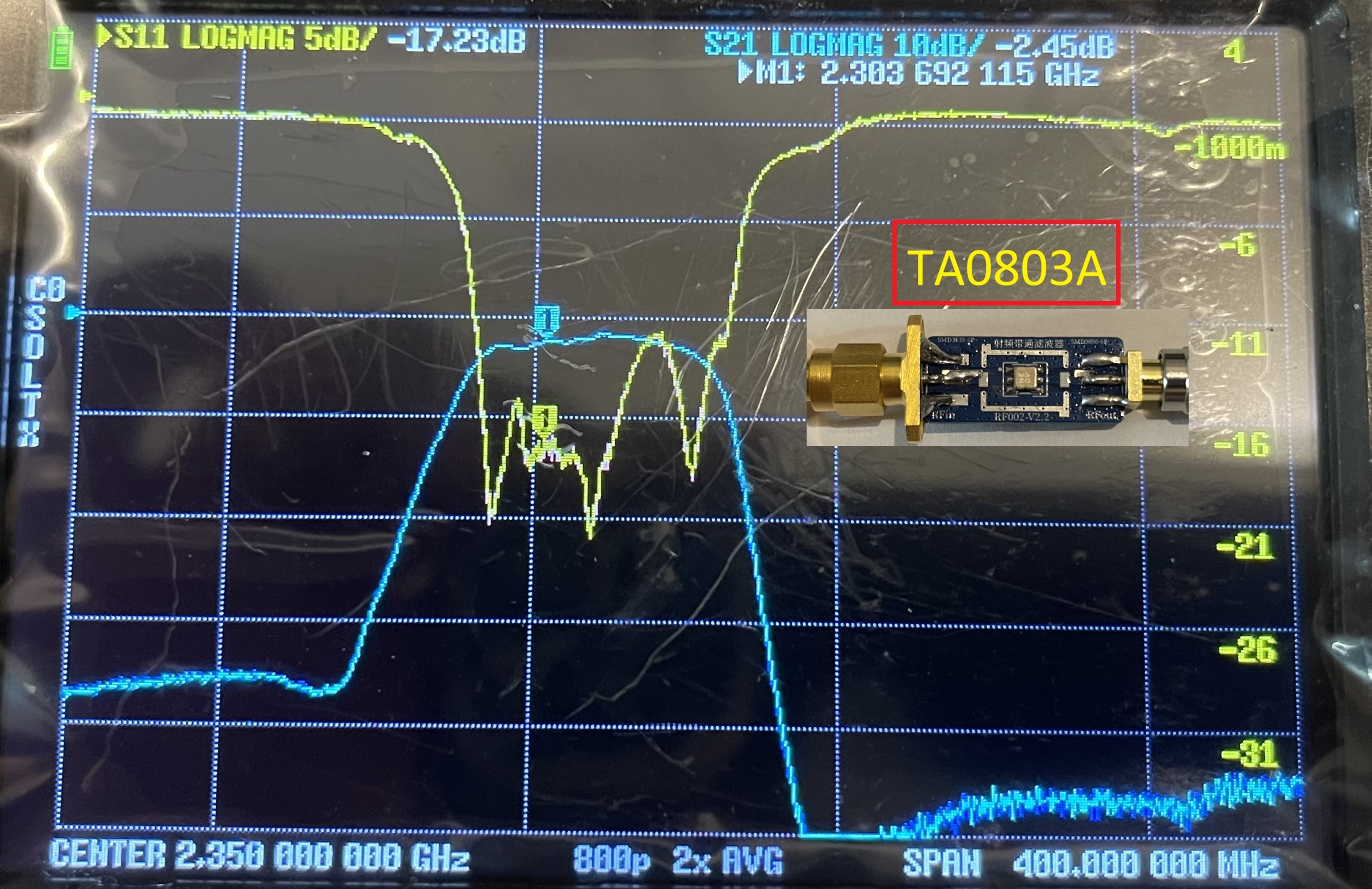 BV3CE SAW TA0803A Test Data
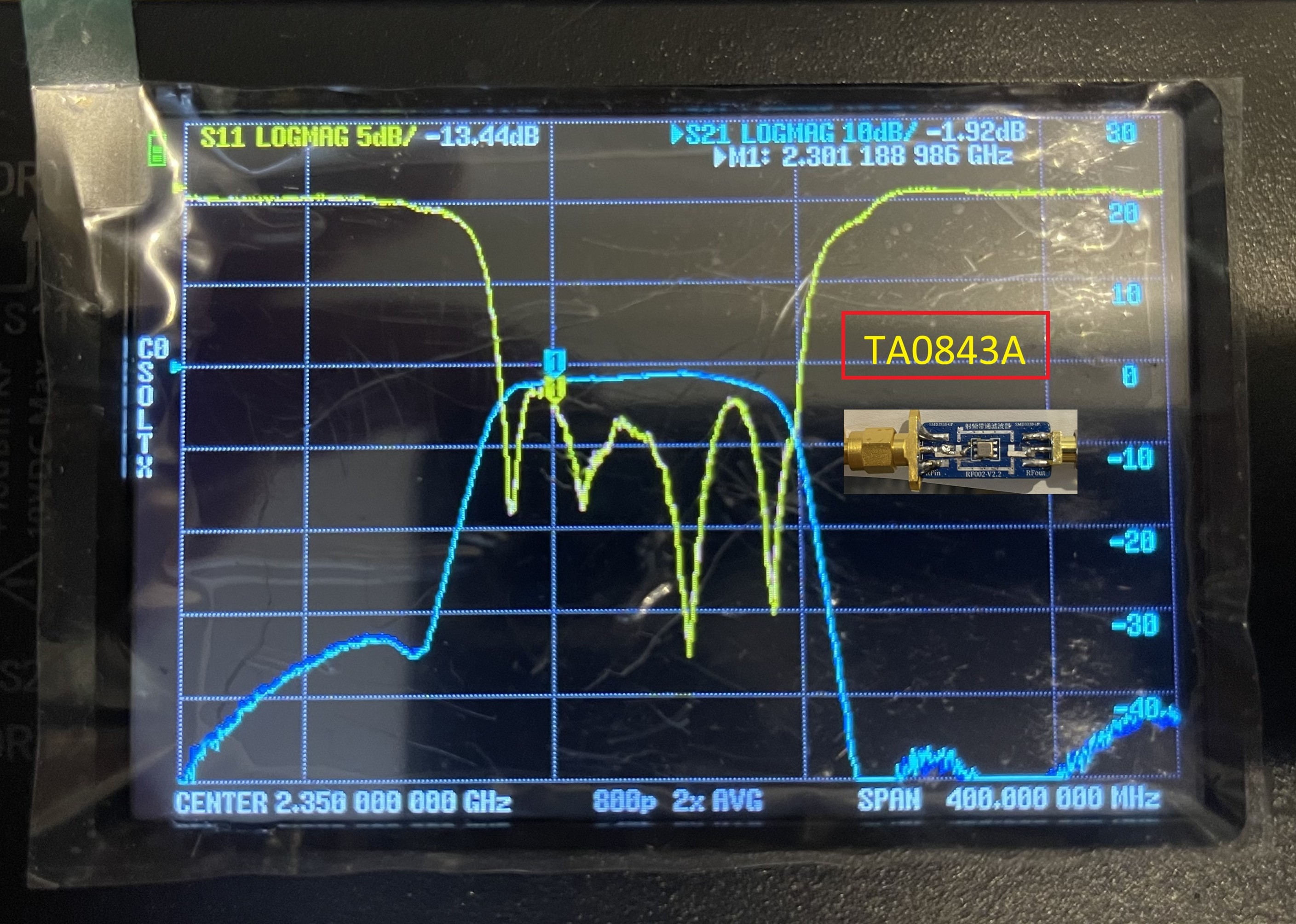 BV3CE SAW TA0843A Test Data
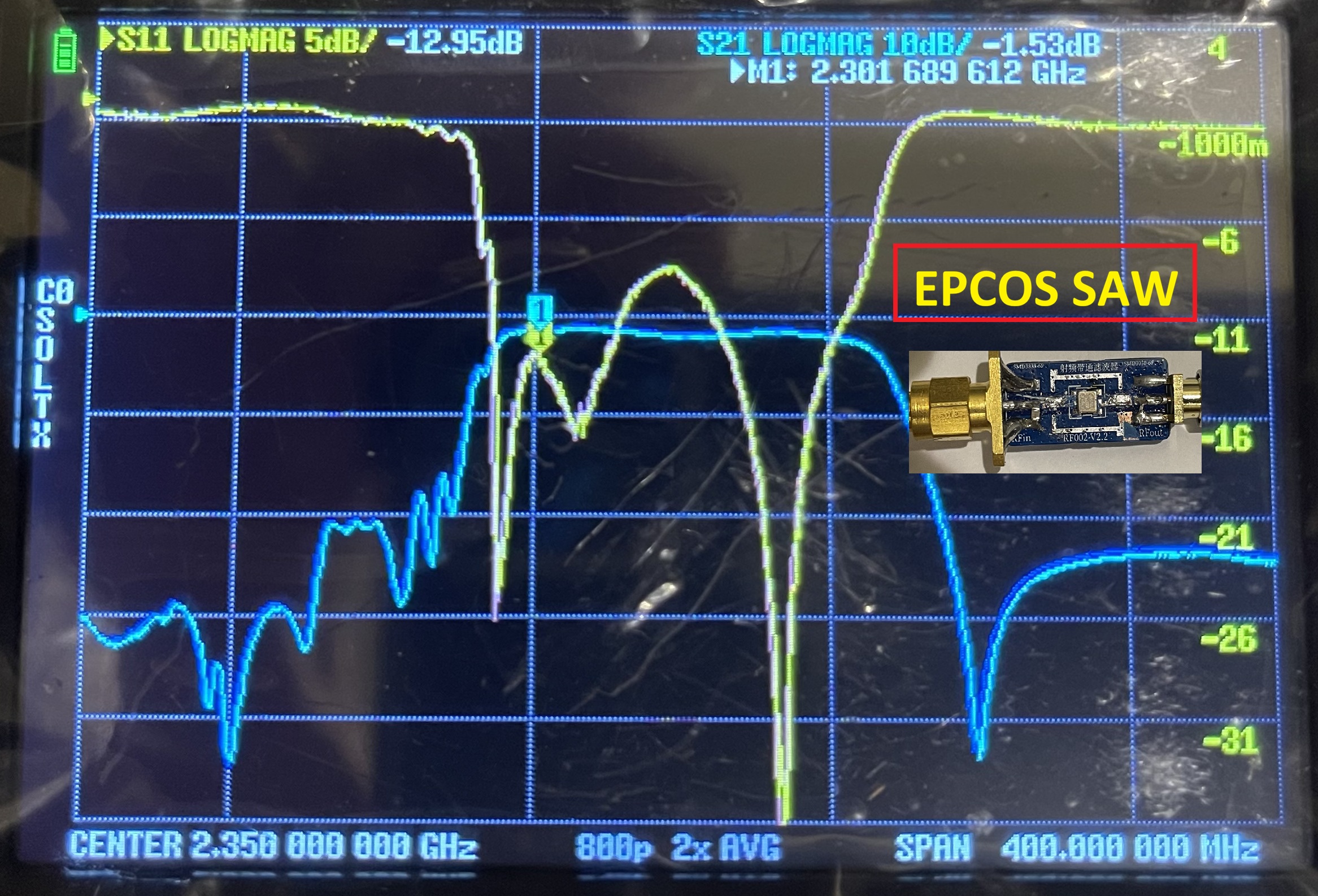 BV3CE SAW EPCOS 2350 MHz
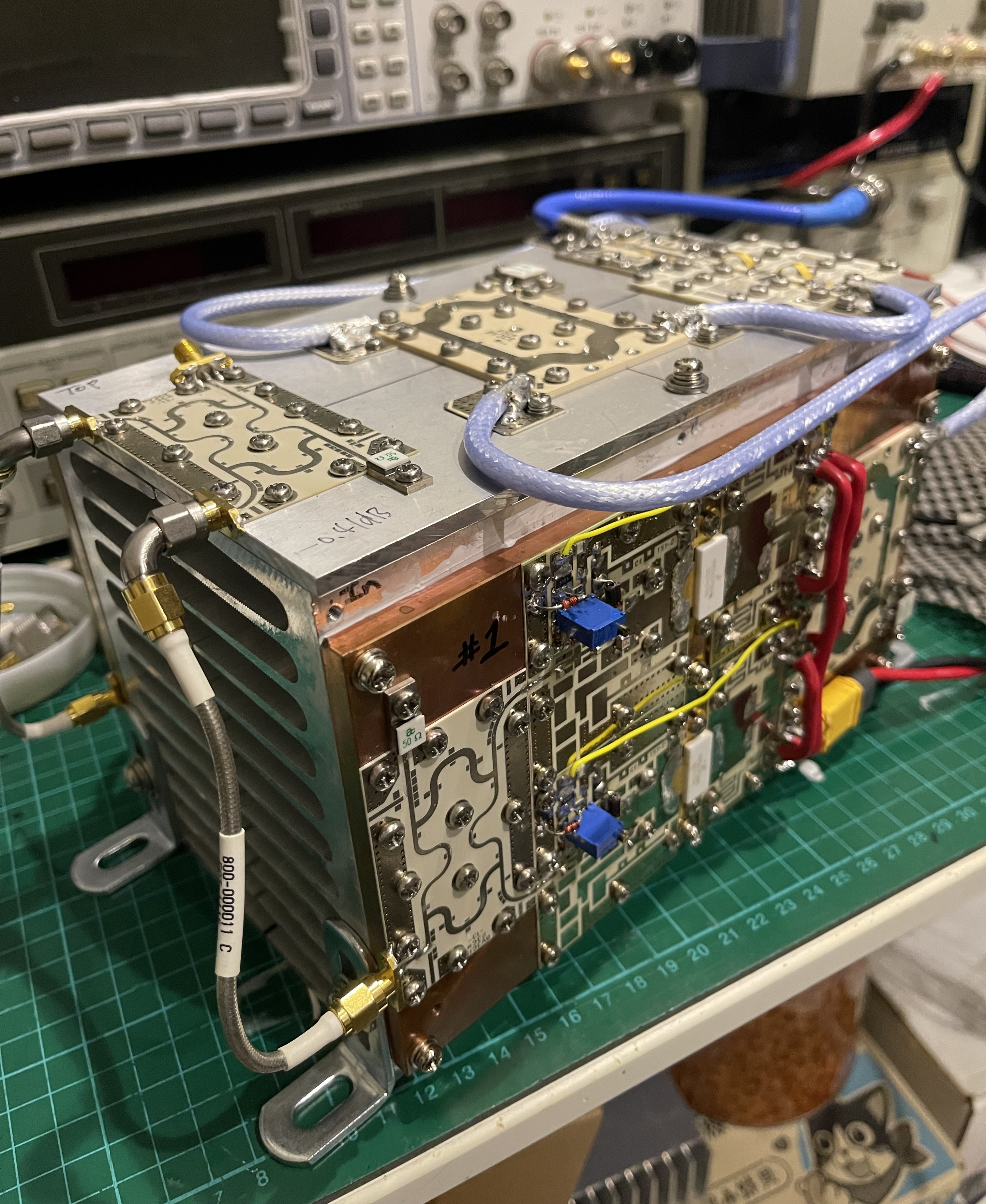 BV3CE PA RF module side view
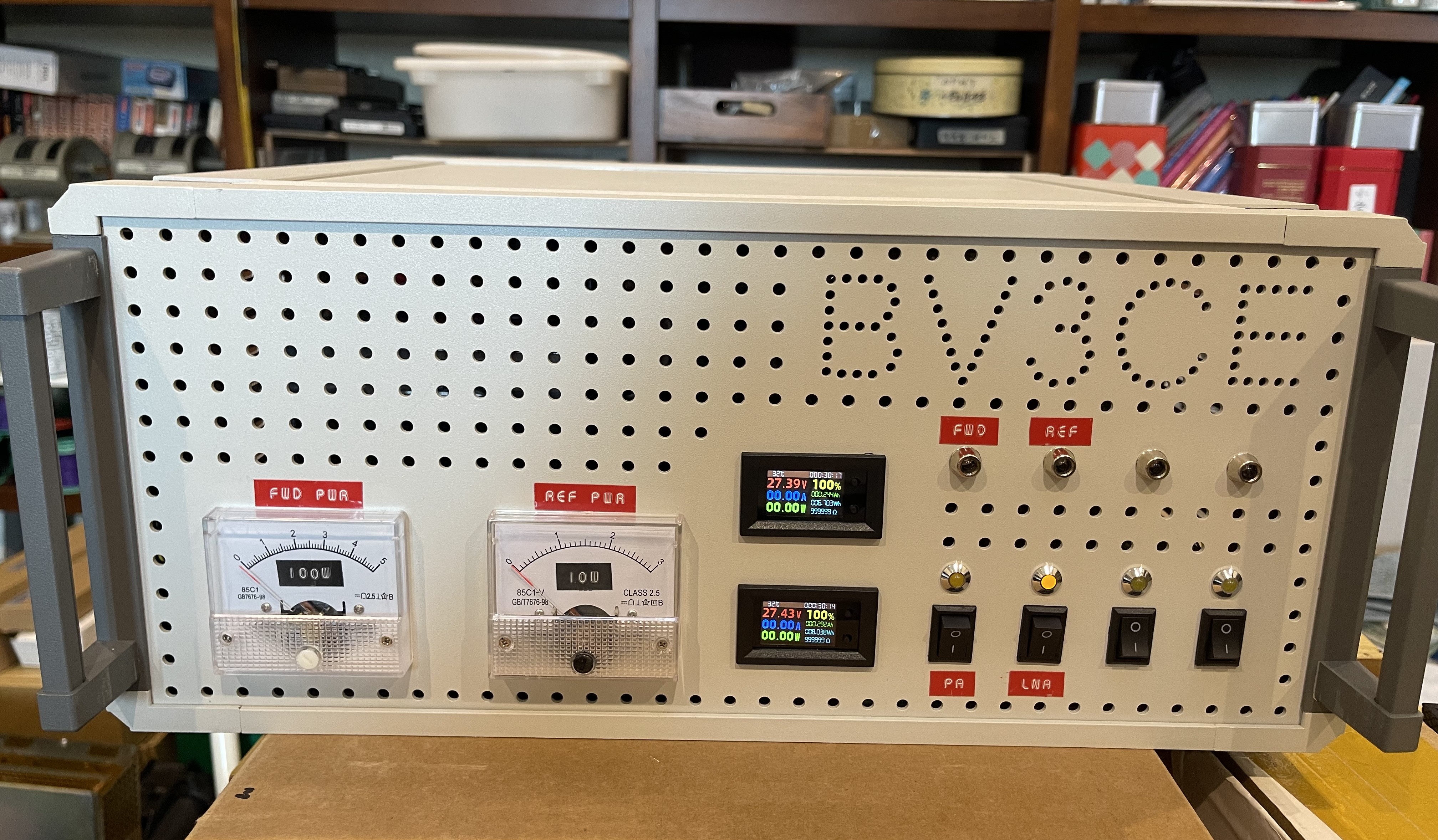 BV3CE PA front view
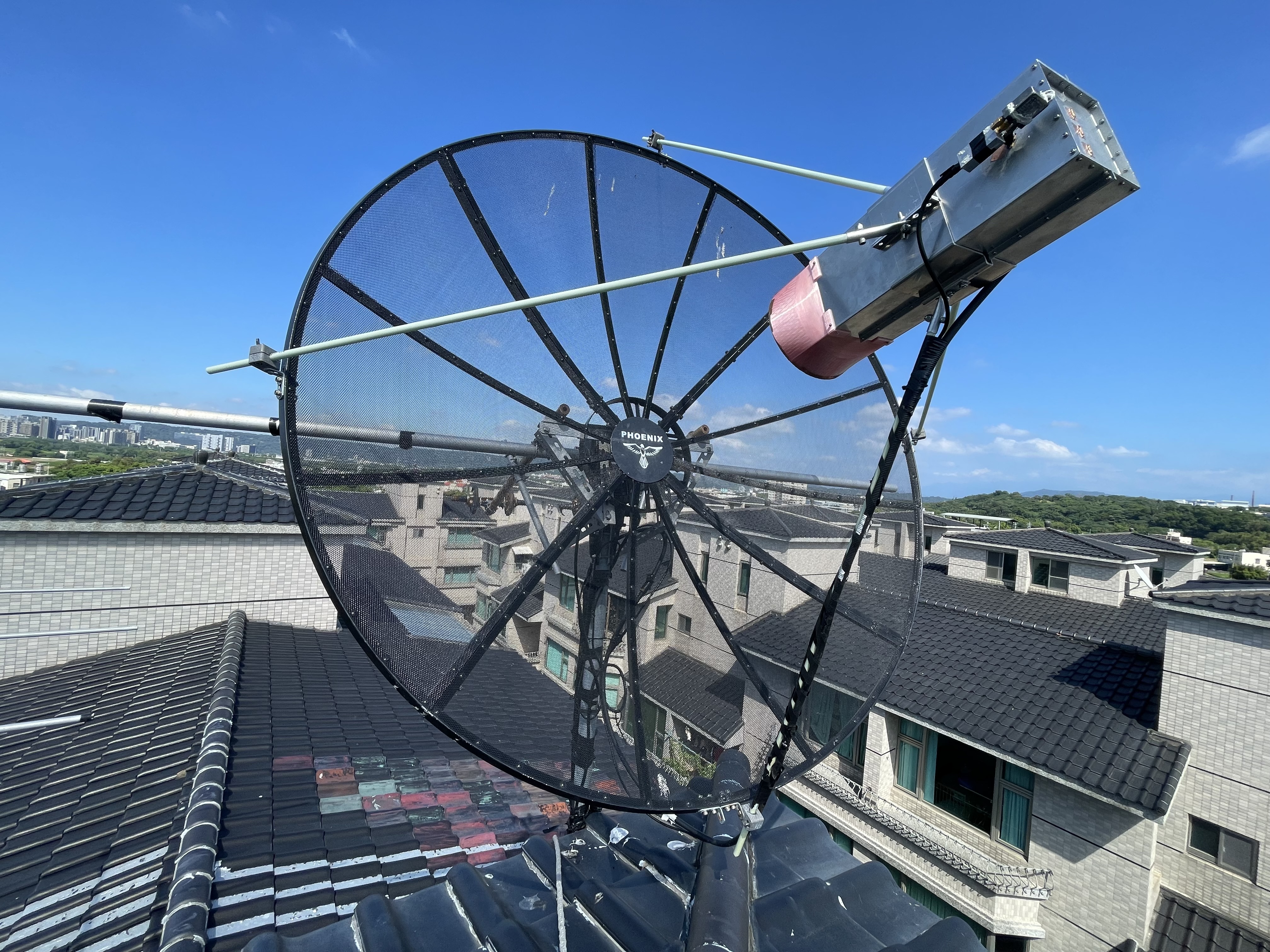 BV3CE 1.8 mmesh dish CP feed 200 mm flare
DL8EBL Olaf
I used the last weeks for some optimization work on my 10 GHz system. I changed from circular septum to a 3D printed vertical polarized Skobolev feed for my f/D 0.8 dish. I designed the horn to fit a WR75 flange. Mechanically it aligns to a photographic rail that I am using for focus adjustment.
Copper foil coating is a bit tricky but still seems to work nicely at 10 GHz. I am including 2 pictures:
1: 3D printed feed using copperfill filament. [Ed Note. Copperfill is a copper infused PLA filament used for 3D printing.]
2: 3D Printed feed with copper foil attached.
A comment on the Copperfill-filament: This is probably misleading. I wanted to try out the material - but it does not develop conductivity. Although it contains copper powder, it does not end in a conductive structure. So electrically it does not make much sense.
However I had the 3D-printed feeds, so I used them. It required the copper foil coating anyway.
Just for an experiment I plan to order a 3D metalprint of the horn, so I can probably compare the copper foil coated version against a full metal version in some weeks.
Having installed this copper foil feed, my best receive of DL0SHF was -5 dB SNR with the 2.4 m dish. The differences between vertical, horizontal and circular polarization are close to the theoretical values.
My operating window (limited sight to the moon) at the beginning of October was in the early UTC hours. So all but one contact has been with European stations. I was able to work the following calls in the past few weeks: IK6CAK, DF5MO, AC0RA, OH3LWP, LZ4OC, IZ4BFA, IT9EQO, DJ7FJ, ON5TA, G4HSK, and DJ7FJ.
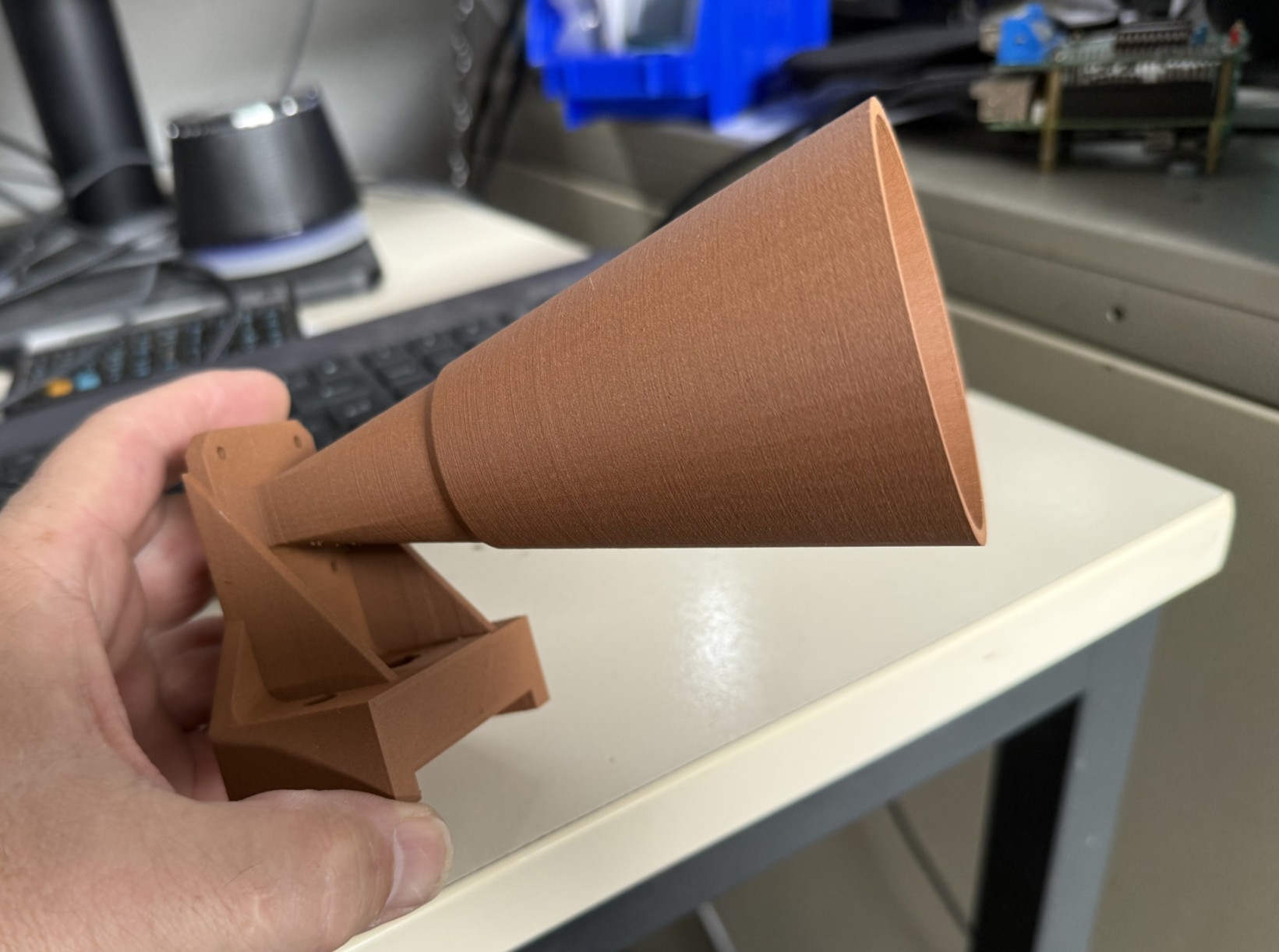 DL8EBL Copperfoill 3D Printed Feed
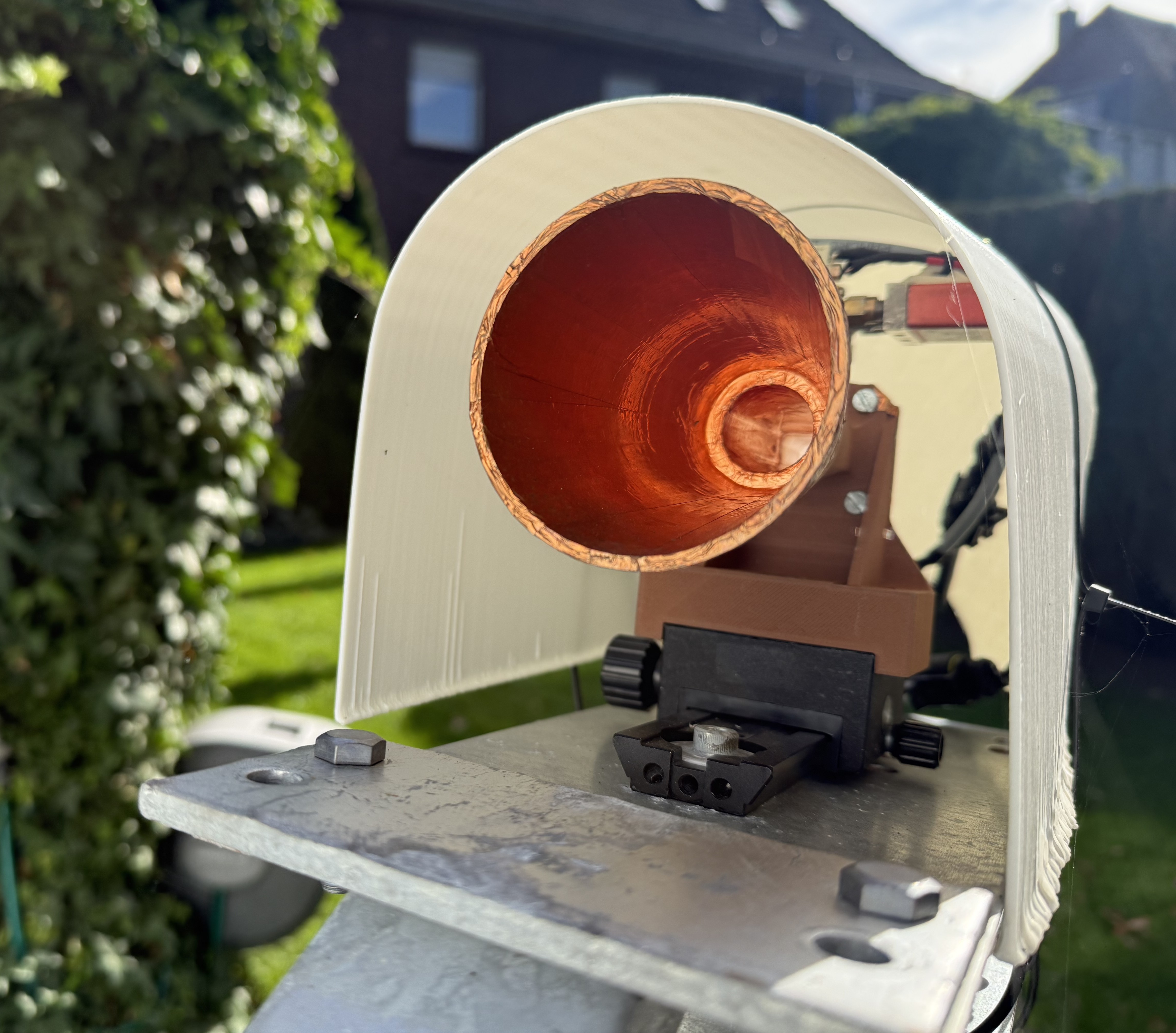 DB8EBL Copper Foil Feed
G3YEG Nic
I mentioned in my last update that I had not managed to go through all my saved files from my reception of the C37EME expedition. Well now I have had a close look at just over 2800 files (over 3 Gbytes of data) and discovered another 3 new station decodes. On the 7th August I found PA0BAT at -31 dB, on 9th August DL4DTU at -25 dB and UX0FF at -32 dB. On the 6th September I managed another new decode, using the 9 element set horizontal - PA3DRK at best of -25 dB. Having tried a few times over the past weeks to decode LA0GE without success, on the 4th October I set the 9 element vertical and had an easy decode at best of -25 dB. This now brings my total of station decodes up to 64 and QSOs 105.
At the beginning of September I repositioned my 15 element antenna pointing at a low elevation to the west to see if I could find some stations from the USA. This has never been a very successful direction for me but I quickly discovered that I had gone completely deaf, not even decoding Dan HB9Q so something was clearly amiss. A quick climb up into the attic soon revealed that disturbing the coax feed into the LNA resulted in clicking noises from the changeover relay. The LNA is powered up the coax so this was clearly intermittent.
To my surprise the LNA coax input N type compression nut wasn't even finger tight. Tightening the compression nut had very little resistance and I suspect tthat the very high temperatures this summer have resulted in the internal rubber "O ring" perishing. A couple of test QSOs with NC1I using the 9 element in its usual position established that all is well again but I will probably have to remake the connection with a new N type sometime soon. Not the easiest of jobs in the attic but I do have power available for the soldering iron.
However I have been using the 7 metres of Westflex 103 coax run for more than 25 years and think it is probably time it was replaced with something more up to date. Having looked at what is available (and practical) I will shortly be ordering a professionally made up 7 m length of LMR-600 Ultra Flex. Looking at the losses this should save me about .25 dB on the run to the LNA from my IC9700. I also considered replacing the 1 m length from the LNA to the antenna but the difference in loss is minimal and that coax doesn’t get disturbed very much when I occasionally re-position the antenna.
G4KLX Jonathon
After a gap of just over a year I have returned to 23 cm EME, and had my first QSOs off the moon on the weekend of 25-27 September, and just for good measure they were both initials and new DXCCs.
The new amplifier is a water cooled pallet from Hans PE1CKK which I bought at the Martlesham Microwave Round Table back in April. I rebuilt my EME system with a number of enhancements that I should have done previously to improve the ergonomics of the system. Building a new PA and rebuilding the power supply was a good excuse for other changes.
The water cooled amplifier is a joy to use, and relatively quiet compared to the amplifier I had previously. There is still fan noise from the power supply and from a small fan which cools the component side of the pallet, but it doesn’t sound like a fighter jet taking off like my previous one did. It also gives more power too.
The rest of the system remains the same with a 2.4 m dish that dominates the garden and a WD5AGO pre-amplifier. The radio is an IC-905.
The stations I worked were GW4ZHI (#192) and HG80BAY (#193), the latter being a special event station operated by HG5BMU.
I also have a W6PQL pallet for 23 cm which I will build up into an air cooled amplifier in the near future.
I hope to be active again later in October, but the two legs of the ARRL contest coincide with the times when I have TVI issues so I may have to sit it out (again) this year, which is a shame. The weekend of the 23rd to 25th of October (before the ARRL contest) looks good for operating though.
An enhancement that I am looking into is to run the complete EME system on a mini-PC and control it remotely within the same house from my laptop, this way I can avoid the temperature and light issues in my normal operating position which reduces the enjoyment of EME for me sometimes. I wonder what software people use to make this happen? There seems to be quite a choice, so personal recommendations would be welcome.
IZ0JNY Ivan
Jan PA0PLY and I are organizing a 24 GHz EME Party on 19–20 December 2026.
There are quite a few new stations becoming active on this very interesting band, so we thought it would be nice to create a bit more activity and have some fun together.
I have also created a Telegram group for 24 GHz EME skeds, not only for this weekend but for future activity as well.
Everyone QRV on 24 GHz is very welcome to join: https://t.me/+oLjmTGHp7Ps1MGFk
During any activity, the HB9Q logger remains the preferred place for real-time coordination.
Save the date, and I hope to see many of you on 24 GHz!
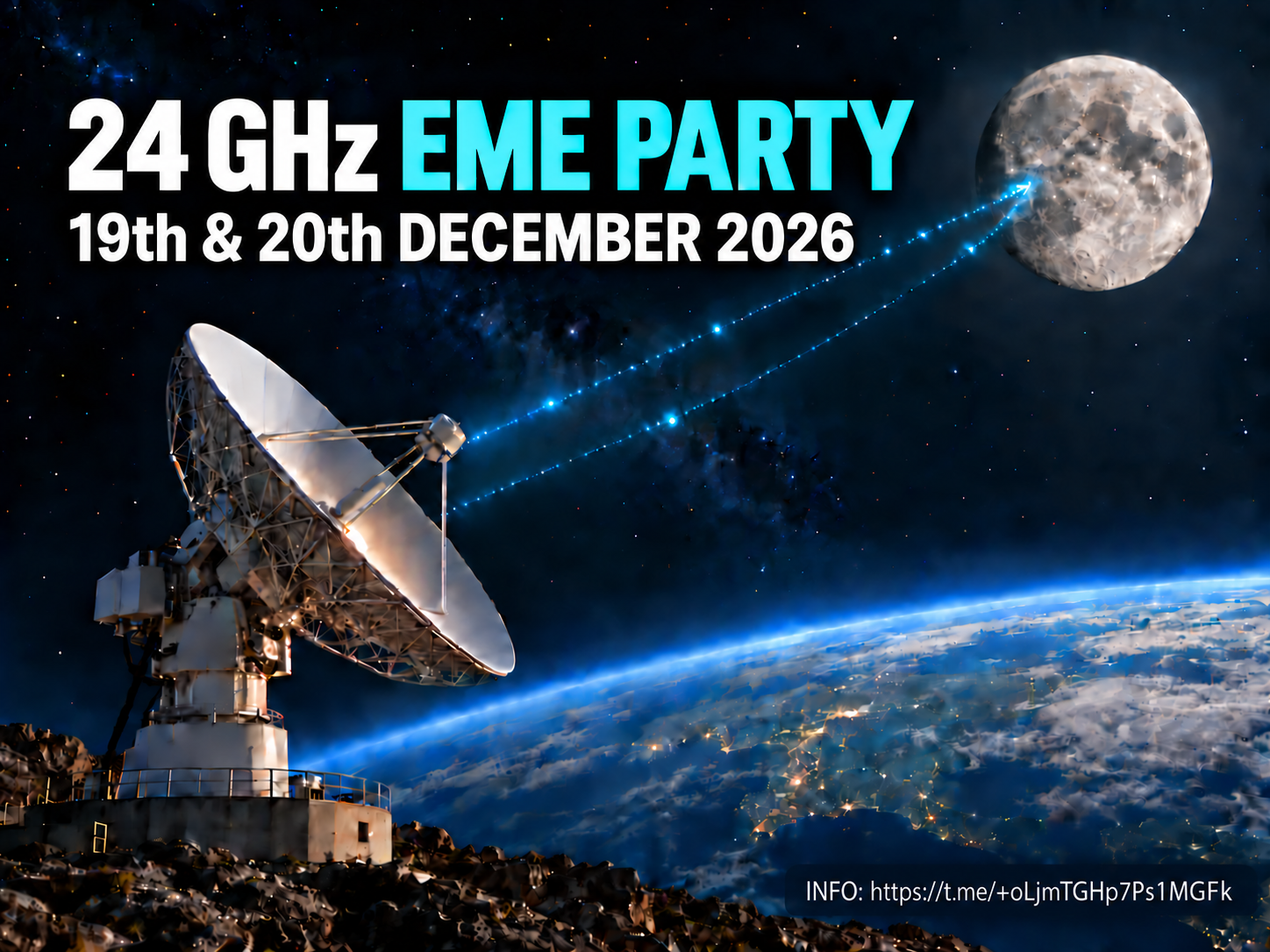 IZ0JNY 24 GHz EME Party Flyer
I have finally had the chance to get to grips with the new 2.4 m dish, rotator and tracking system. I also adapted my 10, 24 and 47 GHz equipment mechanically to install them on the new dish arm and begin testing its performance. After making some adjustments to improve the dish’s convergence, here are my first results.
At 10 GHz, I measured a maximum sun noise of almost 16.7 dB and nearly 2.5 dB of moon noise. With almost 6 W of output power — I am currently using this power level because my previous 25 W SSPA failed — I completed six QSOs, all very smoothly in the first hour of tests. I would say that on 10 GHz the performances are really satisfactory.
I then tested the 24 GHz system and measured 15.1 dB of sun noise. I have not yet had the chance to measure moon noise, as most of my time has gone into building up the new setup, but I hope to do that soon. Performances are good.
With my previous 120 cm dish, I had divided the equipment into separate sections to keep the weight at the dish’s focus manageable. For the new dish, I have built a single frame mounted on an aluminum plate. This has allowed me to connect the TWT directly to the waveguide switch using a 40 mm WR42 twist section. Previously, the connection used a 500 mm flexible WR42 waveguide. The change has brought a clear improvement: I now have approximately 18 W of clean power at the feed input, compared with about 14 W before.
I expect to be QRV on 24 GHz again before the end of the month. It is a band I particularly enjoy and one that has given me many rewarding contacts. I plan to refine the system in preparation for the 24 GHz EME Party on 19–20 December.
I also carried out some tests on 47 GHz and measured 11 dB of sun noise. I do not have transmitter power on this band yet, but I am building an SSPA. The sun noise result leaves room for improvement, particularly in the dish convergence. I am working on a new steel support frame for the dish, which I hope will help improve it further.
As usual, more info on https://www.iz0jny.it
KB7Q Gene
This was the month of debugging my remote setup for the 23 cm EME station.
It turns out that the new mini-computer I dedicated to running the station had serious audio chain problems. Amazon was kind enough to ship out a replacement.
In the meantime I finally figured out my intermittent PTT issue that was eating pre-amps. I found corroded pins on a supposedly waterproof connector, the source of so much grief. I cut that bad boy out and hardwired the cable. The remaining connectors at the dish looked good, but I gave them a bath in DeOxit Gold anyhow.
I'm looking forward to the ARRL EME contest. Can a 1.5 m dish station break 100 contacts on 23 cm? The suspense builds😀. [Ed Note: I am fully convinced that Gene will be able to accomplish this!]
N0AKC Charlie
I ran into some issues with the 13 cm station in August and was not able to be active for that weekend of the EME contest, but I was able to get on for the September weekend and I worked 10 stations.
I plan to be active for both 50 - 1296 contest weekends. I'll be active on 144, 222, 432 and 1296 in October. During the November 28/29th weekend my plan is to swap out the 23 cm feed for the 33 cm feed on the last moon pass.
However, if the weather forecast for the 2nd weekend is not favourable I would probably consider putting the 33 cm feed in for the whole second weekend.
I look forward to working many of you during the contest.
OH3LWP Ari
I had not booked much time for EME during this moon pass as there was no contest or DXpedition activity. I still managed to log a few new initial QSOs.
New inits worked in 22/9/2026 to 19/10/2026 time window are as below (digital if not marked CW):
New 23 cm inits:
22/09/2026 VK7ZBX
03/10/2026 ZS6CCY CW, SQ7D
07/10/2026 ON/PA0MHE
New 13 cm inits:
03/10/2026 PA3JRK
New 3 cm inits:
04/10/2026 DL8EBL
OK1DFC Zdenek
The 34th EME and Microwave Seminar took place from October 16 to 18 at the Balónový Hotel in Radešín. Most of the seminar participants arrived in Radešín as early as Friday afternoon, and discussions continued late into the evening.
On Saturday, Zdeněk OK1DFC opened the seminar and, in his opening remarks, presented the trophies for the 2025 National VHF Championship. The winners were Jirka OK1DCI in the Single category and the OK2C team in the Multi category. OK1CA and OK2IMH then paid tribute to friends who had recently passed away. They were Pavel OK1AIY, Honza OK1MAC, Pepa OK1UWA, Ruda OK2ZZ, and Pavel OK2VJC.
Zdeněk OK1DFC then reported on the meeting of the VHF Commission of IARU Region I regarding the decisions adopted by Working Group C5. These mainly concerned the recommendation to begin using the 1299 MHz frequency and higher in the 23 cm band starting January 1, 2027, to minimize the potential for interference to the Galileo system and to allow the use of the recommended 500 W power level for EME. Another item on the agenda was the approval of self-spotting in 10-minute intervals on DX clusters in terrestrial contests, similar to the practice on ON4KST. Details will be published in the IARU Handbook in the coming days.
OK1CA then summarized other interesting developments and activities in the EME community over the past year. Vláďa OK1DAK from the OK1KIR club station gave an interesting presentation with many images related to the first EME contact in OK on 432 MHz, which took place 50 years ago. He supplemented his talk with a series of period photographs and videos and, on the occasion of the 70th anniversary of the founding of the OK1KIR club. He also discussed the current status of their EME activities.
In the next presentation, Mirek OK2AQ introduced the audience to his experiments measuring neutral hydrogen using an EME antenna. Even with a small antenna (180 cm offset) and a 23 cm band feedhorn, high-quality measurements can be made at 1420 MHz. It’s a small step into the world of radio astronomy.
The morning session of presentations was then concluded by Zdeněk OK1DFC with a talk on “The Use of Offset Parabolic Antennas and Their Optimization for Microwave Bands” and discussed this specifically as it applied to his 2.4 m offset dish used on EME. This has recently been an interesting topic related to EME activity on the 47 GHz and 76 GHz bands.
After lunch, the traditional group photo session took place, organized by Milan OK2IMH. The afternoon session of presentations began with Zdeněk OK1DFC sharing information about the first EME contact in the OK region on the 47 GHz band between OK1DFC and DC7KY, and the world’s first contact on the 76 GHz band between DL7YC and RW3BP.
Aleš OK1FPC then spoke about his microwave-band equipment, which he supplies as commercial products, thereby gradually filling the gap in microwave equipment.
Michal OM3TRN gave a very interesting presentation on his EME system for the 144 MHz and 432 MHz bands.
To conclude the afternoon program, Zdeněk OK1DFC gave a practical demonstration of testing the quality of parabolic reflectors using a 3D scanner.
All presentations and further details will also be available on the OK VHF Club website at https://www.vhf.cz
This year’s EME and Microwave Seminar was attended by 58 radio amateurs from OK, OM, OE, and DL. Next year, the 35th anniversary of the EME and Microwave Seminar will once again take place at the Balloon Hotel in Radešín from September 10 to 12, 2027.
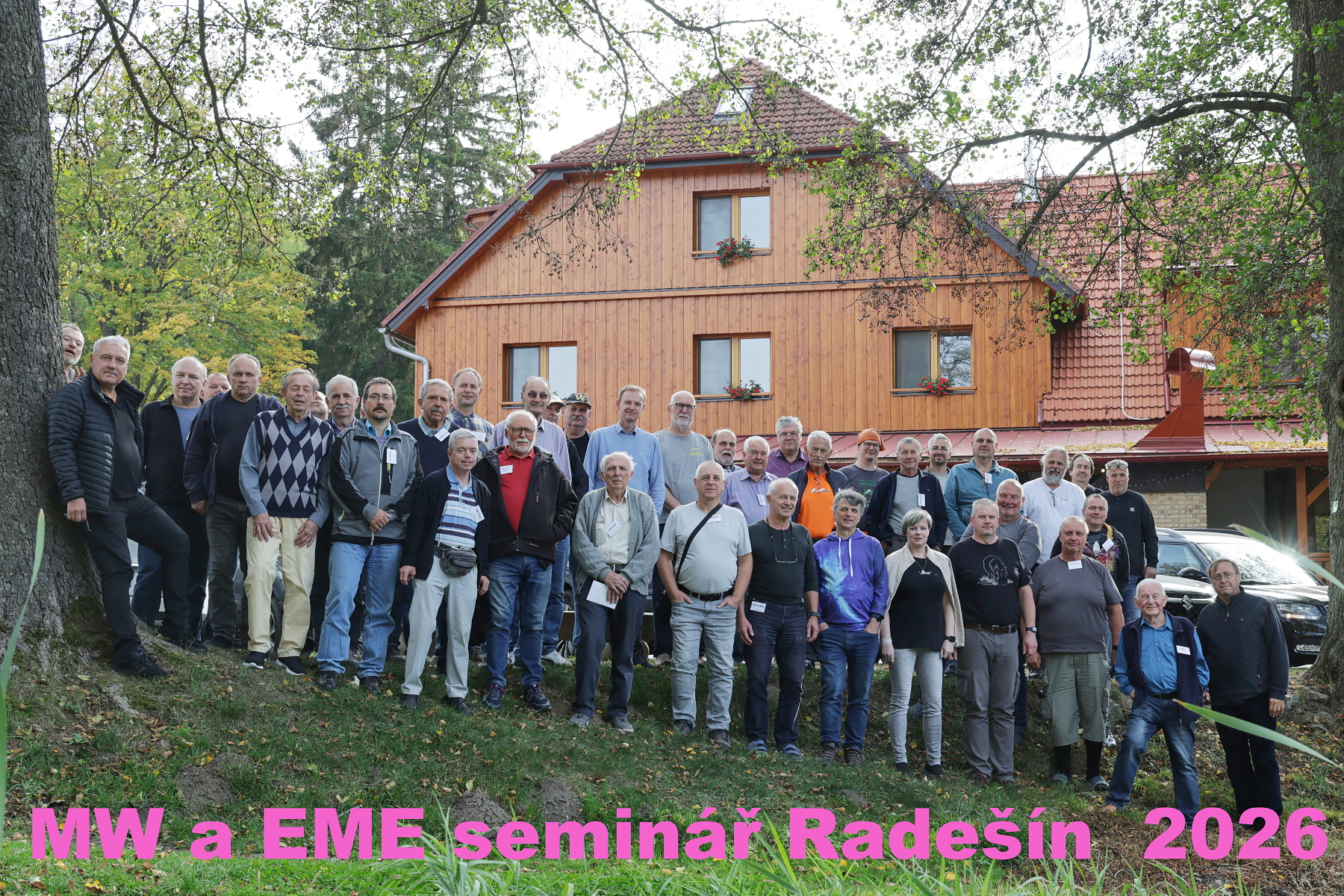 OK1DFC Group Photo 2026 Radesin EME and MW Conference
OK2AQ Mirek
At the end of September and beginning of October, I had a 23 cm antenna installed.
I made 41 QSO Q65 contacts with the initial callsigns EA5Y (-14, -21), SP2WRH (-23, -25), VK7ZBX (-19, -21), R4CX (-10, -16), Q65-120D DL8MAI (-22, -26), OK2CMZ (-24, -25), who was operating with a 1.8-meter reflector and 150 W, SQ7D (-16, -19), and W2LPL (-21, -22) from square FM29 as mixed #287.
Everything went smoothly during this beautiful Indian summer.
PA0PLY Jan
My Murphy Story all started in advance of the first leg of the ARRL 13 cm & up contest.
All of a sudden my VK5DJ dish controller showed a completely different moon location. Some investigation showed it must be in Australia. As a consequence I was not able to autotrack the moon during this contest. Luckily the activity was reasonable, so I had some time to keep an eye on the controller but it is annoying if you get used to automatic tracking.
I decided to skip the second moon pass and started to investigate this problem. All settings for the controller were ok, but I was still pointing to a false moon position. The VK5DJ controller uses a PIC18F4685 and I did have a spare one. So swapping the PICs might solve the problem, however this PIC did not show my antenna positions at all. After consulting John, VK5DJ, I burned another piece of software in this PIC, but I still had the same problem of no antenna position. I ordered a new PIC, programmed it and put this one in to solve the problem! Then I reprogrammed the original “Australian” PIC as well. That turned out to be working correctly now as well. But my spare PIC was damaged and cannot be used. One side benefit to this work was that John solved the PARK problem, which did not function in the earlier versions software.
So far so good and I was ready for the second leg of the ARRL contest. The activity on 13 cm was much lower, but my system did work at least in the morning at moonrise. I stopped for lunch and after 2 hours I entered the shack and restarted my activity. As the moon was in the west now I was looking to see if US based stations could be contacted. Although the signals in the morning were ok, I did not see anyone on the screen. Following conversations on the HB9Q logger which showed there must be activity, so something was wrong.
Echo testing showed no result as well. I quickly turned the dish to the sun, which was at about 180 deg AZ, the sun noise was as expected and the position was also correct. I turned on my beacon to check the frequency, which was also normal. Then I went back to the moon and looked for my echoes. Again no echoes and no stations were found. Maybe the position was wrong again? I swept the dish back and forward around the moon position but nothing. I kept on sweeping in AZ while moving the EL a bit. In this attempt the movements suddenly stopped. What the heck?
I opened up the box behind the dish and found the motor power supply was dead. Further investigation showed a short circuit in the AZ motor section. That was the end of another contest leg. It turned out that the CCW to CW switching using classical relays had developed a short circuit. All the relays have been in service over many years until now. Based on the problems with the VK5DJ controller I decided to start a project to make another controller as a spare.
I ordered the OE5JFL PCB and microchip from Walter ON4BCB and started to collect the parts. As this system uses H-bridges, I wanted to replace the burned AZ relays with an H-bridge system. As the H-bridge BTS7960 can handle some 40 Amp, it will fit in my situation, even with the VK5DJ controller. To slow down the speed I did use a PWM modulator already. Unfortunately this PWM modulator and the H-bridge in series did not work. After some search on the internet, it turned out that most cheaply PWM modulators modulate in the minus leg, which was not accepted by the H-bridge. So I selected another low voltage to PWM module and connected it to the PWM input of the H-bridge. This worked fine on the bench and I installed everything in the dish. To be sure I also replaced the DC power supply for the motors and I was back in full operation at least... tracking wise.
To be sure I did track a complete sun-cycle and guess what? In the afternoon, while the dish was still tracking I lost the sun! Does this sound familiar? Using the shadow in my dish I had to move my dish back to line up and find sun noise again. After some investigation I found that at AZ 238 deg, the antenna position indicator jumped to back 216 deg. Going back and forth it was found a quite accurate point where this glitch in position happens. I checked all the mechanical connections but nothing helped, so it must be the HH-12 encoder causing this.
As a temporary solution I moved this glitch point away from possible moon positions and ordered a replacement HH-12 encoder.
Hopefully Mr. Murphy is satisfied with the above work and I will be freed for some time with this kind of problem, hi! My fingers are crossed that I can join the 13 cm section of the 2nd leg of the ARI contest.
RE: XPA-40 10 GHz PA
The development of the 10 GHz SSPA is completed and we are in the 2nd phase of stress testing before we will start the first production run. The second stress test will be conducted by another HAM in Europe.
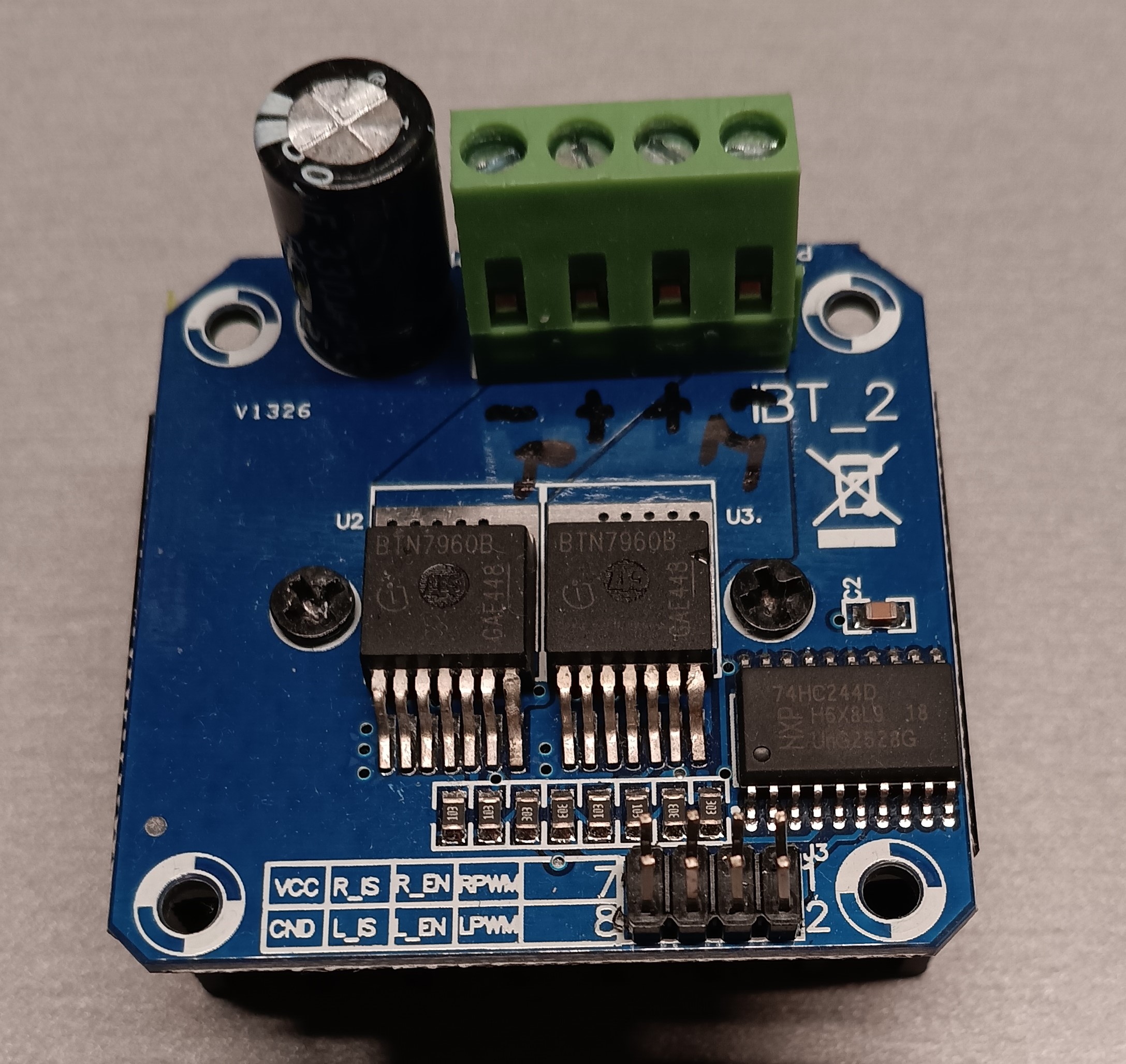 PA0PLY H bridge
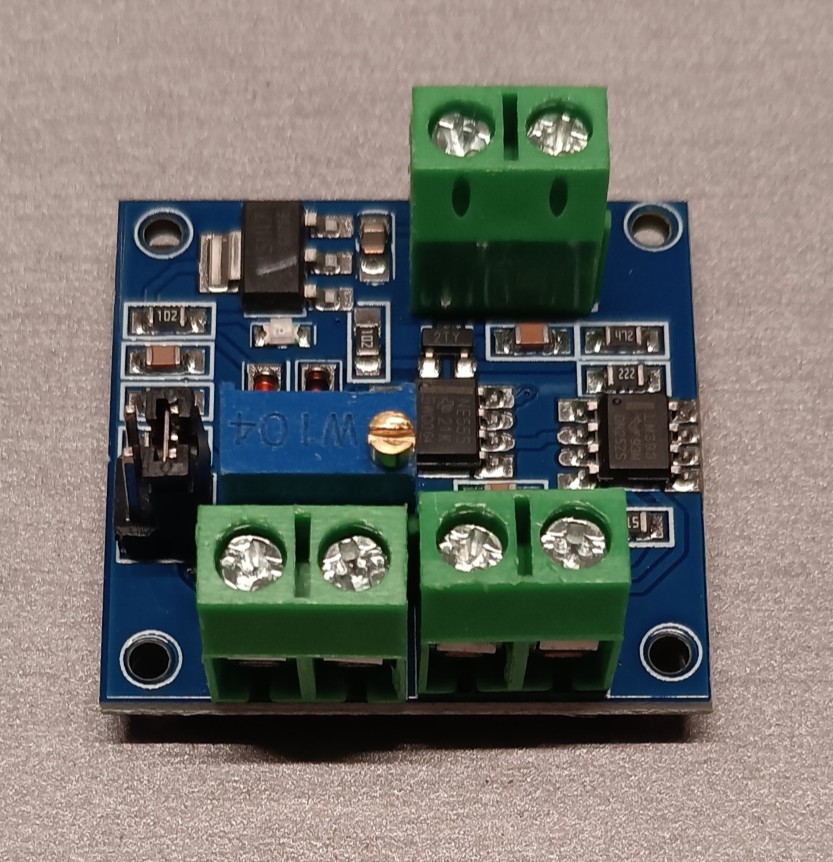 PA0PLY Voltage PWM modulator
PA3DZL Jac
I am very pleased with a very good number of initials on both 432 and 1296 MHz.
I was not very active because of the busy QRL at this moment. I will try to be QRV as much as possible during the upcoming contests on 50, 144, 432 and 1296 MHz.
432 MHz Wkd:
LAØGE # and HA2NP
1296 MHz Wkd:
OK1AQ, SP2HPD #. R1NW, PE1LWT, YU1DA, EA5Y #, G4ALH, IZ5TEP, F4BLE #, OE1ISB #, VK7ZBX #, VK4CDI, DG1WEH #, IZ4VSS, SP4XD, UA1ALD, SQ7D, DL6ZG, F5AOL, IK2DDR and W2LPL # Portable from FM29
PA3FXB Jan
I got a nasty case of bacterial Meningitis caused by Listeria. That’s pretty rare but very dangerous and potentially life threatening. I have been incredibly lucky because my wife, the ambulance personnel and the hospital did exactly the things that were needed and they were all incredibly fast. This could have ended in a very different way…
Anyway, I am very happy to be able to say I survived! And I fully realize that from now on I live in bonus time.
When I got home after 9 days in hospital the first thing I did was make my dish ready for EME. And after a few days I was happy to catch my 800th initial on 23 cm EME. Maarten ON/PA0MHE was the one who made this happen.
So, I am alive and kicking and back in business!
SP9VFD Raf
After more than a year of work, I’ve finally completed the second EME reflector built for 6 cm operation, but also usable on 3 cm, and for listening to the DSN at 8.4 GHz.
Several months ago, I transported a full aluminum 3 m Andrew parabolic reflector to my QTH. It originally served as a single element for a microwave radio link at an airport. The dish is about 3 meters in diameter, so bringing it home 450 km by trailer, was quite a logistical challenge.
Over the following months, I built a new mast and mounted the reflector on a rotating azimuth ring obtained from a small construction mini crane. The antenna drive in azimuth is implemented with a 3 phase AC motor controlled by an inverter, allowing smooth speed control over a wide range and ensuring the precision needed for accurate pointing. Elevation is driven by a SuperJack 24-inch heavy-duty linear actuator. Antenna position feedback is provided by two Briter absolute 15 bit encoders (BRT38), giving position resolution down to about 0.01°.
For this EME antenna, I also built a second controller based on the WinTrak module. I brought two of these WinTrak units back in 2024 at the EME conference in Trenton, NJ. Both controllers were assembled in 19” rack enclosures using Raspberry Pi 4 mini-computers, along with properly sized power supplies (5V/12V/24V). To make operation easier, there’s also an easy remote access option. I configured a VNC Server so I can share the Raspberry Pi desktop and control everything from anywhere.
Many thanks to Gary N8CQ for his great technical support and help getting this project up and running.
I’m now ready for EME CW/Q65 operation on 6 cm with approximately 40 W output power. I’m also preparing 3 cm work—at the moment the only missing piece is an SSPA. I’m currently on the waiting list for the XPA‑40 DU3T amplifier stage.
In late October and November, I will be active in the ARRL EME contests on 1296 MHz and 432 MHz, using Q65 and CW, 6.4 m dish and about 500 W at the feed. I hope to hear you in the ARRL EME contest!
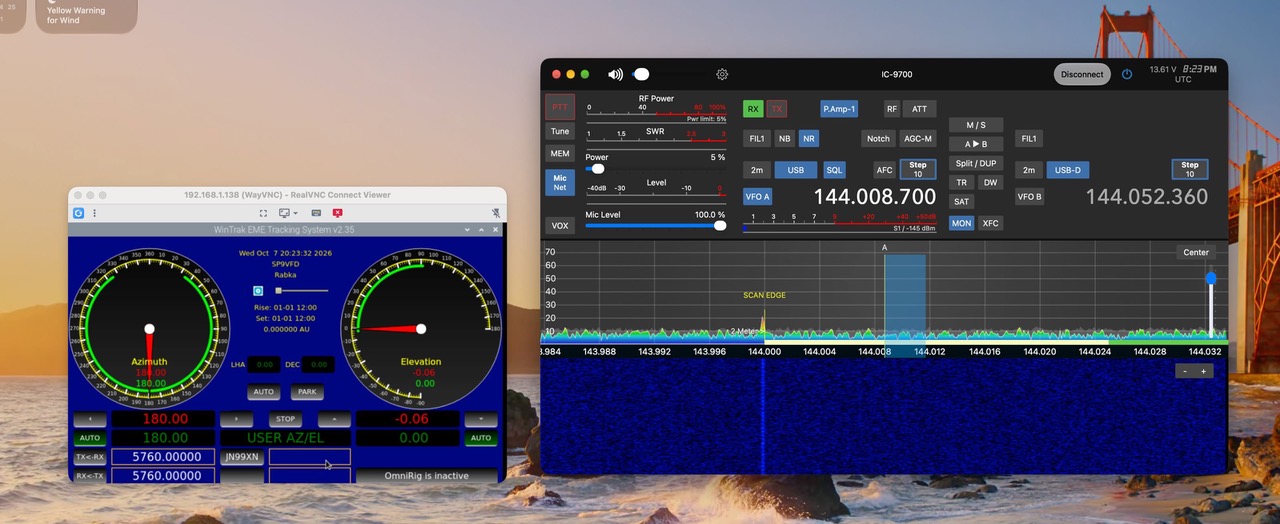 SP9VFD WinTrak and IC9700 Remote Display
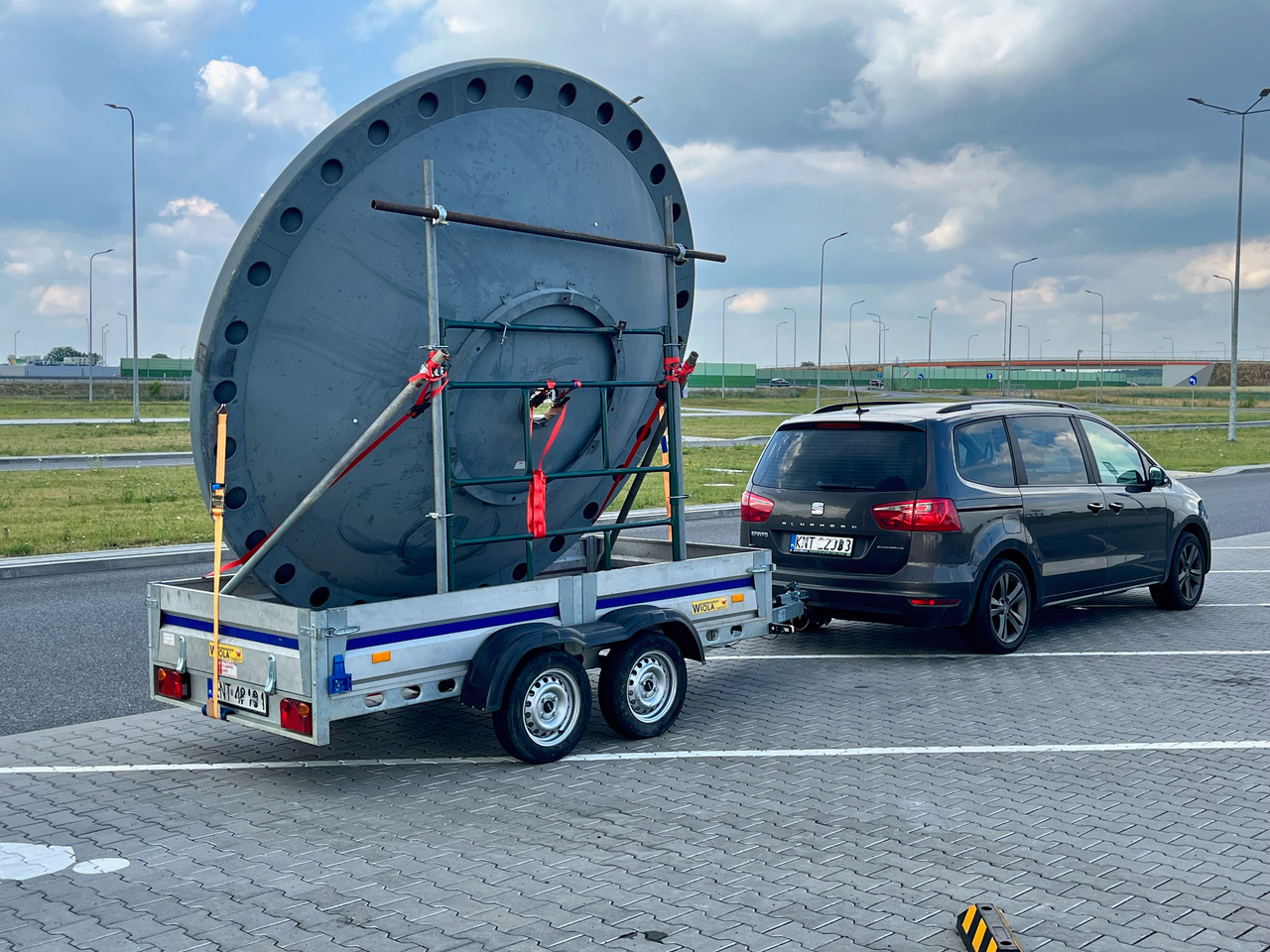 SP9VFD Transport of 3 m Dish on Trailer
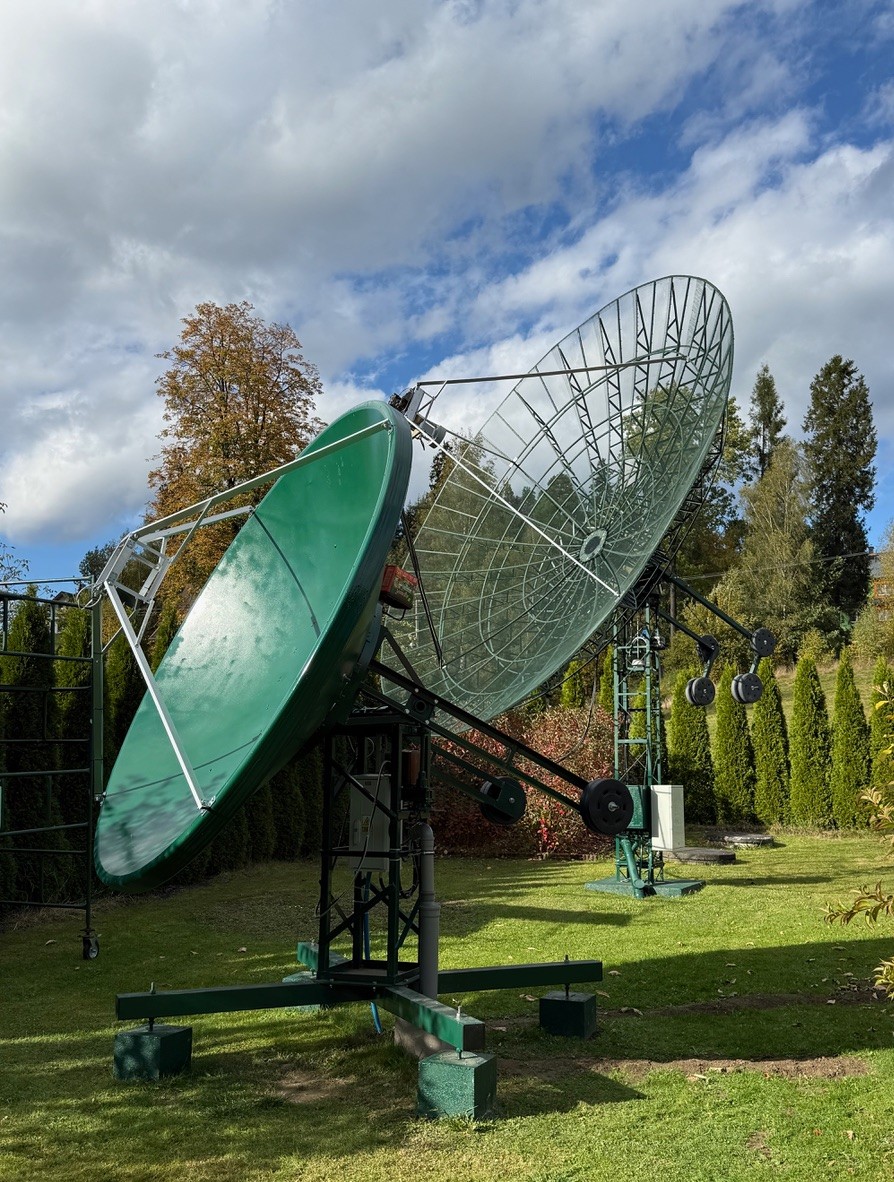 SP9VFD New 3 m Solid Dish and 6.4 m HB Dish
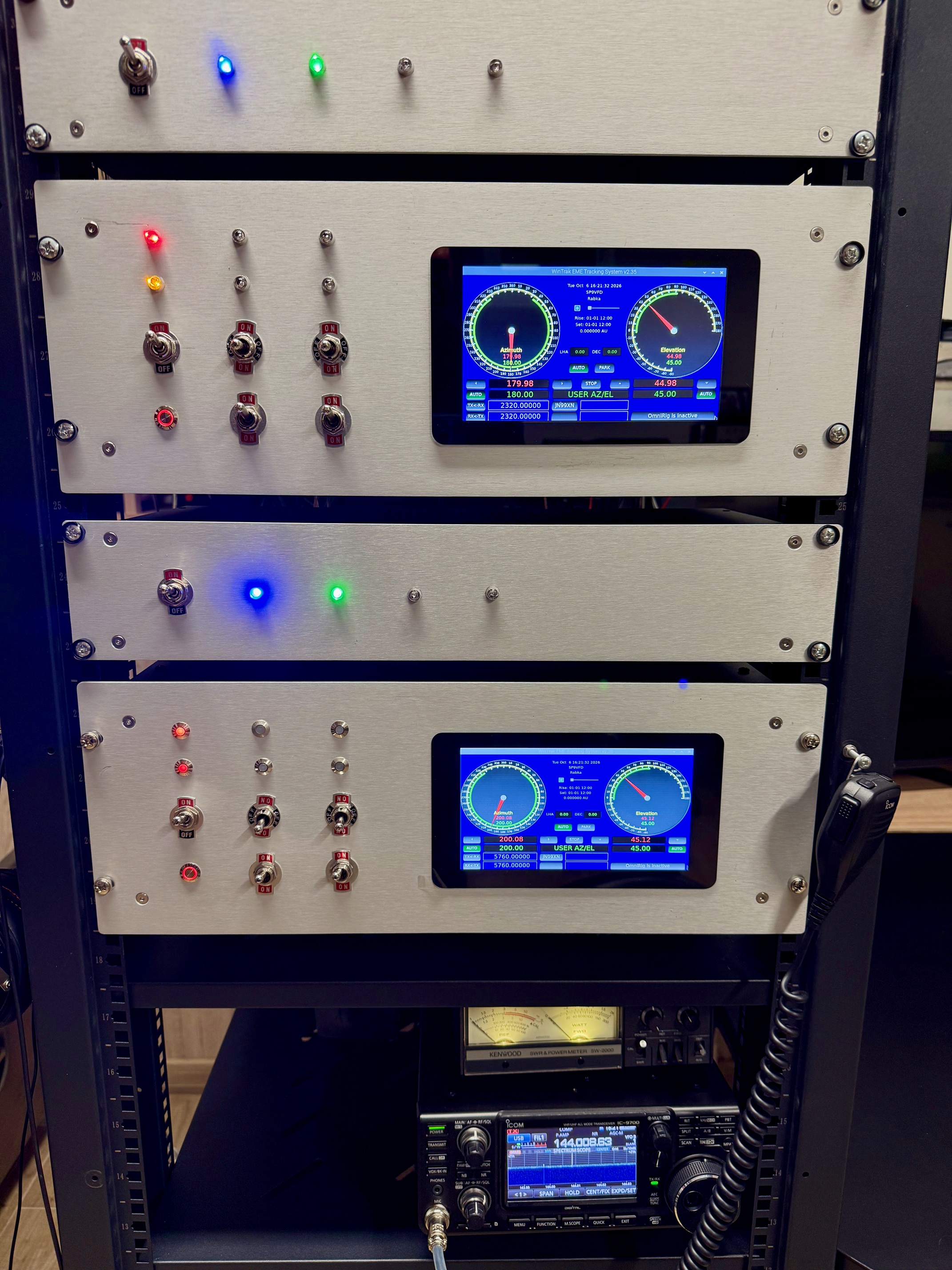 SP9VFD WinTrak RaspberryPi 4 Controllers and Rig
VE4MA Barry
This was a quiet month for me as I have been concentrating on domestic issues before winter arrives. I have also been focussed on improvements to my 241 GHz terrestrial rigs, hoping to use them when the colder weather arrives.
I did manage to re-level my 2.4 m dish which was only mounted on cement pads 26 years ago and which had settled by nearly one degree.
The sun is getting low in the sky now but I was able to use small mirrors to confirm the quality of the focus on both my 2.4 m Offset and 3 m PF dishes. My 2.4 m is good at 10 GHz, OK at 24 but not so good for 47 GHz. I have tested many other 0.6 1.0, 1.2, and 1.8 m dishes that were built for 12/14 GHz satellite use and I am not impressed with the quality of the focus. My Andrew 3 m PF dish was designed to use an ADE (Axially Displaced Ellipse) reflector for 12/14 GHz satellite service and I have never been able to get it to work well on the higher bands without trying the sub-reflector. See W1GHZ Article
Using mirrors on this dish did not provide a nice focal point. It seems to focus on a 9 inch disk, which is the size of the subreflector!
Winter is coming soon and I am looking forward to the planned 24 GHz activity in December. I will plan to operate on 70 cm in the ARRL contest weekends. I will have 300 W into my 3 m dish with a dual polarity PY2BS / W5LUA patch antenna. On the second weekend I will be operating on 33 cm with 700 W and a circular polarity PY2BS / W5LUA patch feed.
Shawn VE4SA lives 1 km from me in a rising moon direction and I will let him operate on 23 cm.
VE4SA Shawn
I was active October 4th on 3 cm EME after troubleshooting LNA stability issues during the previous day. The LNA required an input circulator to remain stable; however it reduced my 1.2 meter offset performance to 5 dB of sun noise (having peaked at 8 dB previously). I completed two more 3 cm EME initials #6 and #7 with OZ1LPR and OE9ERC respectively.
I plan to be QRV 23 cm on the 1st leg of the ARRL 50 to 1296 weekend October 31st and Nov 1st. There is a possibility if weather allows, I might also be QRV on 3 cm for one night.
VK0DS (VK2JDS) Dave
All operations from Davis Research Station in Antarctica have concluded, the gear is packed up and I will be heading home in November.
If anyone wants a QSL card for EME contacts please either send me a self addressed envelope with their own card to my home address as listed on qrz.com, or if they don't have a card then please send me an email. This includes any contacts made during 2023/2024 when I was primarily 23 cm.
It’s been an interesting year, with antennas I homebrewed here on station from hardware store parts brought down on the icebreaker all working ok.
432 MHz was the priority and was the best performing setup, with a pair of 22 element Yagis, homebuilt 250 watt amplifier and some eBay LNAs.
Being able to tilt the array in the surveyor’s tripod yielded many contacts during times of polarisation lockout.
Not having the 2.4 metre dish this time meant I was only able to work the big guns on 23 cm with the 77 element Yagi and 100 watts from one of Carsten’s (OZ9AAR) designed amplifiers built down here. 2 metres was with the single Yagi and a 330 watts homebrewed amplifier was similar, larger stations only worked.
I had 49 EME contacts on 432 MHz, 13 on 23 cm and 4 on 2 metres. The other 10,000+ were on HF FT8 and some SSB.
This is my last time activating Antarctica, I won’t be coming back, but will continue to be on 1296 and 432 from home.
[Ed Note: I am used to Cold WX, But this really looks cold. Thanks Dave for doing this!]
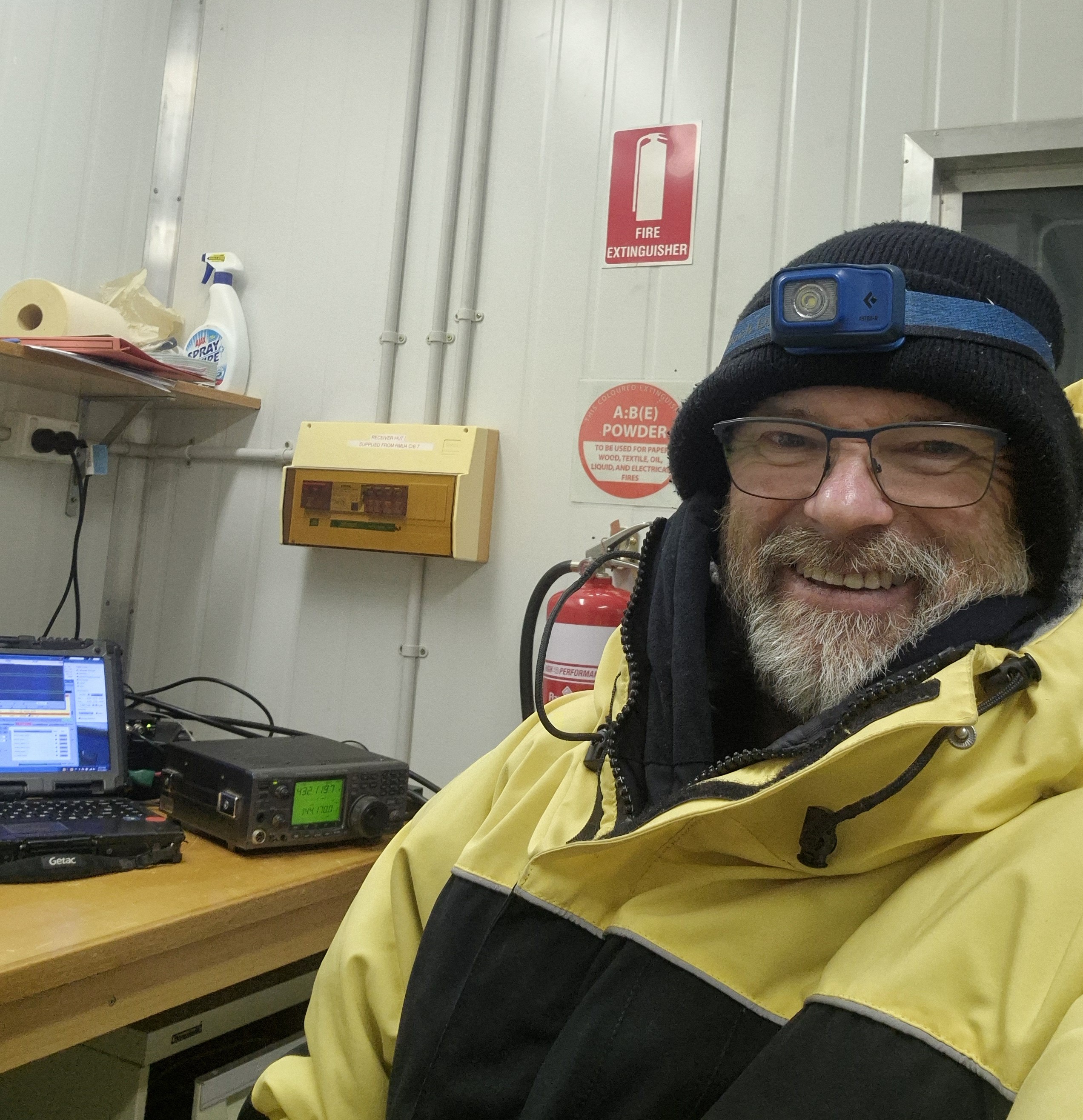 VK0DS Dave in Shack
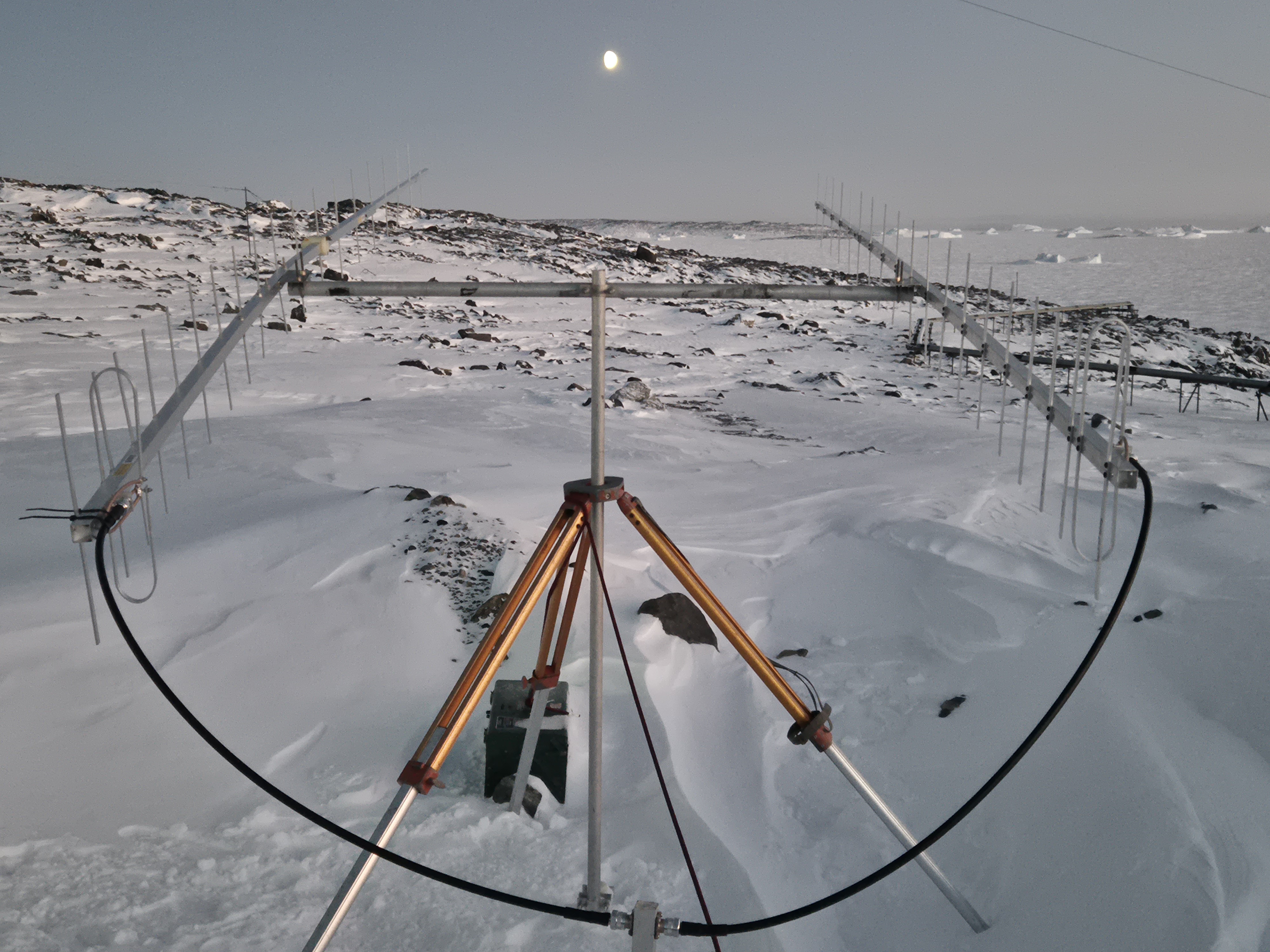 VK0DS 2x 22 El 432 Array
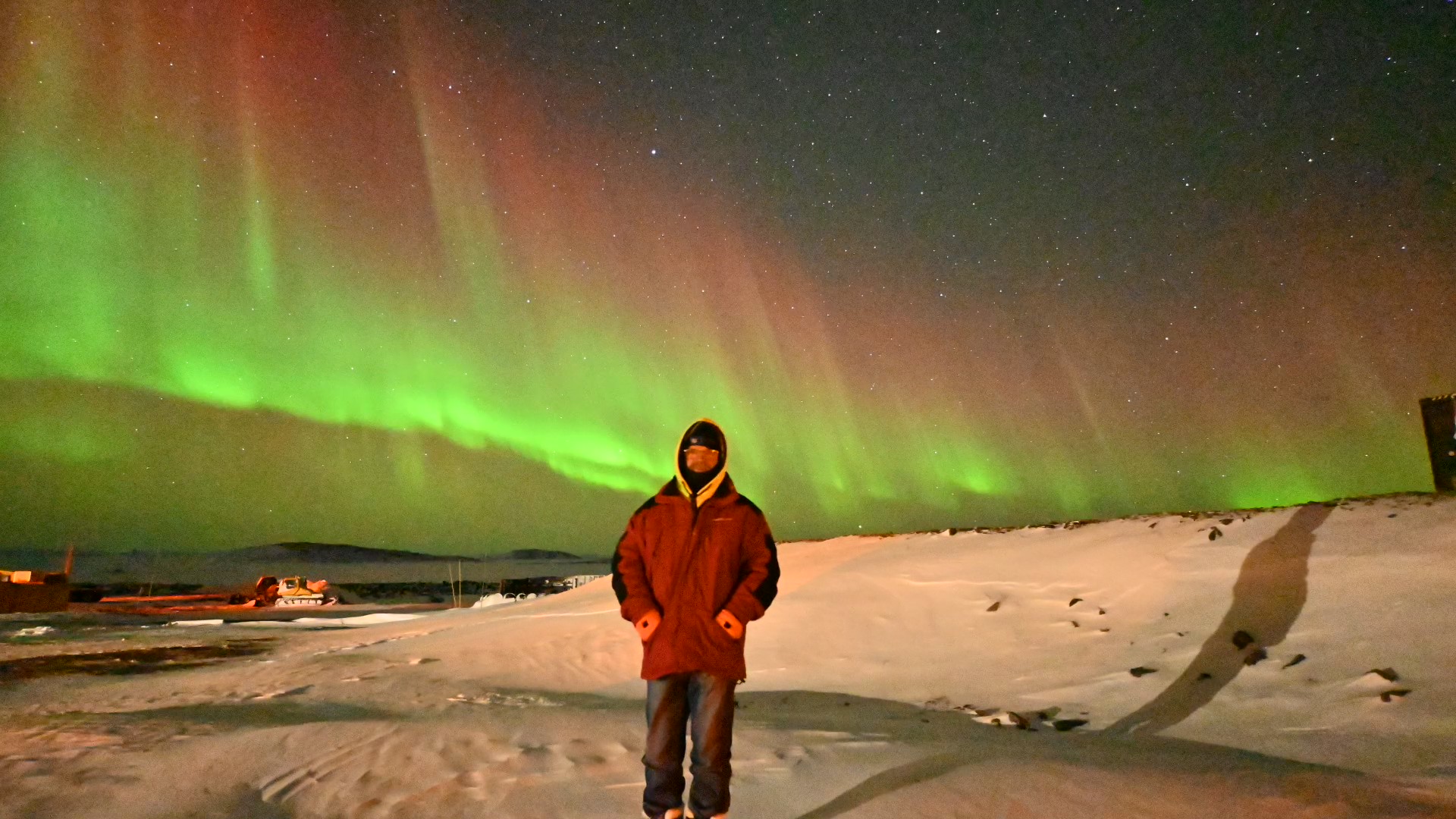 VK0DS at Helipad
VK2CMP Mick
I am not QRV at the moment on 70 cm due to my PA continually tripping the house Earth Leakage Circuit Breaker. Alas I just replaced the PSU module and the PA still trips the ELCB. Next is to investigate the input mains filter and input 240 V relays. Regardless of TX capability I have S9 noise on a bearing of 308 degrees which is my MS.
I got the good wife to drive the 4WD around the neighbourhood along this bearing with myself in the back seat with an Arrow antenna and Airspy SDR. I have narrowed the source down to one of four houses 3 blocks away. Next step on the RFI front is to walk over there with a H4M SDR and stub antenna to identify the house in question. Then I guess I will start up a conversation with the owner.
I also moved the SAW filter from the shack to after the 1st LNA up the tower and it does clean things up, but not the in-band QRM which is around the 434 MHz ISM segment. Not looking great for the next ARRL weekend for 70 cm. [Ed Note: I have done the same thing here due to the ISM QRM]
23 cm is a lot more fun at the moment. I completed my version of the W6PQL KISS 23 cm 600 W PA in a 1560 pelican case complete with PS. It seems even though I wanted to keep it simple, I couldn’t do it. So it’s got PQL's control board and a NARDA directional coupler to provide Over Temp and SWR protection, sequencing and fan control. I call it the KICK PA (Keep It Complex Knucklehead PA). So we are all set for portable ops now with everything organised in pelican cases etc.
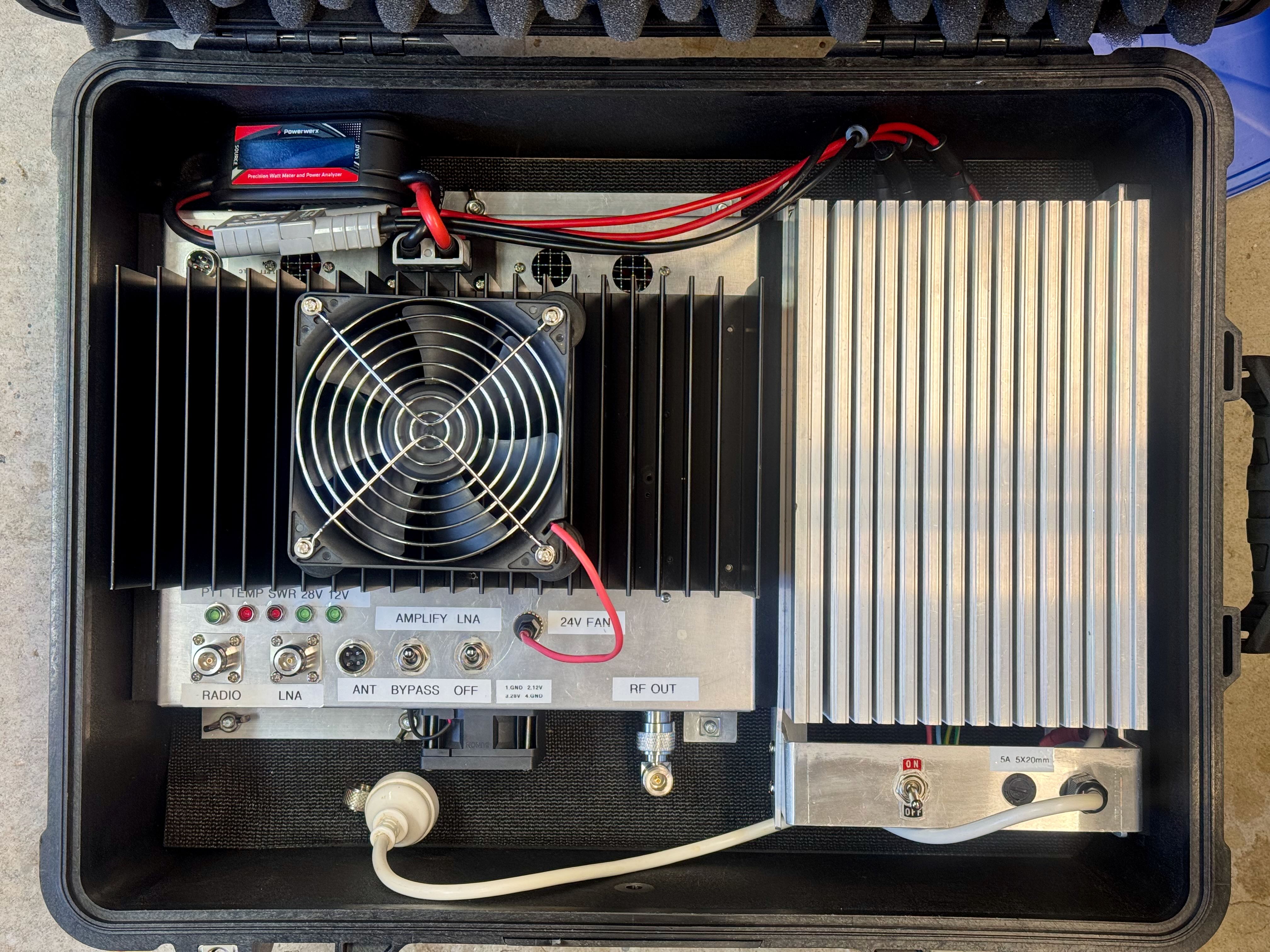 VK2CMP 23 cm KICK PA
VK2SAQ
I activated VK2SAQ 1st Asquith Scouts off the moon for JOTA using my 23 cm portable station of a 2.4 m folding dish, W6PQL PA, AGO LNA and IC9700. The week before JOTA I gave a talk on the portable setup at my local club meeting (HADARC). Kevin VK2KVJ is the Scout Adviser for 1st Asquith Scouts and organises JOTA each year and asked if I could operate at the JOTA event. There was also an HF station to go with kit building, CW practice stations, and VHF/UHF activities.
Kevin was keen to have a new Scout Award for bouncing your name off the moon and printed up a heap of award certificates to be filled out on the day for the event. The forecast had me worried that it was the apogee and the moon was just coming out of the Milky Way along with some local rain. So I hit the keyboard in order to drum up awareness of the event and the operating times etc.
I didn’t need to worry as everyone had an absolute blast on the day, including the operators as well as cubs, joeys, scouts and girl guides. We made a few QSOs with VK7ZBX, KB2SA, VK5MC, JA4LJB and VK3VJP. But the bulk of the day was using Tx6 to send the kids names up to the moon and back. Who knew this was a thing? Everyone took a picture with their mobile phone of the laptop screen as well as receiving a Moonbounce Award Certificate. It turns out you can forget DXCC as this is the award to go for.
KB2SA and VK7ZBX started off proceedings and operated on 1500 and 2000 Hz so most kids got two call signs on their awards. The fact that Bill said it was 8pm on Friday night yet we were operating on Saturday morning got the kids thinking. But the highlight was when Bill said he was from San Diego and the audience asked “what’s San Diego?”. Then one of the scout dads said it was in America and is where SeaWorld is and that he had been to it. From then on KB2SA’s handle was Bill from SeaWorld! Kevin was playing some videos of VK7ZBX that he did on moonbounce in the hall so it was great to see Richard on the TV as well as bouncing names of the moon at the same time. The last shift was with James VK3VJP and was also a long run of more names. James sent a pic of his homestead on a property in the VK3 bush and it was interesting to see the kids keep asking to see the pic of the other end of the QSO, not to mention it was in the bush and not the middle of a city of 6 M people that we were in.
So all up we bounced 31 names of the moon and made a stack of new Moonbounce supporters. Thank you to all the stations that took part and made the day such a great success!
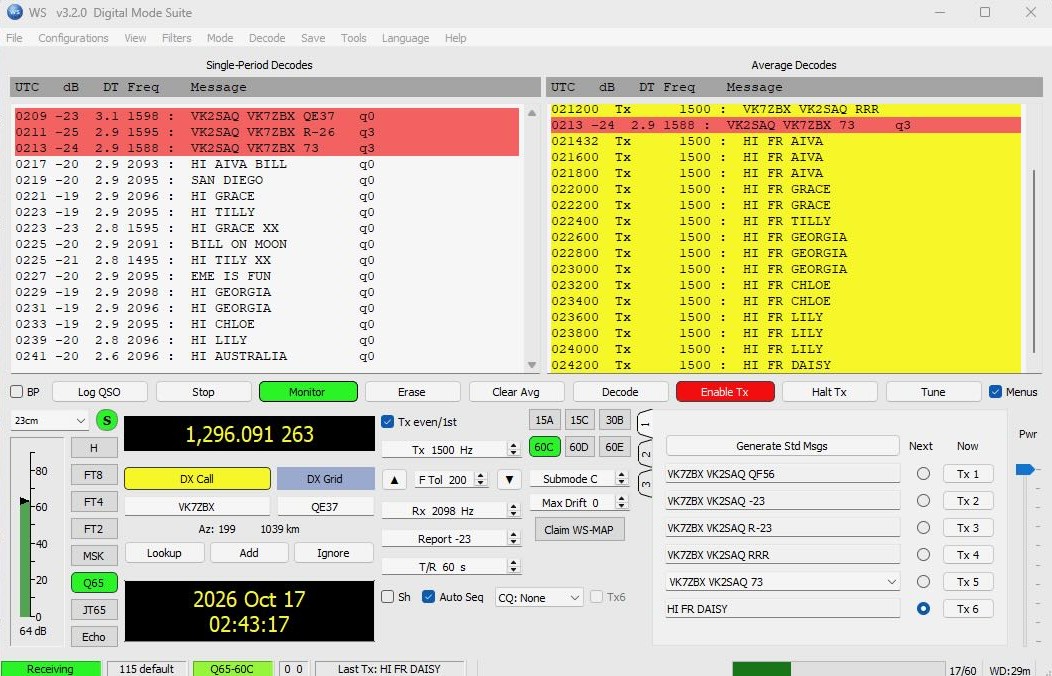 VK2SAQ JOTA screenshot 1
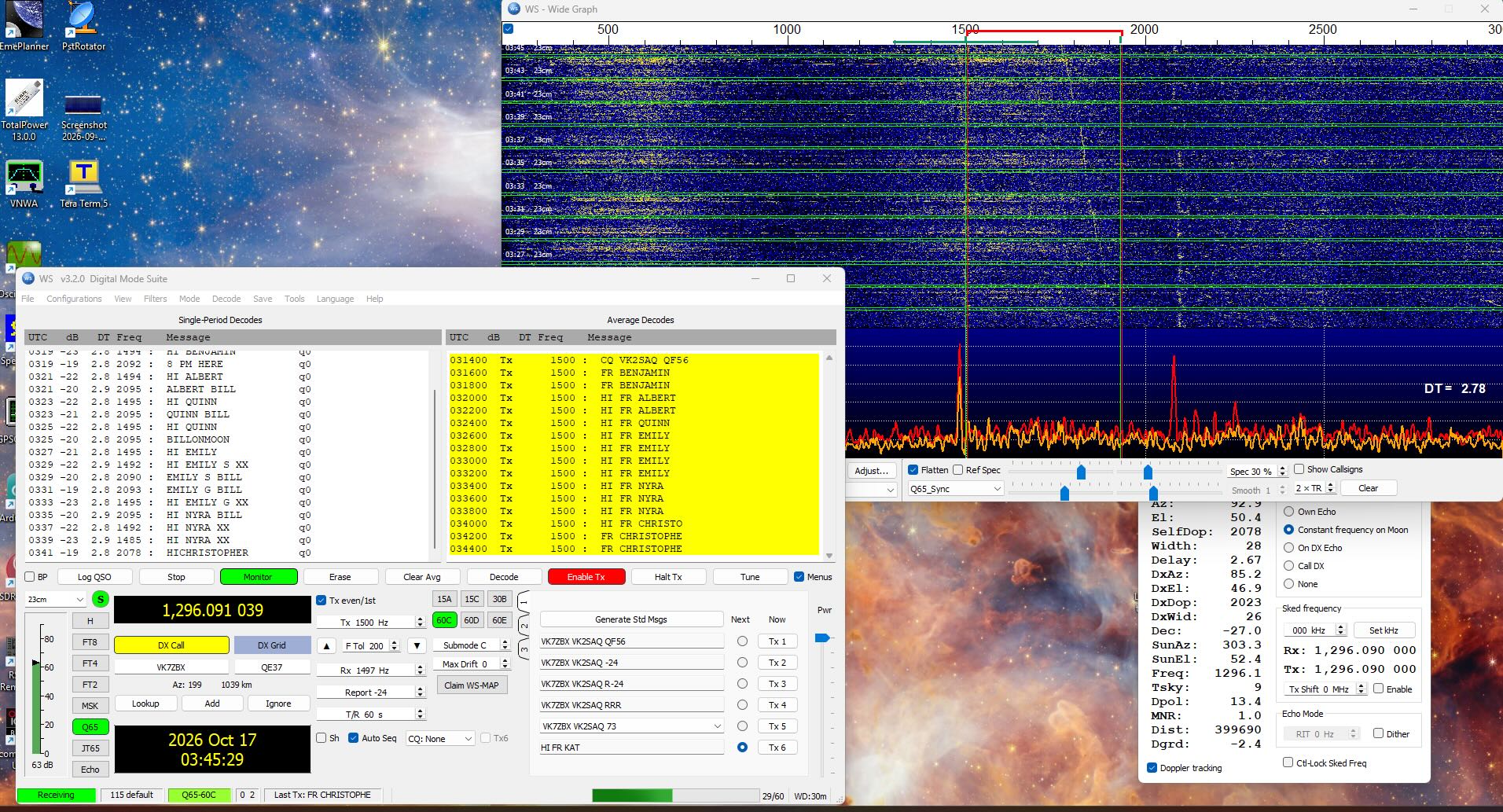 VK2SAQ screenshot 2
VK7ZBX Richard
October has been really busy for me as I have been having fun with my newly commissioned but still being tweaked 23 cm system.
So far I have worked 47 initials in 20 DXCC localities. A long way to go but I'm keen to give DXCC a crack😀
The stations worked so far other than the 1st 5 stations I reported on last newsletter are:
SQ7D, DL8FBD, DF2VJ, DL6ZG, G4CCH, RA4HL, G4YTL, OK2AQ, ES3RF, UA3PTW, EA5Y, OK1USW, R4CX, PA3EXV, HG80BAY special event, UA9FD, OH3LWP, SM5DGX, DL1AT, R1NW, PH0V, OK1VUM, YU1DA, IZ8GGF, A71AW, DF3RU, VK4CDI, PA3DZL, OE3JPC, DM2CFH, OK1UGA, DL1HUH, G0LBK, IQ2DB, JH3AZC, VK3NFI, PA1PS, DL1SUZ and ZS4TX.
Some really fantastic contacts, I'm super impressed at how well this band works and am looking forward to making many new friends on 23 cm. My system is 2.4 m PF Mesh dish, OK1DFC design home-made feed, Antennas Amplifiers LNA with isolation relay and SSPA from VHF design along with GPS locked Icom IC9700.
Thanks to all for their patience and assistance. See you on the moon!
WA6PY Paul
WA6PY was QRV in the ARRL EME MW Contest. On August 8th on 13 cm I QSO’d: G3LTF, G4CCH, SP9VFD, OH1LRY, OH3LWP and KL6M. On August 9th on 6 cm I QSO’d UA3PTW, but this time I experienced very strong QRM, pulses every 800 ms. On 24 GHz during both days I did not find any station working CW, however I heard JT signals.
On August 10th after the contest I QSO’d on 24 GHz PA3DZL O/O #15 and OZ1LPR 579 / O, who was beacon station quality and easy loudspeaker copy.
On September 5th on 10 GHz I QSO’d: SM4DHN 589/559, IK3MAC 589/579 and OZ1LPR 589/569. I heard a few quite easy to copy JT signals.
On my western horizon I called X-band CQ on 10,368.080 and listened also on 10,450.080 +/- 50 kHz, but I had no luck finding any stations. On 13 cm QSO’d OK1DFC 589/579. On my western horizon I called CQ X band on 2304.100 but did not find any station on 2400 MHz. I was also calling CQ on 2301.975 and 2301.100 for VK without success.
I plan to be QRV in the next section of the ARRL EME contest on 1296 MHz. I will give up 432 operations since I don’t expect any CW activity.
XE1XA Max
Greetings to everyone. I’ve had a health issue that kept me QRT for the past few months.
This was troublesome for me, considering that I’ve been active in EME since 1975. I haven’t received any email requests for setting up a sked, perhaps because the vast majority of stations active on 23 cm EME are already in my log.
But I am available if anyone still needs Mexico on 23 cm, though I try to avoid scheduling contacts late at night.😀
Dwingeloo EVE 2026
The Radio telescope Dwingeloo is a Dutch National Monument, being put into use in 1956. In 1998 it was retired.
Ever since radio-amateurs obtained access to this instrument in 2007, it has been used and fine tuned to its current level of perfection. In its new life, the telescope has been often in use for Moonbounce on various bands, but also for amateur astronomy, educational purposes and as a famous place to visit for tourists. Who would have thought that we would ever use it to transmit to the planet Venus and receive an echo? Well, some of us...
Given the distance to Venus of roughly 42 million kilometers, it requires a lot of power to obtain an echo from Venus, as the "link-budget" is very tight, even on the 23 cm band that the 25 m dish is working at its best. The dish was designed for the Hydrogen Line (21 cm) so it was obviously the best frequency to try and use for this experiment.
In our first attempt in 2025, we only went as far as "detecting the signal". We cooperated with the Astropeiler centre in Stockert, Germany, who is using a 25 m dish as well. The advantage in the receiver path of Stockert is that they did not need to use an isolation relay because they are "receive only".
During the recent attempt of 16th and 17th of October 2026, we again cooperated with Stockert and also had one of the 25 m dishes of Westerbork in the Netherlands listening with the same advantage as Stockert.
In Dwingeloo the team consisted of:
- Thomas Telkamp PA8Z (project management, licensing, software development)
- Tammo-Jan Dijkema (technical support, dish operation, ASTRON)
- Kees Bassa (IT, ASTRON)
- Jan Kappert PA0PLY (technical matters)
- Hans Holsink PE1CKK (QRO power amplifier)
- Jan van Muijlwijk PA3FXB (support)
- Dick Harms PA2DW (frequency coordination, licensing, CW)
Some technical details:
- Frequency of the project: 1299.650 MHz
- Transmit bandwidth: maximum 150 kHz (Zadoff-CHU modulation)
- Receive bandwidth: 1 Hz
- Transmit technology: Carrier, modulated with either CW (100 Hz FSK), Q65-60c, home-made protocol FSK, Zadoff-Chu chirps and simple carrier on/off
- Antenna: 25 meter parabolic dish (Radiotelescope Dwingeloo)
- Polarisation: Circular (RHCP transmit, LHCP receive)
- Maximum EIRP: 95.3 MW
The schedule (times and dates in CEST/local time):
- Saturday 17th October from 12:27:00 till 15:12:00 (Venus)
- Sunday 18th October from 12:16:00 till 15:11:00 (Venus)
- Saturday 24th October from 11:11:00 till 15:05:00 (Venus)
- Saturday 24th October from 20:00:00 till October 25th 00:00:00 (Moon)
- Sunday 25th October from 10:00:00 till 14:03:00 (Venus)
The result so far is that we were able to detect our echo from Venus beyond any doubt. Attached is a picture of the echo as received at Dwingeloo and another one after correlating it with the Stockert and Westerbork telescopes.
The great news is that we were able to detect the message "VENUS ECHO" in our own data with the home made FSK that Thomas PA8Z developed. This is a great achievement! Attached is a picture with that message!
There have been other big dishes listening for our signals on October 17th, such as the 100 m Effelsberg telescope in the Eiffel, Germany and the 76 m Lovell telescope in the United Kingdom. The data from these telescopes, with roughly an 8-10 dB advantage on us, is yet to be analysed!
At the time of writing this, we have had 17th and 18th of October behind us. If you read this in time, be aware of the time slot Saturday October 24th from 20:00 till midnight. We will then point our QRO power to the Moon instead of VENUS. It is very unlikely that anyone with a smaller dish than 25 m can detect our VENUS echo. But via the moon we will be roughly 10 dB stronger than usual! So anyone with a small Yagi and an average radio can possibly hear our EME echo! Do let us know if you detected us!
We need to say that it will not be possible to make a QSO with us, as we are transmitting with a special experimental QRO license and not under the PI9RD amateur-radio conditions! So it will be "one way only". As it is an experimental license, we also had to invent an own ID being EVE26RD.
Have fun! We will have more news after the second weekend.
On behalf of the whole team,
Dick PA2DW
October 22 update: CW Echos Detected - more information to follow in the next newsletter.
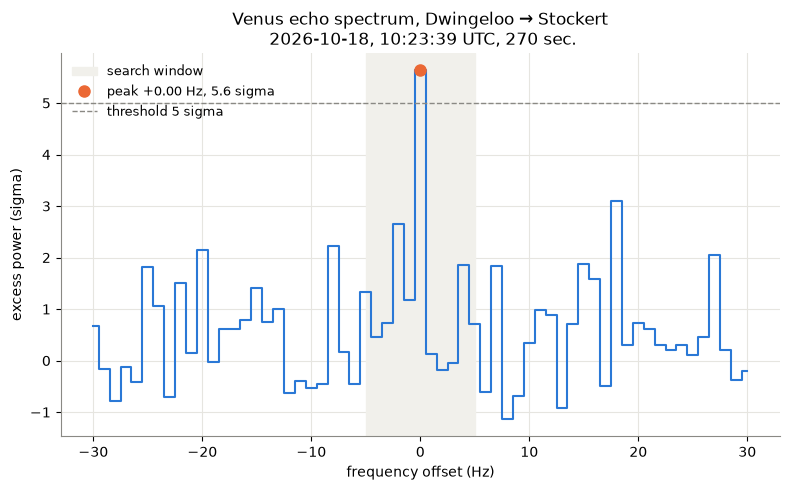 EVE2026 Stockert Echo
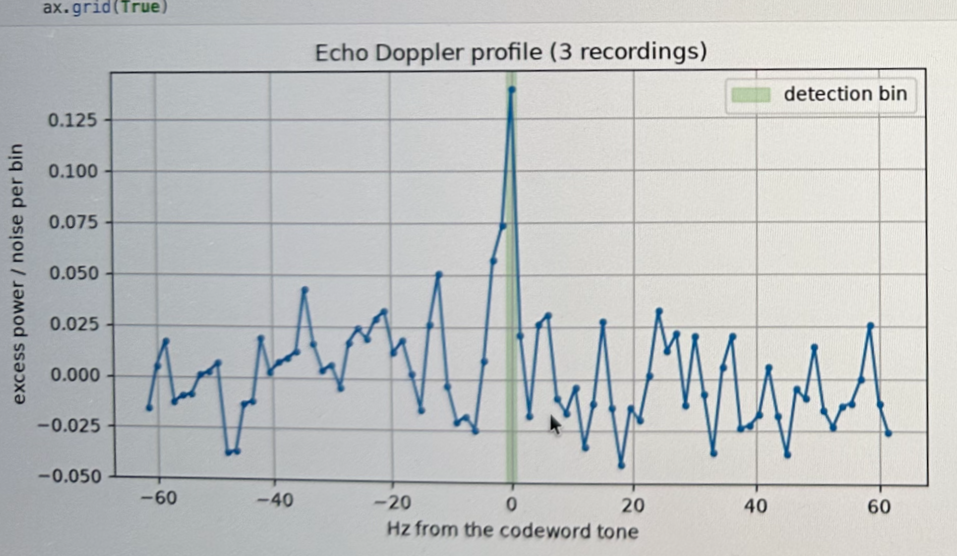 EVE2026 Dwingeloo Echo After 3 Signal Integrations
 EVE2026 Venus Echo of FSK Message
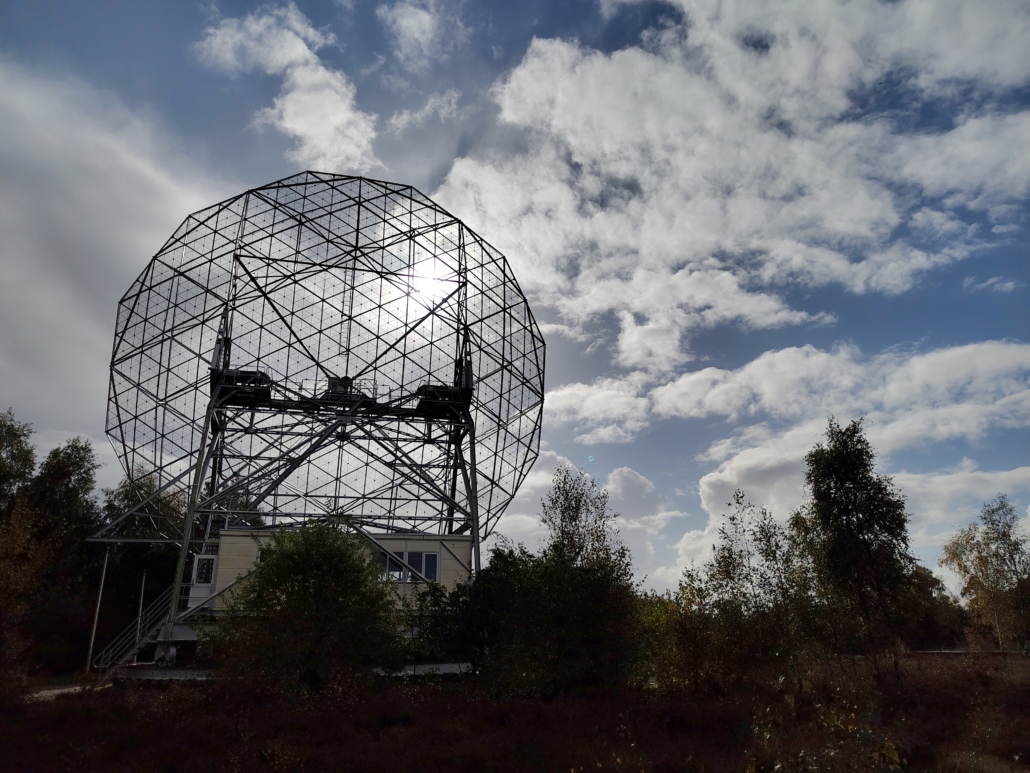 EVE2026 Dwingeloo Dish Pointing to Venus
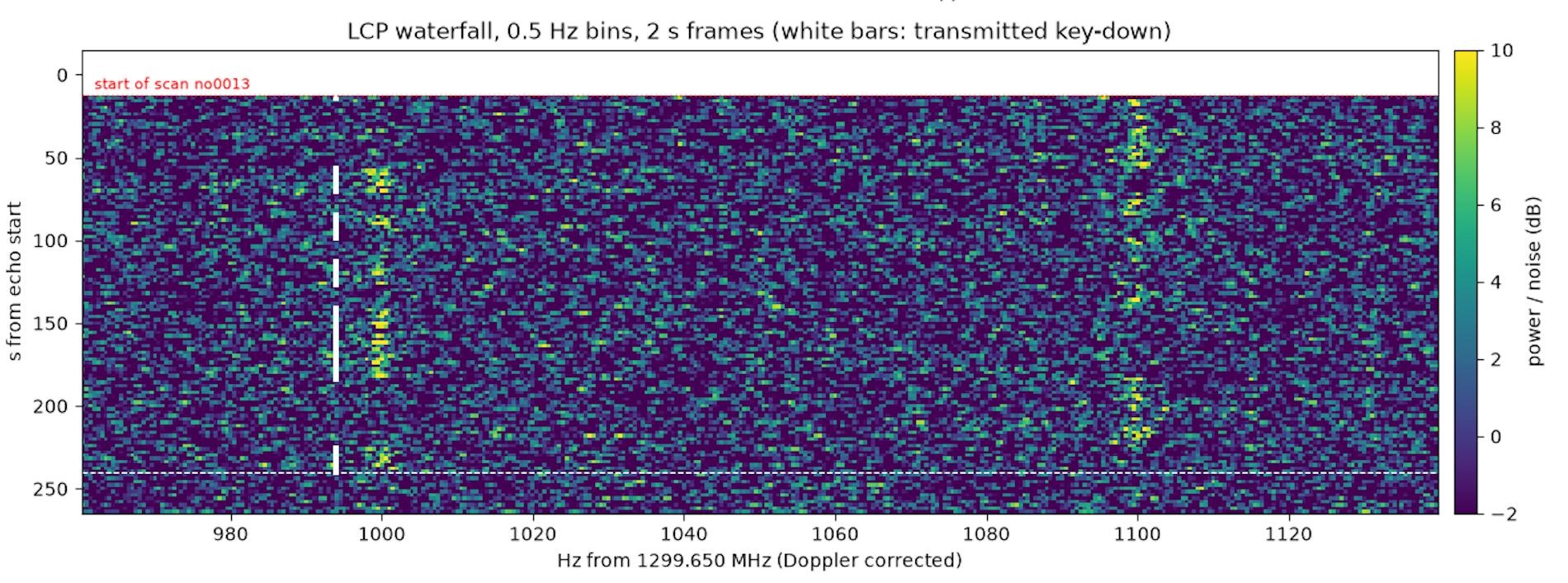 EVE2026 Dwingeloo echos