
News, Contests and DXpeditions
It was a very busy period with both the ARRL and ARI EME contests coinciding, so that the activity was very high. Conditions were somewhat challenging on 70 cm due to the unstable Faraday polarization conditions due to the appearance of aurora. Moon conditions were great otherwise with the very high declination and low loss values. The number of QSOs and initials appearing in the station reports on 23 and 3 cm is quite remarkable.
Also benefiting the QSO Totals was the move to 30 second sequencing (from 60 seconds) and use of the NA contest mode in WSJT-X.
We have so many EME bands on a worldwide or regional basis and it is difficult to coordinate activity on these bands. Jan PA0PLY has been good at coordinating activity on some of these bands but it is often difficult to find a time slot when it does not coincide with contest activity on other bands. Please see the planned activity weekends for 902 MHz and 24 GHz below.
23 cm New Band plan
The IARU C5 group recommendation is to adopt this supplemental 23 cm band plan on the 1st of January 2027, according to the table below in the IARU Region 1 VHF Handbook.
i) ECC Decision (25)01 Annex 1 and national conditions may need to be consulted for Moonbounce operation.
j) Preferred frequency segment for Moonbounce operations from 1st January 2027 Proposed: SRAL Seconded: CRC Vote Plenary 33: In favour: 50, Against: 0, Abstain: 1
 1296 MHz Band Plan Recommendation
The original recommendation was to be applied to support those cases where the ECC Decision (25)01 has been implemented nationally. But of course governments move slowly to implement changes, so the C5 group recommends that we proceed to do this on January 1st anyway.
New EME App for Android & Apple Devices
Dirk ON5GS has developed Apps for Android and Apple devices that provide Moon information, connection to the HB9Q reflector, N0UK, and Live CQ sites. This looks very useful, especially for portable stations. Changes are being made as it is in a rapid phase of development. Please see his article below.
In Memoriam
Following last month’s Silent Key report, the Newsletter team has been working on further developing the “In Memoriam” part of the EME Website. We have merged the reports shown on DF6NA (EA8DMF) and Jan PA0PLY’s websites, and are looking for any further reports, pictures, etc. that can be added to this section. Please see W1QA's article below and forward any new information to Bob W1QA at
NISAR Satellite QRM on 1296 MHz
Bill KB2SA and others are now seeing QRM from the new NISAR satellite that launched in July 2025. See the picture below & this web site:
https://en.wikipedia.org/wiki/NISAR_(satellite)
They have seen them transmit right in our 23 cm EME band. It appears as a very powerful carrier. The frequency slope is the Doppler and the spur spacing is due to the IC-9700 producing artifacts from the front end being saturated. Below is the actual satellite QRM (from an out-of-band transmission). The QRM varies in strength depending on the frequency they're using at the time.
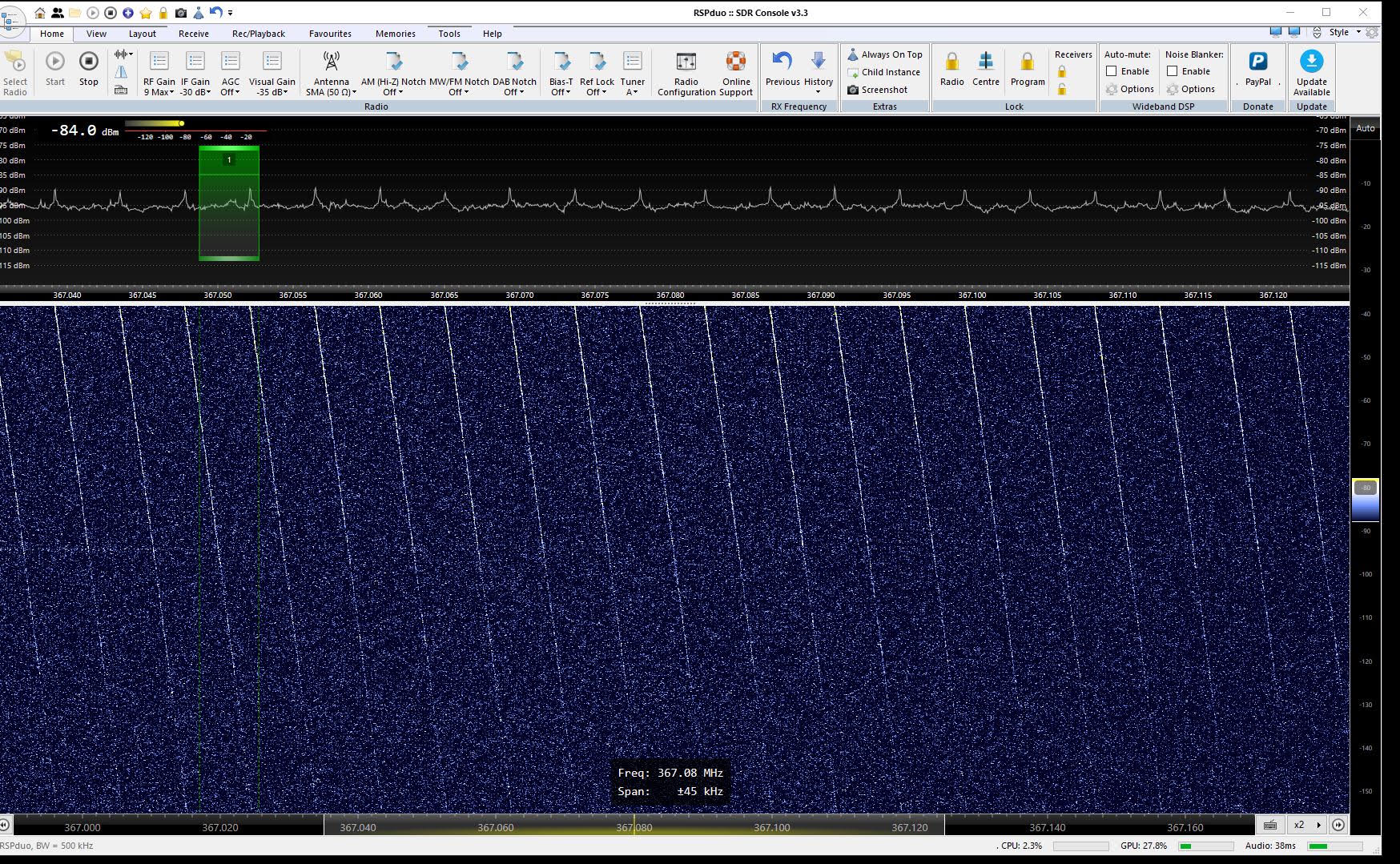 NISAR Satellite QRM at KB2SA
Fortunately it only lasts a few minutes each day. But when it's there, it will wipe out most EME signals.
DL7APV EME Calendar
Zdenek OK1DFC continues to work on updating the DL7APV Calendar for 2027. Please send any updates that you have to him at
PA0PLY EME Directory
Jan PA0PLY continues to update his EME directory on a regular basis. There have been so many new stations appearing recently and I encourage you to forward any updates to Jan at
24 GHz Activity Weekend
On December 19th/ 20th there will be an informal all mode 1.2 cm “Activity Day” as promoted by Ivan IZ0JNY and Jan PA0PLY. We have had similar events proposed for other bands in 2026 by PA0PLY and they were very successful. The DUBUS/REF contests concentrate activity on single bands but this is only for one weekend per year, and with the number of stations that are now capable of operation on 24 GHz, this is just not enough. Please see the IZ0JNY report in the October Newsletter
33 cm activity Weekend
902 MHz is a band that is available in Region 2 and suffers from Industrial, Scientific & Medical device QRM. EME operation has settled on the use of circular polarization and with systems that are often used for 23 cm EME, good results have been achieved. There is an activity period proposed for this next ARRL Contest weekend, which will conflict somewhat, but it’s probably best to monitor HB9Q and Moon-net emails to see how the activity will roll out over the November 28/29 weekend.
CQ WAZ Award Submissions with LoTW
LU7MC Carlos noticed that many EME operators, when uploading their contacts to LOTW, do not specify the propagation mode (EME) in their data; this prevents a match from being found for the ARRL WAZ award. He uses my most recent confirmed contact as an example, but 50% of his log entries fail to show a match.
If you’d like to fix this, you can re-upload the QSOs with the `prop_mode` field included, and LoTW will update the records accordingly. It may take some time, but it is an effective solution. Since some confirmation requirements involve payments via PayPal, it would be ideal if these confirmations also counted toward the awards we are pursuing.
Contests
ARRL International EME
The Remaining weekend of the 2026 ARRL International EME contest will continue on November 28/29th. It runs for the full weekend 48-hour period (0000 UTC on Saturday through 2359 UTC Sunday). See the Rules at: ARRL EME Contest Rules
ARI Autumn Contest
The ARI Autumn contest has concluded and it included the bands 144 MHz, 432 MHz, 1.2 GHz, 2.3 GHz, 5.7 GHz, 10 GHz, & 24 GHz with CW, SSB and/or digital modes. See the rules at: ARI EME Contest Rules
Logs must be emailed within 30 days of the contest (November 30th deadline) to the Contest Manager at
DXpeditions
KH0W Saipan Northern Mariana Islands
Tom KH0/KC0W is getting set up for operation on 2 m and 432 MHz. He has set up a Blog at: https://kh0w-moonbounce.blogspot.com/
AC0RA/R
Wyatt AC0RA operated on 3 cm from 11 different States and 8 different grids during a trip at the end of October. He has started planning the next 10 GHz trip to be conducted roughly in the week before Christmas. Please see his report below.
Z6 Activation
Uwe DG8NCO is planning, together with DF2CZ and possibly also DK2EW and DH7FB, to activate Z6 by moon again, most likely under his call sign Z66EME. The focus will be on 70 cm, as he unfortunately had a problem with the power amplifier during the last activation after just one QSO.
It’s scheduled for 21 August to 4 September 2027.
However, 2 m is also planned. He will provide further details in due course.
AC0RA/R Wyatt
For several years I have wanted to build a portable 10 GHz EME station and this fall everything finally came together and I was able to complete my first 10 GHz EME rove. After a few different station builds I ended up with a 1.2 m dish mounted on a slew drive which bolts to the rover tower in my truck bed. I'm currently using a pair of Green Heron controllers for azimuth and elevation control. On azimuth I am using the slew drive internal hall sensor and on elevation I am using an inclinometer from Level Developments.
For the feed system I'm using a modified feed from a TVRO system connected to PE1RKI transition to a WR90 switch. I'm using a DU3T preamp and TX amplifier is a 30 W Kuhne all connected to a G5 Kuhne transverter. All of this is mounted in a box at the feed. I am using a IC705 at 28 MHz for my IF radio.
The first big rove effort on 10 GHz started in Rochester, New York at the Microwave Update conference. From the parking lot of the conference I was active for 2 nights October 23rd & 24th and had the opportunity to demonstrate 10 GHz EME to quite a few conference attendees. I was also able to work out a few bugs as I had just got this station together less than 24 hours before I drove to New York.
Onward from the conference I operated from the parking lot of my hotel in Massachusetts on October 26th making 10 QSOs. The following night of the 27th I made 12 QSOs from Hogback mountain overlook in Vermont.
The night of October 28th is when things started to get interesting. Heading to my spot in Maine I hit my first deer ever but thankfully I was only going 10 MPH (16 km/h) so no damage. I set up in Maine right along the ocean at York Beach. From there I made 13 QSOs.
I then headed down and set up in New Hampshire along the ocean in Rye. I was back on the air within an hour of leaving Maine but after several contacts I was abruptly instructed by local law enforcement I had to leave, despite zero signs or any indication that I couldn't be there. I quickly finished up in NH with 10 QSOs but missing a few. On my way back to the hotel I stopped briefly in MA to work W5LUA who had missed me on the first night as he was still traveling home from the conference.
The night of October 29th I started out from Judith Point in Rhode Island with 13 QSOs. I then moved down to Barn Island boat ramp in Connecticut to work the same 13 stations from a new state. Then I caught a 4 hour nap and headed down to the next day’s operating spot.
I set up on October 30th from Line Church Rd near Whitesville, Delaware on the state line of Delaware and Maryland for the final pass of the trip. From the state line I worked 14 stations and then headed back east. After a 4 hour drive I stopped at a rest stop in Virginia making 7 QSOs before moving up the Interstate highway to another rest stop in West Virginia for another 7 QSOs. I then made the 900 mile drive home in a straight push to end the trip.
In summary I operated from 11 different States and 8 different grids during the trip. Total contacts made were at 109 with 14 being done on a state line. 16 unique calls were logged during the trip. I've started planning the next 10 GHz rove to be conducted roughly in the week before Christmas.
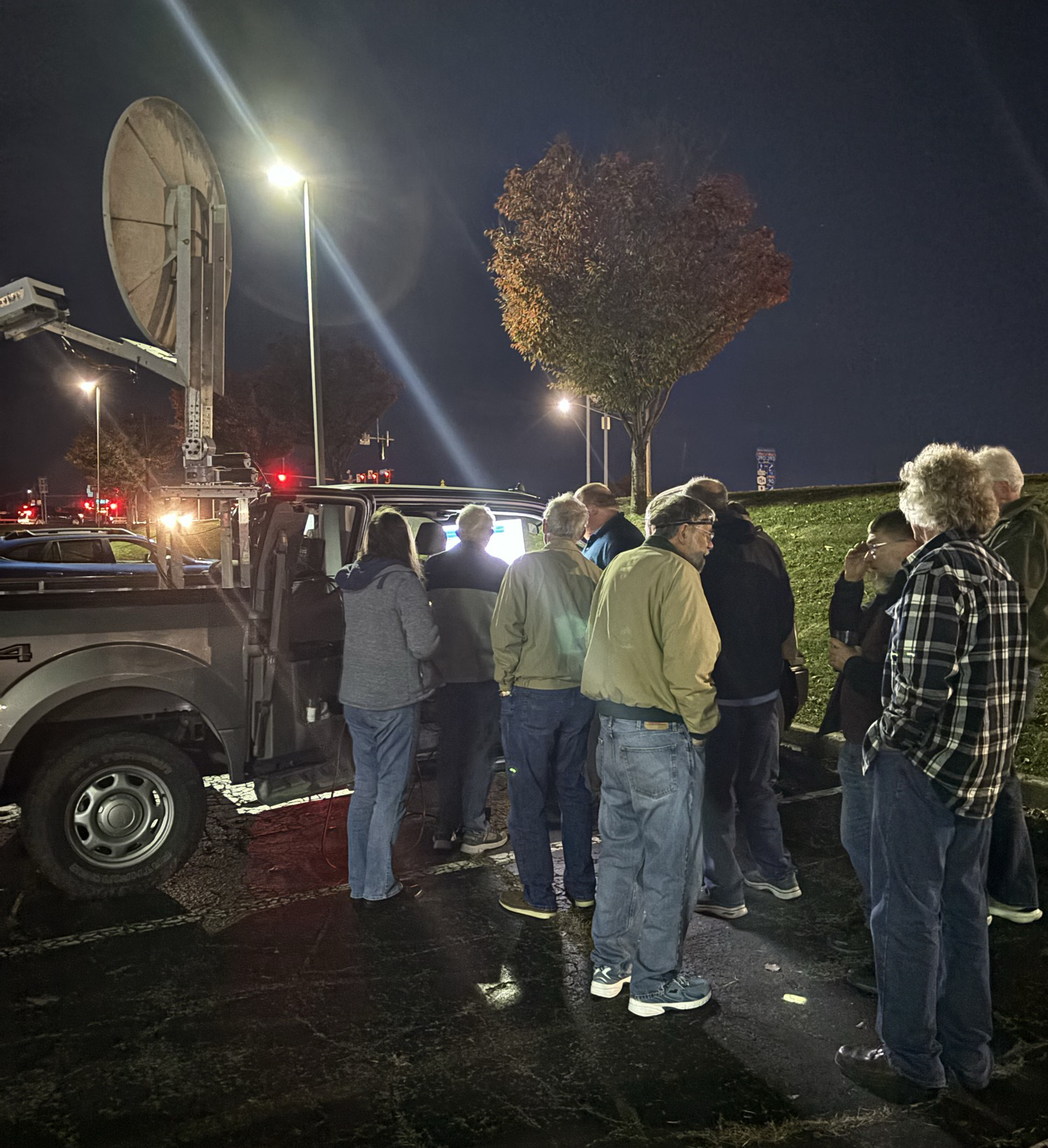 AC0RA EME Demonstration at MUD conference
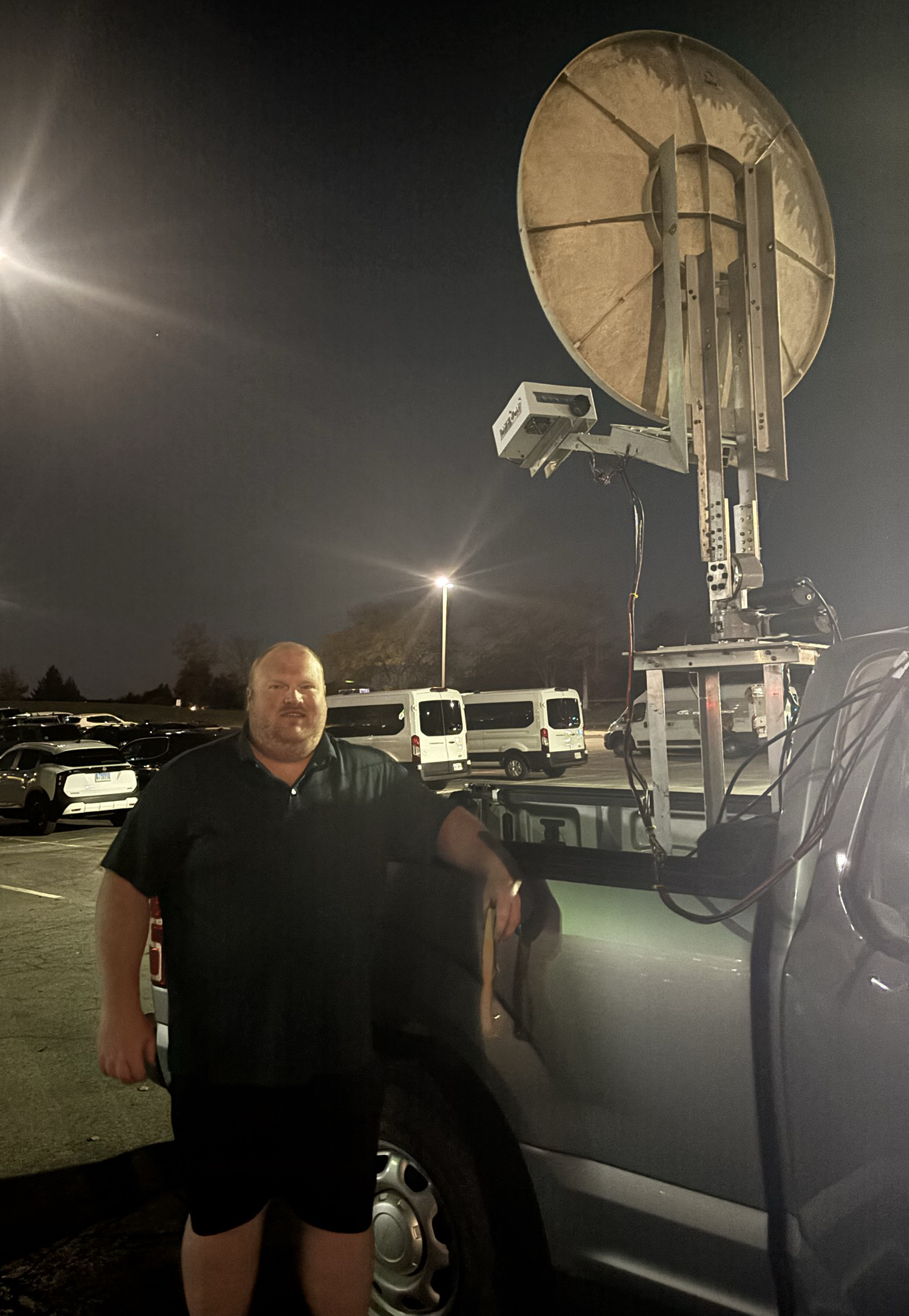 AC0RA Rover at MUD Conference
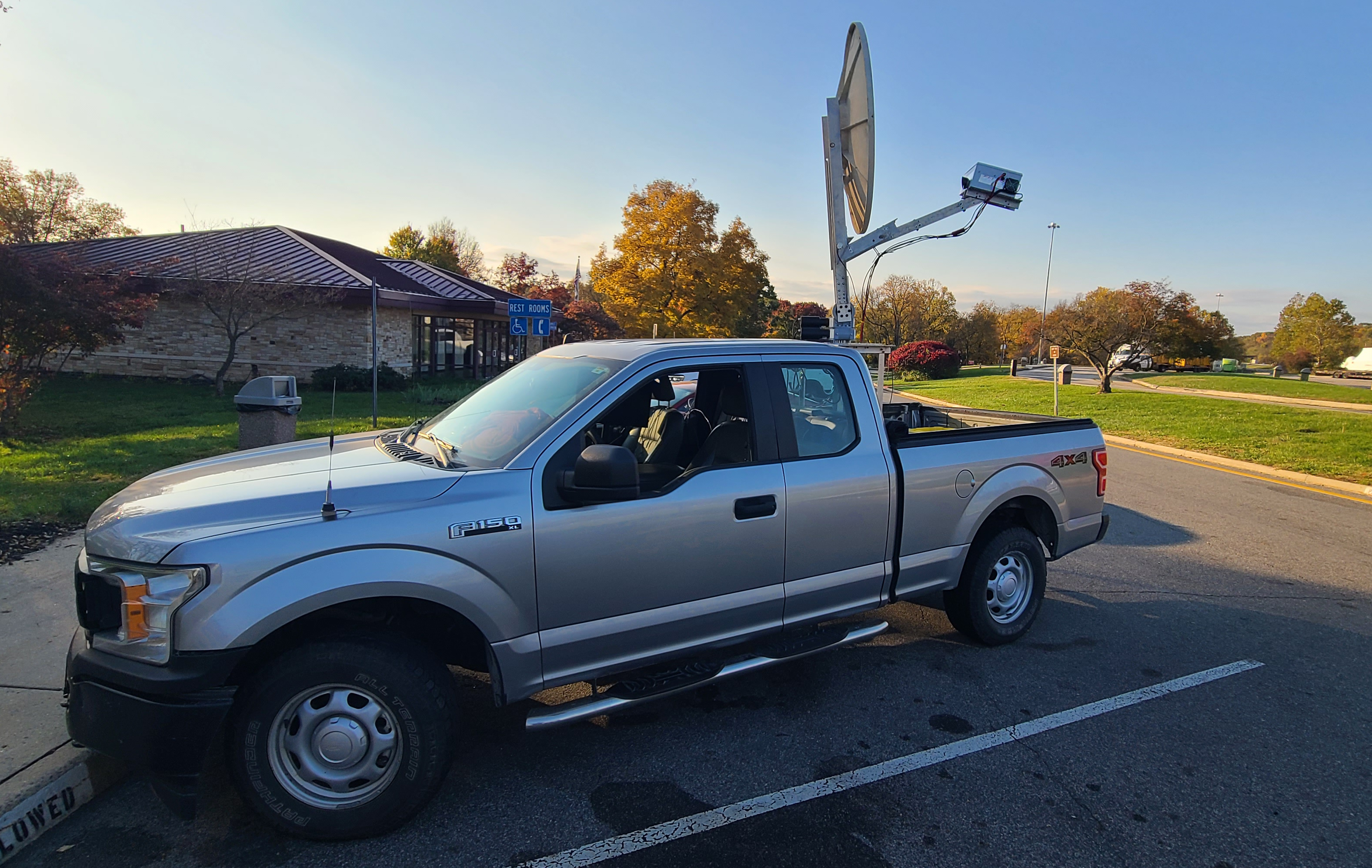 AC0RA Rover at WV Rest Stop
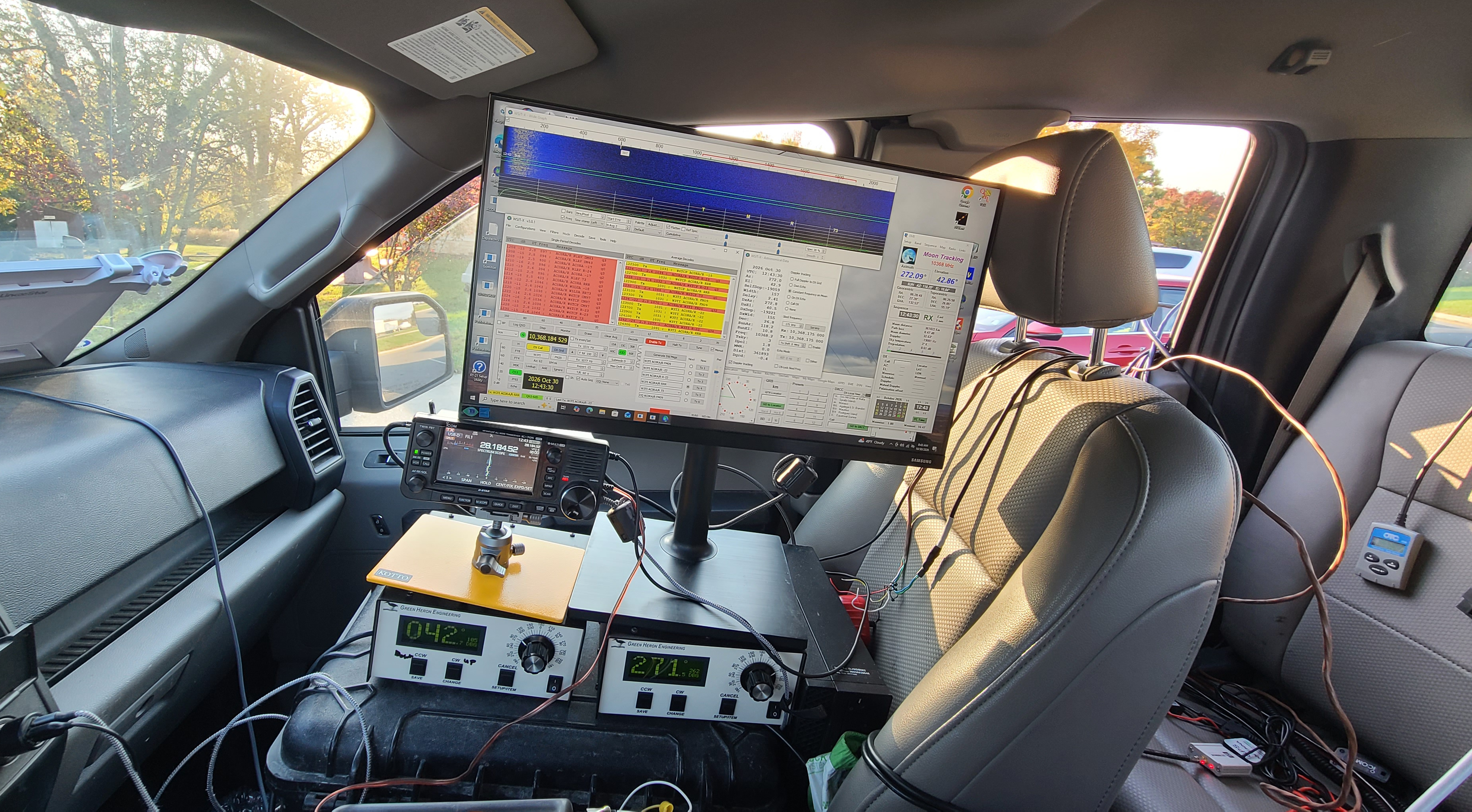 AC0RA Rover Operating Position
DG8NCO Uwe
I’m planning, together with DF2ZC and DK5EW, to activate Z6 by Moon again, most likely under my call sign Z66EME.
The focus will be on 70 cm, as I unfortunately had a problem with the power amplifier during the last activation after just one QSO. However, 2 m is also planned. I’ll provide further details in due course.
It’s scheduled for August 21 to September 4, 2027.
DL3WDG Charlie
I was QRV for a few hours on 1296 MHz during the contest. My main objective was to exercise and test some latest WSJT-X development code from our new releases (see WSJT-X), but I enjoyed making 49 QSOs, almost all of which were Q65-30B. I was mainly testing a new feature that allows decodes in the QMAP window to be clicked to initiate WSJT-X QSOs. Everything worked extremely well. I even experienced one case where I decoded a station calling me on QMAP on a completely different frequency, and a double click on that decode QSY'd me to his frequency, set the callsign mode, period etc.
I also tried seeing if I could receive my own JTTY echoes, following Joe K1JT's lead a few days earlier. Using the 'Contest' message format, it is possible to send and decode your own echo of a short message (e.g., CQ DL3WDG CQ). With my current system (2.4 m, 250 W) I managed to receive a few good decodes, around -15 dB / 2500 Hz SNR.
I also participated in a three way JTTY 'net' a few days later with K1JT operating W2ZQ, and G4CCH. Copy was excellent and here is one example of a message received from Joe towards the end of the test:
112740 1535 -10 I WILL TAKE MY FILES AND GO TO MY UNIVERSITY OFFICE NOW. DE W2ZQ
and one from Howard earlier:
103200 1482 -7 FOX JUMPS OVER THE LAZY DOG HERE IN THE UK TOO
It was quite amazing to see error-free communication at moderate SNRs working at 30 wpm.
F2CT Guy
I am sorry to say that during the ARI autumn party there was nobody on 6 cm. I spent several hours calling on CW and Q65 on 5760.150 MHz but nobody answered!!!
I told Enrico I5WBE that it was not a good idea to organize 2 EME contests on different bands on the same weekend.
I spent a lot of money in order to be QRV on 6 cm EME with the 4 m Cassegrain dish, so I am a little bit disappointed!
I will keep the 6 cm setup on the dish till I will get my 6 cm WAC! I still need South America (CX2SC) and South Africa (ZS6JON)!!!
G3LTF Peter
On October 27th I put the 23 cm feed in the dish and worked on CW OK2PE, EA5Y #577 and G0LBK. On 30th October I worked SP3YDE. I started in the contest at 07:30 October 31st planning to enter both ARI and ARRL. I worked on CW: SP6JLW, SM3YBA, VA7MM, VE6TA, F6ETI, OK1DFC, SP6ITF, WA6PY, DL4DTU, IK2DDR, SP3XBO, G4CCH, OK2DL, F5KUG, and KA1OXQ #578.
Starting again on November 1st at 23:00 I worked: KL6M, UA9FAD, SP9VFD, OK2PE, PA3DZL, JJ3JHP, JA6XED, IK5VLS, OM4XA, IK3MAC, ON5TA, SP3YDE, OM6AA, SM6PGP, EA5Y, SV3AAF, F6KRK, OH3LWP, DF3RU, F5JWF, SA6BUN, ON5GS, SM5DGX, PA2DW, VE4SA, N5BF, IK3COJ, N1AV, OK2DL (dupe), G4YTL and W3SZ. I missed KN0WS and K5QE when I ran out of moon as the dish touched the ground. That is a total of 45 CW QSOs, one less than last year at this point. Thanks to everyone for the nice CW QSOs.
I was sorry to only work 4 Italians for my ARI multipliers, there were three on digi that I’ve worked before on CW but apart from that it was a pretty satisfactory weekend.
On November 4th I was on for some tests with ZS1IX when I spotted ZS6CCY on the SDR on 1296.053 with a big 589 signal, we worked, #579, and his comment was “I hope 5JJ listening” If you are an EME Old Timer you will be able to decode that! ZS6CCY is using OZ4MM’s old 10 m dish, which was originally built by OZ9CR. The tests with ZS1IX were partially successful, I copied him 559 best from 600 W into his 3 m stressed dish. I am running about 350 W into a 6 m dish.
I think in the final leg of the ARRL contest I will start on 23 cm and try some 70 cm on the second pass. On 70 cm I have full polarisation rotation.
G3YEG Nic
The past month started well with a new station decode of DL5FN on the 25th October at -25 dB on the 15 element set for horizontal polarization. However my efforts trying to decode new stations during the ARRL contest weekend were rather underwhelming! I started with the 21 ele pointing low towards the east on Friday evening and only managed to get a few sparkles from Allan VK4EME as the moon had not risen enough to get above the roof construction to provide a clear view. Another 10 degrees would probably have been ok but it had been a long day and my bed beckoned.
For the UK the moon timings were not very user friendly and even with setting the ant location in 4 different locations in the roof with both horizontal and vertical polarities over the weekend, I managed just one new decode of K4EME on the 1st November at -28 dB on the 15 element set vertical. In all I managed just 8 station decodes all weekend and half of those were direct or via aircraft scatter!
However I was only looking for new stations but I did wonder if my LNA had died when a check of UA3PTW's QRG didn't even result in a good DT. It seems a combination of a high pressure area over the UK together with some aurora activity and EU-EU Faraday lockout was probably the problem(s). After the contest weekend I tried a number of times over a week or so to decode Wolfgang DC2TH and succeeded on the 6th November with a best of -28 dB and given my estimate of his ERP at 32 kW he is now the "smallest" station that I have managed to decode and my grand total now stands at 67 different stations. I am particularly pleased with this latest decode as the degradation was quite high at 1.8 dB and the antenna was very close to the roof tiles which I know degrades its performance.
G4KLX Jonathon
On the weekend of the 24/25th of October, the weather conspired to make operating difficult, with high winds and heavy rain it meant that I was only able to be active on the 25th when things settled down a little. I did work three stations, all initials, EA5Y (#194), ON4BCV (#195), and NN3Y {#196). I did discover that a part of my water cooling was less than robust leading to a certain amount of water leakage after some time!
The following weekend for the first leg of the ARRL contest had good weather, but the times weren't ideal because of the need for very late nights and very early mornings, not my forte. I hoped that a quick fix to the water cooling would remove the leak.
I saw plenty of activity and despite an issue with my QMAP with its sensitivity about 6 dB down from previous, I worked a number of stations including: JQ3JWF (#197}, RY4C (#198), SQ7D (#199), DM2CFH (#200), DL4DTU, UA1ALD, BV3CE (#201), DG5NFF (#202), K2UYH, OH3LWP, ZS5Y, ON5TA (#203), IQ2DB, OK2DL, R4CX (#204), OZ9KY (#205), and OM4XA. A getaway was F5AOL who I hope to work at some time in the future, but the QSO was lost due to me being very tired and misreading the power output meter and thinking that I had a serious amplifier fault, I hadn't, but by the time I realised it he'd gone QRT.
It was good to work the K2UYH call sign although I was too late to work Al himself, but we did swap emails around twenty years ago when I was going to get onto EME, but real life got in the way, hence my septum feed is from the same time period.
I didn't see any activity from South America, and I thought that the activity from the USA seemed down.
The water cooling system embarrassed itself during the contest, with towels on the floor to mop up the leakage and the need to replenish the reservoir throughout my activity time. A quick fix with some more butyl tape made it much more agreeable for the second period of operating and no water was spilled that time. The water connections in the amplifier deck were perfect and completely dry throughout. Note that all of the equipment was above where the leak was so there was never any danger of water getting into the electronics.
My equipment was an IC-905, 400 W output in the shack, 2.4 m dish, septum feed, and a WD5AGO pre-amplifier.
This is a picture of the EME rack, with the top being the sequencer, relay power supplies and RF switching, next down is the high current 50 V power supply and SPID power supply, next down is the amplifier, and finally at the bottom is the water reservoir and pump.
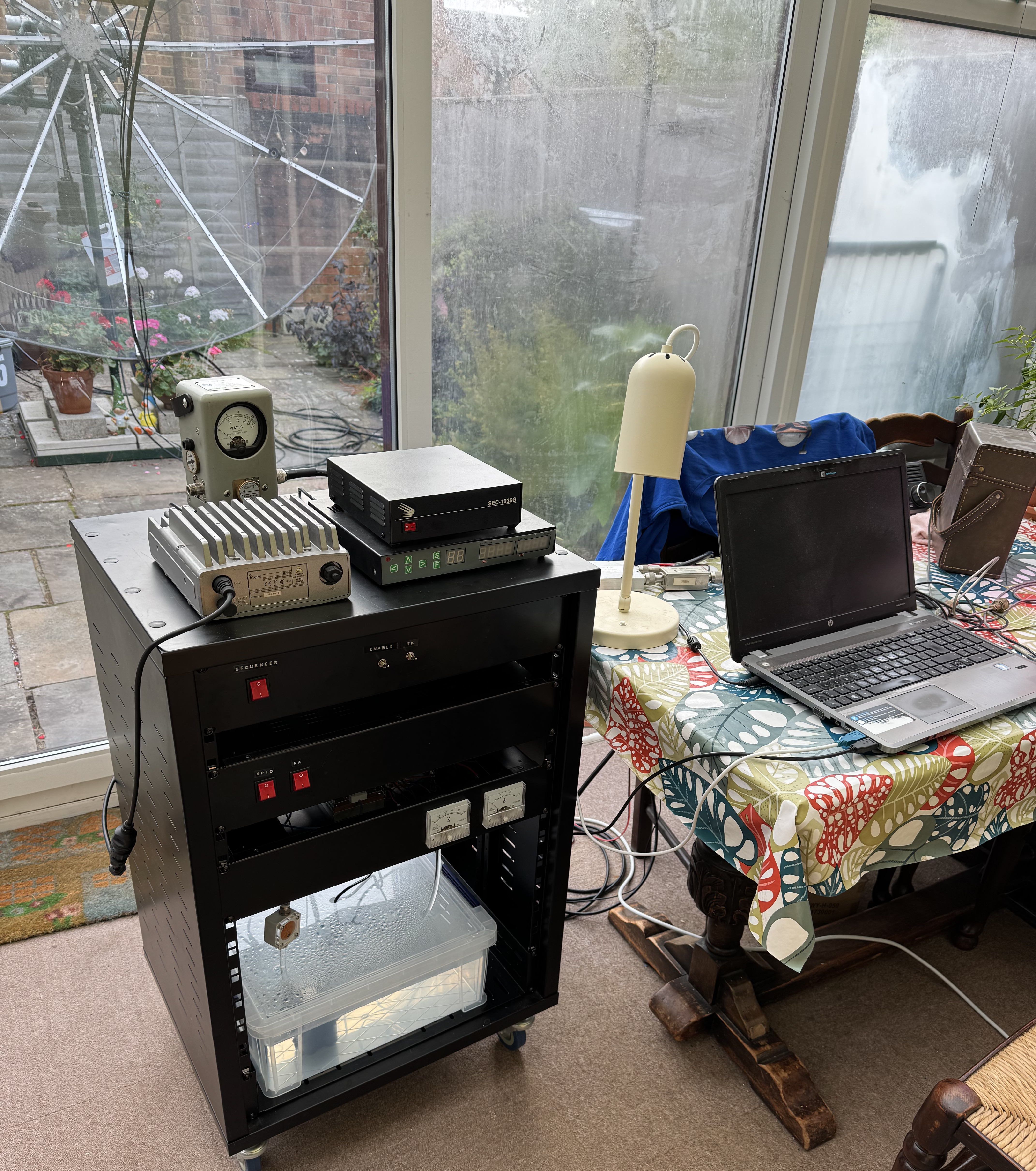 G4KLX EME Rack and Station
G4RGK Dave
I decided that I would give 70 cm all my attention this weekend, I had recently placed a 1.2 m solid dish in the centre of the Yagi array and I was keen to see how badly the performance was degraded. The final conclusion was that it made little difference so it will stay there for the moment. Conditions over the weekend were continually changing, with severe degradation Saturday evening due to the Aurora. I started testing on Friday evening prior to the start and worked ON7EQ, JO4KVP, VK3EME, DL3JJ. All seemed ok with good solid echoes.
I started off at midnight looking for CW stations at bottom end of the band, I found nothing except carriers and a raised noise floor all over the CW part, so I moved up the band and set up on Q65. There followed a steady flow of stations: DD0VF, JA4MVG, JJ1NNJ, OE3JPC, OK1VUM, PA2CHR, W3TI, OK1JG, DL7URH, ON7EQ, KD2LGX, VE4MA, N1AV, K5QE, W4ZST, DC2TH, K4EME, HB9Q, K3SK, W5ZN, and W8IO right on my moonset.
Saturday evening before moonrise a fairly strong aurora developed and this proved to be very destructive to EME signals, Echoes were nonexistent and signals that were easily workable the previous evening were way down in the noise. Eventually I started to get calls to my CQ, and I worked: JO4KVP, IZ2DJP, VK4EME, 7K3LGC, OH3TRN, DL1VPL, JA4MVG, OK1TEH, IW0RNA, OK1DFC, UA3PTW, and JF6CTK. At 0130 I gave up and went to bed.
Back on at 0720 conditions seemed no better but I managed QSOs with DF7LH, PA6Y, XQ3SA, YL2GD, PA3DRK, DC2TH, SM4GGC, S56P, GD0TEP, DF2VJ, and right on my Moonset, K1KG. I was not QRV for the third pass so I ended up with 43 QSOs all on Q65. Everything worked flawlessly, next month I will concentrate mainly on 23 cm with the dish and only operate 70 cm when the dish can’t see the moon.
KB7Q Gene
I made a maximum "butt-in-the-chair" effort for the first weekend of the ARRL EME Contest solely on 23 cm. The remote link to the station held up quite well and I logged 83 contacts from the sanctity of my den. It rained on/off the whole weekend so I had a wet nylon stuff sack covering the feed to keep the relay and pre-amp dry, as a slight handicap. Eight stations were worked for the first time: BV3CE, DG5NFF, JQ3JWF, KL6M, ON5TA, R4CX, SV3AAF, and SM6PGP for initial #292. I used Q65-30B the whole time.
My goal is 100+ contacts in the contest to show what a 1.5 m "cooker" dish and 350 watts can do these days, thanks to the development efforts of so many folks over the past five years.
So please try and work me during the second weekend of the contest. I promise to make it quick!
KN0WS Carl
Since my 3 cm results in August were modest, and my 13 cm results in September were dismal, I was truly hoping for a good EME Halloween weekend. I left my wife with the candy and I set up for 23 cm. It seems like my site is cursed with rain at least one night during contest weekends, and the forecast was just so. Nevertheless, I was able to get everything operational and was pleased to actually see the moon rising through the trees!
I had 10 QSOs in my first hour, but soon my W6PQL amp was cutting out with load failures. The SWR on my antenna cable measured 1.3, so I scratched my head and tried some more. It only got worse. I spent two hours moving my dish back down, testing the components up to the feed. The end of one of my LMR400 cables was acutely kinked at the connector - likely damaging the outer crimp connection. A cable exchange cured things.
I went on that night 10/31 to digitally work OK2DL, YO2LAM, UA1ALD, OK1DFC, SP3YDE, PA0TBR, OM4XA, IK2DDR, NC1I, OK1USW, UA3PTW, UA9FAD, OH1LRY, DL4DTU, K2UYH team, N1AV, IK5VLS, G7TZZ, SQ7D, KC2HFQ, VA7MM, KB7Q, F5AOL, HB9Q, KN2K, ES3RF, OH3LWP, F1RJ, AA6I, W3SZ, VE4SA, K3SK, K5QE, AE6GD, W3TI, N5BF, KH6FA, JJ3JHP, KB2SA, WA3GFZ, VK4CDI, JQ3JWF, VE6TA and KG0D. I had initials with RY4C, ZS5Y, EA5Y, ON5TA, NN3Y, DG5NFF, OZ9AAR, PA1PS (my 300th initial on 23 cm), DL6ZG, N8ECI, GW4ZHI, K4VJ, KD2XN, KE7NR, W8TN and BV3CE.
On the second moon-pass I awoke from my tent to discover that it had been raining and the tarp on top of my power amp had blown off. I removed the top, which has lines of air vents, and sure enough: there was water standing inside, including on the RF deck. I used paper towels to blot up all of the water I could find, and then I said a prayer and turned the amplifier on. No smoke or sparks since I was standing in a puddle next to it. Fortunately, I have the cooling fans wired to blow continuously, so I let the fans blow air through the box for 45 minutes. And that worked!
I went on to work IQ2DB, LA3EQ, RY4C, OZ9KY, DF3RU, DL7UDA, K0DSP, ON4LX, OK1UGA, W2LPL, DL8FBD, RX3DR, DF7KB, PA3EXV, SM5DGX, HG5BMU, DL7UDA, DL1SUZ, NY1V, DL3WDG, PA3DZL, ON5GS, DL4DTU, IK3COJ, AF6SA, R1NW and K6EME. I had initials with N8XS, YU1DA, R4CX, W1XM, SV3AAF, SP9VFD, DM2CFH and KV7E. I did one CW QSO with G4CCH.
I am getting a hip replaced in December, and I have to say that adding fuel to my generators every hour, climbing a ladder to adjust dish declination and such in the cold rain was a bit tough this year. It led me to wrap up early on the second moon pass, costing me another shot at VK, and honestly, I was going to do 70 cm the second pass, but I was intimidated about all the gear change, so I stuck with 23 cm.
For fun, you can see how many duplicates I have listed above. In the end it was 93 QSOs plus 5 additional duplicates. I apologize to those of you who wasted time on my dupes. I am still writing up paper lists and I make mistakes. My MAP65 setup shows me a waterfall but does not do decodes, so I was reminded this year to scroll up and down the dial a bit to find people who are active but not using the logger. Gene KB7Q said his 1.5 meter cooker dish was up to 82 shortly before I quit. I suspect he worked about everyone I did with my 4.8 meter dish, just with a bit smaller signal strengths.
If I am not snowed out of the final ARRL weekend, I will try 70 cm the first pass, and possibly 70 again on the second. If I finish my transverter, I may try 33 cm the second pass once the moon has set in Europe. GL to everybody!
KN2K Ray
My operation on the third weekend of the ARRL EME Contest was on 23 cm. With a fourth weekend yet to go, the 23 cm QSO count has already exceeded 140% of last year’s contest total for 23 cm. A number of factors have helped. First, the weather allowed operation throughout the entire contest weekend. Second, nearly all stations contacted were via Q65-30B. The shift to 30-second periods greatly sped up the making of QSOs. Third, there have been modest improvements to both east and west facing 23 cm stations at KN2K in the last year. Finally, both EME stations at KN2K performed nominally during the contest for the first time.
Some of the improvements made since last year’s contest follows. The IC-9700 in the west-facing station has been cured of its frequency instability problem. A Wintrak controller and SL-1 now orient the west facing solar cooker to which a 115 mm rim fence has been added. In the east-facing station, the main improvement continues to be the smaller, 0.25-inch mesh now covering the 2.3 m 0.4 f/D dish. A recent enhancement available to both east and west facing stations is an Arduino-based power monitor that permits remote monitoring of the W6PQL based SSPA at the dish.
Having focused in the third contest weekend on 23 cm stations workable with Q65-30B, I hope to contact more stations running Q65-60C during the final contest weekend.
Many thanks to all for the QSOs so far and 73!
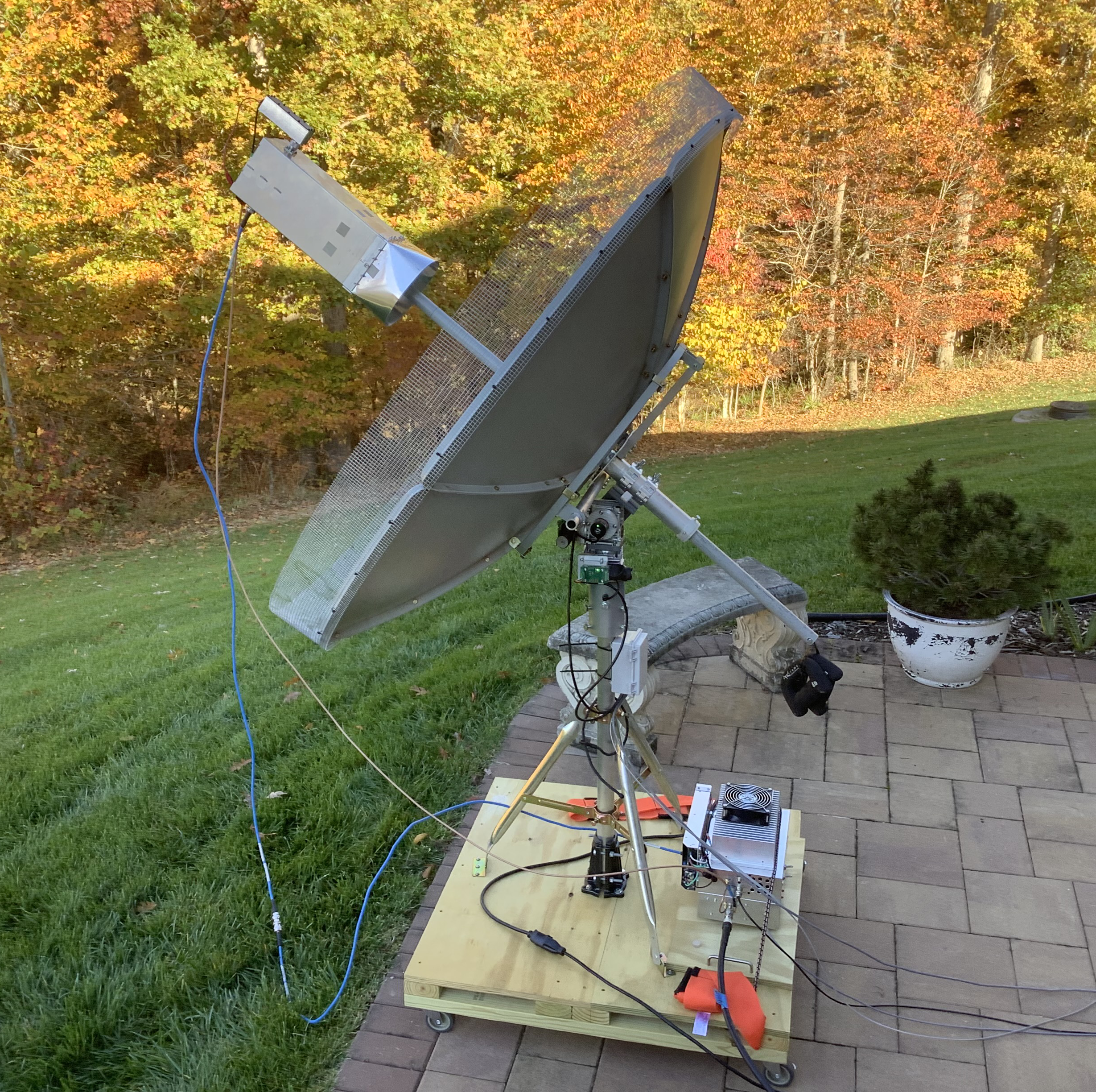 KN2K Improved West Facing Solar Cooker
N0AKC Charlie
During the first leg of the October weekend of the ARRL EME contest I managed 51 QSOs on 144 MHz; 3 on 222 MHz; 14 on 70 cm; and 11 on 23 cm. My dish didn't seem to perform very well, which typically means I need to optimize the feed better, so I've been working on that in hopes of being able to work many more stations on 23 cm during the November weekend. I plan to have the 1296 feed in for the first evening and swap in the 902 feed for the last moon pass.
I have been working on a new HV supply for my 70 cm amplifier. Currently my 2 m and 70 cm RF decks share a common HV supply and it's not capable of running both decks at the same time. If I can manage to complete the new supply prior to the contest weekend I'll be able to run both bands simultaneously.
Aside from the ARRL contest I did not have much time to get on EME most of the summer and fall. I've been bogged down with way too many non-radio projects that have kept me busy, but most of those are completed so I'm looking forward to being a lot more active in the coming months. I still need 15 more states on 70 cm and 22 more on 23 cm for WAS so I'm hoping I'll be able to knock off a few of those.
N5BF Courtney
In ARRL Weekend #3, I had 44 complete QSOs and 8 new initials on 23 cm. Adding the 6 initials from a test run the night before the contest makes 14 initials for the weekend: CT1WO, PA3BYV, F5AOL, K4VJ, AC2AC, EA5Y, RY4C, OZ9AAR, DL6ZG, SQ7D, N8ECI, DM2CFH, and JQ3JWF. It is good to see many new stations balancing attrition.
Studying my logs and contest statistics over the last ten years, I see steady progress first as I learned what I was doing then as station upgrades gave more "reach". However, following a downgrade from "fixed 3.8 m" to "portable 2.4 m" in 2024, I'm only doing about 70% of the old performance on digital. CW completions are down to 20% (both DUBUS and ARRL) from the old days, and sideband is just gone. I realize that some of this is due to global trends (more digital, less analog) but all the QSOs I can't quite make are frustrating for the operators on both ends and it's tough being a less respectable target than I once was. I don't mind the hour long setup and hour long tear down, but it was also nice in the old days to just sit down and throw seven switches and be on the air.
I'm pondering what to do about all this given that, even in retirement, there are only 24 hours in a day and I spend more of them napping than I once did.
Meanwhile, I still need North Dakota for 23 cm WAS and would do a dedicated setup for that if there was an activation.
The attached photo shows the folding dish in the rain with trash bags over the exposed electronics. I wonder if the fabric being wet affects performance?
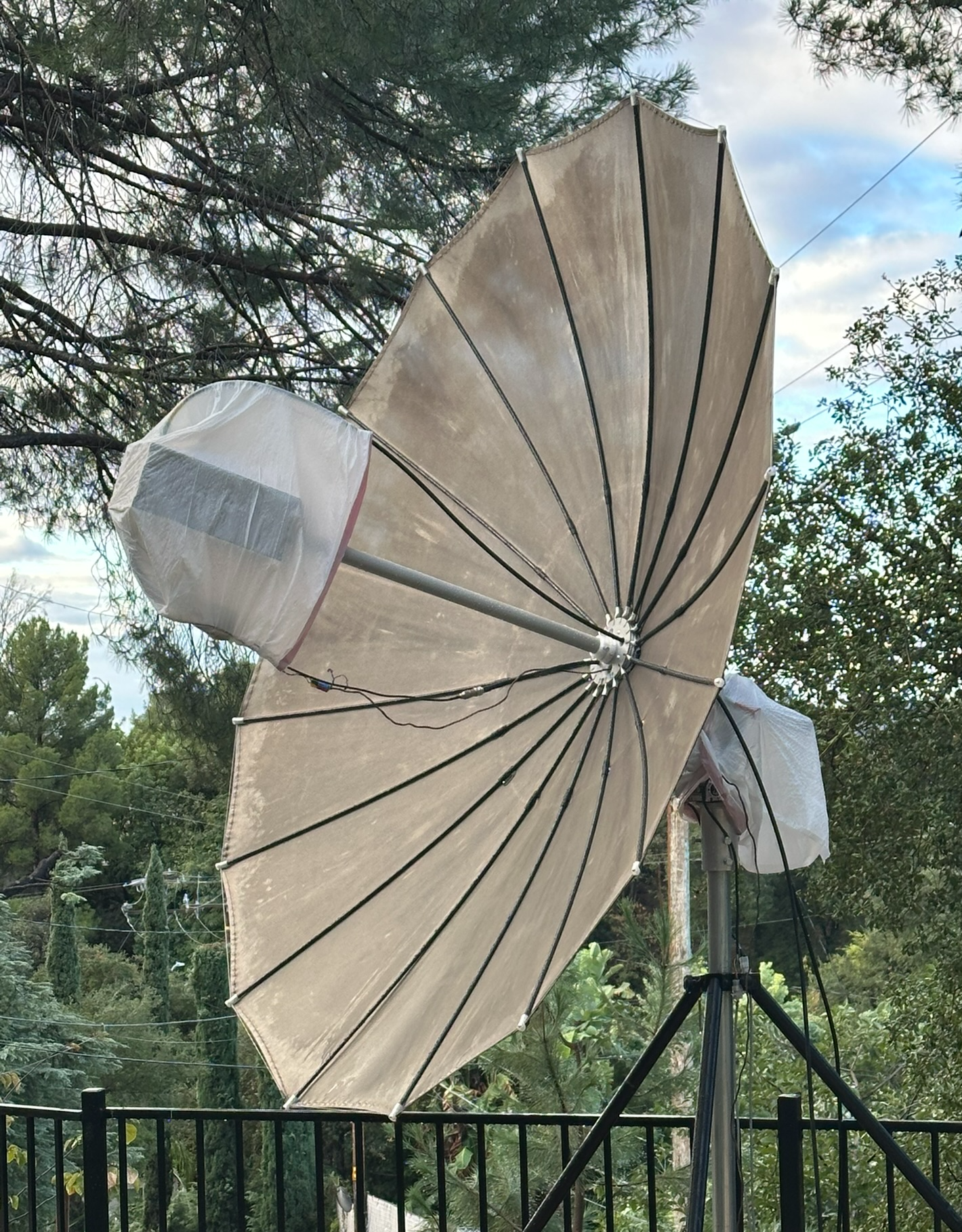 N5BF Weatherproofed 2.4 m Dish
NC1I Frank
Since my report last month, I have added the following initials on 23 cm; NN3Y, GM8RBT, OE1ISB, W0PN, DG5NFF, and OE4MTI.
W1QA operated the 23 cm station during the two contest moon passes using my call. He did not use the logger at all the first night and the second night he only made one post indicating that he would be QRV, and then immediately logged out. He will likely put some time in the last contest weekend also.
I am still off 70 cm. W1QA, K1FMS, and I have been working on getting the station back on line. The amplifier has been repaired and is ready to go. We are currently working on adding additional amplifier protection using OZ9AAR's excellent REPAM board and associated hardware. W1QA has been working on this over the last several weeks but there is still some work to do. It is highly unlikely we will be QRV on 70 cm again until sometime in December.
A few weeks ago, we replaced the AZ prop-pitch drive and the TX and RX flex-lines on the 70 cm array. The amplifier was damaged by an infinite SWR but all tests since that event have shown the array to be nearly flat. We have not yet figured out what caused the SWR to go so high and then return to normal.
OH3LWP Ari
Activity level was high at 23 cm in the ARRL EME contest 3rd weekend this year.
I was QRV for 17 hours and worked the following at 1.3 GHz:
On 31/10/2025 digital JQ3JWF, UA1ALD, BV3CE, SP3YDE, ON5TA, ZS5Y, RY4C, OK1USW, OM4XA, W4ATC, OK1IL, UA9AFD, OZ9KY, IK2DDR, K2UYH, OK2DL, PA0TBR, DL4DTU, F5AOL, N1AV, NN3Y, K5QE, EA5Y, W3TI, KN2K, K0DSP, DJ7FJ, IK2FAK, VE6TA, OK1DFC, IQ2DB, HB9Q, KE7NR, IK5VLS, F1RJ, ON4LX, N8XS, W3SZ, KC2HFQ, K3SK, AF6SA, DL1SUZ, PA3BYV, PA3EXV, SV3AAF, VA7MM, SQ7D, OK1UGA, DL7UDA, DL6ZG, YO2LAM, G7TZZ, DG5NFF, K6FOD, KB7Q, AA6I, N5BF, K4VJ, ES3RF, OH1LRY, & KN0WS.
On 1/11/2025 digital R4CX, DF7KB, DF3RU, G4KLX, YU1DA, W1FKF, WA3GFX, KA1GT, UA3PTW, 9H1BN, W1XM, LA3EQ, W2LPL, SA6BUN, KB2SA, DL3WDG, PA3DZL, GW4ZHI, DM2CFH, SP9VFD, SM6PGP, OE3JPC, NY1V, F4BLE, WB1BQE, KG0D, DL8FBD, IK3COJ, VE4SA, KH6FA, OE3GWC, ON5GS, SM5DGX, KV7E, R1NW, PA0PLY, KB2FCV, G4YTL, AA4MD, N8ECI, VK4CDI, VK3VJP, VK2CMP, YL2GD, PA3FXB, & KL6M.
On 1/11/2025 CW SP3XBO, G3LTF, SP9VFD, & G4CCH.
I had a total of 111 QSOs with a lot of new initials. The average QSO rate was roughly 9 minutes per QSO. A highlight was activation of the K2UYH call sign.
New inits worked in the 20/10/2026 to 16/11/2026 time window are as below (digital if not marked CW):
New 23 cm inits:
24/10/2026 WB1BQE
30/10/2026 PA3BYV
31/10/2026 ON5TA, W4ATC, K2UYH, K0DSP, DG5NFF
01/11/2026 W1XM, KB2FCV
New 3 cm inits:
24/10/2026 AC0RA/R, OK1DGR
28/10/2026 W6TCP, N0LNO, SM7FWZ CW
Worked AC0RA/R 10 GHz rover from a few new US states and locators:
24/10/2026 AC0RA/R FN13 NY
28/10/2026 AC0RA/R FN42 NH
29/10/2026 AC0RA/R FN41 CT
30/10/2026 AC0RA/R FM28 MD
30/10/2026 AC0RA/R FM28 DE
Thank you for the effort, Wyatt!
OK1DFC Zdenek
As I took part in the previous two rounds of the microwave section of ARRL, this is a continuation for me into the third round of the contest, this time on the 1296 and 432 MHz bands. I spent a long time thinking about how to organize the stages to maximize my yield. The thing is that I must retune the large dish to the required band. It was easier in the microwave section. I was always QRV on 13 cm, and I switched between the remaining bands using the small dish.
This leg the moon was already at 40° elevation when the contest began, so I started on the 23 cm band to catch as many stations from the USA as possible. The activity on the 23 cm band was incredible. There were loads of new stations in the US who’d started using ‘umbrella antennas’ and all-metal 180 cm antennas, which they call “solar cookers”. I managed to make 22 new inits on the 23 cm band.
At the next moonrise, I continued on 23 cm, and when the moon reached an azimuth of 180°, I switched to 432 MHz. I already had 122 QSOs on 23 cm in my log, so I started contesting on 432 MHz. On the 432 MHz band, the situation was completely different. It wasn’t that there were no stations, but due to the aurora, the polarization was shifting like mad. I had to make several EU-EU QSOs by switching the polarization from V to H. The rotary feed was therefore in constant use. Many stations from JA and W were also out of alignment, though perhaps only by 45°. So, every time I called CQ, if there was no response on the selected polarization, I would immediately rotate the feed to the opposite polarization for the next call.
Despite this, I managed to make several interesting contacts. One new and interesting station for me was XQ3SA from Chile. Another interesting contact was with Martin OK2CMZ. To work him, I had to switch the polarization so that I was transmitting on the horizontal dipole and listening on the vertical one. Nevertheless, I managed to contact his single Yagi. For the final round, I’m still planning to use the 144 MHz band. I’m returning to it after a long 24 years, but the multiband category simply demands it. I’m very curious to see what the traffic will be like and what I’ll manage to achieve. The system is a 4x7-element G0KSC, with a 0.3 dB N/F LNA and a 2 kW OM Power SSPA. I hope everything works and that I manage to make a few contacts.
Finally, here’s an overview of the call signs I’ve worked on 432 and 1296 MHz. On the 1296 MHz band, I’ve passed the 700-call-sign mark and have thus started the next hundred. Hopefully the weather will hold, and Murphy will take a break again.
1296 MHz
YU1DA #701 SM6ESW #702 GM8RBT #703 RY4C #704 R2BOW #705 WI0JK #706 NN3Y #707 5P3Z #708 N8XS #709 R4CX #710 EA5Y #711 W0PN #712 AF6SA # 713 KV7E #714 OE1ISB #715 KE7NR #716 DG5NFF #717 DL6ZG #718 N8ECI #719 WB1BQE #720 OE3GWC #721 VK2CMP #722
432 MHz
JH0VJW #609 DF5RF # 610 OK2IKT #611 BD8AIS #612 VE3CIO #613 KC1WAY #614 XQ3SA #615 DG9BFJ #616 OK2CMZ #617 PA3DRK #618 K3SK #619 VK4AMG #620 7K3LGC #621
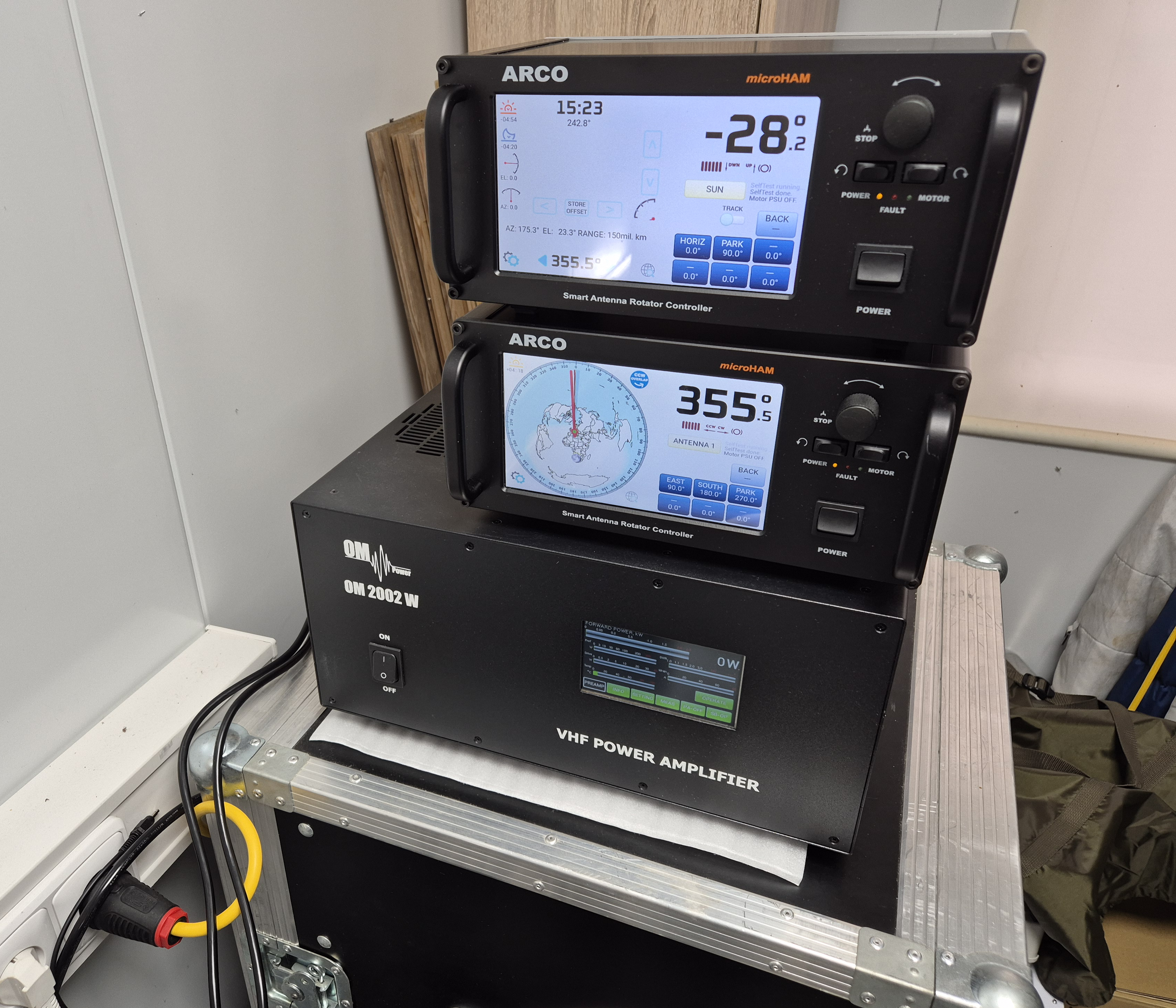 OK1DFC 144 MHz setup
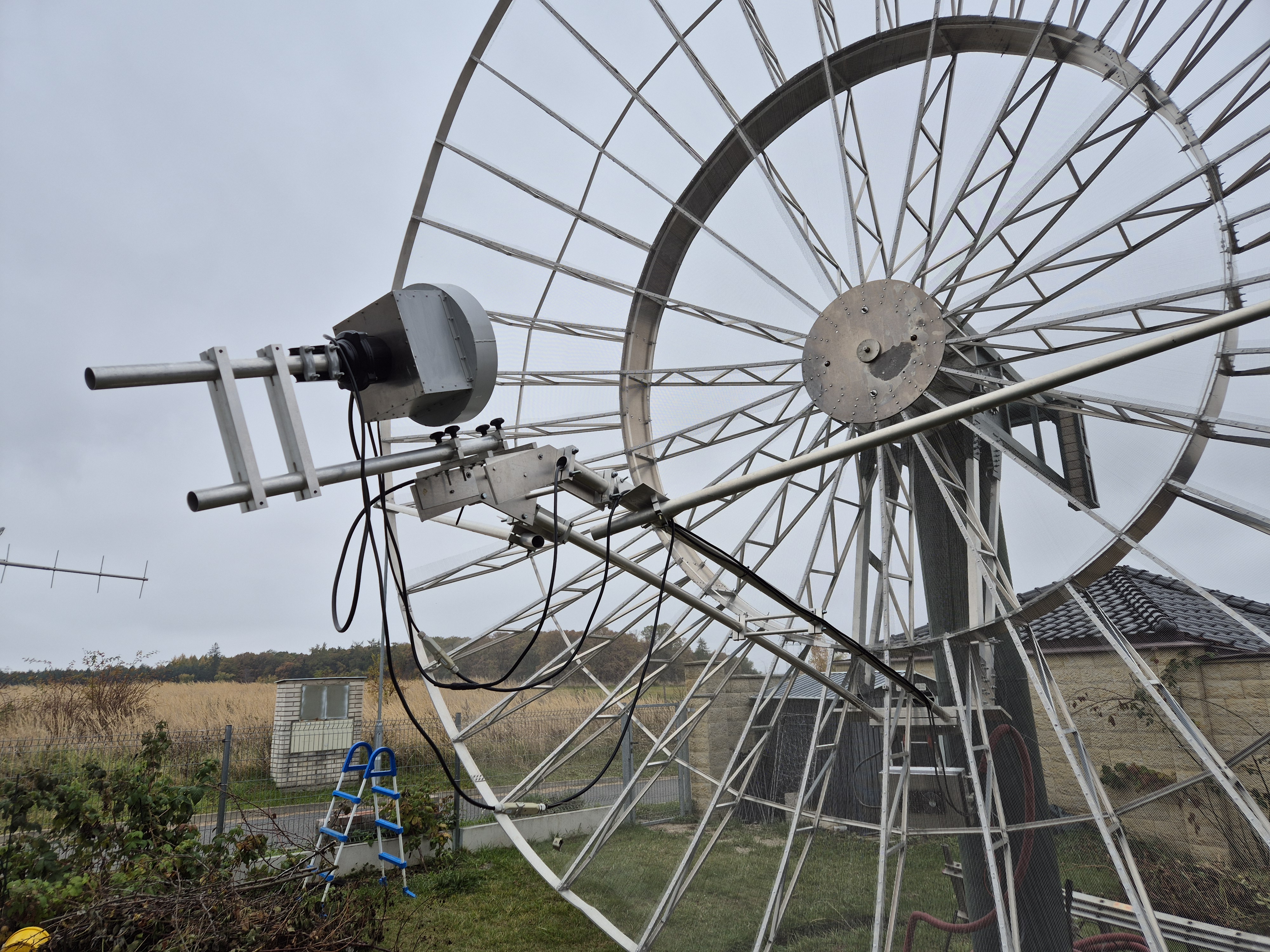
OK1KIR Vlada & Tonda
During the last week of October we spent most nights on 3 cm following the magnificent rover expedition of Wyatt AC0RA/R through the east of the US. Wyatt was active from many states on 3 cm with OF dish 1.8 m and 14 W.
After 3 cm installation and preparation on Oct 22 we worked at 19:54 DL8EBL (-13/-8) as #309. On the next day, October 23rd at 20:35 worked with CW IT9EQO (559/559) as CW #164 and at 21:36 OK1DGR (-18/-14) #310 as a new OK station on 3 cm (PF 1.2 m dish & 12 W). Later at 22:22 we worked the 3 cm expedition AC0RA/R (-15/-11) #311 from NY state.
On October 26th at 00:25 easy AC0RA/R (-16/-12) #312 from MA state and at 01:31 W6TCP (-12/-8) as #313. MN measured at 3.3 dB. Further in the evening on October 26th we worked at 21:37 CT2GUR (-11/-9) followed by IW2FZR (-10/-6). MN was even better at 3.4dB, DL0SHF was +1 dB and IK3HAR was heard at -14 dB.
We continued on October 27th at 00:08 AC0RA/R (-14/-10) #314 from VT state and later at 00:58 with N0LNO (-12/-4) as #315.
On October 28th at 00:48 we worked AC0RA/R (-15/-11) {B-13/B-9} as #316 from ME state. Later on after Wyatt moved, we worked at 04:18 AC0RA/R (-13/-9) #317 from NH state. MN was 3.5 dB at EL 61 deg.
On the next day, October 29th at 01:53 AC0RA/R (-14/-8) #318 from RI state. MN was 3.6 dB at EL 66 degrees. After the next Wyatt move at 04:53 AC0RA/R (-13/-8) as #319 from CT state. In the evening of October 29th worked in CW at 21:57 UA3XCR (559/539) CW #165.
On the next day, October 30th, on route to his IA home we worked at 02:54 AC0RA/R (-14/-9) #320 from MD state and later at 03:04 AC0RA/R (-14/-9) #321 from DE state. Later that morning he made an additional stop in MD and at 09:30 worked again AC0RA/R (-16/-10). During that QSO Dpol was only some -3 deg we had to turn from standard EU V-pol almost by 90 deg to Hpol! Otherwise no QSO was possible!
Unfortunately, the last stop of Wyatt in WV State was already after our MS. However, the overall 8 new US states improved our WAS count on 3 cm to 30. So, just the last 20 missing . . . Many thanks Wyatt!
Conditions on 3 cm were excellent all week and the high elevation of Moon during Wyatt’s operation delivered exceptional MN figures up to 3.6 dB!
After a tough week of operation on 3 cm our participation in the 3rd part of ARRL EME Contest was reduced to searching for new stations on 23 cm. From a total 25 QSOs made during October 31 and November 1 only one was in CW with OK2PE (579/589). From the remaining 24 digi QSOs only 3 were Q65-60C and the rest were done with Q65-30B.
Among them on November 1st was at 05:27 a QSO with the K2UYH call (-1/-1), a reminder of Al‘s legacy.
Overall, we gained on 23 cm 15 new digi initials by QSOs with SQ7D as digi #693, followed by GM8RBT, DG5NFF, R2BOW, NN3B, OE3GWC, WB1BQE, 9A5M, SP2HPD, 5P3Z, OE1ISB, PA3GUO, N8XS, W2MDD and finally KB2FCV as digi #707. Among all QSOs two new locators increased our total account to mixed mode 545 locators.
OK1VUM Mila
On the Friday before the contest, I lowered the 70 cm antenna to the ground to reduce the play in the actuator that controls the elevation. I had a replacement actuator ready that appeared to have no play. Thanks to Tomáš OK1IMJ for his help with the replacement. In the end, however, it turned out that even the replacement actuator has some play, which only becomes apparent under load, but it’s slightly better than the original one.
During the first part of the ARRL contest, I focused on the 70 cm band; but on 23 cm I made a few contacts with friends on Sunday morning when conditions on 70 cm were poor. In total, after deducting duplicate contacts, I made 77 QSOs, including two on CW (DL9BDM and DL9KR).
I missed at least two other CW stations because I didn’t have CW set up on Saturday, and they didn’t appear again on Sunday. I ran the entire contest remotely using the original ICOM remote software RS-BA1, and for CW I used the excellent software from DH4YHR. I managed 10 inits: W8IO, K5QE, DG9BFJ, KC1WAY, OE4MTI/P, DL9BDM, JH0VJW, DF5RF, K1KG, and OK2CMZ.
On Saturday evening, I received an email from IW5BNL with some attached
photos:
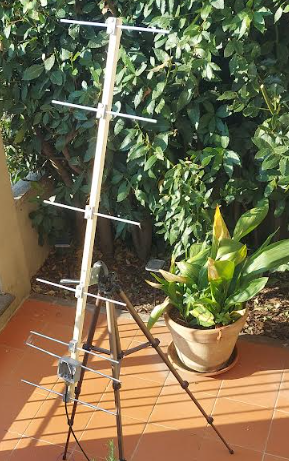 IW5BNL 70 cm antenna
 IW5BNL Decode of OK1VUM
OK2AQ Mirek
From October 22 to November 1, I had the 3 cm antenna set up and made a total of 38 QSOs with six initial callsigns. The first was DL8EBL (-18, -15). I worked AC0RA/R (-20, -22) from a conference in Rochester NY, but I had no luck from the other states. My antenna elevation is limited to < 50°, and Wyatt was active only briefly during the times when the moon was too high.
On October 29, I worked CW with UA3XCR (O, RO). After a few attempts, we subsequently made our first contact with Vladimir OK1DGR (-18, -18) and, the following day, with W6TCP (-10, -14).
In the ARI EME Autumn Trophy, I made 23 QSOs with 1274 points. In addition to the wet weather, attendance was likely also affected by the fact that the ARRL EME Contest (50 MHz to 1296 MHz) was taking place at the same time. Essentially, it was a European contest, and the participation of Italian stations can be viewed positively. Only Zhu BD4SY represented Asia, while VE4MA and KM0T represented North America. A pleasant surprise was UA4LCF (-16, -18) {#204}, who made his second EME QSO with me. With a 1.2 meter offset and 10 W of power, he had a very good signal.
Access my On-line Log
ON5GS Dirk
It was nice to see a lot of old and new friends on 1296 MHz during only 1 moon pass of the ARRL EME contest on October 31st – November 1st! I didn't use CW as much as I wanted because Q65-30B makes QSOs really fast and efficient and the band was nicely filled with stations all through the moon pass.
I made 62 QSOs including:
OK1DFC, PA3EXV, YU1DA, G7TZZ, JQ3JWF, UA1ALD, SP9VFD, OM4XA, UA9FED, SP3YDE, PA0TBR, SQ7D, PA0PLY, DF3RU, JJ3JHP, OZ9KY, BV3CE, EA5Y, GM8RBT, BA7NQ, ZS5Y, DL7UDA, JA4LJB, RY4C, IK5VLS, G4ALH, OM0MS, ON5TA, DF3RU (CW), EA5Y (CW), OK2PE (CW), PA3GUO, KA1GT, DG5NFF, W3SZ, ON4LX, W2LPL, ES3RF, W1XM, K2UYH, VA7MM, DM2CFH, OK1USW, PA3DZL, OK2DL, IQ2DB, R1NW, DL6ZG, F5AOL, KC2HFQ, KN0WS, OH3LWP, N1AV, KH6FA, DF7KB, G3LTF (CW), KG0D, VE6TA, K3SK, KB7Q, AA6I, & VE4SA.
TNX all for nice activity!
OZ9AAR Carsten
Due to family commitments, I was only active for 2 hours on 23 cm EME in the first weekend of the ARRL contest. Despite that, I logged 37 QSOs, and of these 7 were new initials: N1AV, KB7Q, SP3YDE, LA3EQ, IK2DDR, OM4XA, OE4MTI/P, AA6I, AF6SA, OK1DFC, K2UYH, VE4SA, OK2DL, SP2HPD, VA7MM, KN0WS, W3TI, IQ2DB, N8XS, ES3RF, OK1USW, DL8MAI, EA5Y, KN2K, KC2HFQ, NN3Y, RY4C, SP3Z, N5BF, UA1ALD, W3SZ, KV7E, KB2SA, OZ7KY, F1RJ, and SQ7D.
I hope to be more active in the second weekend if everything falls into place. My systems continue to function perfectly, except for one incident. I got an alarm from my REPAM PA monitoring system with "High SWR" some weeks ago. It turned out there was some water on the surface of the 7/16 DIN connector for the TX probe in my feedhorn, there was a small opening I had not noticed before. It was a simple fix, but I was happy that the alarm went off and shut down the dual W6PQL PA before damage could happen 😃. Since the fix, all has been working as expected.
I have released new versions of my SimpleCalc, SkyScanner and the online SkyTemperature applications and they are as usual available from my website:
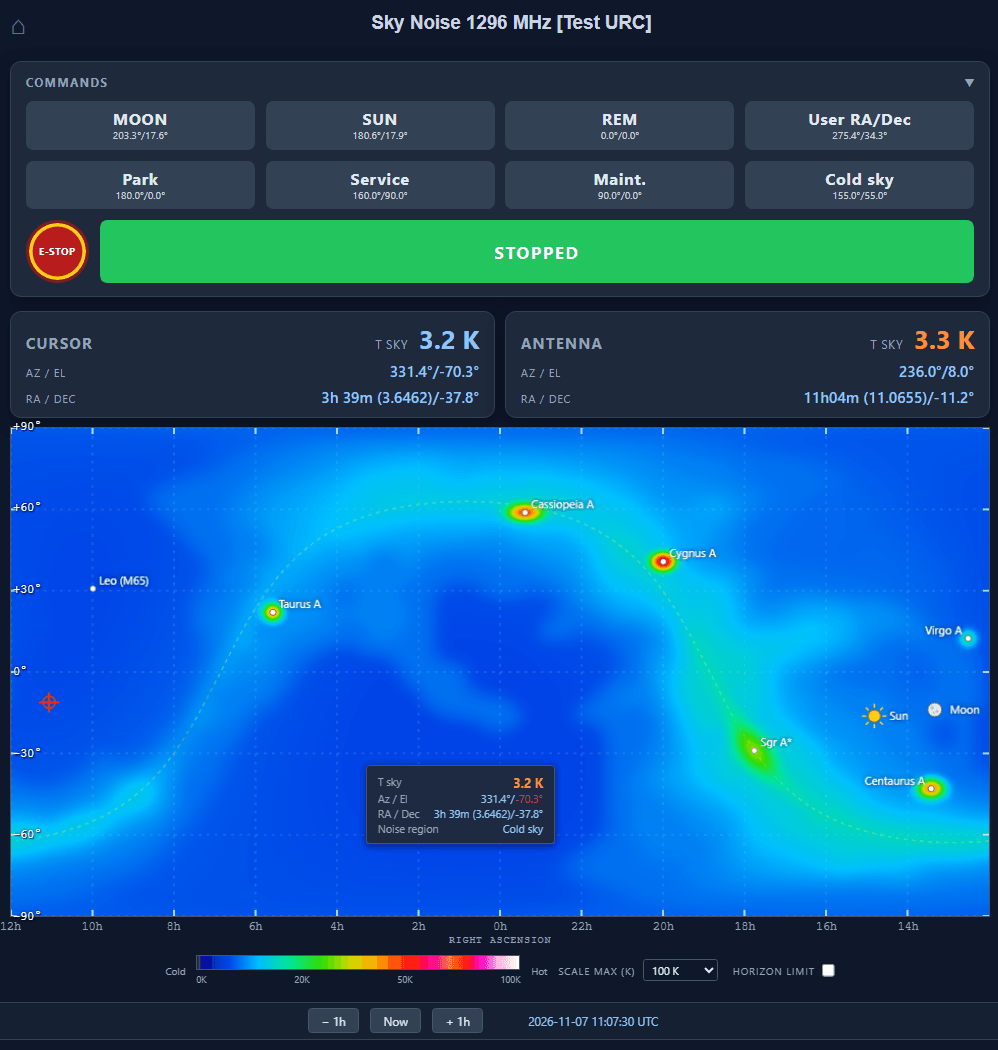 OZ9AAR URC Skynoise
New Projects
The biggest project news for now is that I finished development of my "URC - Ultimate Rotor Controller". It has been running my own systems for more than four years now, the initial plan was for the URC to be my own "internal project", but due to questions from others about availability, I decided to do a proper redesign of the URC so it would be easier to produce, etc.
The URC supports a wide number of absolute encoders, incremental encoders etc. It comes with a built-in webserver, VNC support and a lot of other features. The first 30 units have been shipped out already and several of these are already making contacts. More information on my webpage
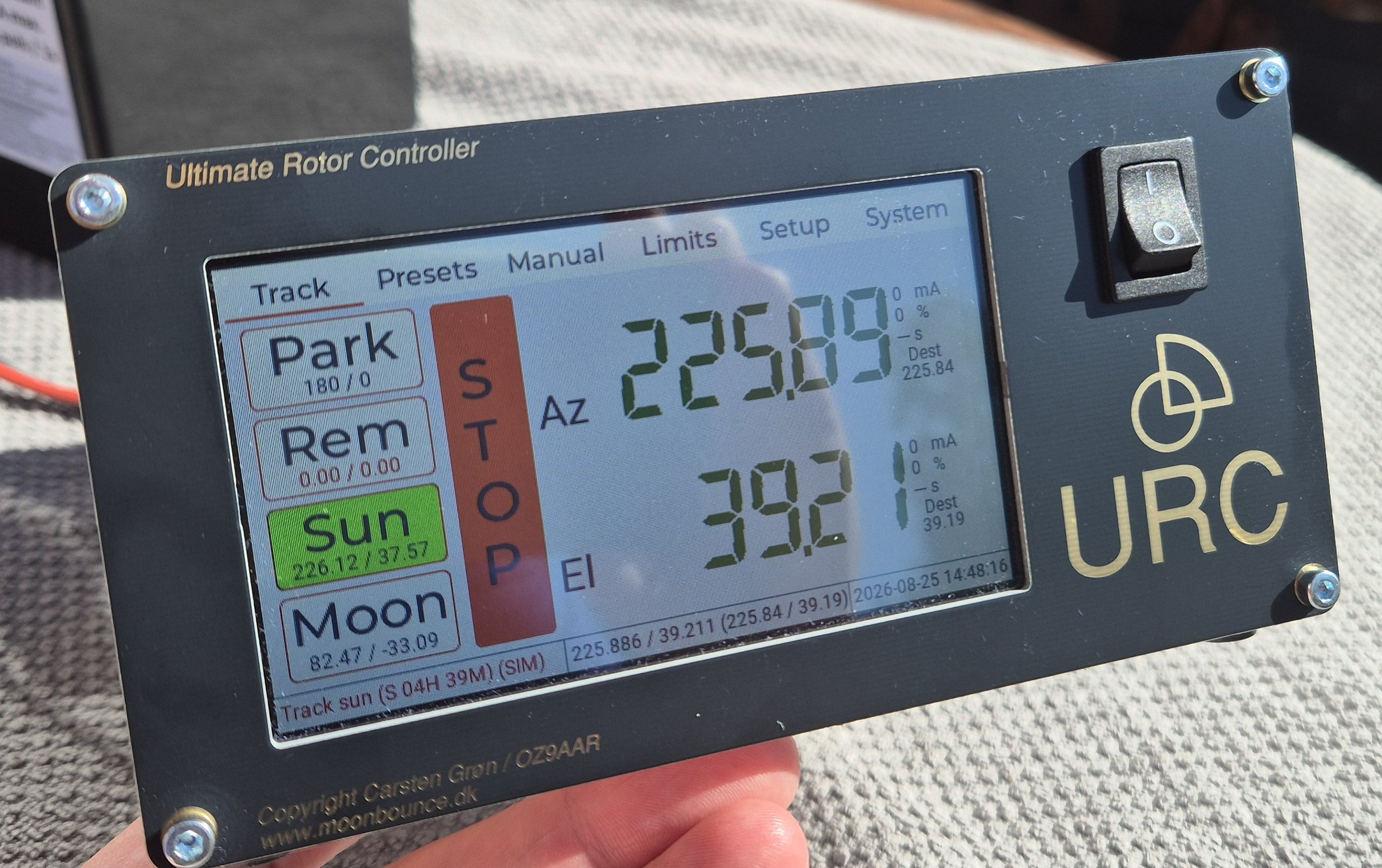 OZ9AAR URC Rotor controller front
I also created a couple of "USB programmable attenuators", one with bypass relays (with DC sense on the coax for direct connection to for example a IC-9700) and one without bypass relays (for use on a "RX only" coax). The programmable attenuators cover at least from 10 MHz to 3 GHz (3 GHz is so far the highest frequency I can calibrate to, but I have a new signal generator incoming shortly).
The programmable attenuators can be controlled from their own small application and also from the newest version of SimpleCalc. When used from within SimpleCalc, an automatic sun noise/termination noise wizard will help measure noise using the accurate "substitution mode", the ultimate way of measuring noise without any problems with receiver linearity problems, compression etc. There is a lot of information about this on the website SimpleCalc
The files for making your own attenuators are available on my website, I have a limited number of ready-made units available (calibrated for 10 different bands), if you don't want to "DIY". Programmable Attenuator
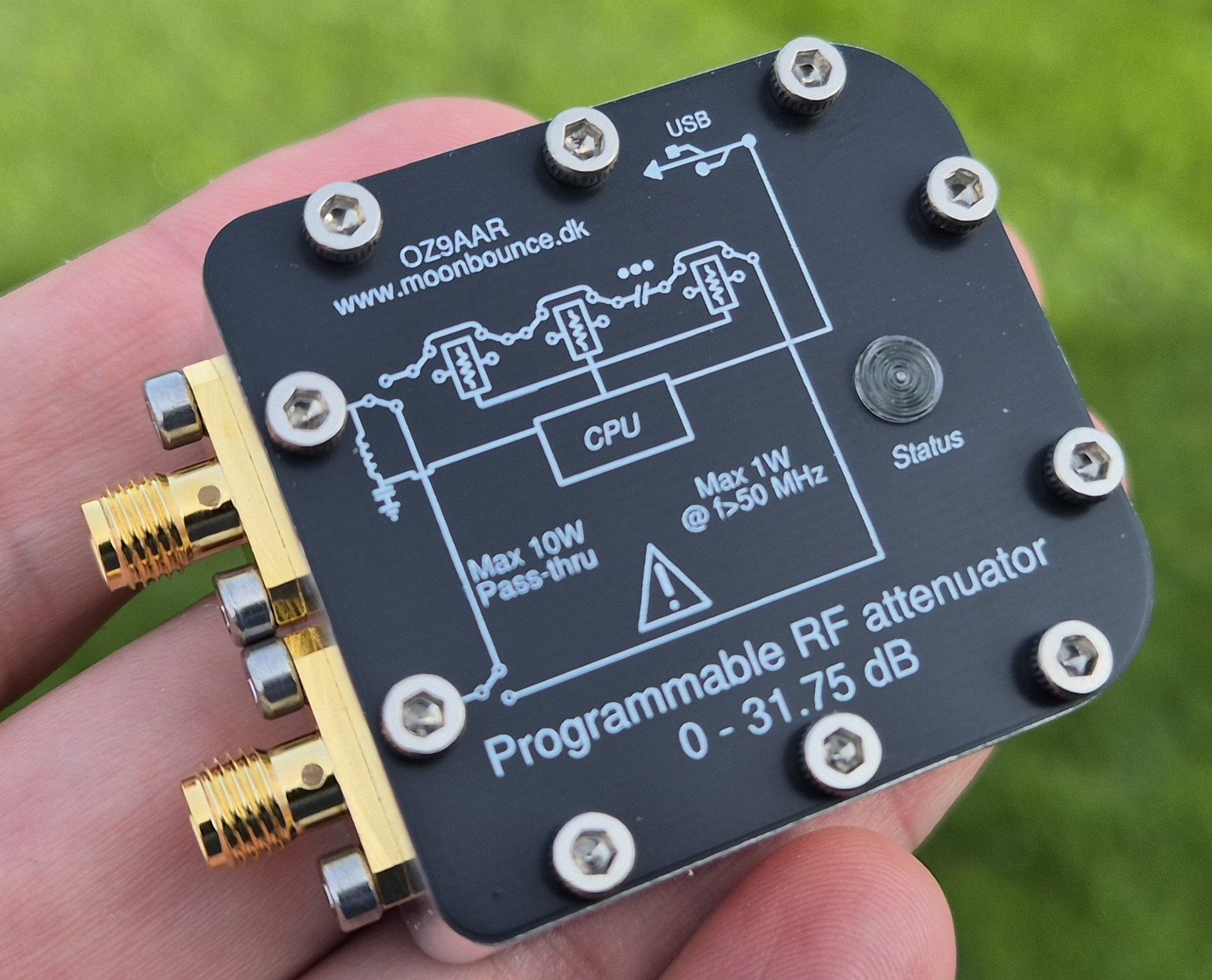 OZ9AAR Programmable attenuator
PA0PLY Jan
For the first moon pass on Saturday October 31st, I was on 13 cm to follow up the ARI spring contest. Unfortunately I had only 2 QSOs in Q65: ON5QT and PA3JRK.
In the afternoon I replaced the 13 cm system for the 23 cm system. The Sunday Nov 1st moon pass was much better as many stations were in the ARRL contest. I used a single DF9IC brick amplifier with some 320 Watts out. It was really hard working in 30B mode. Lucky enough I use LOG4OM which automatically logs the Q65 QSO's from WSJT-X.
I made 58 QSOs and 12 initials: SQ7D, EA5Y, JA4JLB, RY4C, G4ALH, GM8RBT, ON5TA, K5QE, DB5NFF, AF6SA, KV7E and F4BLE.
After the contest I worked on 23cm:
Nov 5th
ON5TA -13/-15
Nov 6th
F1DPX -24/-22, SP5GDM -06/-12, KE7NR -20/-19 #399
Nov 7th
OM6AA -15/-10 #400, F5AOL -19/-18, OE3GWC -20/-24 #401, PH0V -18/-13, & LA3EQ -17/-20
In the meanwhile I replaced my VK5DJ antenna controller for the newly built OE5JFL.
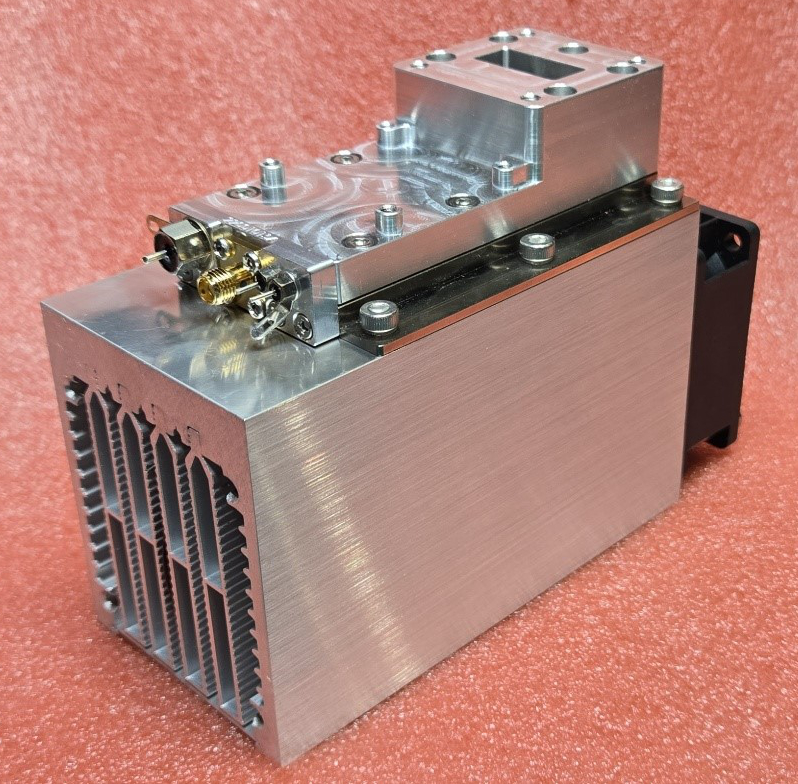
We were able to deliver the first 3 pieces of the CPA100B 100 Watt 5.7 GHz PA produced by DU3T.
For the XPA-40 (40 Watt 10 GHz) we are in the stress test process, executed by an expert ham. Once these tests are completed successfully the production run for the first batch will start.
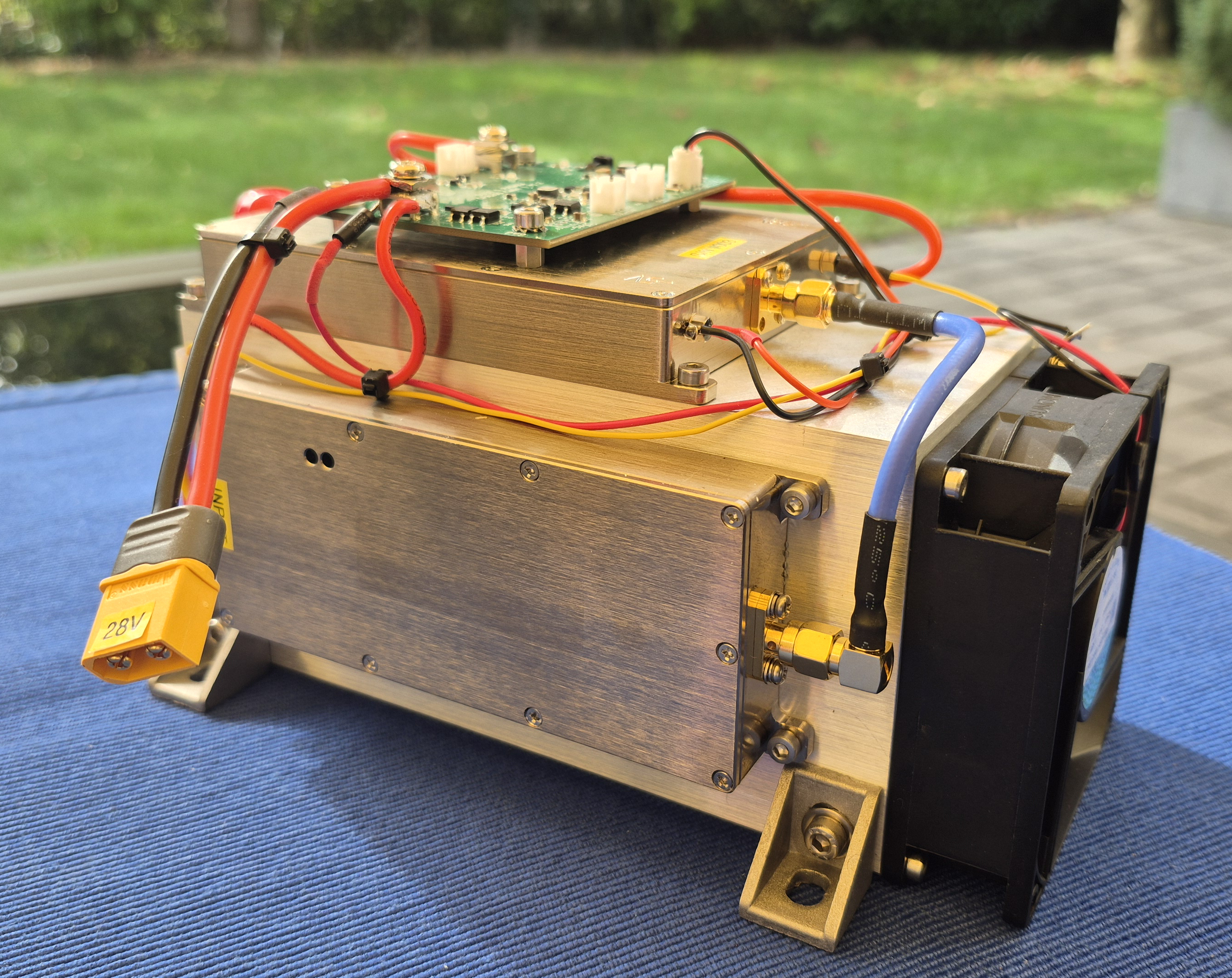 PA0PLY CPA 100B 100 W 5.7 GHz PA
 PA0PLY XPA 40 10 GHz 40 W PA
PA2V Peter
Together with Radioclub Kennemerland we planned all kinds of demonstrations with radio with the main focus on EME for the Saturday. This was also our last activity with the 4 x 14 el array. We take it down and start this week with a new mast and everything for the 3.7 m mesh dish. So, it was more or less a farewell party for the array too.
I started Saturday early to get everything at top performance for demonstrations on 432 MHz EME. I made 5 QSOs with my own call and switched to the club call PA6Y when everything seems to be fine. After 4 QSOs and 1 hour later a very high noise appeared and EME was impossible. We are located at the port of IJmuiden and normally it is a quiet location. But not on this Saturday, and further EME was impossible with the S7 noise. I guess Murphy was at the demonstrations too.
We had around 60 visitors from many parts of The Netherlands and even from Uganda, all coming to see EME. During these bad conditions we made it with K4EME who was very loud all the time. Our visitors were impressed!
A little disappointed with the Saturday results, I would not give up this way and came back on Sunday to make some more contest QSOs. I started at 0600 UTC and had loud echoes and worked many stations one after the other. This was EME as it’s supposed to be! I worked another 25 stations down to 10 degrees before moonset. It surely was much better compared to Saturday. Conditions changed all the time because of Faraday rotation. I also had a very nice CW QSO with Jan DL9KR.
When I came home, I checked 23 cm and saw some big guns on the logger. With my terrestrial setup I was able to work Grant VE6TA. Shortly after I saw K2UYH but could not make a complete QSO because the moon was behind the buildings at 2 degrees elevation. My home 23 cm setup is an IC9700, preamp and PA (250 W) in the shack, and around 0.6 dB loss to a 36 el Yagi with no elevation. My main lobe is between 4 and 8 degrees elevation and exactly where the moon was when Grant and I made it.
At the club we run 432 MHz 4x 14el with elevation, sufficient power and LNA at the antenna. During the weekend we often had good echoes, sometimes at -13 dB. For now, we are QRT in IJmuiden, but we will be back as soon as the dish is up and running. For the next contest in 2027 we hope to be active on 70 cm (H/V pol) and 23 cm.
The 4x 14el YU1CF including a power divider and phasing harness together with my 4x 27el YU1CF 432 MHz Yagis are available now for sale. We can’t store them for very long and I hate the idea of letting them end up as scrap metal. The 4x 27el needs a little maintenance but are still in good shape.
PA6Y will QSL via LoTW and direct. For more details have a look at QRZ.COM See you on the moon.
PA3DZL Jac
I was QRV on 23 cm and 2 m during the ARRL/ARI contest 31st Oct / 1st Nov.
I made 70 QSOs on 23 cm and 25 QSOs on 2 m. There was a lot of activity so in a short time I made many QSOs, but I could not be QRV during the night hours.
Outside the contest I was not QRV due to very busy QRL at this moment.
On 1296 MHz I am very happy with initials worked: PA3GUO #, KV7E #, WB1BQE #, DG5NFF # and JA6XED # after the contest. I'm now up to 737 initials on 23 cm.
PA3GUO Henk
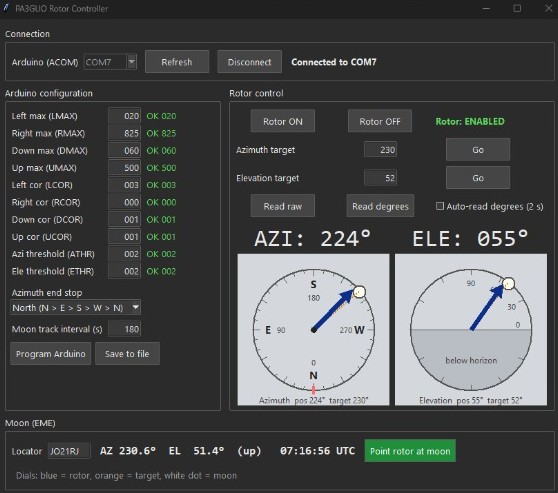
This month I updated my 30 year-old DOS “like” Python script for rotor control. Its User Interface (UI) really needed an update plus it needed moon position input from another piece of software (e.g., SatPC32) via serial port. Using Claude this was a piece of cake: it modernized its ‘look and feel’ and it now also calculates the moon location by itself.
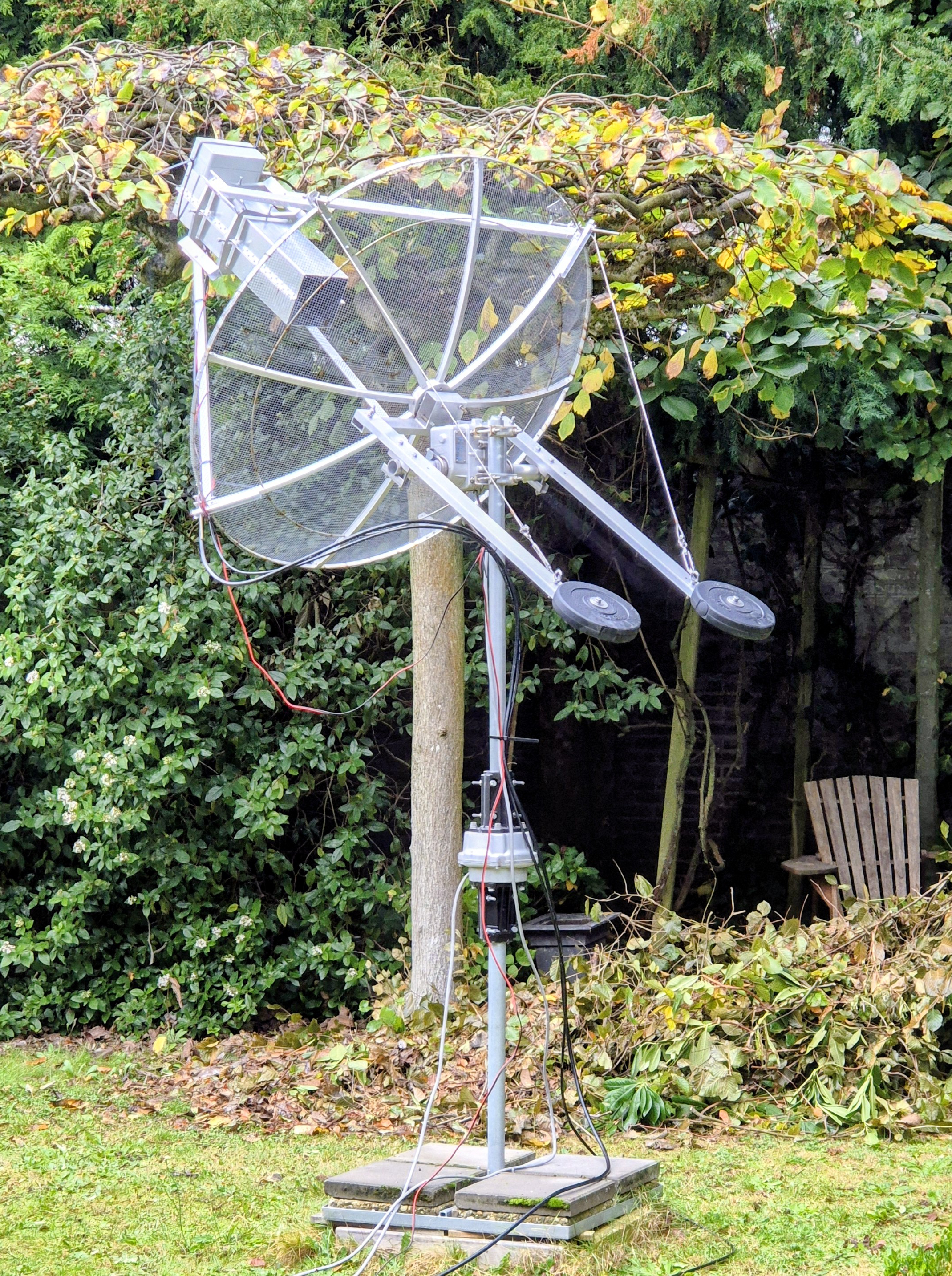
It was time to give it a go in the contest! I rushed home Friday afternoon at 3PM to be able to manually/visually calibrate the 1296 MHz 1.2 m dish direction/pointing, as the last sunshine for the next few days was disappearing rapidly. Later in the darkness of the evening I inserted the septum feed, mounted the cables, and was ready for RX (no time for sun-noise optimization, etc). The dish is in the garden and all other equipment is inside the warm shack. Last year I had it all in the living room, with doors open for coax, while outside it was a cold 5 deg C night on Friday & Saturday but I decoded within 2 hours 16 stations! My dish pointing was apparently not too much off, and the rotor control SW worked fine. The moon was in view at 3AM, and at 5AM I went back to get some sleep. Happy that RX worked!
Saturday afternoon I installed and tested the 150 W PA and checked SWR of the feed. On Sunday I started at 3AM and didn’t go back to bed anymore and I worked 20 stations! With all stations that had a dish of 4 meters and larger I was able to have a QSO with (in Q65) - what a blast!
My very first EME QSO in May this year (using 2 Yagis) was with NC1I. I received him at 19 and he me a -27. This weekend with the dish it was -12/ -18; quite an improvement! Not just due to dish vs. Yagi, but also due to circular vs linear, the LNA directly on the feed vs. through power dividers, the more robust mechanical set-up, etc. There are still lots of items in my set-up to improve upon, yet what a nice start! Thanks to my 20 initials and to those stations that were so kind to give it a try!
 PA3GUO EME Dish Control
 PA3GUO EME Dish Nov 2026
SP9VFD Raf
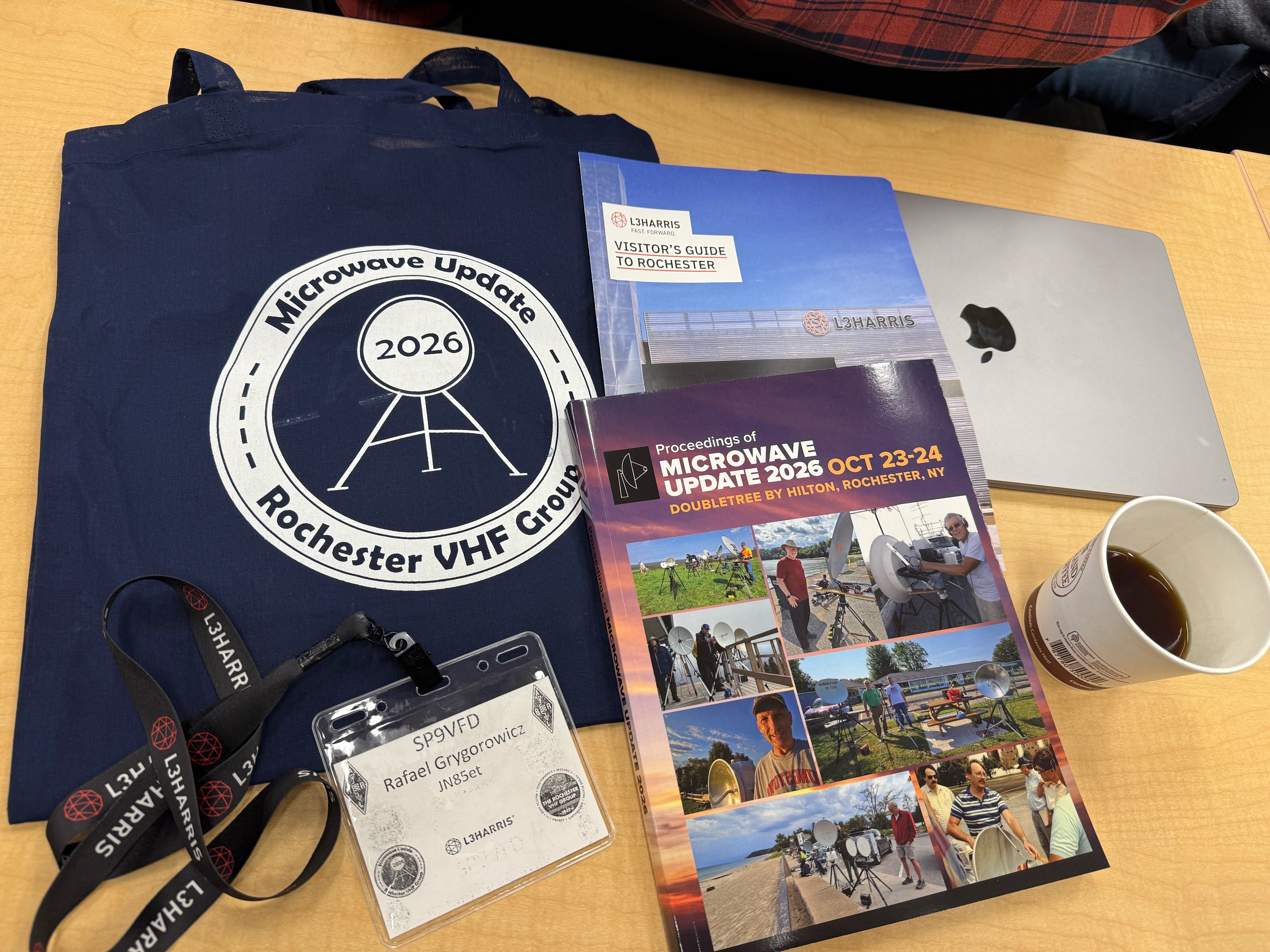
From October 22–24, I had the pleasure of attending the Microwave Update 2026 conference in Rochester, NY, together with many other EME operators and microwave enthusiasts. It was a fantastic event, and I want to thank the hosts, L3 Harris Technologies and the Rochester VHF Group, for all the effort they put into making it such a memorable gathering.
The conference offered a great mix of interesting presentations, technical discussions, and the chance to meet many old friends again. It was also nice to see so many active microwave operators in one place. Events like this are always inspiring, and this one was no exception.
A real highlight for me was the opportunity to tour the L3 Harris facility as well as the Antique Wireless Association Museum. Both visits were excellent and added a lot to the overall experience.
I also came home with a very nice new piece of hardware: a dual-band 10 GHz / 24 GHz feed, now professionally brought into production by the Rochester VHF Group team. The feed is based on a design by Paul, W1GHZ, and it looks like it will be a very good match for my offset dishes. I’m really looking forward to putting it on the air.
Just a few days later, from October 31 to November 1, I was active in the ARRL EME Contest on 1296 MHz, using my 6.4 m HB dish. Conditions were decent, band activity was good, and I managed to work several new initials, which always makes a contest weekend especially enjoyable.
I could not spend the entire weekend in the shack, but I still had a very satisfying number of QSOs.
Q65 – 61 QSOs:
KH6FA, PE1LWT, SM5DGX, DL6ZG, F5AOL, OK1UGA, VA7MM, OE3JPC, F1RJ, SA6BUN, AF6SA, DF7KB, DG5NFF, ON4LX, OH3LWP, IQ2DB, OK1IL, W3TI, K5QE, KC2HFQ, K3SK, KB2SA, N1AV, KB7Q, KN0WS, W2LPL, OM4XA, PA0PLY, IK5VLS, DF3RU, GM8RBT, ZS5Y, BV3CE, SP2HPD, G4ALH, EA5Y, ON5GS, UA1ALD, JQ3JWF, DL7UDA, OZ9KY, BA7NQ, IK2DDR, G7TZZ, JJ3JHP, DK1KW, GM8RBT, UA9FAD, K2UYH, OK2DL, OK1USW, KA1GT, YU1DA, YO2LAM, I2FAK, OK1DFC, DM2CFH, SQ7D, PA0TBR, SP3YDE, RY4C
CW – 19 QSOs:
DF3RU, SM2CEW, F6KRK, OM6AA, OH3LWP, SA6BUN, SV3AAF, SM3BYA, G3LTF, UA9FAD, OM4XA, G4CCH, IK2DDR, KL6M, SP6JLW, SP3XBO, OK2PE, JH1KRC, SP6ITF
I probably missed a few stations in my notes, so there is still room to do better in the November leg of the contest.
My current plan is to be active again on:
• 1296 MHz on Saturday, November 28
• 432 MHz on Sunday, November 29
On both days I plan to use CW and Q65. For 70 cm EME, I’ll be on with the 6.4 m dish and my rotary “pancake” loop feed. Looking forward to more activity, more signals off the moon, and hopefully a few more new initials.
 SP9VFD Microwave Update 2026 Rochester NY
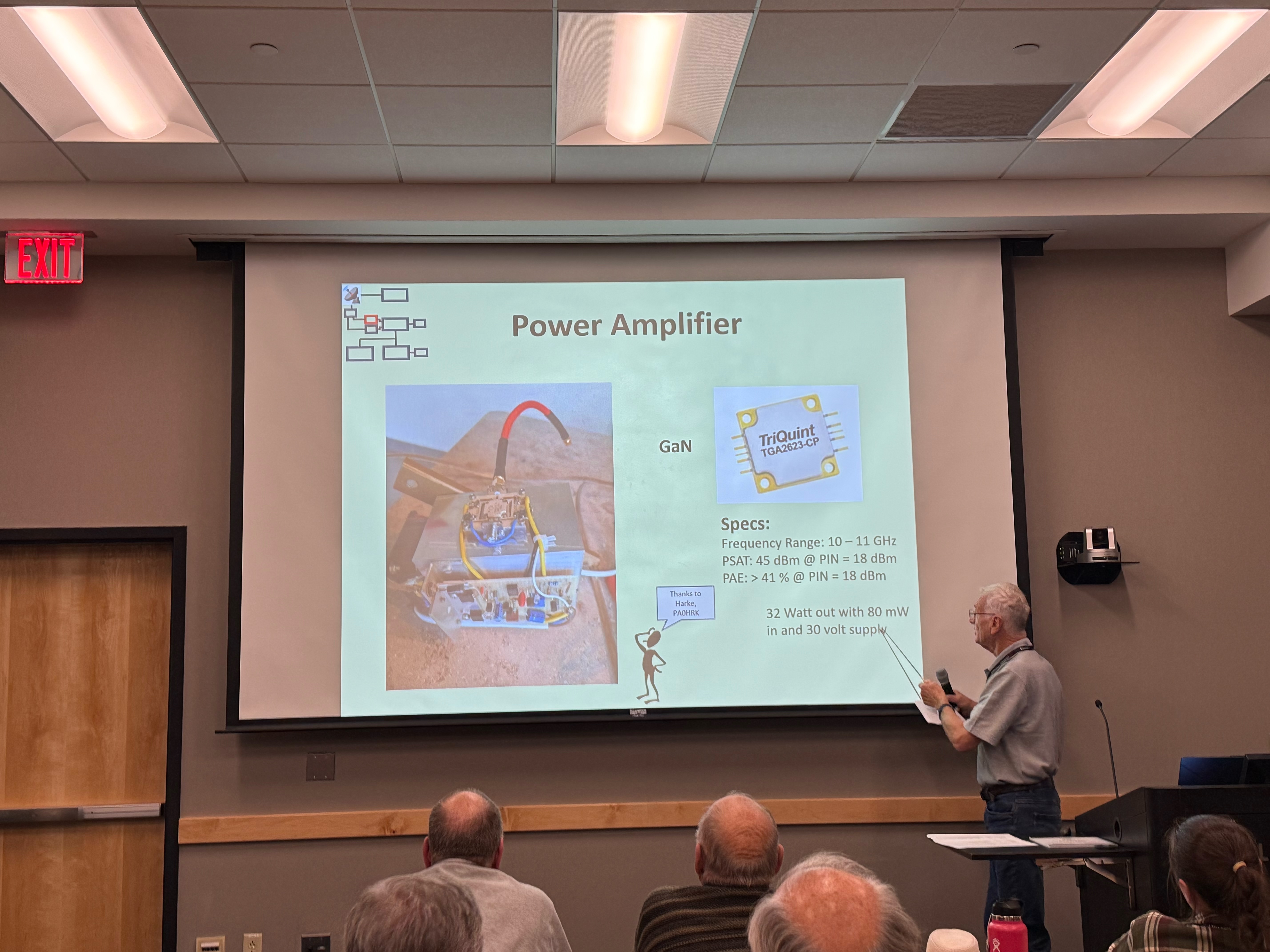 SP9VFD ON4CDU Presentation at MUD2026
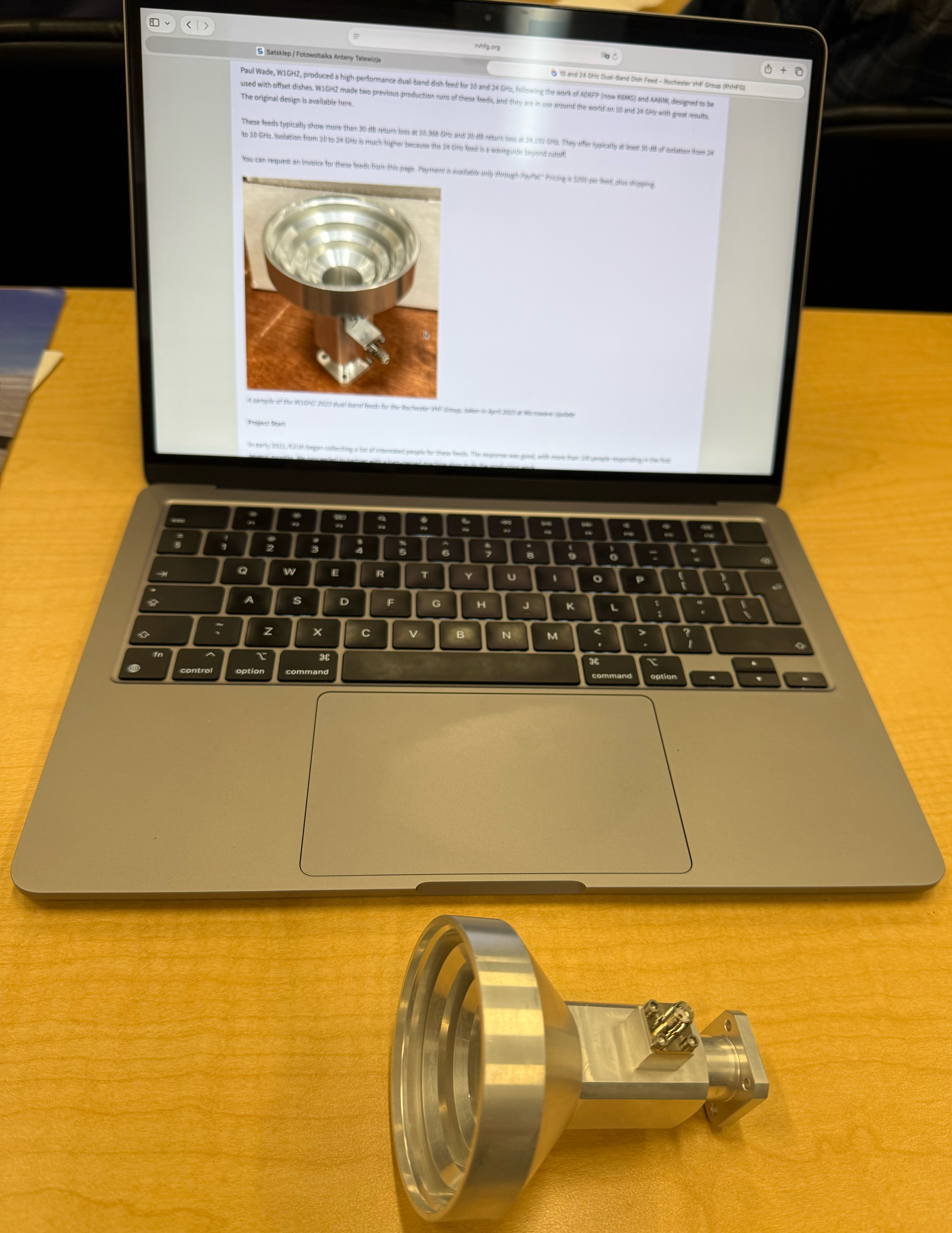 SP9VFD 10 GHz 24 GHz Dualband Feed
VE4MA Barry
On October 28th on 3 cm I QSO’d: AC0RA/R in DE/MD, N0LNO and W6TCP all with good signals.
I decided to operate on 70 cm for the 3rd weekend of the ARRL EME contest on October 31st/ November 1st to avoid a conflict with VE4SA operating on 23 cm and who is 1 km from me in a rising moon direction. I am still using a 3 m dish on 70 cm with a dual polarity (switched) patch feed and about 300 W.
On October 31 I QSO’d: UA3PTW, K4EME, OK1VUM, HB9Q, N1AV, G4RGK, DD0VF, K5QE, W3TI and KD2LGX on Digital. I had a partial with PA6Y and I had a CW QSO with SM2CEW. This CW QSO was difficult as one minute sequences were used and with the libration of weak signals the copy was not very good! I also decoded RD3FD, GW4ZHI, W4ZHI, YL2DG, SM2GGC, PA3FMW, & GD0TEP.
On November 1st I responded to a request by OZ1LPR for 3 cm QSOs for the ARI contest and QSO’d on 3 cm : DL4DTU, OZ1LPR (-1,-9) and 579/549, DL4DTU 559 both, YO8RHI, LZ4OC, G4HSK, IW2FZR, OK2AQ, IZ2DJP (-17/-15) 1 m dish & 10 W!, UA4LCF, KM0T, OK1DGR 1.2 m & 12W, & DL6SH (-5/-7). I was seeing 2.6 dB of moon noise.
I moved to 70 cm again and QSO’d: PA6V, OK1DFC (a long time since last 70 cm QSO), W4ZST, PA3DRK, PA2CHR, DL1VPL, GW4ZHI, DL5FN & S56P. I also decoded GD0TEP, ON7EQ, DC2TH, & SM4GGC. I found the Faraday rotation to be changing and a bit of a challenge to figure out the right combination!
There was a visual Aurora reported in Northern latitudes (near me) and in past years that usually resulted in Faraday rotation instability and even some absorption of signals on 70 cm.
So in summary I had 20 QSOs on 70 cm and 12 on 3 cm (everyone that was QRV). I have not yet decided exactly how I will be QRV for the final ARRL contest weekend 9 November 28/29, but I will be on 33 cm in support of planned activity, but I may also be on 70, 3 or 1.25 cm depending on planned activity.
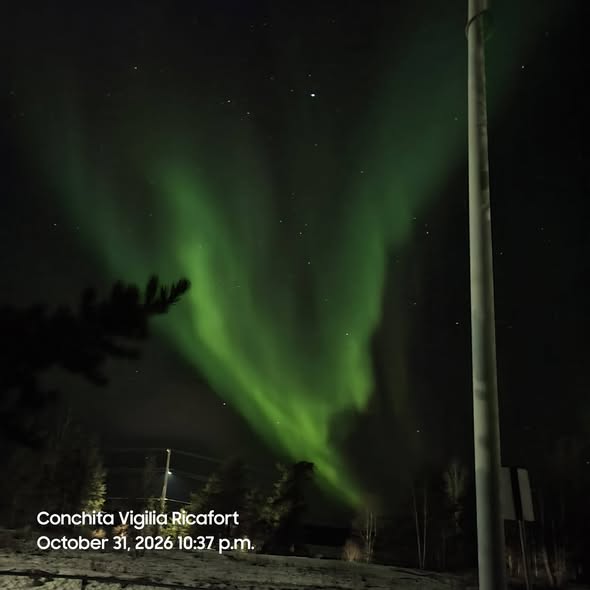 VE4MA Aurora in VE4 November 1 0300 UTC
VE6TA Grant
I worked Alex LY3UM at home in Lithuania on Sept 29th. Thanks to Alex for DXCC #94.
During the ARRL contest on 23 cm I worked:
On CW: SP6JLW, SP6ITF, G3LTF, WA6PY, VA7MM, G4CCH, W3SZ, and NQ7B.
On Q65: DF3RU, YO2LAM, SP3YDE, #ZS5Y, PA0TBR, IQ2DB, #N8XS, OM4XA, R1NW, OK1USW, OH3LWP, RY4C, #EA5Y, OK2DL, K2UYH, KB2SA, IK2DDR, DL4DTU, ON5TA, W3SZ, #UA1ALD, N1AV, IK5VLS, KE7NR, K3SK, DL1SUZ, #DG5NFF, G7TZZ, ON4LX, #OE4MTI/P, #OZ9KY, #WB1BQE, K5QE, KB7Q, HB9Q, #SQ7D, OK1DFC, #DL6ZG, OE3JPC, F1RJ, VK4CDI, BV3CE, KN0WS, W3TI, W1FKF, KN2K, KC2HFQ, AE6GD, KD2XN, VA7MM, JJ3JHP, KG0D, AF6SA, N8ECI, W2LPL, JQ3JWF, VK3NFI, VE4SA, GW4ZHI, ON5GS, NY1V, #9A5M, F4BLE, #DM2CFH, AA6I, #PA2V (35 el Yagi on the horizon), N5BF, WA3GFZ, N0LWF, KB2FCV, KL6M, LU1HKO, K0DSP, AA4MD,and NN3Y.
There was some very good activity, with in the middle of the night operating for the most part. I heard several stations that quit early though, and unfortunately I never heard them again.
After the EME weekend I switched over the 432 feed and worked; NY1V, and #KI6WJ in Nevada for a new state and grid.
I plan to be on 432 and likely 222 EME for the last weekend of the contest.
VK2CMP Mick
For the ARRL 23 cm and down weekend I was portable in Bents Basin National Park (NP) QF56HB on 23 cm with the 2.4 m folding dish and PQL PA. It’s close to the home QTH so we thought we would check it out and got there on Friday afternoon. The WX was thunder and lightning but I still managed to set things up in a break on Saturday AM and lined things up on the sun during a brief break in the WX before covering the dish with a fly. When the contest started about 1:30 AM it seemed like I was operating from a black hole. Eventually I worked just 10 stations and I was left wondering what was going on with the previously good performing set up.
On Sunday I again peaked things up on the sun to within a fraction of a degree ready for the 2nd pass. I woke up at 2 AM to a beautiful night and noticed the tracking was 4 degrees out. This was the issue the previous night but I did not have visibility of the moon and did not think to check with a compass etc. So I peaked up on the moon manually and normal operating conditions were restored.
On Monday morning during my MS two truckloads of park rangers came to a screeching halt about 6 feet away from my operating position in their two all-terrain vehicles that make being a ranger fun. They asked what I was doing because they had been taking bets on it in their trucks. I duly explained all things moonbounce to them and walked them through the station for a good 20 minutes as they had lots of questions. I asked who won the bet and they said no one. I guess I was the 1st EME op in QF56HB!
I worked just over 30 stations from a beautiful QTH using battery power over the two days. I had over 40% battery capacity at the end and some new ranger buddies. I now need to work out the tracking issue on the folding dish.
I plan to be QRV on 70 cm for the last weekend as my house switchboard has been replaced and every power and light circuit has its own earth leakage breaker rather than a shared ELCB. So far this seems to have fixed the 70 cm PA problem. I still have QRM to sort out on my MS so if you plan to work VK please do it while my elevation is high. I might put the 23 cm dish in the front drive where I can get about 70% of the moon pass for 23 cm, WX permitting of course, for when things are quiet on 70 cm.
VK7ZBX Richard
This year I was contacted by Mick VK2CMP and Kevin VK2KVJ to ask me if I would be interested in helping him with a project. This project was to create an award for Scouts and Guides that to qualify for, they would see their names bounced off the moon. What a cool idea! So I immediately offered my service. The award had the kids name as well as the callsign of the other station that sent their name back off the moon and confirmed that their name had been bounced off the moon.
Mick's plan was to send the Scouts and Guides names using WSJT-X text messages and the other stations were to respond with Hello directed to each of the participants. In one respect the timing of the moon was not very good, with a very southern declination, the Milky Way in the background and a high degradation based on the distance from the earth.
As it turned out we had quite a number of stations come on and send messages to Mick and the Scout team at VK2SAQ Asquith. Stations worked included Bill KB2SA, James VK3VJP, Chris VK5MC, Richard VK7ZBX, and Masayuki JA4LJB.
Sadly, I was not able to be QRV for the ARRL and the ARI contest weekend due to other commitments. During the month I did work Derek ZS5Y, Jan PA3FXB, Mike K4VJ, Jan SP5GDM and Eric OE9ERC on 23cm. I didn't get a chance to play any 3 cm this month.
73 from Hobart, see you on the moon.
Apps for EME Enthusiasts
ON5GS Dirk
Exploring the new Claude-superpowers resulted in me making a little handy Android app for EME enthusiasts to check the moon statistics, planning and activity. It came as an idea to bundle all the websites and data I regularly check before turning the dish to the moon:
- moon azimuth/elevation, moonrise/culmination/moonset, next day moonrise, moon phase projected on a world map with your callsign and also live-CQ callsigns per band on a world map
- degradation as shown on MMMonVHF with a graph showing past and future moon distance, declination and degradation, and a ranking very bad to excellent with the best 5 days on graph shown below.
- HB9Q chat (login and password in settings) can be only viewed per band for now, and a second page shows the last activity. Present logged in users could not be imported from the site yet. Thanks Dan for the positive reply!
- Chat-CQ chronologically shows all the stations who were calling CQ on the HB9Q chat per band, showing time, frequency, period, callsign, mode, CFOM y/n and HZ for what was given in the CQ message on the chat. It shows”?” where info is missing.
- Live CQ lists the stations that are shown on the W3SZ page including a report from the station who uploaded the message via WSJT X.
- N0UK Chat is supported for 144 MHz EMEers.
- 13 languages
The app is open for everyone to use and modify freely to encourage EME activity. This was a nice exploring adventure for me. I'm more of a musician than a programmer but it gave me a sense of what's possible these days.
Open the link below with an Android smartphone, ignore all warnings and install anyway.
Some bugs are coming in which are being fixed and there will be some layout changes. DL6ZG and ON8AR are really supportive. We've been adding some features. Newest is adding horizon obstacles manually or via the DL6ZG webcam tool. ON8AR hosts a web version for Iphones on eme.on8ar.eu, and ON4AOI has made a version for Raspberry PI. Lots of fun :-)
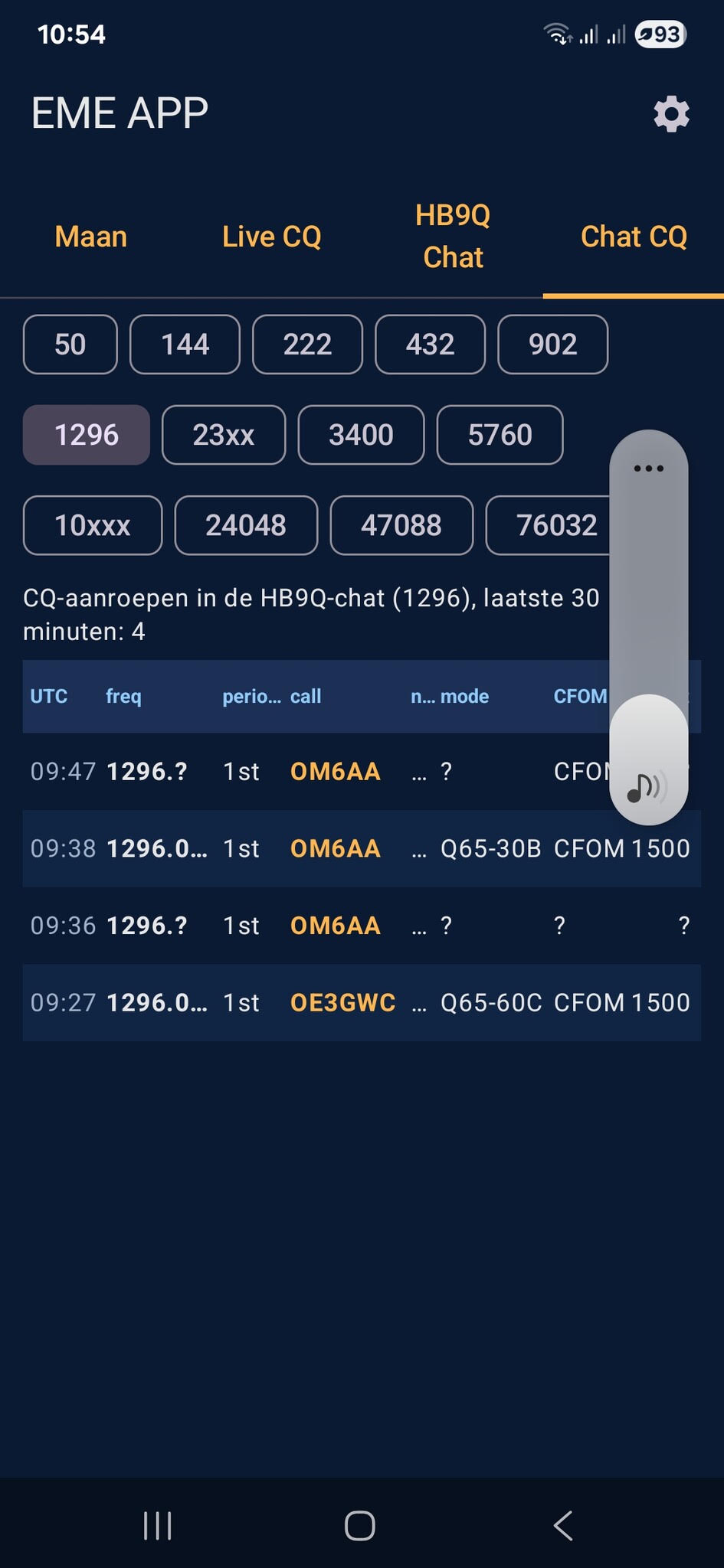 ON5GS EME App Chat CQ Page
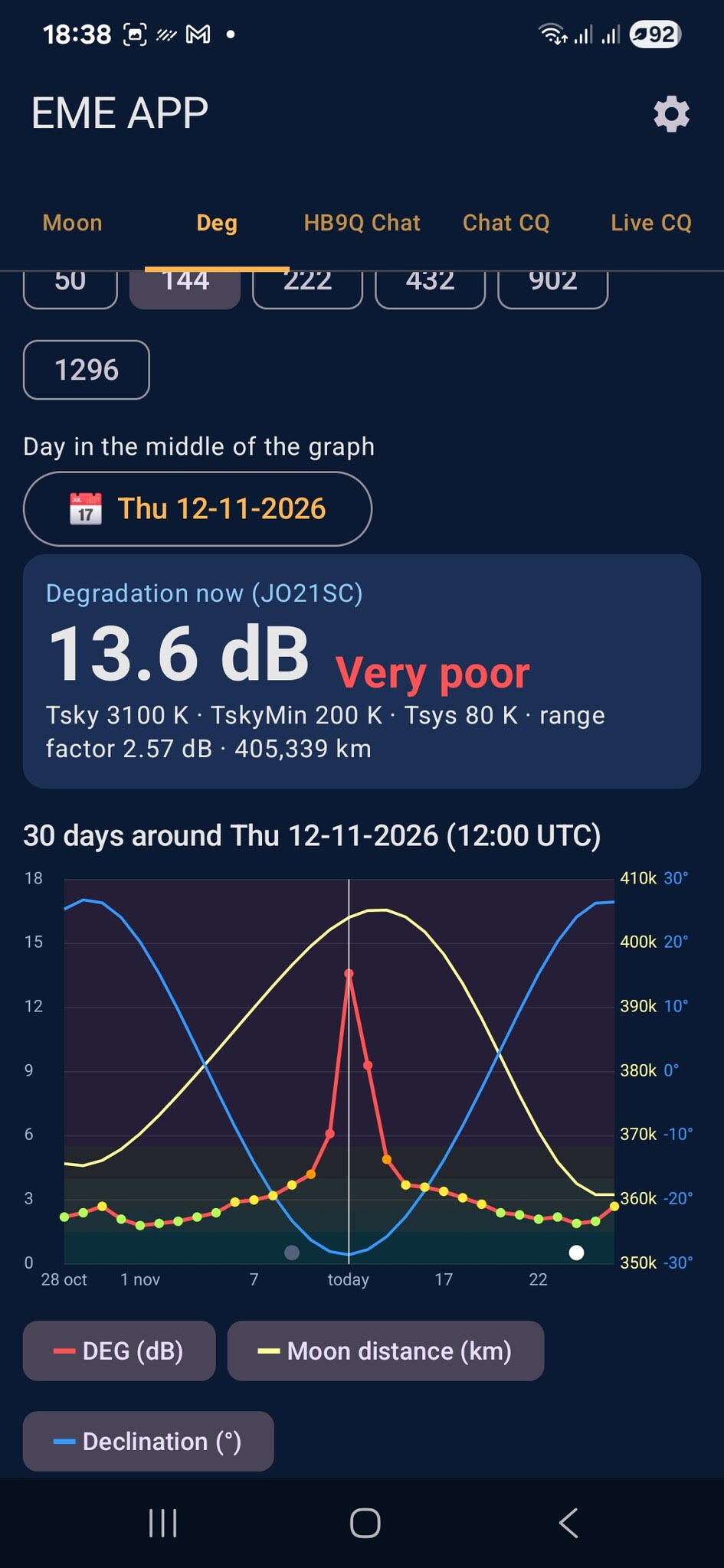 ON5GS EME App Degrade Page
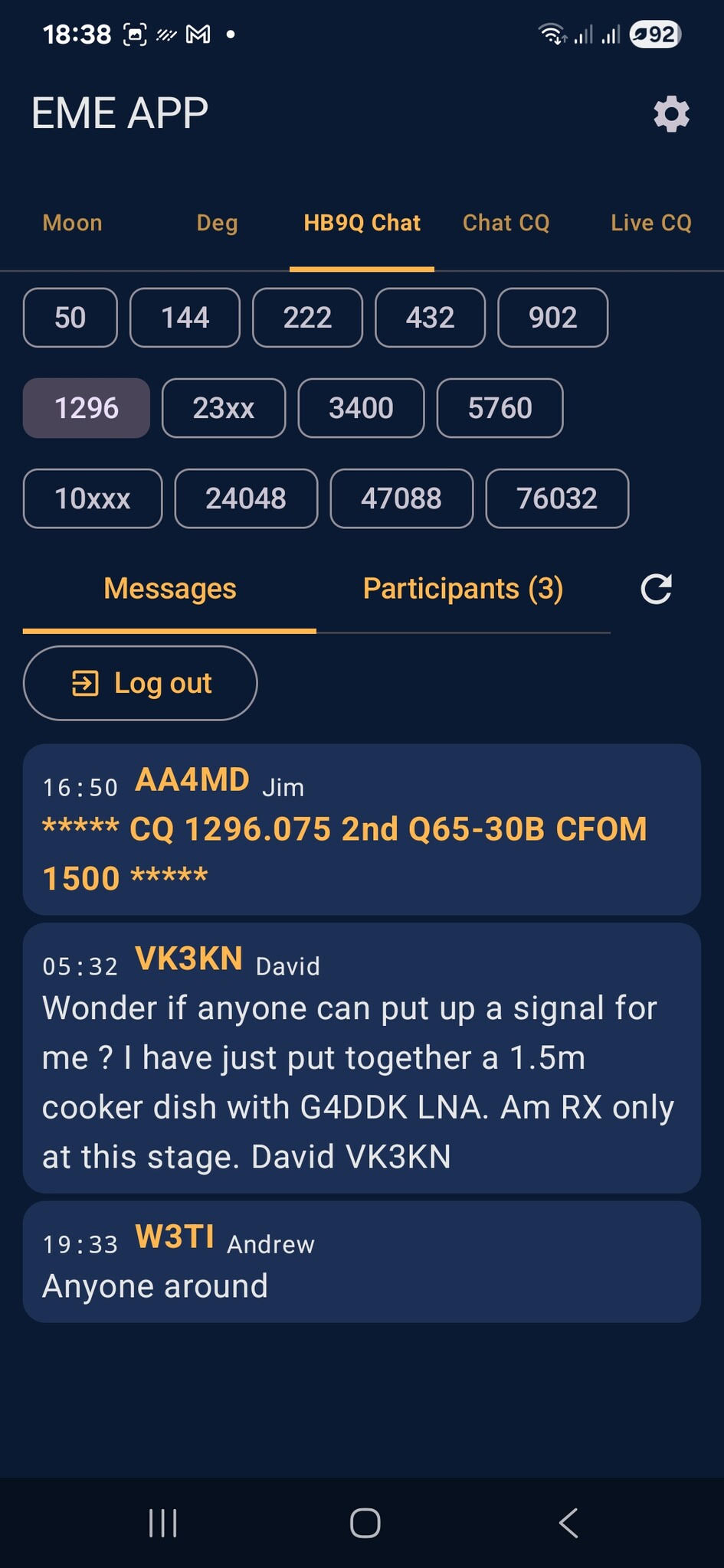 ON5GS EME App HB9Q Page
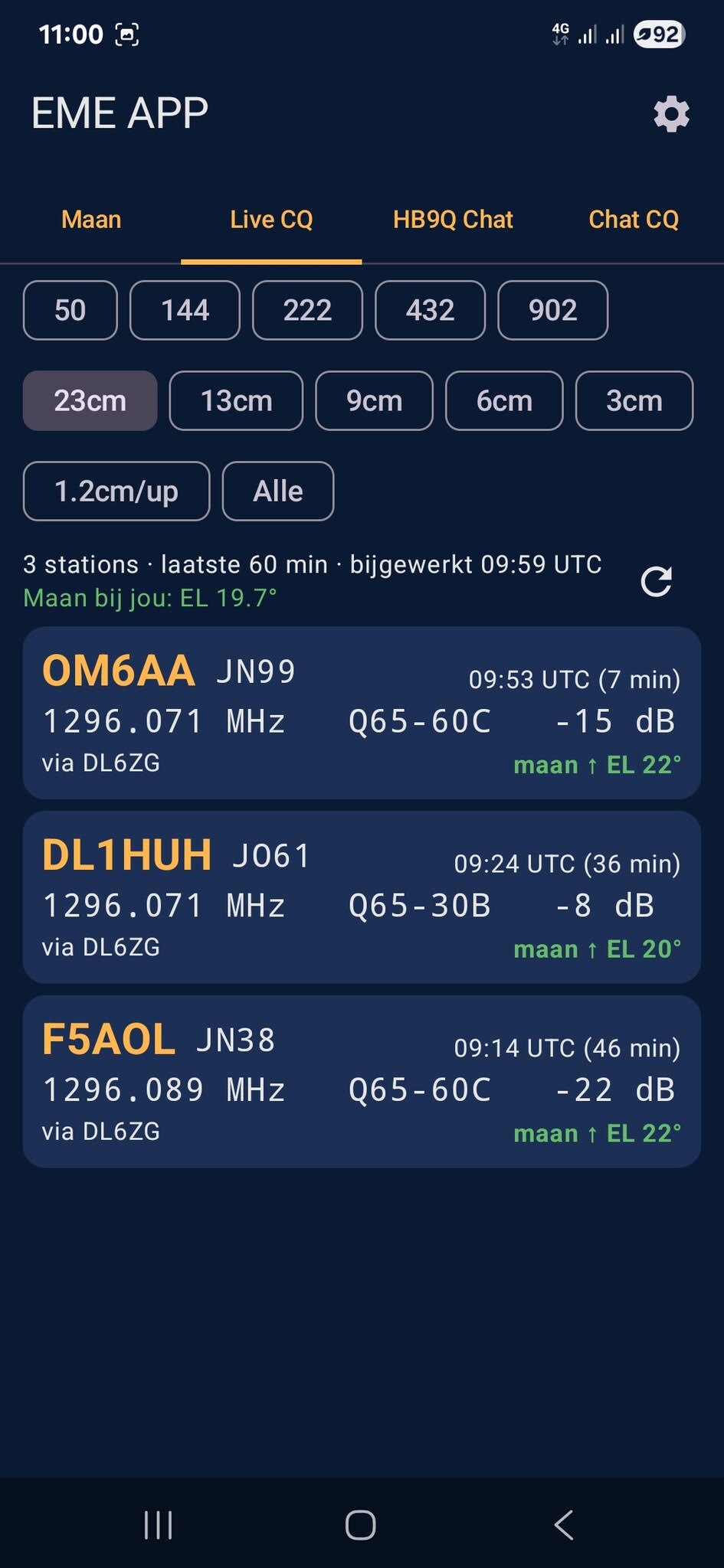 ON5GS EME App Live CQ Page
EME.RADIO In Memoriam
Bob W1QA
When we initially designed the EME.RADIO web site we thought about including an area where we could keep tributes for SK who are no longer with us.
Thanks to Jan PA0PLY and Rainer EA8DMF / DF6NA for providing their lists of silent keys, which we have used to populate an initial list on EME.RADIO
Some of the calls link to an In Memoriam page - as an example here's Al K2UYH
We are accepting additions to the list - please let us know: CALL, First Name, SK Date, and any other calls they may have held.
We're also accepting info to create a dedicated In Memoriam page. This can include a tribute / obituary along with pictures.
If you know of an existing page you can point us there, and we'll work on getting the content. If you provide us content, it would be nice to give credit to any author or photographer, or source of the info.
We'll also create an In Memoriam page for anyone who we publish in the newsletter.
Updates will be published on an ad-hoc schedule, and we'll include a list of new / updated calls in each newsletter.